
Managing Acute Pain in Children: A Multimodal Approach From Assessment to Treatment
Clinical Practice Update — Pain Assessment, Non-Pharmacological Strategies, Analgesic Selection, and Safe Opioid Prescribing in Paediatric Patients
This is an original clinical education article informed by current guidelines and evidence. See References below for source documents.
- Clinical Focus
- Assessment of acute pain, multimodal analgesia (non-pharmacological and pharmacological), safe opioid prescribing and stewardship, regional anaesthesia, and pain management across emergency, inpatient, and outpatient paediatric settings
- Target Audience
- General paediatricians, emergency physicians, paediatric surgeons, paediatric anaesthetists, family physicians, nurses, pharmacists, residents
- Setting
- Emergency departments, inpatient wards, ambulatory surgery, outpatient clinics, primary care
- Source Evidence
- •AAP Clinical Practice Guideline — Opioid Prescribing for Acute Pain Management in Children and Adolescents in Outpatient Settings (Pediatrics, 2024)
- •ESPA Pain Management Ladder Initiative — Postoperative Pain Management in Children (Paediatr Anaesth, 2018 & 2024)
- •APA (Great Britain & Ireland) — Good Practice in Postoperative and Procedural Pain Management, 2nd Edition (Paediatr Anaesth, 2012)
- •WHO Guidelines on the Management of Chronic Pain in Children (2020) — principles applicable to acute pain
Key Clinical Takeaways
The most important actionable points from this Practice Update on managing acute pain in children. Each links to the full discussion below.
- 1Assess pain using an age-appropriate validated tool at every encounter — pain in children is systematically under-recognised and under-treated → Pain Assessment
- 2Treat acute pain using a multimodal approach that combines non-pharmacological strategies, non-opioid analgesics, and opioids only when needed → Multimodal Analgesia
- 3Paracetamol (acetaminophen) and ibuprofen are first-line for mild-to-moderate pain — these two drugs work better together than either alone → Non-Opioid Analgesics
- 4Never prescribe codeine for children under 12 — unpredictable metabolism creates a risk of fatal respiratory depression → Drugs to Avoid
- 5When opioids are needed, prescribe immediate-release formulations at the lowest effective dose for 5 days or fewer, and never as monotherapy → Safe Opioid Prescribing
- 6Non-pharmacological techniques — distraction, guided imagery, hypnosis, cold packs, positioning — are evidence-based and should never be omitted → Non-Pharmacological Approaches
- 7Regional anaesthesia techniques are a cornerstone of multimodal postoperative analgesia — use them whenever feasible → Regional Anaesthesia
- 8Provide naloxone with every outpatient opioid prescription and educate families on recognising overdose → Opioid Safety
- 9Address disparities — Black, Hispanic, and Indigenous children receive less timely and adequate pain treatment; actively work to correct this → Equity
- 10Screen for anxiety and psychosocial factors — these amplify pain and, if unaddressed, can drive the transition from acute to chronic pain → Psychosocial Factors
How Should You Assess Acute Pain in a Child?
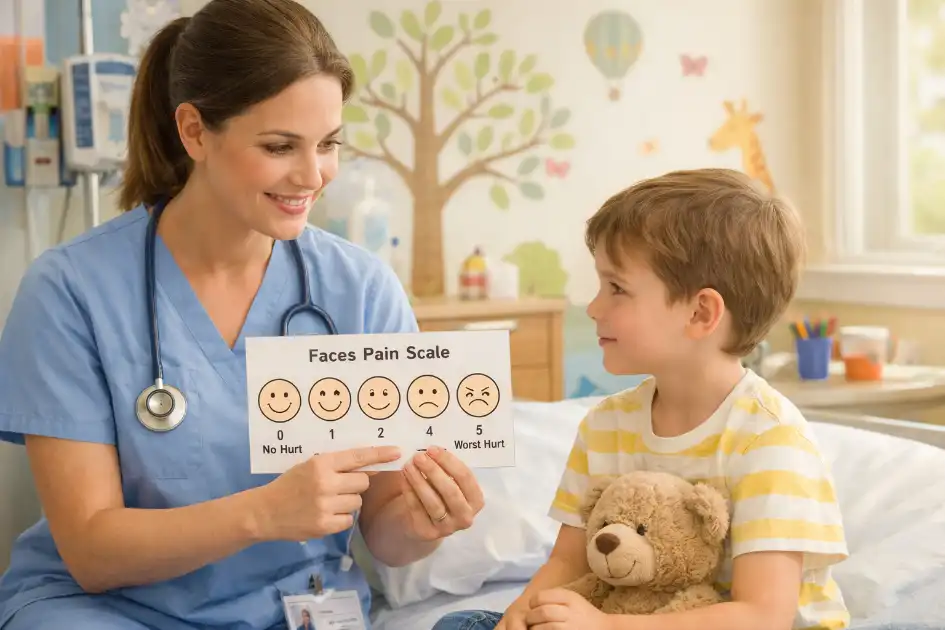
Accurate pain assessment is the foundation of effective treatment, yet paediatric pain remains systematically under-recognised. The choice of assessment tool must match the child's developmental stage, cognitive ability, and clinical context. No single tool works for all children.
Perform and document a pain assessment using a validated, age-appropriate tool at every clinical encounter, before and after any intervention, and at regular intervals throughout hospital admission.
Strong Rec High Evidence APA 2012 ESPA 2018Prioritise the child's self-report whenever developmentally possible. Self-report is the gold standard from approximately age 4 years upwards. For younger children, preverbal infants, or those with cognitive impairment, use a validated behavioural observation tool.
Strong Rec High Evidence APA 2012 WHO 2020Consider parent and caregiver input as a valuable adjunct, but do not substitute it for the child's own report. Parents may under- or over-estimate pain, particularly in the postoperative setting.
Moderate Rec Moderate Evidence ESPA 2018Choosing the Right Pain Assessment Tool: A Guide by Developmental Stage
| Age Group | Recommended Tool | How It Works | Practical Tip |
|---|---|---|---|
| Preterm & term neonates | PIPP-R (Premature Infant Pain Profile – Revised) | Behavioural & physiological: gestational age, behavioural state, heart rate, oxygen saturation, facial actions | Best validated for procedural pain in NICU; adjusts for prematurity |
| Infants & toddlers (0–3 years) | FLACC (Face, Legs, Activity, Cry, Consolability) | Observer-rated behavioural scale, scored 0–10 | Quick to learn; reliable across settings. A sleeping child may score 0 but still have pain — reassess after waking |
| Preschool (4–6 years) | FPS-R (Faces Pain Scale – Revised) | Six neutral-to-distressed faces, child points to the one that matches their pain, scored 0–10 | Use neutral (not smiling) “no pain” face to avoid inflating scores. Preferred over Wong-Baker by many guidelines |
| School-age & adolescents (>7 years) | NRS (Numerical Rating Scale) or VAS (Visual Analogue Scale) | Child rates pain 0–10 verbally (NRS) or marks a 10 cm line (VAS) | NRS is faster; VAS may be more sensitive for research. Validate understanding by asking “What does 10 mean to you?” |
| Cognitive impairment (any age) | r-FLACC (Revised FLACC) or PPP (Paediatric Pain Profile) | Modified behavioural observation incorporating individual pain behaviours | Ask the caregiver to describe their child's usual pain behaviours and document these in the chart for consistency |
- Physiological signs (tachycardia, hypertension) are not reliable pain indicators in isolation — they may reflect fear, fever, or hypovolaemia.
- Consistently use the same tool across a clinical episode to allow meaningful trend comparison.
What Non-Pharmacological Strategies Should You Use?
Non-pharmacological approaches are not optional extras — they are an evidence-based component of multimodal pain management. They reduce pain scores, decrease analgesic requirements, and lower anxiety. Every child with acute pain should receive non-pharmacological interventions alongside any pharmacological treatment.
Incorporate non-pharmacological strategies into every pain management plan, including distraction (age-appropriate play, videos, music, virtual reality), guided imagery, relaxation breathing, and cognitive behavioural techniques.
Strong Rec High Evidence AAP 2024 WHO 2020Use sucrose or breastfeeding for procedural pain relief in neonates and young infants. Oral sucrose (0.1–0.5 mL of 24% solution given 2 minutes before the procedure) is effective for minor procedures such as heel lance and venepuncture.
Strong Rec High Evidence APA 2012Encourage skin-to-skin (kangaroo) care during and after painful procedures in neonates and young infants. It significantly reduces physiological and behavioural pain responses.
Strong Rec High Evidence APA 2012Screen for anxiety, catastrophising, and low mood in children with acute pain, especially postoperatively. These psychological factors amplify the pain experience and increase analgesic consumption. Early psychological support can prevent the transition from acute to chronic pain.
Moderate Rec Moderate Evidence WHO 2020Which Analgesics Should You Choose?
The pharmacological approach to acute paediatric pain follows a stepladder: start with non-opioid analgesics, add opioids only when needed, and always combine with non-pharmacological strategies. The AAP 2024 guideline is the first to provide comprehensive evidence-based guidance on safe outpatient opioid prescribing for children.
Prescribe paracetamol (acetaminophen) and/or ibuprofen as first-line analgesics for mild-to-moderate acute pain. These two drugs act through different mechanisms and can be given together or alternated for enhanced effect.
Strong Rec High Evidence AAP 2024 APA 2012 ESPA 2018Do not prescribe opioids as monotherapy for acute pain. Always combine with paracetamol and/or an NSAID as the analgesic backbone. Opioids are an adjunct to, not a replacement for, non-opioid analgesics.
Strong Rec Moderate Evidence AAP 2024Do not prescribe codeine for children under 12 years, or for any child after tonsillectomy or adenoidectomy, or for adolescents with obesity, obstructive sleep apnoea, or severe lung disease. Genetic variation in CYP2D6 metabolism creates an unpredictable risk of respiratory depression or no effect at all.
Against High Evidence AAP 2024 FDA 2017Do not prescribe tramadol for children under 12 years, or for the same high-risk groups as codeine. Tramadol undergoes the same CYP2D6-dependent metabolism, creating identical risks of toxicity in ultra-rapid metabolisers.
Against Moderate Evidence AAP 2024 FDA 2018Do not prescribe codeine or tramadol to any patient who is breastfeeding, regardless of age. Active metabolites of both drugs are transmitted through human milk and can cause excessive sleepiness and respiratory depression in the breastfed infant.
Against High Evidence AAP 2024 FDA 2017When opioids are indicated, prescribe immediate-release formulations (such as oral morphine or oxycodone) at the lowest age- and weight-appropriate dose. Provide an initial supply of 5 days or fewer, unless the pain is from trauma or surgery with an expected longer recovery.
Moderate Rec Moderate Evidence AAP 2024Provide naloxone with every outpatient opioid prescription, and counsel families on safe storage, directly observed administration, recognising signs of overdose (extreme drowsiness, slow or absent breathing), and how to use naloxone.
Moderate Rec Low Evidence AAP 2024Analgesic Options for Acute Pain in Children: A Drug-by-Drug Guide
| Drug | Typical Paediatric Dose | Best Suited For | Key Caution |
|---|---|---|---|
| Paracetamol (acetaminophen) | 15 mg/kg PO q4–6h (max 75 mg/kg/day or 4 g/day) | First-line for mild pain; analgesic backbone when combining with opioids | Hepatotoxicity from cumulative dosing — track total daily dose across all formulations |
| Ibuprofen | 10 mg/kg PO q6–8h (max 40 mg/kg/day) | First-line for mild-moderate pain, especially musculoskeletal and inflammatory pain | Avoid in dehydrated children (renal risk) and known asthma exacerbation by NSAIDs |
| Ketorolac | 0.5 mg/kg IV q6h (max 15 mg/dose; limit 48–72h) | Moderate-severe acute pain (postoperative, fractures) when child cannot take oral | Short-course only; platelet inhibition, renal and GI risks with prolonged use |
| Morphine (oral) | 0.2–0.3 mg/kg PO q4h PRN (start low in opioid-naive) | Moderate-severe acute pain when non-opioids are insufficient | Start conservatively; titrate in 25% increments. Monitor sedation and respiratory rate |
| Oxycodone (oral) | 0.1–0.2 mg/kg PO q4–6h PRN | Alternative to oral morphine for moderate-severe pain | Higher oral bioavailability than morphine — use lower mg/kg doses |
| Intranasal fentanyl | 1.5 µg/kg IN (via mucosal atomiser) | Rapid-onset severe pain in ED (fracture reduction, burn dressing) when IV not yet available | Onset ~5 min; short duration ~30–45 min. Monitor closely. Ensure correct atomiser device |
- Verify all doses against local formulary. Use ideal body weight for dosing in obese children.
- Codeine and tramadol are intentionally excluded — they should not be used in children under 12, after tonsillectomy or adenoidectomy in patients under 18, or in any breastfeeding patient.
Clinical Decision Pathway
A practical, question-based approach to managing acute pain in a paediatric patient. Follow the questions in order.
Monitoring, Equity, and Addressing Disparities
Monitor sedation level and respiratory rate in all children receiving opioids, particularly in the first 24 hours postoperatively, in infants under 6 months, and in children with obstructive sleep apnoea or neuromuscular disease. Opioid-related respiratory depression occurs in roughly 0.1–0.4% of hospitalised paediatric patients — identifiable risk groups should receive enhanced monitoring.
Strong Rec Moderate Evidence APA 2012 ESPA 2018Exercise caution when prescribing opioids alongside benzodiazepines or other sedating medications in children and adolescents. The combination substantially increases the risk of respiratory depression.
Strong Rec Moderate Evidence AAP 2024Actively work to eliminate disparities in pain treatment. Evidence shows that Black, Hispanic, and Indigenous children and adolescents receive less timely and less adequate pain management than white children. Apply standardised pain assessment and treatment protocols to every child, regardless of race, ethnicity, language, or socioeconomic status.
Strong Rec Moderate Evidence AAP 2024Evidence in Context
Where the evidence is strong, where the major guidelines agree, and where they diverge in clinical practice.
Where the Guidelines Agree
All major guidelines (AAP 2024, ESPA 2018/2024, APA 2012, WHO 2020) agree on the multimodal approach: always combine non-pharmacological techniques with pharmacological agents, use paracetamol and NSAIDs as the analgesic backbone, reserve opioids for moderate-to-severe pain that does not respond to non-opioids, and avoid codeine in young children. All endorse age-appropriate pain assessment as a foundational step.
Where the Guidelines Differ
Tramadol: The FDA and AAP restrict tramadol in children under 12. However, ESPA notes that tramadol remains available for in-hospital use in European settings, reflecting different regulatory contexts. The underlying pharmacogenomic concern (CYP2D6 ultra-rapid metabolism) is identical regardless of geography.
Naloxone co-prescribing: The AAP 2024 guideline is the first to explicitly recommend co-prescribing naloxone with every outpatient paediatric opioid prescription. European guidelines have not yet adopted this position as a universal standard, though the principle is broadly supported.
NSAIDs after tonsillectomy: Older concern about post-tonsillectomy bleeding with NSAIDs has been largely addressed by recent meta-analyses showing ibuprofen does not significantly increase the risk. Both the AAP and ESPA now support NSAID use after tonsillectomy, while noting the need for clinician judgement in individual cases.
The AAP 2024 Opioid Guideline: Key Contributions
This is the first AAP clinical practice guideline dedicated to safe opioid prescribing for paediatric acute pain in outpatient settings. It fills a significant gap: previously, clinicians had no paediatric-specific evidence-based guidance and relied on extrapolation from adult guidelines or local protocols. Key contributions include formalising the “no opioid monotherapy” principle, setting a default supply limit of 5 days, requiring naloxone co-prescribing, and explicitly addressing racial and ethnic disparities in paediatric pain treatment.
Regional Anaesthesia in Children: Growing Evidence
The ESPA 2018 and 2024 Pain Management Ladder and the APA 2012 guideline both position regional anaesthesia as a cornerstone of postoperative multimodal analgesia in children. Ultrasound-guided peripheral nerve blocks have expanded rapidly, with increasing feasibility and safety data. Unlike in adults, regional blocks in children are typically performed under sedation or general anaesthesia, and the ESRA/ASRA published dosing guidelines for local anaesthetics and adjuvants in paediatric regional anaesthesia in 2018 to standardise practice.
What We Still Don't Know
References
- 1.Hadland SE, Agarwal R, Raman SR, et al. Opioid Prescribing for Acute Pain Management in Children and Adolescents in Outpatient Settings: Clinical Practice Guideline. Pediatrics. 2024;154(5):e2024068752. doi:10.1542/peds.2024-068752
- 2.Vittinghoff M, Lonnqvist PA, Mossetti V, et al. Postoperative pain management in children: Guidance from the pain committee of the European Society for Paediatric Anaesthesiology (ESPA Pain Management Ladder Initiative). Paediatr Anaesth. 2018;28(6):493–506. doi:10.1111/pan.13373
- 3.Association of Paediatric Anaesthetists of Great Britain and Ireland. Good practice in postoperative and procedural pain management, 2nd edition. Paediatr Anaesth. 2012;22(Suppl 1):1–79. doi:10.1111/j.1460-9592.2012.03838.x
- 4.World Health Organization. Guidelines on the management of chronic pain in children. Geneva: WHO; 2020. who.int/publications/i/item/9789240017870
- 5.Gai N, Naser B, Hanley J, et al. A practical guide to acute pain management in children. J Anesth. 2020;34(3):421–433. doi:10.1007/s00540-020-02767-x
How to Read the Evidence Tags
Every recommendation in this article carries two tags indicating how strong the recommendation is and how robust the supporting evidence is. These are Medaptly's own simplified interpretations for educational clarity.
Recommendation Strength
| Tag | What It Means | In Practice |
|---|---|---|
| Strong Rec | High-quality evidence broadly supports this action. Benefits clearly outweigh risks. | This should be standard practice. |
| Moderate Rec | Evidence favours this action, though some uncertainty remains. | Most patients should receive this, but clinical context may reasonably differ. |
| Conditional Rec | Benefit is less certain. Depends on individual circumstances. | Discuss with patient/family. Use shared decision-making. |
| Against | Evidence shows no benefit, or risks outweigh benefits. | Avoid this intervention. |
Evidence Quality
| Tag | What It Means | Confidence |
|---|---|---|
| High Evidence | Multiple well-designed RCTs or high-quality meta-analyses. | Very confident. Unlikely to change substantially. |
| Moderate Evidence | Single RCT, large observational studies, or meta-analyses with limitations. | Reasonably confident. Direction likely correct. |
| Low Evidence | Expert consensus, small studies, or extrapolated evidence. | Less certain. Best available guidance but may change. |
These are Medaptly's simplified interpretations for educational clarity. For the full classification systems used by each source guideline, consult the original documents listed in References.