
Uncontrolled Blood Pressure: What the Evidence Shows About Why It Persists
A practical troubleshooting guide synthesising 11 studies and AHA/ESH guidelines on pseudo-resistance, medication non-adherence, secondary causes, and optimal fourth-line therapy for resistant hypertension. Evidence level: high (RCTs, systematic reviews, meta-analyses).
This is an original evidence synthesis. See References for source studies.
One-Minute Takeaway
One-Minute Takeaway
- Uncontrolled blood pressure on three or more drugs is common — affecting approximately 10–15% of treated hypertensive patients — but the majority of cases are pseudo-resistant, driven by non-adherence (27–45% globally), white-coat effect, or suboptimal dosing rather than true pharmacological resistance (Noubiap et al. 2019; Lee et al. 2022).
- The PATHWAY-2 trial (n = 314) provides strong RCT evidence that spironolactone is the most effective fourth-line agent for true resistant hypertension, reducing home systolic BP by 8.7 mmHg more than placebo and 4.3 mmHg more than bisoprolol or doxazosin (Williams et al. 2015).
- The TRIUMPH trial (n = 140) demonstrated that structured lifestyle modification — DASH diet, exercise, and weight management — produced a clinically significant 12.5 mmHg reduction in clinic systolic BP in patients with resistant hypertension, independent of medication changes (Blumenthal et al. 2021).
- Screening for secondary causes — particularly primary aldosteronism (estimated in up to 20% of resistant hypertension) and obstructive sleep apnea — is consistently recommended but inconsistently performed in practice; long-term outcome data from interventional trials (e.g., renal denervation) remain insufficient to change first-line management.
Why Uncontrolled Blood Pressure Demands a Systematic Approach
Hypertension remains the single largest modifiable contributor to cardiovascular mortality worldwide, and the gap between population targets and actual control rates persists in every healthcare system studied. When a patient's blood pressure remains above target despite three or more medications including a diuretic, the clinical reflexes of most physicians are to add another agent. However, a growing body of evidence indicates that treatment intensification without systematic troubleshooting frequently leads to polypharmacy without benefit — and occasionally to harm.
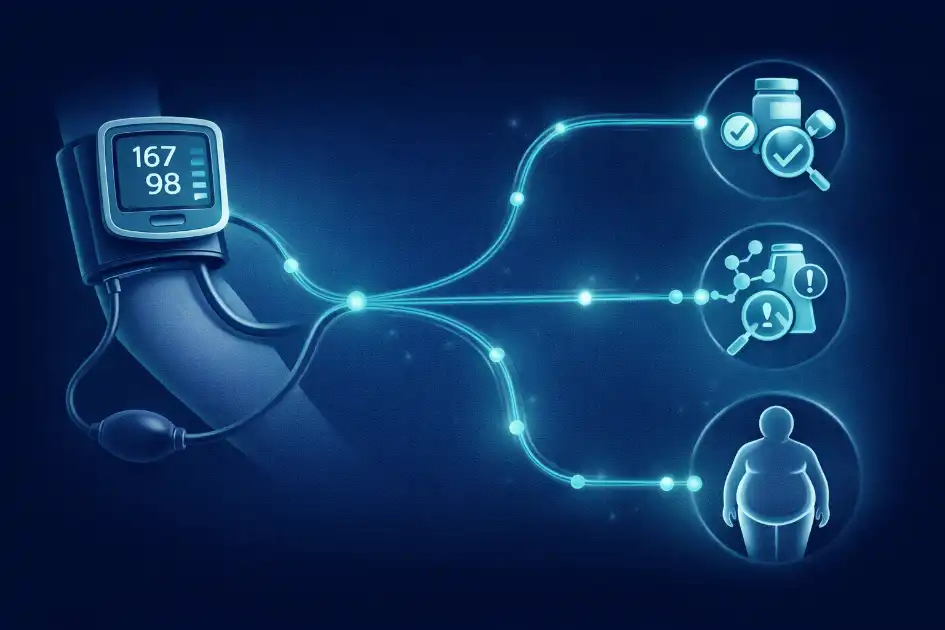
The 2018 AHA Scientific Statement on resistant hypertension, the 2023 ESH guidelines, and the 2024 ESC guidelines all emphasise a stepwise diagnostic approach: first confirming true resistance by excluding measurement error, white-coat effect, and non-adherence; then screening for secondary causes; and finally optimising pharmacotherapy. Despite clear guidance, implementation lags — approximately 40% of drug-treated hypertensive patients in the United States receive monotherapy alone, and systematic adherence assessment remains uncommon outside specialist centres. This evidence review synthesises findings from 11 key studies to provide a practical, evidence-based troubleshooting framework.
What Evidence Was Reviewed
This synthesis draws on 11 studies published between 2014 and 2024, including landmark RCTs, large-scale meta-analyses, AHA scientific statements, and guideline documents. Studies were selected for their direct clinical applicability to troubleshooting uncontrolled hypertension in primary care and internal medicine settings. Evidence through 2025.
| Study | Design | n | Population | Key Finding | Quality |
|---|---|---|---|---|---|
| Noubiap et al. 2019 | SR/MA | 3,207,911 | Treated hypertensive patients globally | Apparent resistant HTN prevalence ~14.7%; true resistant ~10.3%; wide variation by measurement method | High |
| Lee et al. 2022 | SR/MA | 27 million | Hypertensive patients worldwide | Medication non-adherence: 27–40% globally; no improvement 2010–2020; linked to worse CV outcomes | High |
| Abegaz et al. 2017 | SR/MA | 13,688 | Hypertensive adults (28 studies) | Non-adherence in 45.2%; 83.7% of uncontrolled patients were non-adherent | Moderate |
| Tomaszewski et al. 2014 | Cross-sectional | 208 | Referred hypertensive patients (UK) | Urine drug analysis revealed 25% complete non-adherence and 10% partial non-adherence | High |
| Williams et al. 2015 (PATHWAY-2) | Crossover RCT | 314 | Resistant hypertension | Spironolactone superior to bisoprolol, doxazosin, and placebo as fourth-line agent | High |
| Williams et al. 2018 (PATHWAY-2 Mechanisms) | Nested substudies | 269 | Resistant hypertension (PATHWAY-2 cohort) | Resistant HTN is a sodium-retaining state; ~25% had inappropriately elevated aldosterone | High |
| Blumenthal et al. 2021 (TRIUMPH) | RCT | 140 | Resistant hypertension | Structured lifestyle modification reduced clinic SBP by 12.5 mmHg vs 7.1 with standard advice | High |
| Carey et al. 2018 (AHA Statement) | Scientific statement | NR | Expert consensus / evidence review | Comprehensive framework: confirm adherence → exclude white-coat → screen secondary → optimise therapy | High |
| Lauder et al. 2024 | Narrative review | NR | Resistant hypertension (Ann Rev Med) | True resistant HTN affects <10% of treated patients; renal denervation emerging as adjunctive option | Moderate |
| Buso et al. 2024 | Narrative review | NR | Resistant hypertension (Eur Cardiol) | Prevalence declined to ~5% with modern combination therapy; renal denervation FDA-approved 2023 | Moderate |
| Burnier & Egan 2019 | Review | NR | Hypertensive patients (Circ Res) | Multi-level adherence framework; single-pill combinations and simplified dosing improve adherence | Moderate |
Key Findings: Why Blood Pressure Stays High
1. Pseudo-Resistance: The Majority of Cases Are Not Truly Resistant
A meta-analysis of 91 studies encompassing over 3.2 million treated hypertensive patients found that while apparent treatment-resistant hypertension (aTRH) affected approximately 14.7% of the treated population, the prevalence dropped substantially when pseudo-resistant causes were excluded. When ambulatory or home BP monitoring was used rather than office measurements alone, true resistant hypertension affected roughly 10.3% of patients. The gap between apparent and true resistance is primarily explained by three factors: the white-coat effect, inaccurate office measurement technique, and undetected non-adherence.
The 2018 AHA Scientific Statement and the 2023 ESH guidelines both emphasise that out-of-office BP measurement — either 24-hour ambulatory monitoring (ABPM) or systematic home BP monitoring (HBPM) — is essential before labelling a patient as truly resistant. White-coat uncontrolled hypertension, where office readings are elevated but out-of-office readings are at target, is estimated to account for 30–50% of apparent resistant hypertension cases. Misclassification due to improper technique (wrong cuff size, failure to rest, talking during measurement) further inflates apparent resistance.
2. Medication Non-Adherence: The Most Common — and Most Under-Detected — Cause
A 2022 meta-analysis of 27 million patients across multiple countries found that global antihypertensive medication non-adherence ranged from 27% to 40%, with no significant improvement observed between 2010 and 2020 despite guideline updates. The prevalence was higher in low- to middle-income countries and was consistently associated with suboptimal BP control, cardiovascular complications, and all-cause mortality. Among patients specifically labelled as having apparent resistant hypertension, non-adherence rates are substantially higher — reaching 25–65% when assessed by biochemical methods such as urine drug analysis.
A landmark UK study by Tomaszewski et al. (2014) used liquid chromatography–tandem mass spectrometry (LC-MS/MS) of urine samples in 208 patients referred for resistant hypertension and found that 25% were completely non-adherent to their prescribed regimen, with an additional 10% partially non-adherent. Notably, self-reported adherence questionnaires consistently overestimated actual adherence when compared with biochemical testing. The 2018 AHA Scientific Statement describes physicians' clinical assessment of patient adherence as being equivalent to chance — a finding that underscores the need for more objective approaches in patients with uncontrolled BP.
The evidence supports a multi-level approach to adherence. At the health system level, single-pill combinations (SPCs) consistently demonstrate higher adherence rates than equivalent free combinations — a finding supported by both prescription refill data and clinical outcomes studies. The 2023 ESH and 2024 ESC guidelines explicitly recommend initiating two-drug SPCs as first-line therapy and escalating to three-drug SPCs before labelling a patient as resistant. At the clinician level, non-judgmental, open-ended questioning about medication-taking behaviour is more effective than closed questions. Where available, biochemical adherence testing (urine or serum drug detection) provides objective data and has been shown to improve both adherence and BP control when results are discussed transparently with patients. At the patient level, simplifying regimens, reducing pill burden, aligning medication timing with daily routines, and addressing specific barriers (cost, side effects, health beliefs) are supported by systematic reviews, though no single intervention is uniquely effective in isolation.
Non-adherence is not solely a patient-side problem. Clinician therapeutic inertia — the failure to intensify treatment when BP is persistently above target — is a well-documented contributor to uncontrolled hypertension. US data indicate that approximately 40% of drug-treated hypertensive patients remain on monotherapy despite clear guideline recommendations for combination therapy. In integrated health systems such as Kaiser Permanente Southern California, where standardised BP measurement protocols and stepwise treatment algorithms are systematically implemented, control rates have reached over 80% — far exceeding the national average. This demonstrates that system-level interventions addressing both patient adherence and clinician inertia can produce transformative improvements in hypertension control.
3. Secondary Causes: Underscreened and Undertreated
Among patients with confirmed true resistant hypertension, the prevalence of identifiable secondary causes is substantially higher than in the general hypertensive population. The AHA Scientific Statement estimates that primary aldosteronism — the most common endocrine cause — may be present in up to 20% of resistant hypertension cases, far exceeding the 5–10% estimate in the broader hypertensive population. The PATHWAY-2 mechanistic substudies found that approximately 25% of participants had biochemical evidence of inappropriately elevated aldosterone relative to renin, supporting the hypothesis that sodium retention driven by excessive aldosterone is a predominant mechanism underlying treatment resistance.
Obstructive sleep apnea (OSA) is another commonly underdiagnosed contributor. Population studies estimate OSA prevalence at 30–50% among patients with resistant hypertension, and nocturnal hypoxemia associated with untreated OSA independently contributes to sympathetic activation and aldosterone excess. Renal artery stenosis, pheochromocytoma, Cushing syndrome, and primary renal parenchymal disease should also be considered, particularly in patients with clinical features suggestive of these conditions. The 2023 ESH guidelines recommend screening for primary aldosteronism (aldosterone-to-renin ratio) and OSA (STOP-BANG or equivalent) in all patients with confirmed resistant hypertension.
Multiple commonly prescribed and over-the-counter substances can elevate BP or blunt antihypertensive efficacy. NSAIDs — including selective COX-2 inhibitors — increase BP by an average of 3–5 mmHg through sodium and water retention and can attenuate the effects of ACE inhibitors, ARBs, and diuretics. Oral contraceptives, decongestants (pseudoephedrine, phenylephrine), systemic corticosteroids, calcineurin inhibitors (ciclosporin, tacrolimus), erythropoiesis-stimulating agents, and certain antidepressants (venlafaxine, duloxetine) are also well-documented pressor agents. Excessive alcohol consumption (>2 standard drinks daily for men, >1 for women), high dietary sodium intake (>5 g/day), and liquorice-containing products can all contribute to BP elevation. A thorough medication and dietary history — including supplements, herbal products, and recreational substances — is an essential but frequently omitted component of the resistant hypertension workup.
4. Optimising Pharmacotherapy: Spironolactone as the Evidence-Based Fourth Drug
The PATHWAY-2 trial is the definitive RCT addressing fourth-line pharmacotherapy for resistant hypertension. In this double-blind, randomised, crossover trial, 314 patients with confirmed resistant hypertension (on maximal or tolerated ACE inhibitor/ARB + calcium channel blocker + diuretic) rotated through 12-week cycles of spironolactone (25–50 mg), bisoprolol (5–10 mg), doxazosin (4–8 mg), and placebo. Spironolactone reduced home systolic BP by 8.7 mmHg more than placebo (p <0.001) and by 4.3 mmHg more than the average of the two active comparators (p <0.001). Spironolactone was the most effective drug in the vast majority of individual patients, with its superiority most pronounced in those with low plasma renin — a marker of volume-dependent, sodium-retaining physiology.
The mechanistic substudies confirmed that spironolactone's superiority was driven by its natriuretic effect: thoracic fluid content decreased significantly with spironolactone but not with other treatments. Furthermore, amiloride (10–20 mg daily) — another distal tubular diuretic — achieved comparable BP reductions to spironolactone in an open-label runout phase, supporting the sodium-retention hypothesis and offering an alternative for patients who cannot tolerate spironolactone (e.g., due to gynaecomastia). Serious adverse events were uncommon (2.3% with spironolactone), though monitoring of potassium and renal function is essential, particularly in patients with CKD or concurrent RAAS blockade.
5. Lifestyle Modification: Effective Even in Resistant Hypertension
The TRIUMPH trial was the first RCT to evaluate structured lifestyle intervention specifically in patients with resistant hypertension. One hundred forty patients (mean age 63 years; 59% Black; 31% with diabetes; mean 5 antihypertensives at baseline) were randomised to an intensive 4-month programme of supervised exercise, DASH dietary counselling, and behavioural weight management, or a single educational counselling session. The structured intervention group achieved a 12.5 mmHg reduction in clinic systolic BP compared to 7.1 mmHg in the control group (p = 0.03 for between-group difference), along with improvements in 24-hour ambulatory BP, weight, and cardiovascular biomarkers including baroreflex sensitivity.
These findings are clinically significant because they demonstrate that lifestyle modifications — which are often deprioritised once patients are on multiple medications — produce meaningful, additive BP reductions even in the most pharmacologically challenging population. The magnitude of the clinic SBP difference between groups (approximately 5.4 mmHg) is comparable to adding a pharmacological agent. The trial population was notably diverse (59% Black), enhancing generalisability to communities disproportionately affected by resistant hypertension.
Quality & Consistency of Evidence
What the Evidence Does Not Show
Despite extensive literature, clinically important gaps remain in our ability to manage resistant hypertension optimally.
No RCT has compared biochemical adherence testing (urine or serum drug analysis) against standard care in a large population to determine whether routine testing improves long-term cardiovascular outcomes. While studies show that disclosing adherence test results to patients is associated with improved BP control in the short term, the sustainability of this effect and its impact on clinical events remain unstudied. The practicality and cost-effectiveness of implementing biochemical testing in routine primary care — outside specialist hypertension centres — also requires evaluation.
The PATHWAY-2 trial, while landmark, enrolled predominantly white participants in the UK and excluded patients with eGFR <45 mL/min/1.73 m² or potassium >5.0 mmol/L. Whether spironolactone's superiority extends to patients with more advanced CKD or different racial/ethnic backgrounds has not been directly tested in an RCT. For patients unable to tolerate spironolactone or with contraindications, the optimal alternative is unclear — amiloride data from PATHWAY-2 are limited to a small open-label extension, and eplerenone has not been evaluated head-to-head.
Regarding renal denervation, the devices approved in 2023 produced only modest BP reductions in clinical trials, and the populations most likely to benefit have not been clearly defined. No renal denervation study has demonstrated a reduction in cardiovascular events or mortality. Whether this procedure should precede or follow optimised pharmacotherapy (including spironolactone) in the treatment algorithm is a question that current evidence does not answer.
Practical Implications
Based on the current evidence, the following stepwise considerations may guide clinicians managing patients whose blood pressure remains above target on three or more agents. These reflect evidence-based observations, not directive recommendations.
Out-of-office BP measurement (ABPM or systematic HBPM) should precede any treatment intensification beyond three agents. This step alone reclassifies 30–50% of apparent resistant hypertension as white-coat uncontrolled hypertension, avoiding unnecessary medication burden. Proper technique — validated device, correct cuff size, seated rest, and no conversation — is fundamental.
Given that 25–45% of patients with uncontrolled hypertension are non-adherent, a systematic adherence assessment — ideally incorporating prescription refill data, open-ended questioning, and where available, biochemical testing — should be performed before adding further medications. Switching to single-pill combinations is associated with improved adherence and BP control.
An aldosterone-to-renin ratio (with attention to medications that interfere with testing), renal function panel, renal artery imaging (in selected patients), and OSA screening (STOP-BANG questionnaire) are warranted in all patients with confirmed true resistant hypertension. Primary aldosteronism may be present in up to 20% of this population and is specifically treatable.
PATHWAY-2 provides unequivocal RCT evidence for spironolactone (25–50 mg daily) as the preferred fourth-line agent. Monitor potassium and eGFR at 1–2 weeks and periodically thereafter. For patients intolerant of spironolactone, amiloride (10–20 mg) or eplerenone are reasonable alternatives based on lower-level evidence. Structured lifestyle intervention (DASH diet, aerobic exercise, sodium restriction) provides additive benefit.
Evidence Grade + Bottom Line
Overall Evidence Grade: Strong
The evidence base for systematically troubleshooting uncontrolled blood pressure is robust. The contribution of pseudo-resistance (white-coat effect and non-adherence) is well-established by large meta-analyses. Spironolactone's superiority as a fourth-line agent is supported by a definitive crossover RCT. Lifestyle modification efficacy in resistant hypertension is supported by a well-conducted single-centre trial. Guideline recommendations from the AHA, ESH, and ESC are concordant on the systematic diagnostic and therapeutic approach.
A "strong" evidence grade indicates that the core recommendations — confirm true resistance before escalating, assess adherence systematically, screen for secondary causes, and add spironolactone as the fourth drug — are supported by high-quality evidence and are unlikely to change substantially with additional research. The approach should be implemented systematically in every patient whose BP appears uncontrolled on three or more medications.
- Most uncontrolled hypertension on three drugs is pseudo-resistant — confirm with out-of-office BP measurement before escalating.
- Medication non-adherence affects 27–45% of hypertensive patients globally and is the most common reason for apparent treatment failure.
- Spironolactone 25–50 mg daily is the most effective fourth-line agent, supported by the PATHWAY-2 RCT, targeting the sodium-retaining physiology underlying most true resistance.
- Structured lifestyle modification (DASH diet, exercise, weight management) produces clinically meaningful BP reductions even in resistant hypertension (TRIUMPH trial).
- Key limitation: No RCT has demonstrated that renal denervation or biochemical adherence testing improves long-term cardiovascular outcomes; current evidence supports pharmacological and lifestyle optimisation as first-line management.
Article Information
For Educational Purposes Only. This is an original evidence synthesis informed by the studies listed below. It does not replace clinical judgement. Drug dosages should be verified against current prescribing information.
References
- Carey RM, Calhoun DA, Bakris GL, et al. Resistant hypertension: detection, evaluation, and management: a scientific statement from the American Heart Association. Hypertension. 2018;72(5):e53–e90. DOI: 10.1161/HYP.0000000000000084
- Noubiap JJ, Nansseu JR, Nyaga UF, et al. Global prevalence of resistant hypertension: a meta-analysis of data from 3.2 million patients. Heart. 2019;105(2):98–105. DOI: 10.1136/heartjnl-2018-313599
- Williams B, MacDonald TM, Morant S, et al. Spironolactone versus placebo, bisoprolol, and doxazosin to determine the optimal treatment for drug-resistant hypertension (PATHWAY-2): a randomised, double-blind, crossover trial. Lancet. 2015;386(10008):2059–2068. DOI: 10.1016/S0140-6736(15)00257-3
- Williams B, MacDonald TM, Morant SV, et al. Endocrine and haemodynamic changes in resistant hypertension, and blood pressure responses to spironolactone or amiloride: the PATHWAY-2 mechanisms substudies. Lancet Diabetes Endocrinol. 2018;6(6):464–475. DOI: 10.1016/S2213-8587(18)30071-8
- Blumenthal JA, Hinderliter AL, Smith PJ, et al. Effects of lifestyle modification on patients with resistant hypertension: results of the TRIUMPH randomized clinical trial. Circulation. 2021;144(15):1212–1226. DOI: 10.1161/CIRCULATIONAHA.121.055329
- Lee EKP, Poon P, Yip BHK, et al. Global burden, regional differences, trends, and health consequences of medication nonadherence for hypertension during 2010 to 2020: a meta-analysis involving 27 million patients. J Am Heart Assoc. 2022;11(17):e026582. DOI: 10.1161/JAHA.122.026582
- Abegaz TM, Shehab A, Gebreyohannes EA, Bhagavathula AS, Elnour AA. Nonadherence to antihypertensive drugs: a systematic review and meta-analysis. Medicine. 2017;96(4):e5641. DOI: 10.1097/MD.0000000000005641
- Tomaszewski M, White C, Patel P, et al. High rates of non-adherence to antihypertensive treatment revealed by high-performance liquid chromatography-tandem mass spectrometry (HP LC-MS/MS) urine analysis. Heart. 2014;100(11):855–861. DOI: 10.1136/heartjnl-2013-305063
- Burnier M, Egan BM. Adherence in hypertension: a review of prevalence, risk factors, impact, and management. Circ Res. 2019;124(7):1124–1140. DOI: 10.1161/CIRCRESAHA.118.313220
- Lauder L, Mahfoud F, Böhm M. Management of resistant hypertension. Annu Rev Med. 2024;75:443–457. DOI: 10.1146/annurev-med-050922-052605
- Buso G, Agabiti-Rosei C, Lemoli M, et al. The global burden of resistant hypertension and potential treatment options. Eur Cardiol. 2024;19:e07. DOI: 10.15420/ecr.2023.51