
Neuropathic Pain Management: A Practical Guide to First-, Second-, and Third-Line Therapy
Clinical Practice Update — Drug Selection by Comorbidity, Combination Therapy, Topical Options, Trigeminal Neuralgia, and When to Refer
This is an original clinical education article informed by current guidelines and evidence. See References below for source documents.
- Clinical Focus
- Pharmacological management of neuropathic pain across aetiologies (diabetic neuropathy, postherpetic neuralgia, radiculopathy, central pain), first-line drug selection guided by comorbidities, combination therapy, topical options, trigeminal neuralgia, and opioid stewardship
- Target Audience
- Neurologists, primary care physicians, pain specialists, diabetologists, geriatricians, pharmacists
- Setting
- Primary care, neurology clinics, pain clinics, diabetic foot clinics
- Source Evidence
- •NeuPSIG 2015 — Pharmacotherapy for Neuropathic Pain: Systematic Review, Meta-Analysis and Updated Recommendations
- •NICE CG173 (2013, updated 2025) — Neuropathic Pain: Pharmacological Management
- •OPTION-DM Trial (Tesfaye et al., Lancet 2022) — Amitriptyline, Duloxetine, Pregabalin Monotherapy and Combinations for Painful Diabetic Neuropathy
- •AAN 2011 — Treatment of Painful Diabetic Neuropathy
- •French Society of Neurology 2020 / German Society of Neurology 2019 — National Neuropathic Pain Guidelines
Key Clinical Takeaways
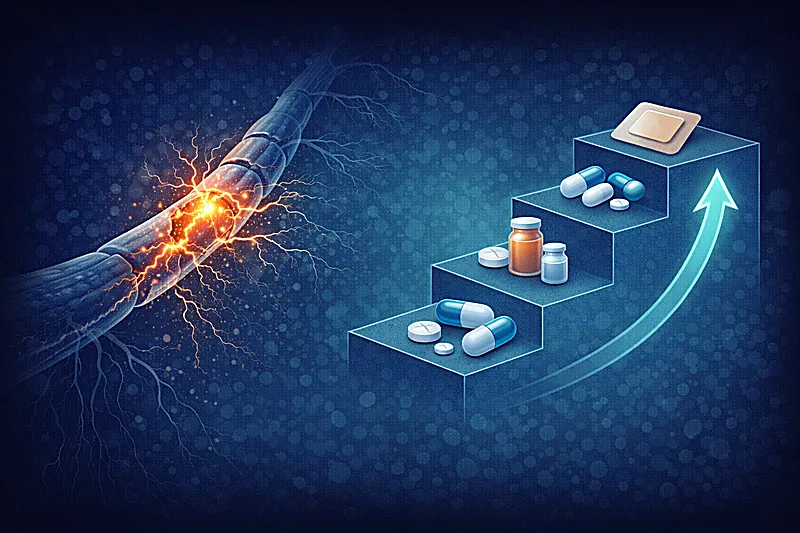
- 1First-line options are amitriptyline, duloxetine, gabapentin, or pregabalin — all have equivalent overall efficacy (OPTION-DM trial); choose based on comorbidities and side-effect profile → First-Line
- 2If monotherapy at maximum tolerated dose is insufficient, combination therapy from different drug classes (e.g., pregabalin + duloxetine) is more effective than dose escalation of a single agent → Combination Therapy
- 3Trigeminal neuralgia is an exception: carbamazepine (or oxcarbazepine) is the specific first-line treatment — the four standard neuropathic pain drugs are NOT effective for this condition → Trigeminal Neuralgia
- 4Avoid amitriptyline in elderly patients (>65 years) at doses above 75 mg/day due to anticholinergic burden, cardiac risk, and falls — duloxetine or gabapentin may be safer alternatives → Special Populations
- 5Pregabalin is a federally controlled substance in the USA (Schedule V) and UK (Class C). Gabapentin is Class C in the UK but is not a federally scheduled substance in the USA, though many individual states have added scheduling requirements — evaluate patients for substance use history before prescribing either drug → Drug Safety
- 6Topical lidocaine 5% patches and capsaicin 8% patches are second-line options for focal peripheral neuropathic pain — they have fewer systemic side effects and may be preferred in the elderly → Topical Therapy
- 7Do not start long-term opioids for neuropathic pain in non-specialist settings — strong opioids are third-line only, require specialist oversight, and carry risks of dependence, tolerance, and cognitive impairment → Opioids
- 8Always assess pain as part of a broader picture: sleep disturbance, mood, function, and quality of life should all be treatment targets → Holistic Assessment
- 9Duloxetine requires doses of at least 60 mg/day to be effective for neuropathic pain — doses below 60 mg are not effective for pain (though they may help depression) → Dosing
- 10NeuPSIG recommends against cannabinoids and valproate for neuropathic pain, and strongly recommends against levetiracetam and mexiletine → Drugs to Avoid
How Should You Choose a First-Line Drug?
The four first-line agents have similar overall efficacy but different side-effect profiles. The OPTION-DM trial confirmed that amitriptyline, duloxetine, and pregabalin are equally effective as monotherapy for painful diabetic neuropathy, and that combination therapy provides additional benefit when monotherapy fails. Choice should be individualised based on comorbidities, concurrent medications, and patient preference.
Neuropathic Pain Medications: Choosing by Patient Profile
| Drug | Effective Dose Range | Favoured When | Avoid or Use Caution When | NeuPSIG NNT |
|---|---|---|---|---|
| Amitriptyline | 25–75 mg at bedtime (max 150 mg) | Comorbid insomnia; low cost; younger patients without cardiac risk | Age >65 (anticholinergic); cardiac disease; glaucoma; urinary retention; orthostatic hypotension. Risk of sudden cardiac death at >100 mg/day | 3.6 |
| Duloxetine | 60–120 mg daily (start 30 mg, increase after 1–2 weeks) | Comorbid depression/anxiety; diabetic neuropathy (FDA-approved); elderly patients | Significant liver disease; severe renal impairment (CrCl <30); concurrent MAOIs. Doses <60 mg/day not effective for pain | 6.4 |
| Pregabalin | 150–600 mg daily in 2 divided doses | Comorbid anxiety (GAD); central neuropathic pain; rapid dose titration possible | Peripheral oedema; weight gain; history of substance abuse (controlled substance); renal impairment (dose-adjust) | 7.7 |
| Gabapentin | 1200–3600 mg daily in 3 divided doses | Postherpetic neuralgia (FDA-approved); renal impairment (dose-adjustable); lower cost than pregabalin | Same cautions as pregabalin; slower titration needed; TID dosing may reduce adherence | 6.3 |
- NNT = number needed to treat for 50% pain relief. Lower NNT indicates greater efficacy. NNTs are from the NeuPSIG 2015 meta-analysis.
- Allow adequate trial duration (4–8 weeks at maximum tolerated dose) before concluding treatment failure.
- Venlafaxine (150–225 mg/day) is an alternative SNRI with neuropathic pain evidence, though less studied than duloxetine.
Clinical Decision Pathway
Evidence in Context
Where NeuPSIG, NICE, and AAN Agree
All major guidelines agree on TCAs (amitriptyline), SNRIs (duloxetine), and gabapentinoids (pregabalin, gabapentin) as first-line agents. All recommend against long-term opioid use as initial therapy. NICE and NeuPSIG agree that carbamazepine is the specific first-line for trigeminal neuralgia. They differ modestly on the positioning of topical agents: NeuPSIG places lidocaine patches and capsaicin patches as second-line with a weak recommendation, while NICE permits capsaicin cream (not patches) in non-specialist settings and restricts capsaicin 8% patches to specialist initiation.
The Problem of Modest Efficacy and Large Placebo Responses
NNTs for first-line agents range from 3.6 (amitriptyline) to 7.7 (pregabalin), meaning that for every 4–8 patients treated, only one achieves 50% pain relief beyond placebo. Placebo response rates in neuropathic pain trials can reach 30–40%, particularly in diabetic neuropathy and HIV neuropathy. This modest drug efficacy underscores the importance of setting realistic expectations with patients, using validated outcome measures, addressing comorbid sleep and mood disorders, and incorporating non-pharmacological approaches (physiotherapy, CBT, TENS) alongside medication.
What We Still Don’t Know
Phenotype-guided treatment: Emerging evidence (e.g., from the COMBO-DN trial) suggests that specific pain phenotypes (burning vs evoked vs paraesthesia-dominant) may predict response to individual drugs. Clinical implementation of phenotypic profiling remains investigational.
Optimal combination regimens: The OPTION-DM trial showed benefit of combination therapy, but the optimal pairing and dose ratio for each patient remain undefined.
Role of cannabinoids: NeuPSIG 2015 recommended against cannabinoids for neuropathic pain. Subsequent trials have produced mixed results, and no major guideline has changed this position.
Long-term outcomes: Most RCTs last 8–12 weeks. Long-term efficacy, safety, and discontinuation strategies are poorly studied for all neuropathic pain drugs.
References
- 1.Finnerup NB, Attal N, Haroutounian S, et al. Pharmacotherapy for Neuropathic Pain in Adults: A Systematic Review and Meta-Analysis (NeuPSIG). Lancet Neurol. 2015;14(2):162–173. doi:10.1016/S1474-4422(14)70251-0
- 2.National Institute for Health and Care Excellence. Neuropathic Pain in Adults: Pharmacological Management in Non-Specialist Settings. NICE Clinical Guideline CG173. Published November 2013, last updated March 2025. nice.org.uk/guidance/cg173
- 3.Tesfaye S, Sloan G, Petrie J, et al. Comparison of Amitriptyline Supplemented With Pregabalin, Pregabalin Supplemented With Amitriptyline, and Duloxetine Supplemented With Pregabalin for the Treatment of Diabetic Peripheral Neuropathic Pain (OPTION-DM): A Multicentre, Double-Blind, Randomised Crossover Trial. Lancet. 2022;400(10353):680–690. doi:10.1016/S0140-6736(22)01472-6
- 4.Bril V, England J, Franklin GM, et al. Evidence-Based Guideline: Treatment of Painful Diabetic Neuropathy. Neurology. 2011;76(20):1758–1765. doi:10.1212/WNL.0b013e3182166ebe
- 5.Schlereth T. Guideline: Diagnosis and Non-Interventional Therapy of Neuropathic Pain of the German Society of Neurology (DGN). Neurol Res Pract. 2020;2:16. doi:10.1186/s42466-020-00063-3
How to Read the Evidence Tags
Every recommendation carries two tags. These are Medaptly’s own simplified interpretations.
Recommendation Strength
| Tag | Meaning | In Practice |
|---|---|---|
| Strong Rec | Benefits clearly outweigh risks. | Standard practice. |
| Moderate Rec | Evidence favours benefit; some uncertainty. | Most patients should receive this. |
| Conditional Rec | Benefit less certain; individualise. | Shared decision-making. |
| Against | No benefit or risks outweigh benefits. | Avoid. |
Evidence Quality
| Tag | Meaning | Confidence |
|---|---|---|
| High Evidence | Multiple RCTs or meta-analyses. | Very confident. |
| Moderate Evidence | Single RCT or large observational studies. | Reasonably confident. |
| Low Evidence | Expert consensus or small studies. | Less certain. |
These are Medaptly’s simplified interpretations. For full classification systems, consult the original documents in References.