
Osteoporosis Screening and Treatment: A Practical Guide for Internal Medicine
Clinical Practice Update — DXA Screening, FRAX Risk Assessment, Bisphosphonate Selection, Anabolic Therapy, Drug Holidays, and Denosumab Transitions
This is an original clinical education article informed by current guidelines and evidence. See References below for source documents.
- Clinical Focus
- Screening with DXA and FRAX, treatment thresholds, first-line pharmacotherapy, risk stratification (high vs very high), sequential therapy, bisphosphonate holidays, denosumab discontinuation, calcium and vitamin D
- Target Audience
- Internists, primary care physicians, endocrinologists, rheumatologists, geriatricians, residents
- Setting
- Primary care, endocrinology clinic, rheumatology clinic, geriatrics
- Source Evidence
- •USPSTF 2025 Recommendation Statement — Screening for Osteoporosis to Prevent Fractures (JAMA, 2025)
- •AACE/ACE 2020 Clinical Practice Guidelines for Diagnosis and Treatment of Postmenopausal Osteoporosis (Endocrine Practice, 2020)
- •Endocrine Society 2019 Guideline — Pharmacological Management of Osteoporosis in Postmenopausal Women (JCEM, 2019)
- •ACP 2023 Clinical Guideline — Pharmacologic Treatment of Primary Osteoporosis or Low Bone Mass
Key Clinical Takeaways
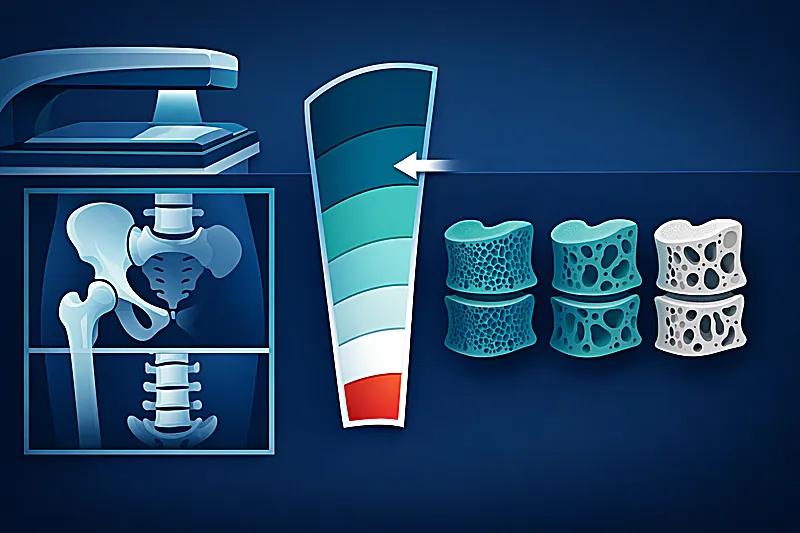
- 1Screen all women ≥65 with DXA; screen postmenopausal women <65 who are at increased risk as determined by a clinical risk assessment tool → Who to Screen
- 2Treat when: T-score ≤-2.5, or fragility fracture regardless of T-score, or T-score -1.0 to -2.5 with FRAX ≥20% for major osteoporotic fracture or ≥3% for hip fracture → When to Treat
- 3For most high-risk patients, start with a bisphosphonate (alendronate, risedronate, or zoledronate) or denosumab as first-line therapy → Choosing Treatment
- 4For very high-risk patients (multiple fractures, T-score ≤-3.0, FRAX >30%/>4.5%), consider anabolic therapy first (teriparatide, abaloparatide, or romosozumab) followed by an antiresorptive → Very High Risk
- 5Consider a bisphosphonate holiday after 5 years of oral or 6 years of IV zoledronate if fracture risk is no longer high — reassess every 2–4 years during the holiday → Drug Holidays
- 6Never stop denosumab without transitioning to a bisphosphonate or another antiresorptive — abrupt discontinuation causes rebound bone loss and increased vertebral fracture risk → Denosumab Transitions
- 7Limit teriparatide and abaloparatide to 2 years, romosozumab to 1 year — always follow anabolic therapy with an antiresorptive to consolidate gains → Sequential Therapy
- 8Maintain vitamin D ≥30 ng/mL and calcium intake of 1,000–1,200 mg/day (diet plus supplements) as adjuncts to pharmacotherapy → Foundational Measures
- 9Evaluate all patients for secondary causes of osteoporosis before starting treatment (thyroid disease, vitamin D deficiency, coeliac disease, myeloma, hyperparathyroidism, glucocorticoid use) → Initial Evaluation
- 10Monitor DXA every 1–3 years on treatment; two or more fragility fractures on therapy suggests treatment failure → Monitoring
Who Should Be Screened and When Should You Treat?
The USPSTF (updated 2025) recommends DXA screening for all women aged 65 and older (Grade B), and for postmenopausal women younger than 65 at increased risk as determined by a clinical risk assessment tool such as FRAX (Grade B). Evidence for screening men remains insufficient. The AACE recommends evaluating all women aged 50 and older for osteoporosis risk.
Perform DXA screening of the lumbar spine and hip in all women aged ≥65. For postmenopausal women <65, use a clinical risk assessment tool (FRAX, OST, or ORAI) to identify those at increased risk who should undergo DXA.
Strong RecModerate EvidenceUSPSTF 2025AACE 2020Initiate pharmacotherapy when any of the following criteria are met: (a) T-score ≤-2.5 at spine, femoral neck, total hip, or 1/3 radius; (b) low-trauma hip or spine fracture regardless of T-score; (c) T-score between -1.0 and -2.5 with a fragility fracture of the proximal humerus, pelvis, or distal forearm; or (d) T-score between -1.0 and -2.5 with FRAX 10-year probability ≥20% for major osteoporotic fracture or ≥3% for hip fracture.
Strong RecModerate EvidenceAACE 2020Evaluate all patients diagnosed with osteoporosis for secondary causes before starting pharmacotherapy. Minimum workup: CBC, CMP (calcium, renal function, liver function), 25-hydroxyvitamin D, TSH, and serum protein electrophoresis in patients with vertebral fractures. Consider PTH, 24-hour urinary calcium, coeliac serology, and testosterone (in men) based on clinical suspicion.
Strong RecLow EvidenceAACE 2020Which Treatment Should You Start?
The AACE 2020 guideline stratifies patients into high risk and very high risk. This distinction drives initial drug selection. For high-risk patients, antiresorptive agents are appropriate first-line. For very high-risk patients, anabolic agents should be considered first, followed by transition to an antiresorptive to consolidate bone gains.
Drug Selection by Risk Category: A Practical Guide
| Drug | Route / Frequency | Best For | Duration / Holiday | Practical Tips |
|---|---|---|---|---|
| Alendronate | Oral, weekly (70 mg) | First-line for most high-risk patients | Holiday after 5 years if no longer high risk | Take fasting with plain water; stay upright 30 min. Avoid if eGFR <30–35. |
| Risedronate | Oral, weekly (35 mg) or monthly (150 mg) | First-line alternative; may have lower GI side effects | Holiday after 5 years if no longer high risk | Same administration rules as alendronate. |
| Zoledronate | IV, annually (5 mg) | Patients unable to take oral; adherence concerns | Holiday after 6 years (3 annual infusions = minimum) | Acute-phase reaction (flu-like) common after first dose. Ensure adequate hydration. Avoid if eGFR <35. |
| Denosumab | SC, every 6 months (60 mg) | First-line alternative; safe in CKD; no GI issues | No holiday. Must transition to bisphosphonate if stopping. | Do not delay or skip doses. Rebound vertebral fractures on discontinuation. Check calcium before each dose. |
| Teriparatide | SC daily (20 mcg) | Very high risk: severe/multiple vertebral fractures | Limit to 2 years. Must follow with antiresorptive. | Anabolic — builds new bone. Orthostatic hypotension early. Gains lost without follow-on antiresorptive. |
| Romosozumab | SC monthly (210 mg) | Very high risk; dual mechanism (anabolic + antiresorptive) | Limit to 1 year. Must follow with antiresorptive. | Avoid if MI/stroke within past year or high CV risk (boxed warning). Most rapid BMD gains of any agent. |
Clinical Decision Pathway
Evidence in Context
Where Guidelines Agree
All major guidelines agree on: DXA screening for women ≥65 (and at-risk younger postmenopausal women), the T-score ≤-2.5 treatment threshold, bisphosphonates as appropriate first-line therapy, the need to follow anabolic agents with antiresorptives, the danger of abrupt denosumab discontinuation, vitamin D and calcium as adjuncts, and the need for periodic reassessment of fracture risk during treatment.
Where They Differ
FRAX thresholds: The AACE uses fixed US thresholds (≥20% MOF / ≥3% hip). Some international guidelines use age-dependent thresholds. The AACE 2020 introduced “very high risk” thresholds (FRAX >30% MOF / >4.5% hip) that trigger anabolic-first strategies.
Bisphosphonate holiday timing: The Endocrine Society suggests reassessing at 3–5 years for oral and 6 years for IV. The AACE specifies 5 years oral / 6 years IV. Both agree a holiday is only appropriate if fracture risk has decreased.
Screening in men: The USPSTF finds insufficient evidence. The Endocrine Society and AACE recommend DXA for men ≥70 or those with risk factors.
The Anabolic-First Strategy: What the Evidence Shows
The ARCH trial (romosozumab vs alendronate) and the VERO trial (teriparatide vs risedronate) demonstrated that starting with an anabolic agent followed by an antiresorptive produces greater BMD gains and greater fracture risk reduction than starting with an antiresorptive alone in very high-risk patients. Conversely, starting with an antiresorptive can blunt the subsequent response to an anabolic agent. This has led AACE to recommend an anabolic-first approach for very high-risk patients.
What We Still Don’t Know
References
- 1.US Preventive Services Task Force. Screening for Osteoporosis to Prevent Fractures: US Preventive Services Task Force Recommendation Statement. JAMA. 2025;333(6):498–508. doi:10.1001/jama.2024.27154
- 2.Camacho PM, Petak SM, Binkley N, et al. American Association of Clinical Endocrinologists/American College of Endocrinology Clinical Practice Guidelines for the Diagnosis and Treatment of Postmenopausal Osteoporosis — 2020 Update. Endocr Pract. 2020;26(Suppl 1):1–46. doi:10.4158/GL-2019-0524
- 3.Eastell R, Rosen CJ, Black DM, et al. Pharmacological Management of Osteoporosis in Postmenopausal Women: An Endocrine Society Clinical Practice Guideline. J Clin Endocrinol Metab. 2019;104(5):1595–1622. doi:10.1210/jc.2019-00221
- 4.Qaseem A, Hicks LA, Etxeandia-Ikobaltzeta I, et al. Pharmacologic Treatment of Primary Osteoporosis or Low Bone Mass to Prevent Fractures in Adults: A Living Clinical Guideline From the American College of Physicians. Ann Intern Med. 2023;178(6):784–799. doi:10.7326/M22-1239
How to Read the Evidence Tags
Every recommendation carries two tags. These are Medaptly’s own simplified interpretations for educational clarity.
Recommendation Strength
| Tag | Meaning | In Practice |
|---|---|---|
| Strong Rec | Benefits clearly outweigh risks. | Standard practice. |
| Moderate Rec | Evidence favours benefit. | Most patients should receive this. |
| Conditional Rec | Right choice depends on individual. | Shared decision-making. |
| Against | Risks outweigh benefits. | Avoid. |
Evidence Quality
| Tag | Meaning | Confidence |
|---|---|---|
| High Evidence | Multiple RCTs or meta-analyses. | Very confident. |
| Moderate Evidence | Single RCT or large observational studies. | Reasonably confident. |
| Low Evidence | Expert consensus or small studies. | May change. |
These are Medaptly’s simplified interpretations. Consult original documents in References for full details.