
Migraine Medication Review — Triptans, Gepants, and Ditans: What the Evidence Shows
Synthesising data from 64+ RCTs involving over 46,000 patients, network meta-analyses, and the 2024 AHS position statement to compare triptans, CGRP receptor antagonists (gepants), and the 5-HT1F agonist lasmiditan for acute and preventive migraine treatment in adults. Evidence through 2025.
This is an original evidence synthesis. See References for source studies.
One-Minute Takeaway
One-Minute Takeaway
- Triptans remain the most effective acute migraine-specific treatments: a network meta-analysis of 64 RCTs (46,442 patients) found that eletriptan 40 mg and rizatriptan 10 mg yield the highest 2-hour pain freedom rates among oral agents, with all triptans producing significantly higher odds of pain freedom than gepants or ditans (Yang et al. 2021, JAMA Network Open).
- Gepants (rimegepant, ubrogepant) and the ditan lasmiditan are effective for acute migraine versus placebo but produce lower 2-hour pain freedom rates than most triptans. Their primary advantage lies in the absence of vasoconstrictive effects, making them suitable for patients with cardiovascular contraindications to triptans.
- Rimegepant (75 mg ODT) is uniquely approved for both acute treatment and preventive therapy, offering a dual-purpose option. Atogepant is the first oral gepant approved specifically for migraine prevention (episodic and chronic), and both are now considered first-line preventive options alongside CGRP monoclonal antibodies per the 2024 AHS position statement.
- Lasmiditan provides the highest acute efficacy among the newer agents but carries the most adverse events (dizziness, somnolence), requires an 8-hour driving restriction post-dose, and is classified as a Schedule V controlled substance in the US — factors that limit its clinical utility.
- Head-to-head RCTs directly comparing gepants and ditans to triptans are lacking; existing comparative data derive entirely from network meta-analyses of placebo-controlled trials, limiting the certainty of between-class efficacy comparisons.
Why This Topic Matters
Migraine affects approximately 12–15% of the global population and is the second leading cause of disability worldwide. For acute attacks, triptans have been the mainstay of migraine-specific therapy since sumatriptan’s introduction in 1991. However, triptans carry cardiovascular contraindications due to their vasoconstrictive 5-HT1B/1D receptor agonism, and approximately 30–40% of patients have an insufficient response to triptans or cannot tolerate them.
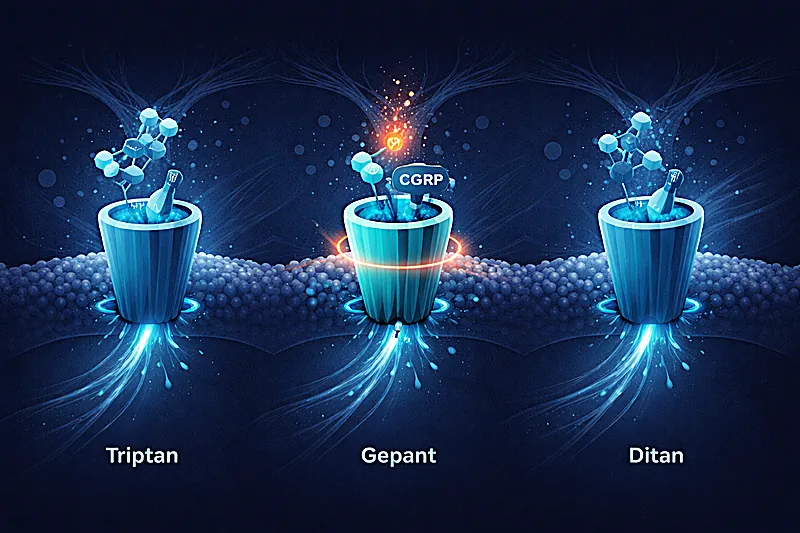
Between 2018 and 2023, the FDA approved four gepants (rimegepant, ubrogepant, atogepant, zavegepant) and one ditan (lasmiditan), fundamentally expanding the migraine-specific therapeutic landscape. These agents offer non-vasoconstrictive mechanisms — CGRP receptor antagonism for gepants and selective 5-HT1F agonism for lasmiditan — and some can serve dual acute and preventive roles.
This evidence synthesis addresses the central clinical question: where do these newer agents fit relative to established triptans, and how should clinicians navigate agent selection across the expanding treatment armamentarium?
What Evidence Was Reviewed
This synthesis draws on the largest available network meta-analyses comparing all migraine-specific acute agents, pivotal RCTs for each gepant and lasmiditan, systematic reviews of triptans, and the 2024 AHS position statement on CGRP-targeting therapies.
| Study | Design | n | Agents Compared | Key Finding | Quality |
|---|---|---|---|---|---|
| Yang et al. 2021 (JAMA Netw Open) | NMA of 64 RCTs | 46442 | 7 triptans + lasmiditan + rimegepant + ubrogepant | Triptans superior to gepants/ditans for 2-h pain freedom; gepants had fewest AEs | High |
| Thorlund et al. 2014 (Cephalalgia) | NMA of 74 RCTs | 24000+ | 7 oral triptans | Eletriptan 40 mg and rizatriptan 10 mg most effective; eletriptan 68% probability of ranking first | High |
| Laohapiboolrattana et al. 2024 (J Headache Pain) | SR & NMA | 3004 | Lasmiditan, rimegepant, ubrogepant in TIR | All effective in triptan-insufficient responders; high-dose lasmiditan ranked highest for pain control | High |
| SAMURAI / SPARTAN (ubrogepant) | Phase 3 RCTs | 3358 | Ubrogepant vs placebo | 2-h pain freedom: 19–22% (50 mg) vs 12–14% placebo | High |
| Study 301 / 303 (rimegepant) | Phase 3 RCTs | 2669 | Rimegepant 75 mg ODT vs placebo | 2-h pain freedom: 21% vs 11% placebo; dual acute/preventive approval | High |
| ADVANCE (atogepant prevention) | Phase 3 RCT | 873 | Atogepant 10/30/60 mg vs placebo | Reduced MMD by 3.7–4.2 vs 2.5 placebo (episodic migraine) | High |
| PROGRESS (atogepant CM) | Phase 3 RCT | 778 | Atogepant 60 mg vs placebo | Reduced MMD by 7.5 vs 5.1 placebo at 12 weeks (chronic migraine) | High |
| SAMURAI (lasmiditan) | Phase 3 RCT | 2231 | Lasmiditan 100/200 mg vs placebo | 2-h pain freedom: 28–32% vs 15% placebo; high CNS AE rate | High |
| Zavegepant nasal spray Phase 3 | Phase 3 RCT | 1405 | Zavegepant 10 mg nasal vs placebo | 2-h pain freedom: 24% vs 15%; rapid onset; dysgeusia most common AE | High |
| Charles et al. 2024 (AHS Position) | Consensus statement | NR | All CGRP-targeting therapies | CGRP therapies recommended as first-line preventive without prior failure requirement | High |
Key Findings: Migraine Medication Review Across Drug Classes
Triptans: Still the Efficacy Standard for Acute Treatment
Across all available network meta-analyses, oral triptans consistently produce higher rates of 2-hour pain freedom and pain relief than gepants or lasmiditan. The comprehensive NMA by Yang and colleagues (64 RCTs, 46,442 patients) found that for 2-hour pain freedom, most triptans were associated with significantly higher odds ratios than lasmiditan, rimegepant, or ubrogepant. Eletriptan 40 mg and rizatriptan 10 mg ranked highest among oral formulations, while subcutaneous sumatriptan 6 mg offers the fastest onset and highest absolute efficacy of any acute migraine treatment.
However, the tolerability profile varies within the class. Certain triptans — particularly rizatriptan, sumatriptan, and zolmitriptan — were associated with higher odds of adverse events than gepants. All triptans carry 5-HT1B-mediated vasoconstriction and are contraindicated in patients with coronary artery disease, uncontrolled hypertension, cerebrovascular disease, or peripheral vascular disease. This cardiovascular limitation affects an estimated 10–15% of migraine patients and increases with age.
Gepants: The Non-Vasoconstrictive Alternative With Dual Utility
The gepants represent the first migraine-specific oral agents that act without vasoconstrictive effects. As small-molecule CGRP receptor antagonists, they block CGRP signalling peripherally at trigeminal afferents without crossing the blood–brain barrier in significant quantities (unlike lasmiditan). Four gepants are now FDA-approved: rimegepant (Nurtec ODT) and ubrogepant (Ubrelvy) for acute treatment, atogepant (Qulipta) for prevention, and zavegepant (Zavzpret) as a nasal spray for acute treatment. Rimegepant uniquely holds dual approval for both indications.
In pivotal acute treatment trials, gepants demonstrated consistent superiority over placebo for 2-hour pain freedom (rimegepant 75 mg: 21% vs 11%; ubrogepant 50 mg: 19–22% vs 12–14%; zavegepant nasal: 24% vs 15%). While these rates are numerically lower than those reported with the most effective triptans, the side effect profile is markedly more favourable. The Yang et al. NMA confirmed that gepants were not associated with increased adverse events compared with placebo — a finding that sharply contrasts with triptans and lasmiditan.
A 2024 network meta-analysis by Laohapiboolrattana and colleagues specifically evaluated the newer agents in patients who self-reported insufficient response to triptans (TIR) — a population representing approximately 30–40% of triptan users. Across five phase 3 RCTs enrolling 3,004 TIR patients, lasmiditan, rimegepant, and ubrogepant all demonstrated significant efficacy for acute migraine compared with placebo. High-dose lasmiditan (200 mg) ranked highest for 2-hour pain control based on SUCRA analysis.
This finding is clinically significant: patients who do not respond adequately to triptans represent a major unmet need, and the different mechanisms of action of gepants and ditans — targeting CGRP receptors and 5-HT1F receptors respectively, rather than the 5-HT1B/1D receptors targeted by triptans — may explain their efficacy in this population. The distinct pharmacological pathways suggest these agents address different components of migraine neurobiology rather than simply duplicating the triptan mechanism.
Atogepant (Qulipta) is the first oral gepant developed specifically for migraine prevention. In the ADVANCE trial (episodic migraine), atogepant at 60 mg daily reduced monthly migraine days by 4.2 versus 2.5 for placebo over 12 weeks. The PROGRESS trial extended this to chronic migraine, where atogepant 60 mg reduced monthly migraine days by 7.5 versus 5.1 for placebo. Long-term open-label data through 52 weeks show sustained efficacy without new safety signals, tachyphylaxis, or rebound headache.
Rimegepant (75 mg every other day) also received FDA approval for preventive treatment, with the pivotal prevention trial showing a reduction of 4.3 monthly migraine days versus 3.5 for placebo over the final 4 weeks of a 12-week treatment period. Both agents are now endorsed by the 2024 AHS position statement as first-line preventive options alongside CGRP monoclonal antibodies, without requiring prior failure of older oral preventives such as topiramate or beta-blockers.
Lasmiditan is a selective 5-HT1F receptor agonist that acts centrally within the trigeminal nucleus caudalis, inhibiting glutamate and CGRP release without vasoconstriction. In the SAMURAI and SPARTAN phase 3 trials, lasmiditan 200 mg produced 2-hour pain freedom rates of 28–32% versus 15% for placebo — the highest absolute efficacy among the newer agents, approaching triptan-level performance at higher doses.
However, its clinical utility is significantly tempered by a high rate of CNS adverse events. The NMA by Yang et al. confirmed that lasmiditan was associated with the highest odds of any adverse events among all acute agents studied. Dizziness, somnolence, paraesthesia, and fatigue occur in 15–20% of patients at therapeutic doses. The FDA mandated a Schedule V controlled substance classification and an 8-hour driving restriction post-dose — a substantial practical limitation for a medication intended for episodic use. These factors position lasmiditan as a niche agent for patients who cannot use triptans and who prioritise efficacy over CNS tolerability.
Zavegepant (Zavzpret) is the third-generation gepant, administered as a 10 mg nasal spray — the only non-oral gepant formulation. In its phase 3 trial (n=1,405), zavegepant demonstrated statistically significant superiority over placebo for 2-hour pain freedom (24% vs 15%) and most bothersome symptom freedom. The nasal route offers potential advantages for patients with nausea and vomiting who cannot reliably absorb oral medications, addressing one of the key limitations of oral triptans and gepants.
The most common adverse event is dysgeusia (taste disturbance), reported in approximately 20% of patients. Nasal discomfort also occurs but is generally mild and transient. No hepatotoxicity — a concern with first-generation gepants that led to the discontinuation of telcagepant and others — has been observed with zavegepant, rimegepant, ubrogepant, or atogepant. An oral formulation of zavegepant is currently in clinical development for preventive migraine treatment.
Comparative Safety Across Drug Classes
The safety differentiation between drug classes is as clinically important as the efficacy data. Triptans, while most effective, carry class-wide cardiovascular contraindications (5-HT1B-mediated coronary vasoconstriction) and are associated with a higher rate of adverse events including chest tightness, triptan sensations, and CNS effects. Gepants stand out for their placebo-like adverse event profiles in the NMA data — a remarkable finding for migraine-specific agents. Lasmiditan occupies an intermediate position: no cardiovascular vasoconstriction, but substantial CNS effects including a driving restriction that limits its practical appeal.
Quality & Consistency of Evidence
What the Evidence Does Not Show
No head-to-head RCTs between drug classes: The central limitation of the current evidence. All comparative efficacy data between triptans, gepants, and lasmiditan derive from network meta-analyses of separately conducted placebo-controlled trials. Differences in trial populations, baseline severity, and placebo response rates limit the reliability of cross-class comparisons. Direct active-comparator trials are urgently needed.
Gepant efficacy in comparison with individual triptans (not just class-level): The NMA data suggest triptans as a class are more effective than gepants, but the range within triptans is wide (naratriptan is far less effective than eletriptan). Whether gepants perform comparably to lower-efficacy triptans or even exceed them in certain patient subgroups is not clearly established.
Long-term cardiovascular safety of chronic CGRP blockade: CGRP plays protective roles in cardiovascular physiology (vasodilation, ischaemic preconditioning). While no clinical cardiovascular signals have emerged with gepants or CGRP mAbs over several years of monitoring, patients with established cardiovascular disease were largely excluded from pivotal trials. The safety of chronic CGRP antagonism in this specific population remains theoretically uncertain.
Optimal sequencing and combination strategies: Whether combining a gepant with a triptan within the same attack is safe and effective, and whether alternating between classes for different attacks offers advantages, are open questions with limited data. A small study found no safety concerns with concurrent rimegepant and CGRP mAb use, but robust combination data are lacking.
Practical Implications
Based on the current evidence, the following considerations may inform the selection of migraine-specific acute and preventive therapies.
For patients without cardiovascular contraindications, triptans offer the highest probability of 2-hour pain freedom. Eletriptan 40 mg and rizatriptan 10 mg consistently rank highest in meta-analyses. Sumatriptan remains the most prescribed due to availability in multiple formulations and generic pricing. Individual variation in response is well documented — patients who do not respond to one triptan may benefit from a different agent within the class.
For patients with cardiovascular disease, uncontrolled hypertension, or cerebrovascular risk factors, gepants offer migraine-specific efficacy without vasoconstriction. Their placebo-like tolerability profile is an additional advantage over lasmiditan. Rimegepant ODT offers the convenience of dual acute/preventive use; zavegepant nasal spray addresses nausea-related absorption concerns.
Among non-vasoconstrictive acute agents, lasmiditan offers the highest pain freedom rates, approaching triptan levels at the 200 mg dose. However, the 8-hour driving restriction, Schedule V classification, and high CNS adverse event rate (dizziness in ~15%, somnolence in ~7%) position it as a second-line option among the newer agents, most appropriate for patients treating attacks at home or before sleep.
The 2024 AHS position statement endorses atogepant, rimegepant, and CGRP monoclonal antibodies as first-line preventive options alongside traditional oral preventives. For patients requiring both acute and preventive therapy, rimegepant offers a single-agent approach. Atogepant provides the strongest preventive data among oral gepants, with proven efficacy in both episodic and chronic migraine.
Evidence Grade & Bottom Line
Evidence Grade: Moderate (for between-class comparisons); Strong (for individual agent efficacy vs placebo)
Each drug class has robust placebo-controlled RCT evidence establishing its efficacy. However, the comparative effectiveness between drug classes relies entirely on indirect (network meta-analytic) comparisons, which are inherently less certain than head-to-head trial data. The overall evidence base is large and growing, but the critical missing piece — direct active-comparator trials between triptans, gepants, and lasmiditan — limits the precision of treatment-selection recommendations.
- Triptans remain the most effective acute migraine-specific agents based on NMA data, with eletriptan 40 mg and rizatriptan 10 mg ranking highest among oral formulations.
- Gepants (rimegepant, ubrogepant, zavegepant) offer effective migraine-specific acute treatment with a placebo-like adverse event profile and no cardiovascular vasoconstriction — the preferred class for patients with cardiovascular contraindications to triptans.
- Lasmiditan achieves the highest acute efficacy among newer agents but is limited by substantial CNS effects, driving restrictions, and controlled substance classification.
- Atogepant and rimegepant are now first-line preventive options per the 2024 AHS statement, with rimegepant uniquely offering dual acute/preventive use in a single agent.
- Head-to-head RCTs directly comparing triptans to gepants and ditans remain the most important evidence gap in acute migraine pharmacotherapy.
Article Information
For Educational Purposes Only. This is an original evidence synthesis informed by the studies listed below. It does not replace clinical judgement. Drug dosages should be verified against current prescribing information.
References
- Yang CP, Liang CS, Chang CM, et al. Comparison of new pharmacologic agents with triptans for treatment of migraine: a systematic review and meta-analysis. JAMA Netw Open. 2021;4(10):e2128544. DOI: 10.1001/jamanetworkopen.2021.28544
- Thorlund K, Mills EJ, Wu P, et al. Comparative efficacy of triptans for the abortive treatment of migraine: a multiple treatment comparison meta-analysis. Cephalalgia. 2014;34(4):258–267. DOI: 10.1177/0333102413508661
- Laohapiboolrattana W, Jansem P, Anukoolwittaya P, et al. Efficacy of lasmiditan, rimegepant and ubrogepant for acute treatment of migraine in triptan insufficient responders: systematic review and network meta-analysis. J Headache Pain. 2024;25(1):194. DOI: 10.1186/s10194-024-01904-1
- Charles AC, Digre KB, Goadsby PJ, et al. Calcitonin gene-related peptide-targeting therapies are a first-line option for the prevention of migraine: an AHS position statement update. Headache. 2024;64(4):333–341. DOI: 10.1111/head.14692
- Lipton RB, Dodick DW, Ailani J, et al. Effect of ubrogepant vs placebo on pain and the most bothersome associated symptom in the acute treatment of migraine (ACHIEVE II). JAMA. 2019;322(19):1887–1898. DOI: 10.1001/jama.2019.16711
- Croop R, Goadsby PJ, Stock DA, et al. Efficacy, safety, and tolerability of rimegepant orally disintegrating tablet for the acute treatment of migraine: a randomised, phase 3, double-blind, placebo-controlled trial. Lancet. 2019;394(10200):737–745. DOI: 10.1016/S0140-6736(19)31606-X
- Goadsby PJ, Dodick DW, Ailani J, et al. Safety, tolerability, and efficacy of orally administered atogepant for the prevention of episodic migraine in adults: a double-blind, randomised phase 2b/3 trial (ADVANCE). Lancet Neurol. 2020;19(9):727–737. DOI: 10.1016/S1474-4422(20)30234-9
- Goadsby PJ, Wietecha LA, Dennehy EB, et al. Phase 3 randomized, placebo-controlled, double-blind study of lasmiditan for acute treatment of migraine. Brain. 2019;142(7):1894–1904. DOI: 10.1093/brain/awz134
- Lipton RB, Croop R, Stock EG, et al. Rimegepant, an oral calcitonin gene-related peptide receptor antagonist, for migraine. N Engl J Med. 2019;381(2):142–149. DOI: 10.1056/NEJMoa1811090
- Cameron C, Kelly S, Hsieh SC, et al. Triptans in the acute treatment of migraine: a systematic review and network meta-analysis. Headache. 2015;55(Suppl 4):221–235. DOI: 10.1111/head.12601
- Ferrari MD, Roon KI, Lipton RB, Goadsby PJ. Oral triptans (serotonin 5-HT1B/1D agonists) in acute migraine treatment: a meta-analysis of 53 trials. Lancet. 2001;358(9294):1668–1675. DOI: 10.1016/S0140-6736(01)06682-3
- Ailani J, Lipton RB, Goadsby PJ, et al. Atogepant for the preventive treatment of migraine. N Engl J Med. 2021;385(8):695–706. DOI: 10.1056/NEJMoa2035908