
BPPV Treatment: Dix-Hallpike, Epley, and Office Maneuvers
Clinical Practice Update — Positional Vertigo Diagnosis, Canalith Repositioning, and Red-Flag Assessment in Primary Care
This is an original clinical education article informed by current guidelines and evidence. See References below for source documents.
- Clinical Focus
- Evidence-based BPPV treatment, canalith repositioning, and red-flag referral in primary care
- Target Audience
- Family physicians, general practitioners, emergency physicians, physiotherapists, nurse practitioners
- Setting
- Primary care clinics, urgent care, emergency departments
- Source Evidence
- •AAO-HNS Clinical Practice Guideline: Benign Paroxysmal Positional Vertigo (Update, 2017)
- •AAN Practice Parameter: Therapies for Benign Paroxysmal Positional Vertigo (2008)
- •Barany Society Diagnostic Criteria for BPPV — ICVD (2015)
- •Cochrane Review — Epley Maneuver for BPPV (Hilton & Pinder, 2014)
Key Clinical Takeaways
Effective BPPV treatment in primary care rests on three steps that almost every clinician can master: a positional test to localise the affected canal, a canal-specific repositioning maneuver, and a brief safety screen to exclude central causes of vertigo. The rules below distil current evidence into a single, actionable office workflow.
- 1Perform the Dix-Hallpike test on any patient with brief, positional, spinning vertigo to identify posterior canal BPPV → Diagnosing BPPV
- 2Screen every dizzy patient for central causes with the HINTS examination before attributing symptoms to BPPV → Red Flags
- 3Treat posterior canal BPPV with the Epley maneuver as first-line therapy at the point of diagnosis → Posterior Canal
- 4Use the supine roll test to identify horizontal canal BPPV in patients whose Dix-Hallpike is negative but history fits → Horizontal Canal
- 5Treat horizontal canal BPPV with the Lempert (BBQ roll) or Gufoni maneuver, not the Epley → Horizontal Canal
- 6Avoid vestibular suppressants (meclizine, prochlorperazine) as primary treatment — they delay recovery → Pitfalls
- 7Do not impose post-maneuver positioning restrictions — the evidence does not support additional benefit → Post-Treatment
- 8Refer urgently for vertical nystagmus, new headache, focal neurology, or HINTS-central signs → Red Flags
- 9Counsel patients that recurrence occurs in roughly half within 5 years — the maneuver can be repeated safely → Monitoring
- 10Distinguish BPPV from vestibular neuritis, vestibular migraine, and Meniere disease by pattern, not by single features → Differential
Diagnosing BPPV Before Treatment
Accurate localisation is the foundation of BPPV treatment. The wrong maneuver for the wrong canal will not work and will frustrate patient and clinician alike. Two bedside tests identify the vast majority of cases.
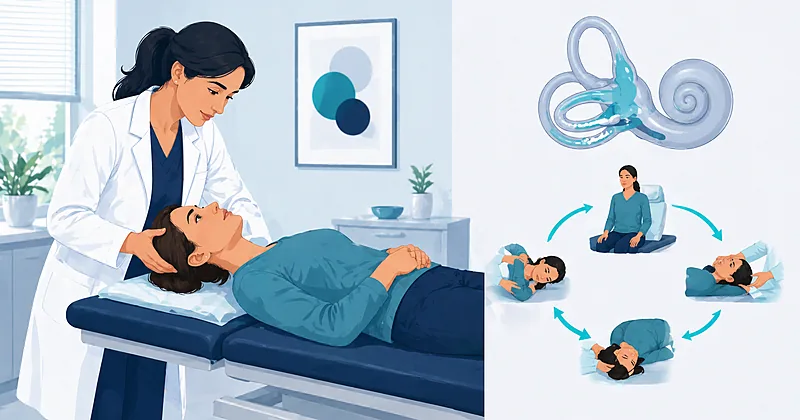
BPPV is caused by free-floating otoconia inside a semicircular canal. A quick review of vestibular anatomy helps: the posterior canal is involved in roughly 80–90% of cases, the horizontal (lateral) canal in around 10–15%, and the anterior canal in well under 5%.
Perform the Dix-Hallpike test in any adult with brief (under 60 seconds) positional vertigo triggered by rolling over in bed, looking up, or bending forward. A positive test reproduces the patient’s vertigo along with a characteristic upbeating and torsional nystagmus that beats toward the dependent ear.
Strong Rec High Evidence AAO-HNS 2017 Barany ICVD 2015Perform the supine roll test (Pagnini-McClure) in patients with a typical positional history but a negative Dix-Hallpike. Horizontal nystagmus that changes direction as the head is rolled from one side to the other confirms horizontal canal BPPV.
Strong Rec Moderate Evidence AAO-HNS 2017Do not obtain routine MRI, CT, audiometry, or vestibular laboratory testing in patients with a clear history and typical positional findings. Imaging is reserved for red-flag features, atypical nystagmus, or failure of two or more correctly performed maneuvers.
Against Moderate Evidence AAO-HNS 2017Evaluate for significant cervical spine disease, carotid stenosis, severe cardiopulmonary disease, or recent retinal detachment before positional testing. Modify the maneuver or defer to a specialist when these relative contraindications are present.
Moderate Rec Low Evidence AAO-HNS 2017Posterior Canal BPPV Treatment
The Epley (canalith repositioning) maneuver is the cornerstone of posterior canal BPPV treatment. A single correctly performed maneuver resolves symptoms in the majority of patients; two sequential attempts raise the success rate further. Success also depends on knowing which side is affected — the ear that was dependent during a positive Dix-Hallpike.
Perform the Epley maneuver at the point of diagnosis in any patient with a positive Dix-Hallpike for posterior canal BPPV. Correct Epley maneuver technique uses four 30-second pauses: head turned 45° to the affected side while supine with neck extended, then rotated 90° to the opposite side, then onto the lateral decubitus with the nose angled toward the floor, then sitting upright.
Strong Rec High Evidence AAO-HNS 2017 AAN 2008 Cochrane 2014Offer the Semont (liberatory) maneuver as an equally effective alternative, particularly when cervical range of motion limits head rotation or when the Epley has failed twice despite good technique. The Semont uses rapid lateral transitions rather than gradual head rotations.
Moderate Rec Moderate Evidence AAO-HNS 2017Do not restrict patient posture after a successful maneuver. Randomised trials have not shown that wearing a cervical collar, sleeping upright, or avoiding the affected side improves outcomes beyond the maneuver itself.
Against High Evidence AAO-HNS 2017 Cochrane 2014Do not routinely prescribe vestibular suppressants (meclizine, dimenhydrinate, prochlorperazine, benzodiazepines) for BPPV treatment. These medications blunt central compensation, cause sedation and falls in older adults, and have not been shown to shorten episodes.
Against Moderate Evidence AAO-HNS 2017 AAN 2008Choosing Between the Epley and the Semont
Both maneuvers work by guiding otoconia out of the posterior canal. The choice often comes down to the patient in front of you rather than the published effect size.
| Patient Factor | Prefer Epley | Prefer Semont | Practical Tip |
|---|---|---|---|
| Cervical spine disease | Limited neck extension is a relative problem | Better tolerated — less neck rotation | Examine the neck before positioning |
| Obesity or limited mobility | Gradual pace, easier to guide | Rapid transitions may be difficult | Ensure adequate couch width |
| First episode | First-line by guideline | Reasonable alternative | Document laterality in the record |
| Two failed Epley attempts | Recheck technique first | Reasonable next step | Rule out horizontal canal |
| Anxiety about the procedure | Slower, feels more controlled | Brief but intense | Warn about transient vertigo |
Horizontal Canal Variants
Horizontal (lateral) canal BPPV is often missed because clinicians stop at a negative Dix-Hallpike. Patients describe the same positional pattern but test positive on the supine roll. Two clinical sub-types exist and they demand different maneuvers.
Distinguish geotropic (beats toward the ground) from apogeotropic (beats away from the ground) nystagmus patterns on the supine roll test. Geotropic nystagmus reflects canalolithiasis, while apogeotropic nystagmus reflects cupulolithiasis — the otoconia are stuck to the cupula rather than free-floating.
Strong Rec Moderate Evidence Barany ICVD 2015Perform the Lempert (barbecue or BBQ roll) 360° maneuver or the Gufoni maneuver for geotropic horizontal canal BPPV. Roll the patient in 90° increments toward the unaffected side, pausing for about 30 seconds at each position.
Moderate Rec Moderate Evidence AAO-HNS 2017Consider the Gufoni maneuver for apogeotropic horizontal canal BPPV to dislodge otoconia from the cupula. Expertise varies in primary care — refer when the canal variant is uncertain or the maneuver is unfamiliar.
Conditional Rec Low Evidence AAO-HNS 2017Clinical Decision Pathway
A practical, question-based sequence for the first visit and the follow-up.
Red Flags, Differential Diagnosis, and When to Refer
Most positional vertigo is benign — but the consequences of missing a posterior circulation stroke are severe. A short, structured red-flag screen keeps the rare catch from being missed.
Refer urgently to the emergency department if any of the following central features are present: vertical or direction-changing nystagmus, skew deviation on alternate cover testing, new severe or occipital headache, focal neurology, or gait ataxia severe enough that the patient cannot walk unaided.
Strong Rec High Evidence AAO-HNS 2017Refer non-urgently to ENT or vestibular physiotherapy when two to three correctly performed maneuvers fail to resolve symptoms, when the canal variant is unclear, or when episodes recur more than twice in a year. Vestibular rehabilitation provides additional benefit alongside repositioning.
Moderate Rec Moderate Evidence AAO-HNS 2017Evaluate for secondary causes of BPPV when episodes recur frequently or present after head trauma: labyrinthitis, Meniere disease, prolonged bedrest, osteoporosis with low vitamin D, and migraine-associated vestibulopathy. Treating the underlying contributor reduces recurrence.
Conditional Rec Low Evidence AAO-HNS 2017Distinguishing BPPV from Other Causes of Vertigo
| Condition | Episode Duration | Trigger | Associated Features | Key Differentiator |
|---|---|---|---|---|
| BPPV | Seconds (under 60s) | Head position change | None — normal between episodes | Positive Dix-Hallpike or roll test |
| Vestibular neuritis | Days | Often post-viral onset | Continuous vertigo, nausea, unsteady gait | Spontaneous unidirectional horizontal nystagmus |
| Meniere disease | 20 min – hours | Often spontaneous | Hearing loss, tinnitus, fullness | Cochlear symptoms between attacks |
| Vestibular migraine | Minutes to hours | Migraine triggers | Photophobia, headache history | Migrainous features with vertigo |
| Central (stroke) | Continuous | Sudden onset | Severe ataxia, focal signs | Vertical or direction-changing nystagmus |
Monitoring, Recurrence, and Patient Counselling
Post-maneuver care is simpler than traditional teaching suggests. Counsel patients, re-test if symptoms persist, and repeat the maneuver as needed.
Assess gait and fall risk before and after the maneuver, particularly in patients over 65. Residual unsteadiness for 24–48 hours is common; supervise the first steps out of the clinic and advise against driving until balance has returned.
Strong Rec Moderate Evidence AAO-HNS 2017Reassess at 1 to 4 weeks. Repeat the Dix-Hallpike test; if still positive, perform the Epley again. Two to three sequential treatments in one session, or at a follow-up visit, resolve symptoms in approximately 90% of patients with posterior canal BPPV.
Strong Rec High Evidence Cochrane 2014 AAO-HNS 2017Counsel patients that BPPV recurs in roughly 15% at 1 year and around 50% within 5 years. Teach them to recognise symptoms early and to seek re-treatment rather than tolerating weeks of positional vertigo. Home Epley self-treatment can be taught to motivated patients with recurrent disease.
Moderate Rec Moderate Evidence AAO-HNS 2017| Parameter | When to Check | What to Look For | Common Pitfalls |
|---|---|---|---|
| Maneuver response | Immediately after each attempt | Repeat Dix-Hallpike; a clearly negative retest predicts resolution | Interpreting residual dizziness as failure rather than central compensation |
| Symptom resolution | 1–4 weeks | Complete disappearance of positional triggers | Missing canal conversion (posterior → horizontal) after Epley |
| Bone health (if recurrent) | After two or more episodes in a year | Serum 25-OH vitamin D; consider DEXA if low | Not investigating low vitamin D as a contributor to recurrence |
| Medication review | Every visit in older adults | Withdraw unnecessary sedating or vestibular-suppressant drugs | Continuing meclizine “as needed” long-term |
Evidence in Context
Where the major guidelines agree, where subtle differences remain, and what the recent evidence adds.
Where AAO-HNS, AAN, and Cochrane Agree
All three bodies converge on three points: the Dix-Hallpike is the diagnostic standard for posterior canal BPPV, the Epley maneuver is the first-line therapy with clear benefit over observation, and pharmacotherapy alone is inferior to repositioning. Routine imaging, vestibular laboratory testing, and sedating drugs are consistently discouraged in uncomplicated cases.
Post-Maneuver Restrictions: What Changed
Traditional teaching emphasised sleeping upright and avoiding the affected side for 48 hours after the Epley. Multiple randomised trials, summarised in the Cochrane review, show no additional benefit from these restrictions. Current guidelines explicitly recommend against mandating them, although brief informal advice to avoid extreme positions on the first night remains common practice.
Vestibular Rehabilitation as an Adjunct
Several randomised trials suggest that vestibular rehabilitation after repositioning reduces residual imbalance and speeds return to normal activity, particularly in older adults. Current guidance recommends offering rehabilitation as an adjunct — not a substitute — to the mechanical maneuver.
Vitamin D and Recurrence
Observational studies and a few randomised trials suggest that correcting vitamin D deficiency reduces BPPV recurrence, possibly through its effects on otoconial metabolism. The signal is not strong enough to recommend universal screening, but checking 25-OH vitamin D in patients with frequent recurrences is reasonable.
References
- 1.Bhattacharyya N, Gubbels SP, Schwartz SR, et al. Clinical Practice Guideline: Benign Paroxysmal Positional Vertigo (Update). Otolaryngol Head Neck Surg. 2017;156(3 Suppl):S1–S47. doi:10.1177/0194599816689667
- 2.Fife TD, Iverson DJ, Lempert T, et al. Practice parameter: therapies for benign paroxysmal positional vertigo (an evidence-based review). Neurology. 2008;70(22):2067–2074. doi:10.1212/01.wnl.0000313378.77444.ac
- 3.von Brevern M, Bertholon P, Brandt T, et al. Benign paroxysmal positional vertigo: Diagnostic criteria. J Vestib Res. 2015;25(3-4):105–117. doi:10.3233/VES-150553
- 4.Hilton MP, Pinder DK. The Epley (canalith repositioning) manoeuvre for benign paroxysmal positional vertigo. Cochrane Database Syst Rev. 2014;(12):CD003162. doi:10.1002/14651858.CD003162.pub3
- 5.Kim JS, Zee DS. Clinical practice. Benign paroxysmal positional vertigo. N Engl J Med. 2014;370(12):1138–1147. doi:10.1056/NEJMcp1309481
How to Read the Evidence Tags
Every recommendation carries two tags for recommendation strength and evidence quality — Medaptly’s own simplified interpretations.
Recommendation Strength
| Tag | What It Means |
|---|---|
| Strong Rec | High-quality evidence broadly supports this action. |
| Moderate Rec | The weight of evidence favours this action. |
| Conditional Rec | The benefit is less certain — individualise based on patient factors. |
| Against | Evidence shows no benefit or potential harm. |
Evidence Quality
| Tag | What It Means |
|---|---|
| High Evidence | Multiple well-designed RCTs or high-quality meta-analyses. |
| Moderate Evidence | Single RCT or large observational studies. |
| Low Evidence | Expert consensus or small studies. |