
Bell’s Palsy Treatment: Steroids and Recovery Guide
Clinical Practice Update — Corticosteroids, Antivirals, Eye Care, and Recovery in Adults
This is an original clinical education article informed by current guidelines and evidence. See References below for source documents.
- Clinical Focus
- Evidence-based Bell’s palsy treatment: corticosteroid dosing, antiviral role, eye protection, and recovery monitoring in immunocompetent adults
- Target Audience
- Primary care physicians, emergency physicians, neurologists, ENT specialists, residents
- Setting
- Primary care, emergency departments, outpatient neurology and ENT clinics
- Source Evidence
- •AAN Practice Parameter Update — Steroids and Antivirals for Bell’s Palsy (2012)
- •AAO-HNS Clinical Practice Guideline: Bell’s Palsy (2013)
- •Scottish Bell’s Palsy Study — Sullivan et al. (NEJM, 2007)
- •Engström et al. Prednisolone and valaciclovir trial (Lancet Neurology, 2008)
- •Cochrane Review — Corticosteroids for Bell’s Palsy (Madhok et al., 2016)
Key Clinical Takeaways
Effective Bell’s palsy treatment rests on two decisions made within the first 72 hours: start high-dose corticosteroids and protect the eye. The remaining work — antivirals in selected cases, red-flag surveillance, and structured recovery counselling — follows from those first two. Roughly 70% of untreated patients recover fully; with corticosteroids started early, that figure rises above 85%.
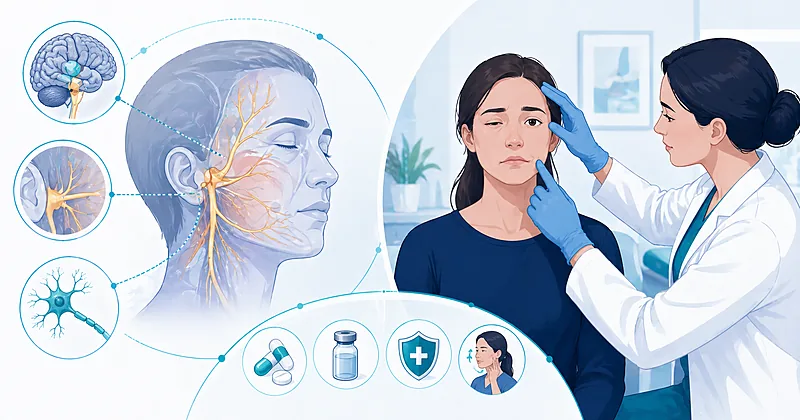
- 1Diagnose Bell’s palsy clinically — acute unilateral lower motor neuron facial weakness that progresses over 72 hours or less, with no other neurological signs → Diagnosis
- 2Grade severity at baseline using House-Brackmann grading — it anchors prognosis and follow-up comparison → Diagnosis
- 3Start oral prednisone 60–80 mg daily (or 1 mg/kg) within 72 hours of symptom onset — the single highest-yield step in Bell’s palsy treatment → Corticosteroids
- 4Consider adding an antiviral (valaciclovir 1000 mg three times daily for 7 days) to corticosteroids in severe palsy — modest additional benefit in House-Brackmann V–VI → Antivirals
- 5Do not give antivirals as monotherapy — the evidence shows no benefit over placebo alone → Antivirals
- 6Protect the eye aggressively — artificial tears by day, lubricating ointment and lid taping at night, in every patient who cannot close the eye fully → Eye Protection
- 7Do not order routine imaging — MRI is reserved for atypical features, progression beyond 72 hours, or absence of recovery by 3–4 months → Workup
- 8Refer urgently for any red flag — bilateral weakness, progression beyond 3 weeks, other cranial nerves involved, vesicles, or recurrent episodes → Red Flags
- 9Set expectations clearly — most patients see improvement within 3 weeks and substantial recovery by 3–6 months → Recovery
Recognizing and Diagnosing Bell’s Palsy
Bell’s palsy is a clinical diagnosis. It is defined as an acute, unilateral, peripheral (lower motor neuron) facial paralysis of unknown aetiology that progresses to maximum severity within 72 hours. It accounts for roughly 60–75% of all cases of acute unilateral facial weakness.
The central task at first presentation is distinguishing idiopathic Bell’s palsy from the handful of specific disorders that look similar but require different management — Ramsay Hunt syndrome, Lyme-associated facial palsy, acute stroke, tumour compressing the facial nerve, and otitis media with facial involvement.
Confirm a lower motor neuron pattern of weakness — loss of forehead movement, inability to close the eye, flattening of the nasolabial fold, and drooping of the corner of the mouth on one side. Preserved forehead movement points to a central lesion and demands urgent stroke workup.
Strong Rec Moderate Evidence AAN 2012 AAO-HNS 2013Inspect the external ear, ear canal, palate, and tongue. Vesicles in the ear canal or concha suggest Ramsay Hunt syndrome — this requires a different treatment plan with higher-dose antivirals and carries a worse prognosis.
Strong Rec Moderate Evidence AAO-HNS 2013Grade the facial weakness at baseline using House-Brackmann grading (I–VI). Documented baseline severity informs prognosis, drives antiviral decisions, and provides a comparison point at follow-up.
Strong Rec Moderate Evidence AAO-HNS 2013Do not order routine laboratory tests, MRI, CT, or electrodiagnostic studies in typical Bell’s palsy. Reserve these investigations for atypical presentations, failure to improve by 3 months, or evidence of recurrence.
Against Moderate Evidence AAO-HNS 2013Bell’s Palsy Treatment with Corticosteroids
Corticosteroids are the single most effective component of Bell’s palsy treatment. Two large, well-designed randomised trials — the Scottish Bell’s Palsy Study and the Swedish trial by Engström and colleagues — together with multiple Cochrane updates have established that prednisolone, given within 72 hours of symptom onset, significantly increases the proportion of patients who achieve complete recovery.
The benefit is most pronounced in adults with complete or near-complete paralysis (House-Brackmann IV–VI). The number needed to treat to achieve one additional full recovery is approximately 8–10.
Prescribe prednisone 60–80 mg daily (or 1 mg/kg) for 5 days, followed by a 5-day taper — starting within 72 hours of symptom onset — for every adult with new-onset Bell’s palsy, unless clearly contraindicated.
Strong Rec High Evidence AAN 2012 AAO-HNS 2013Offer an alternative regimen of prednisolone 25 mg twice daily for 10 days when it aligns with local formulary — this was the schedule used in the Scottish trial.
Moderate Rec High Evidence Scottish BPS 2007Counsel patients with diabetes mellitus, glaucoma, tuberculosis, or active peptic ulcer disease on the risks of short-course steroids, and make an individualised decision. Do not withhold corticosteroids automatically — the absolute risks of a 10-day course are small compared with the benefit.
Moderate Rec Low Evidence AAO-HNS 2013Do not delay corticosteroids to obtain imaging, electrodiagnostic studies, or specialist review in a typical case. The 72-hour treatment window closes quickly; later initiation substantially attenuates benefit.
Strong Rec Moderate Evidence AAN 2012Corticosteroid Regimens at a Glance
| Drug | Typical Regimen | Trial Evidence | Practical Tips |
|---|---|---|---|
| Prednisone | 60–80 mg (or 1 mg/kg) daily × 5 days, then 10 mg/day taper over 5 days | Widely used in North America; supported by AAN meta-analysis | Single morning dose, with food. Warn about insomnia, appetite, and glucose. |
| Prednisolone | 25 mg twice daily × 10 days (no taper) | Scottish Bell’s Palsy Study regimen | UK/European standard. Active metabolite — preferable in liver disease. |
| Methylprednisolone | Equivalent dose conversion; oral or IV if unable to tolerate oral | Pragmatic option; fewer direct trial data in Bell’s palsy | Convert doses carefully (4 mg methylprednisolone = 5 mg prednisone). |
Role of Antivirals in Bell’s Palsy Treatment
Antivirals are the most contested component of Bell’s palsy treatment. The biological rationale — reactivated herpes simplex virus as a plausible cause — is strong, but randomised trials have shown that the clinical benefit of antivirals added to corticosteroids is at best modest and most apparent in patients with the most severe weakness.
The AAN practice parameter concluded that antivirals added to steroids may offer a small additional benefit compared with steroids alone, but that antiviral monotherapy is probably inferior to corticosteroid monotherapy. Contemporary practice uses antivirals selectively, not routinely.
Consider adding valaciclovir 1000 mg three times daily for 7 days (or acyclovir 400 mg five times daily for 10 days) to corticosteroids in patients with severe palsy (House-Brackmann V–VI), started within 72 hours of onset.
Conditional Rec Moderate Evidence AAN 2012 AAO-HNS 2013Do not use antivirals as monotherapy for Bell’s palsy. Trials have consistently shown no meaningful benefit compared with placebo, and they are clearly inferior to corticosteroids.
Against High Evidence AAN 2012Prescribe antivirals at full Ramsay Hunt syndrome doses (valaciclovir 1000 mg three times daily for 7–10 days) if auricular vesicles are present, even without culture confirmation — the threshold for treating herpes zoster oticus is low.
Strong Rec Moderate Evidence AAO-HNS 2013Clinical Decision Pathway
A practical, question-based approach to the first consultation. Work through the questions in order from presentation to prescription.
Eye Protection During Bell’s Palsy Treatment
Exposure keratopathy is the most common preventable complication of Bell’s palsy treatment. Incomplete eye closure, reduced blink rate, and impaired tear distribution combine to dry out the cornea within hours. Aggressive lubrication and mechanical protection from day one prevent the majority of these complications.
Prescribe preservative-free artificial tears every 1–2 hours during waking hours and a thicker lubricating ointment at night, with gentle lid taping, for every patient who cannot fully close the affected eye. This prevents most cases of exposure keratopathy.
Strong Rec Moderate Evidence AAO-HNS 2013Refer urgently to ophthalmology for any red eye, persistent foreign body sensation, decreased visual acuity, or visible corneal change — these signal possible ulceration.
Strong Rec Low Evidence AAO-HNS 2013Consider physical therapy, facial neuromuscular re-education, or mirror biofeedback for patients with persistent weakness beyond 3 months — benefit is small but the intervention is low-risk.
Conditional Rec Low Evidence AAO-HNS 2013Do not routinely perform acupuncture, electrical stimulation, or surgical decompression outside of specialist protocols — evidence for benefit is insufficient and potential harm exists.
Against Low Evidence AAN 2012Expected Recovery and Red Flags
Most patients can be reassured that recovery is the expected outcome. Natural history studies show improvement in the majority within 3 weeks and near-complete recovery by 3–6 months. Treatment with corticosteroids pushes the proportion of full recoveries higher.
Prognosis is worse with complete paralysis at presentation, older age, diabetes, pregnancy, and hypertension. Knowing these factors helps frame individual expectations.
Expected Recovery Timeline
| Time from Onset | Expected Clinical State | What to Do | When to Worry |
|---|---|---|---|
| Day 1–3 | Maximum severity reached | Start steroids within the window; initiate eye protection | Progression beyond 72 hours raises suspicion of an alternative diagnosis |
| Week 2–3 | Earliest signs of improvement in most patients | Review at 2–3 weeks; document progress with House-Brackmann grade | No improvement by 3 weeks warrants specialist review |
| Month 2–3 | Substantial recovery in most; some residual weakness common | Consider referral for facial rehabilitation if recovery is incomplete | Lack of any recovery at 3 months should prompt MRI of brain and parotid |
| Month 6–12 | Final outcome established; synkinesis may emerge | Refer persistent cases for facial nerve specialist evaluation | New weakness or progression should be re-imaged and reassessed |
Red Flags — Refer and Reconsider the Diagnosis
| Red Flag | Possible Cause | Immediate Action |
|---|---|---|
| Bilateral weakness | Sarcoidosis, Guillain-Barré, Lyme, HIV seroconversion | Urgent neurology referral; targeted workup |
| Progression beyond 3 weeks | Tumour (e.g. acoustic neuroma, parotid malignancy) | MRI of brain with contrast and parotid imaging |
| Other cranial nerve involvement | Skull base lesion, brainstem stroke | Urgent imaging; specialist review |
| Auricular vesicles or severe otalgia | Ramsay Hunt syndrome | Escalate to full antiviral dosing; refer ENT |
| Recurrence on the same side | Tumour or Melkersson-Rosenthal syndrome | MRI with contrast; ENT or neurology review |
| No recovery at 3 months | Structural lesion, incorrect original diagnosis | MRI and facial nerve specialist referral |
Monitoring and Follow-Up
A structured follow-up plan catches the minority of patients whose trajectory deviates from the expected course. Schedule explicit reviews rather than relying on as-needed visits.
| Parameter | When to Check | What to Look For | Common Pitfalls |
|---|---|---|---|
| House-Brackmann grade | Baseline, 2–3 weeks, 3 months | Stepwise improvement in grade | Relying on patient self-report rather than objective grading |
| Eye examination | Every visit until closure restored | Complete closure, absence of redness, clear cornea | Missing subtle exposure changes — use fluorescein if available |
| Steroid tolerance | Day 3–5 if diabetes or comorbidities | Glucose control, blood pressure, mood changes | Not warning patients about insomnia and mood effects up front |
| Need for specialist review | 2–3 week visit and again at 3 months | Any red flag; absence of recovery at 3 months | Delayed imaging in non-recovering patients |
| Psychological impact | Every visit | Anxiety about appearance, social withdrawal, work impact | Focusing only on the motor outcome and missing the distress |
Evidence in Context
A brief map of where the major guidelines converge, where they diverge, and which trials continue to shape contemporary Bell’s palsy treatment.
Where AAN and AAO-HNS Agree
Both the AAN and AAO-HNS agree that early high-dose corticosteroids are the cornerstone of Bell’s palsy treatment in adults, that antiviral monotherapy is not recommended, that routine imaging and electrodiagnostic studies are not needed in typical presentations, and that aggressive eye protection is mandatory for any patient with incomplete eye closure.
Where AAN and AAO-HNS Differ
Antivirals: The AAN concludes antivirals paired with steroids may modestly improve outcomes. AAO-HNS takes a slightly more permissive stance, offering antivirals alongside steroids to most patients as an option. Both agree monotherapy is not appropriate.
Physical therapy: AAO-HNS offers facial rehabilitation as an option for patients with persistent weakness; AAN notes insufficient evidence to recommend it either way.
The Scottish and Swedish Trials
The Scottish Bell’s Palsy Study (Sullivan and colleagues, 2007) and the Swedish trial by Engström and colleagues (2008) are the two pivotal randomised studies underpinning modern Bell’s palsy treatment. Both showed clear benefit of corticosteroids and no meaningful benefit of antivirals alone. The AAN practice parameter and the Cochrane review both draw heavily on these trials.
Open Questions in Bell’s Palsy Treatment
Outstanding questions include the optimal corticosteroid dose and duration, whether antivirals offer a meaningful subgroup benefit in severe palsy (the available evidence is suggestive but not definitive), the role of early specialist physical therapy, and the management of Bell’s palsy in pregnancy and childhood — populations underrepresented in the pivotal trials.
References
- 1.Gronseth GS, Paduga R. Evidence-based guideline update: Steroids and antivirals for Bell palsy. Report of the Guideline Development Subcommittee of the American Academy of Neurology. Neurology. 2012;79(22):2209–2213. doi:10.1212/WNL.0b013e318275978c
- 2.Baugh RF, Basura GJ, Ishii LE, et al. Clinical Practice Guideline: Bell’s Palsy. Otolaryngol Head Neck Surg. 2013;149(3 Suppl):S1–S27. doi:10.1177/0194599813505967
- 3.Sullivan FM, Swan IRC, Donnan PT, et al. Early treatment with prednisolone or acyclovir in Bell’s palsy. N Engl J Med. 2007;357(16):1598–1607. doi:10.1056/NEJMoa072006
- 4.Engström M, Berg T, Stjernquist-Desatnik A, et al. Prednisolone and valaciclovir in Bell’s palsy: a randomised, double-blind, placebo-controlled, multicentre trial. Lancet Neurol. 2008;7(11):993–1000. doi:10.1016/S1474-4422(08)70221-7
- 5.Madhok VB, Gagyor I, Daly F, et al. Corticosteroids for Bell’s palsy (idiopathic facial paralysis). Cochrane Database Syst Rev. 2016;7(7):CD001942. doi:10.1002/14651858.CD001942.pub5
How to Read the Evidence Tags
Every recommendation in this article carries two tags — for recommendation strength and evidence quality — along with a source tag. These are Medaptly’s own simplified interpretations, not reproductions of any guideline body’s classification system.
Recommendation Strength
| Tag | What It Means |
|---|---|
| Strong Rec | High-quality evidence broadly supports this action. |
| Moderate Rec | The weight of evidence favours this action. |
| Conditional Rec | The benefit is less certain — individualise. |
| Against | Evidence shows no benefit or potential harm. |
Evidence Quality
| Tag | What It Means |
|---|---|
| High Evidence | Multiple well-designed RCTs or high-quality meta-analyses. |
| Moderate Evidence | Single RCT or large observational studies. |
| Low Evidence | Expert consensus or small studies. |