
Concussion Management: 8 Essential Return-to-Play Rules
Clinical Practice Update — Recognition, Assessment, Recovery, and Staged Return to Activity
This is an original clinical education article informed by current guidelines and evidence. See References below for source documents.
- Clinical Focus
- Evidence-based concussion management from sideline recognition to full return to activity
- Target Audience
- Primary care, emergency physicians, sports medicine, neurology, school health, team physicians
- Setting
- Pitchside, emergency department, primary care follow-up, school health office
- Source Evidence
- •CISG Amsterdam 2022 Consensus Statement on Concussion in Sport
- •Sport Concussion Assessment Tool 6 (SCAT6) — BJSM 2023
- •AMSSM Position Statement on Concussion in Sport (2019)
- •Leddy et al. Early Sub-Threshold Aerobic Exercise Trial (JAMA Pediatr, 2019)
- •CDC HEADS UP Clinical Guidance for Concussion
Key Clinical Takeaways
Modern concussion management has shifted decisively from prolonged rest to early, graduated activity. The CISG Amsterdam 2022 consensus reframed recovery around stepwise exposure, sub-threshold aerobic exercise, and individualised return-to-learn and return-to-play progressions. The points below distil that evidence into rules you can apply pitchside, in the emergency department, and at primary care follow-up.
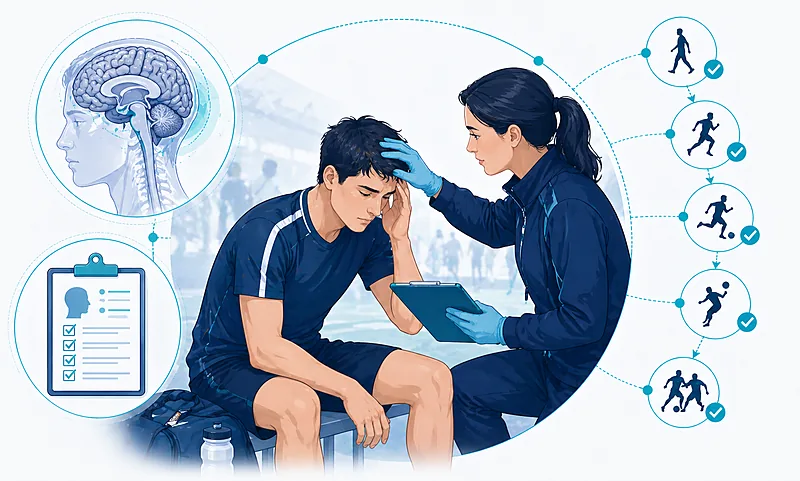
- 1Remove any athlete with suspected concussion immediately — “if in doubt, sit them out” remains the foundational rule of concussion management → Sideline
- 2Use SCAT6 for acute sideline and clinic assessment in athletes aged 13 and older; use Child SCAT6 for ages 5–12 → Assessment
- 3Reserve CT imaging for patients with red flags — focal deficit, repeated vomiting, worsening headache, seizure, declining consciousness → Red Flags
- 4Limit strict rest to the first 24–48 hours; extended cocoon rest no longer has an evidence base and may prolong recovery → Early Recovery
- 5Introduce sub-threshold aerobic exercise within 48 hours in most patients — it shortens recovery and reduces persisting symptoms → Early Recovery
- 6Follow the six-stage return-to-play progression with a minimum of 24 hours at each stage — do not skip steps → Return to Play
- 7Integrate return-to-learn with return-to-play — students should be back in school (with accommodations) before returning to contact sport → Return to Learn
- 8Refer to a specialist if symptoms persist beyond 4 weeks in adults (2 weeks in children/adolescents) — targeted rehabilitation outperforms waiting → Persistent Symptoms
- 9Screen for mood symptoms at every follow-up — anxiety and depression are common and under-recognised components of concussion management → Monitoring
Recognising Concussion: The Sideline Decision
Early concussion management starts with recognition, and recognition is often the hardest part. Only about one in ten concussions involves loss of consciousness, and athletes frequently minimise symptoms to stay on the field. A low threshold to suspect injury after any blow to the head, face, neck, or body with transmitted force to the head is the single most important habit to cultivate.
Observable Signs That Should Trigger Removal
Several observable signs warrant immediate, non-negotiable removal from play. These include any loss of consciousness, tonic posturing, convulsive movements, impact seizure, balance difficulty or motor incoordination, dazed or blank expression, disorientation, visible facial injury with plausible head impact, and the athlete lying motionless on the playing surface.
Remove any athlete with suspected concussion from play immediately, regardless of the score, minutes remaining, or the athlete’s protest. Same-day return to contact activity is never appropriate in concussion management after a confirmed or suspected injury.
Strong Rec High Evidence CISG 2022 AMSSM 2019Perform a sideline assessment using the Concussion Recognition Tool 6 (CRT6) when a trained clinician is not immediately available, or SCAT6 when performed by a healthcare professional. Both tools are free, validated, and designed for first-contact use.
Strong Rec Moderate Evidence CISG 2022Arrange medical review within 24–48 hours for every athlete removed with suspected concussion. Symptoms often evolve over the first day, and a normal sideline exam does not rule out the injury.
Strong Rec Moderate Evidence CISG 2022Provide the athlete and a responsible adult with clear written safety-net advice covering red-flag symptoms that should prompt urgent reassessment, and the plan for follow-up.
Strong Rec Low Evidence CDC HEADS UPAssessment Tools in Concussion Management
Structured assessment tools are central to modern concussion management because clinical gestalt alone has poor sensitivity in the acute phase. The SCAT6 suite, updated in 2023, is the most widely validated toolset for athletes aged 13 and older. Child SCAT6 covers ages 5–12, and the companion SCOAT6 (Sport Concussion Office Assessment Tool) is designed for subacute and follow-up visits.
Use SCAT6 as the standard acute assessment tool in athletes aged 13 and older. It should be administered within the first 72 hours for maximum diagnostic value. After 72 hours, transition to SCOAT6 for office-based follow-up.
Strong Rec Moderate Evidence CISG 2022Include a vestibular-ocular assessment at the first clinic visit. VOMS findings identify patients at higher risk of prolonged recovery and direct targeted rehabilitation earlier in concussion management.
Moderate Rec Moderate Evidence CISG 2022Track symptom burden at each visit using the Post-Concussion Symptom Scale (PCSS) embedded in SCAT6/SCOAT6. Changes across visits are clinically more useful than any single score in isolation.
Strong Rec Moderate Evidence CISG 2022Do not rely on computerised neuropsychological testing alone to clear an athlete for return to play. It complements — but does not replace — clinical assessment, symptom resolution, and stepwise exertion progression.
Against Moderate Evidence CISG 2022Which Tool, When, and for Whom
| Tool | Age Group | Best Use Window | Who Administers | Practical Tip |
|---|---|---|---|---|
| CRT6 | All ages | Pitchside, first minutes | Coach, teammate, first responder | Print and keep in the first-aid kit — designed for non-clinicians |
| SCAT6 | 13 years and older | 0–72 hours post-injury | Healthcare professional | Requires 15–20 min — allocate a quiet room |
| Child SCAT6 | 5–12 years | 0–72 hours post-injury | Healthcare professional | Include parent-reported symptom scale |
| SCOAT6 | 13 years and older | Day 3 onwards | Clinician in office setting | Includes VOMS and cervical screens |
| PCSS | All ages | Every visit during recovery | Patient self-report | 22 items; track the trend, not just the total |
Red Flags and When to Image
Most concussions do not require neuroimaging. CT is indicated only to rule out structural injury — skull fracture, intracranial haemorrhage, contusion — not to diagnose concussion itself. Routine imaging in uncomplicated concussion management is low-yield, exposes patients to unnecessary radiation, and is not recommended.
Order an urgent non-contrast CT head in any patient with red-flag features. Use a validated decision rule (Canadian CT Head Rule in adults, PECARN in children) to guide imaging decisions in borderline cases.
Strong Rec High Evidence CISG 2022 PECARNDo not order routine MRI, CT, or blood biomarkers in uncomplicated concussion. They do not diagnose concussion, do not change acute concussion management, and do not predict recovery.
Against Moderate Evidence CISG 2022Red Flags That Mandate Imaging or Transfer
- Glasgow Coma Scale < 15 at any point, or declining level of consciousness
- Focal neurological deficit (motor, sensory, language, cranial nerve)
- Seizure at any point after injury (other than immediate impact seizure)
- Repeated vomiting (≥ 2 episodes)
- Severe or worsening headache, particularly with neck stiffness
- Suspected skull fracture: palpable step, haemotympanum, Battle’s or raccoon sign, CSF leak
- Amnesia for events more than 30 minutes before impact
- High-risk mechanism: ejection from vehicle, fall from height > 1 m, assault with object
- Age ≥ 65 with loss of consciousness or amnesia
- Anticoagulant or antiplatelet therapy (beyond low-dose aspirin)
Early Active Recovery: Rest, Then Move
The biggest paradigm shift in recent concussion management is the retirement of prolonged cocoon rest. Evidence now supports a brief initial rest period — no more than 24–48 hours — followed by early introduction of light, sub-threshold physical and cognitive activity. The landmark Leddy trial showed that adolescent athletes randomised to early sub-threshold aerobic exercise recovered roughly 5–6 days faster than those prescribed standard rest.
Advise relative (not strict) rest for the first 24–48 hours: avoid high-risk environments, limit cognitively demanding screen time, prioritise sleep. Everyday activities such as walking and light household tasks are encouraged from day one if tolerated.
Strong Rec High Evidence CISG 2022Start sub-threshold aerobic exercise within 48 hours for most patients in concussion management — 15–20 minutes of light activity (walking, stationary cycling) at an intensity that does not worsen symptoms beyond a mild, tolerable increase.
Strong Rec High Evidence CISG 2022 Leddy 2019Teach the “mild symptom increase” rule: activity is acceptable if it causes no more than a 2-point rise on a 0–10 symptom scale, and symptoms settle within an hour of stopping. Anything beyond this threshold means scale back.
Moderate Rec Moderate Evidence CISG 2022Counsel patients that sleep is therapeutic. Prioritise good sleep hygiene, avoid alcohol during recovery, and address caffeine intake. Sleep disturbance is a major driver of prolonged symptoms.
Strong Rec Moderate Evidence CISG 2022Avoid routine prescription of medications in the acute phase. Short courses of paracetamol or simple analgesia for headache are acceptable. Routine NSAIDs are often cautioned against in the first 24–48 hours because of the small intracranial bleed risk, though recent evidence is reassuring.
Conditional Rec Low Evidence CISG 2022Return-to-Learn and Return-to-Play Progressions
The concussion management pathway culminates in a structured, stepwise return to cognitive and physical activity. Each stage requires at least 24 hours of tolerance before progression. Return to learn typically precedes full return to play, particularly in student athletes — the brain must tolerate classroom demands before it handles contact.
The Six-Stage Return-to-Play Progression
| Stage | What It Looks Like | Objective | Common Pitfall |
|---|---|---|---|
| 1. Symptom-limited activity | Daily living tasks that don’t worsen symptoms | Gradual reintroduction of normal routine | Mistaking complete rest for this stage |
| 2. Light aerobic exercise | Walking, stationary cycling; < 70% max heart rate | Increase heart rate safely | Going too hard, triggering symptoms |
| 3. Sport-specific exercise | Running drills; no head impact | Add movement complexity | Jumping to ball-handling drills too soon |
| 4. Non-contact training | Passing drills, progressive resistance | Test coordination, cognitive load | Allowing incidental contact |
| 5. Full contact practice | Normal training, requires medical clearance | Restore confidence and skills | Skipping clearance step |
| 6. Return to sport | Normal competition | Full return to play | No plan for re-injury surveillance |
Coordinate return to learn with the school, providing a written letter outlining academic accommodations (shortened day, reduced screen time, extra breaks, extended test time). Students should be tolerating a full school day before full contact sport resumes.
Strong Rec Moderate Evidence CISG 2022Require documented medical clearance before stage 5 (full contact practice). Typical minimum time from injury to return to sport is 11–14 days in adults and longer in adolescents.
Strong Rec Moderate Evidence CISG 2022 AMSSM 2019Drop back one stage if symptoms recur during progression; wait 24 hours symptom-free before re-attempting. Repeated setbacks at the same stage warrant reassessment for persistent symptoms or specialist referral.
Strong Rec Moderate Evidence CISG 2022Refer for multidisciplinary rehabilitation when symptoms persist beyond 4 weeks in adults or 2 weeks in children and adolescents. Targeted vestibular, cervical, or exercise-based therapy outperforms continued watchful waiting.
Strong Rec Moderate Evidence CISG 2022Clinical Decision Pathway
A practical, question-based walk-through of acute concussion management from the sideline to office follow-up. Work through the questions in order.
Monitoring and Follow-Up
Structured follow-up is an underappreciated driver of outcomes in concussion management. A brief review at 24–48 hours, 1 week, and again before the athlete progresses to contact is more useful than a single “clearance” visit. Focus on three domains: symptom burden, cognitive and vestibular-ocular performance, and mood.
| Parameter | When to Check | What to Look For | Common Pitfalls |
|---|---|---|---|
| Symptom burden (PCSS) | Every visit | Trend in total score and individual symptoms | Fixating on single scores instead of the trajectory |
| Cognitive screen | First clinic visit, and before clearance | Orientation, concentration, delayed recall | Accepting the athlete’s self-report of being “fine” |
| VOMS / balance | First clinic visit | Symptom provocation with smooth pursuit, saccades, VOR, convergence | Skipping in non-sports patients where VOMS is equally useful |
| Mood symptoms | Every visit | Anxiety, low mood, irritability, sleep disruption | Treating the concussion without addressing the psychological load |
| Academic or occupational tolerance | Before stage 4–5 progression | Can handle a full school or work day without symptom flare | Clearing for sport before full academic tolerance |
Evidence in Context
What the current evidence supports, where the major consensus statements align, and where clinically relevant gaps remain.
Where CISG 2022 and AMSSM 2019 Align
Both sources agree on core principles: immediate removal from play, no same-day return after suspected concussion, imaging only for red flags, brief initial rest followed by early aerobic activity, stepwise return-to-play progression with at least 24 hours per stage, and the importance of return-to-learn in student athletes. Both also endorse multidisciplinary care for persistent symptoms.
The Biggest Shift: Rest to Active Recovery
The Leddy 2019 randomised trial in adolescents with sport-related concussion demonstrated that individualised sub-threshold aerobic exercise, started within 10 days of injury, shortened median recovery from roughly 17 to 13 days compared with stretching alone. Subsequent trials and pooled analyses have reinforced this finding and pushed the recommended start window earlier — the CISG 2022 statement now endorses starting within 24–48 hours for most patients. This represents the single biggest practice change in concussion management of the last decade.
What About Children and Adolescents?
Paediatric concussion recovery is typically longer than adult recovery, with median symptom resolution of around 2–4 weeks. The threshold for specialist referral is correspondingly lower — 2 weeks rather than 4. Return-to-learn commonly precedes and paces return-to-play. Imaging thresholds also differ: the PECARN rule should be used rather than adult decision rules.
Blood Biomarkers and Advanced Imaging
Serum GFAP and UCH-L1 have regulatory approval for ruling out intracranial injury in adults who meet criteria for CT imaging after mild TBI, but their role in uncomplicated sport-related concussion remains undefined. Advanced MRI techniques (DTI, fMRI, MR spectroscopy) are research tools; they do not currently inform day-to-day concussion management.
What We Still Don’t Know
Long-term neurodegenerative risk from repeated concussion and sub-concussive impacts remains incompletely characterised. Optimal retirement criteria for athletes with multiple concussions are not standardised. Pharmacological interventions for acute concussion have disappointing evidence so far, and no drug is endorsed for routine use. Biomarker-guided return-to-play decisions remain aspirational.
References
- 1.Patricios JS, Schneider KJ, Dvorak J, et al. Consensus statement on concussion in sport: the 6th International Conference on Concussion in Sport–Amsterdam, October 2022. Br J Sports Med. 2023;57(11):695–711. doi:10.1136/bjsports-2023-106898
- 2.Echemendia RJ, Brett BL, Broglio S, et al. Sport Concussion Assessment Tool – 6 (SCAT6). Br J Sports Med. 2023;57(11):622–631. doi:10.1136/bjsports-2023-106849
- 3.Leddy JJ, Haider MN, Ellis MJ, et al. Early Subthreshold Aerobic Exercise for Sport-Related Concussion: A Randomized Clinical Trial. JAMA Pediatr. 2019;173(4):319–325. doi:10.1001/jamapediatrics.2018.4397
- 4.Harmon KG, Clugston JR, Dec K, et al. American Medical Society for Sports Medicine position statement on concussion in sport. Br J Sports Med. 2019;53(4):213–225. doi:10.1136/bjsports-2018-100338
- 5.Stiell IG, Wells GA, Vandemheen K, et al. The Canadian CT Head Rule for patients with minor head injury. Lancet. 2001;357(9266):1391–1396. doi:10.1016/S0140-6736(00)04561-X
- 6.Kuppermann N, Holmes JF, Dayan PS, et al. Identification of children at very low risk of clinically-important brain injuries after head trauma: a prospective cohort study. Lancet. 2009;374(9696):1160–1170. doi:10.1016/S0140-6736(09)61558-0
How to Read the Evidence Tags
Every recommendation in this article carries two tags — one for recommendation strength and one for evidence quality — using Medaptly’s own simplified interpretations.
Recommendation Strength
| Tag | What It Means |
|---|---|
| Strong Rec | High-quality evidence broadly supports this action. |
| Moderate Rec | The weight of evidence favours this action. |
| Conditional Rec | The benefit is less certain — individualise based on patient factors. |
| Against | Evidence shows no benefit or potential harm. |
Evidence Quality
| Tag | What It Means |
|---|---|
| High Evidence | Multiple well-designed RCTs or high-quality meta-analyses. |
| Moderate Evidence | Single RCT or large observational studies. |
| Low Evidence | Expert consensus or small studies. |