
Trigeminal Neuralgia Treatment: 7 Essential Clinical Rules
Clinical Practice Update — Diagnosis, First-Line Medical Therapy, and Surgical Options
This is an original clinical education article informed by current guidelines and evidence. See References below for source documents.
- Clinical Focus
- Evidence-based trigeminal neuralgia treatment across medical and surgical pathways
- Target Audience
- Primary care physicians, neurologists, pain specialists, neurosurgeons, residents
- Setting
- Primary care, neurology outpatient, pain clinic, neurosurgical referral
- Source Evidence
- •European Academy of Neurology Guideline on Trigeminal Neuralgia (2019)
- •AAN/EFNS Practice Parameter on Trigeminal Neuralgia Management
- •ICHD-3 Classification Criteria (International Headache Society)
- •Cruccu et al. New Classification and Diagnostic Grading (Neurology, 2016)
- •Di Stefano et al. Real-World Carbamazepine and Oxcarbazepine Data (Eur J Pain, 2021)
Key Clinical Takeaways
Effective trigeminal neuralgia treatment begins with a precise diagnosis and follows a clear sequence: confirm classical features, rule out secondary causes on MRI, start sodium channel blockade, and escalate to surgical options only when medical therapy fails or becomes intolerable. The points below distil current evidence into rules you can apply at the bedside.
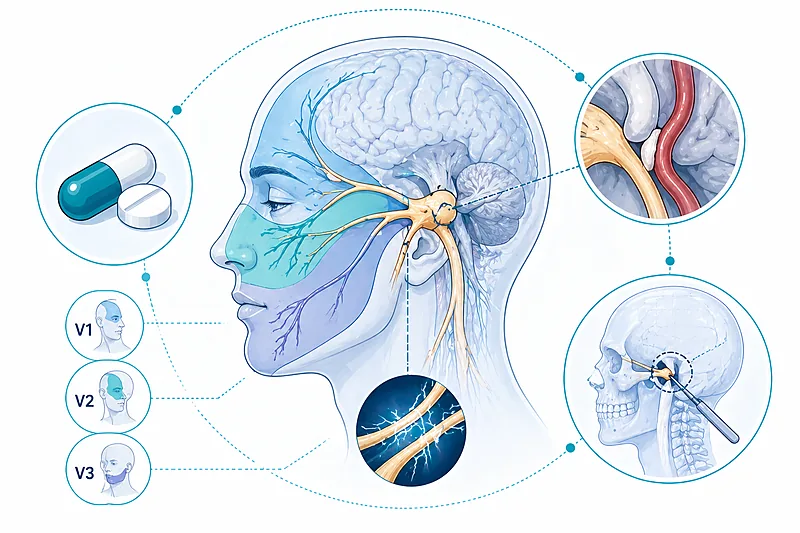
- 1Diagnose trigeminal neuralgia using ICHD-3 criteria — brief, shock-like pain in one or more trigeminal divisions, triggered by innocuous stimuli → Confirming Diagnosis
- 2Order an MRI of the brain with trigeminal-specific sequences in every patient to exclude secondary causes → Confirming Diagnosis
- 3Start carbamazepine or oxcarbazepine as first-line medical trigeminal neuralgia treatment — both have the strongest evidence → First-Line Therapy
- 4Titrate slowly from a low starting dose and check baseline sodium, liver enzymes, and full blood count → First-Line Therapy
- 5Consider lamotrigine, baclofen, gabapentin, or botulinum toxin A as add-on or alternative options when first-line is inadequate → Add-On Therapy
- 6Refer early for surgical evaluation when pain remains uncontrolled or medication is poorly tolerated — do not wait years → Surgical Options
- 7Microvascular decompression offers the highest rate of long-term pain freedom in fit patients with classical neurovascular conflict → Surgical Options
- 8Percutaneous procedures and gamma knife radiosurgery are valid options for patients unfit for open surgery or who prefer less invasive treatment → Surgical Options
- 9Screen every patient for depression, anxiety, and suicidal ideation — the psychological burden of this condition is often underestimated → Monitoring
Confirming the Diagnosis Before Starting Trigeminal Neuralgia Treatment
A precise diagnosis drives every downstream decision in trigeminal neuralgia treatment. Misdiagnosis — most commonly as dental pain, atypical facial pain, or cluster-type headache — delays effective therapy and exposes patients to unnecessary procedures. The goal of the initial workup is to confirm classical features, exclude secondary causes, and classify the subtype.
Diagnostic Features to Confirm
Hallmark features are brief (seconds to two minutes) shock-like or electric pain, unilateral and confined to one or more divisions of the trigeminal nerve, reliably triggered by light touch, chewing, speaking, brushing teeth, or a cold breeze. Pain-free intervals between attacks are typical in the early course but may shorten over time. A persistent background ache between paroxysms defines the Type 2 or concomitant-continuous-pain subtype.
Apply ICHD-3 criteria to every suspected case. Pain must be paroxysmal, unilateral, limited to trigeminal distribution, severe in intensity, and provoked by innocuous stimuli. These features distinguish trigeminal neuralgia from painful trigeminal neuropathies and persistent idiopathic facial pain.
Strong Rec High Evidence ICHD-3 2018 EAN 2019Perform a focused cranial nerve examination. Subtle sensory loss, weak masseter or temporalis, or an absent corneal reflex points to a structural lesion and warrants prompt imaging.
Strong Rec Moderate Evidence EAN 2019Order an MRI of the brain with thin-slice trigeminal-specific sequences (high-resolution T2, 3D TOF-MRA, constructive interference in steady state) for every patient at diagnosis to identify neurovascular conflict, multiple sclerosis plaques, tumours, or other secondary causes.
Strong Rec High Evidence EAN 2019 AAN/EFNSClassify the case as classical (vascular contact with morphological changes), secondary (attributable to MS, tumour, or other lesion), or idiopathic (no structural cause identified). This classification directs both prognostic counselling and surgical suitability.
Moderate Rec Moderate Evidence Cruccu 2016Differential Diagnoses Not to Miss
| Condition | Distinguishing Feature | Tip for the Bedside |
|---|---|---|
| Dental pain | Continuous ache, localised to tooth, responds to dental block | Rule out before first dental extraction — many patients arrive after multiple extractions |
| Cluster headache | Longer attacks (15–180 min), autonomic features (tearing, rhinorrhoea) | Ask about restlessness during attacks — characteristic of cluster, not trigeminal neuralgia |
| Painful trigeminal neuropathy | Continuous burning, sensory deficit, follows trauma or herpes zoster | Responds less well to sodium channel blockers — tricyclics and gabapentinoids are preferred |
| Temporomandibular disorder | Pain with jaw movement, tenderness on palpation, clicking | Palpate masseter and TMJ — local tenderness is absent in trigeminal neuralgia |
| Persistent idiopathic facial pain | Poorly localised, dull, constant, no trigger zones | No paroxysms, no shock-like quality — a different entity requiring different management |
First-Line Medical Trigeminal Neuralgia Treatment
Sodium channel blockade remains the cornerstone of medical trigeminal neuralgia treatment. Carbamazepine has the longest and most robust evidence base, with response rates of roughly three-quarters of patients at adequate doses. Oxcarbazepine shows similar efficacy with a more favourable side-effect and interaction profile, which explains why many clinicians now reach for it first.
Prescribe carbamazepine starting at 100–200 mg once or twice daily, titrated every 3–7 days in 100–200 mg increments as tolerated. Most patients achieve pain control at 600–1200 mg daily in divided doses. The modified-release formulation improves tolerability.
Strong Rec High Evidence EAN 2019 AAN/EFNSPrescribe oxcarbazepine starting at 150–300 mg twice daily, titrated to 600–1800 mg daily as tolerated. Oxcarbazepine is often preferred for trigeminal neuralgia treatment in older patients or those on multiple medications because it has fewer drug interactions than carbamazepine.
Strong Rec Moderate Evidence EAN 2019Check baseline sodium, liver function, renal function, and full blood count before starting. Repeat sodium at 2–4 weeks, then every 3–6 months — hyponatraemia is common at higher doses and often asymptomatic until severe.
Strong Rec Moderate Evidence EAN 2019Screen patients of Han Chinese, Thai, or other Southeast Asian ancestry for HLA-B*15:02 before starting carbamazepine or oxcarbazepine — carriers are at markedly increased risk of Stevens–Johnson syndrome and toxic epidermal necrolysis.
Strong Rec High Evidence FDACounsel patients on the pattern of response. The goal of medical trigeminal neuralgia treatment is substantial pain reduction with tolerable side effects, not pharmacological cure — most patients will eventually need dose adjustment, add-on therapy, or surgical referral.
Strong Rec Low Evidence EAN 2019First-Line Agents: A Drug-by-Drug Guide
| Drug | Starting Dose | Target Range | Key Monitoring | Practical Tips |
|---|---|---|---|---|
| Carbamazepine | 100–200 mg BD | 600–1200 mg/day | Sodium, LFTs, FBC, drug levels | Use modified-release form; many interactions via CYP3A4 |
| Oxcarbazepine | 150–300 mg BD | 600–1800 mg/day | Sodium, renal function | Fewer interactions than carbamazepine; higher hyponatraemia risk |
| Eslicarbazepine | 400 mg daily | 800–1600 mg daily | Sodium, renal function | Once-daily dosing; limited but growing evidence |
Add-On and Alternative Medications
When first-line therapy is partially effective or poorly tolerated, several agents have supportive evidence either as add-ons or as monotherapy alternatives. None matches the pain relief achieved by full-dose sodium channel blockade, but combinations can allow dose reduction of the primary agent and improve tolerability.
Consider lamotrigine (titrated slowly to 200–400 mg/day) as add-on therapy in patients with partial response to carbamazepine or oxcarbazepine. Slow titration over 6–8 weeks is essential to reduce the risk of serious rash.
Moderate Rec Moderate Evidence EAN 2019Consider the gabapentinoids — gabapentin (900–3600 mg/day) or pregabalin (150–600 mg/day) — either as add-on or monotherapy alternative, particularly when sodium channel blockers are contraindicated.
Conditional Rec Low Evidence EAN 2019Consider baclofen (titrated to 40–80 mg/day in divided doses) as add-on therapy, particularly in trigeminal neuralgia treatment for patients with multiple sclerosis, where small trials suggest benefit.
Conditional Rec Low Evidence EAN 2019Consider botulinum toxin type A injection into painful facial trigger zones as an add-on option. Randomised data support reduction in paroxysm frequency, with effect typically lasting 10–12 weeks.
Moderate Rec Moderate Evidence EAN 2019Admit and consider intravenous fosphenytoin or lidocaine infusion for acute severe exacerbation — sometimes called “trigeminal neuralgia crisis” — when oral therapy cannot be continued because of pain-triggered inability to eat or swallow.
Moderate Rec Low Evidence EAN 2019Do not use opioids as maintenance therapy. They are ineffective against the paroxysmal pain of trigeminal neuralgia and expose patients to dependence and side-effect risks that outweigh any short-term benefit.
Against Moderate Evidence EAN 2019Surgical Options in Trigeminal Neuralgia Treatment
Surgical trigeminal neuralgia treatment is not a last resort reserved for desperate cases. The majority of patients eventually require a procedure, and delay is associated with poorer long-term outcomes. Early referral to a neurosurgical service — even for a discussion, not necessarily a commitment — should be considered as soon as monotherapy fails or becomes intolerable.
Refer to neurosurgery for consideration of microvascular decompression in patients with classical trigeminal neuralgia, imaging evidence of neurovascular conflict, and acceptable operative risk. MVD delivers the highest rate of initial pain freedom and the best durability of response.
Strong Rec High Evidence EAN 2019 AAN/EFNSOffer percutaneous procedures — balloon compression, radiofrequency thermocoagulation, or glycerol rhizotomy — to patients unfit for open surgery, those who decline MVD, or those with secondary trigeminal neuralgia from MS. These procedures are repeatable and can be performed under sedation.
Strong Rec Moderate Evidence EAN 2019 AAN/EFNSOffer gamma knife stereotactic radiosurgery to patients who decline invasive procedures, have bleeding-risk or anaesthesia contraindications, or prefer an outpatient option. Pain relief is often delayed by 4–8 weeks after treatment.
Moderate Rec Moderate Evidence EAN 2019Counsel patients explicitly on trade-offs before surgical trigeminal neuralgia treatment. MVD offers the highest chance of pain-free outcome without sensory loss, but carries a small risk of serious complications. Ablative procedures are safer short-term but typically leave some facial numbness and have a higher long-term recurrence rate.
Strong Rec Moderate Evidence EAN 2019Comparing Surgical Options at a Glance
| Procedure | Best Candidate | Initial Pain Freedom | Main Trade-Offs |
|---|---|---|---|
| Microvascular decompression | Classical TN, fit for craniotomy, clear vascular conflict | ~90%; best long-term durability | Posterior fossa craniotomy; rare but serious complications |
| Balloon compression | Elderly, frail, or MS-related TN | ~80% initial; higher recurrence | Facial numbness; repeat procedures often needed |
| Radiofrequency thermocoagulation | Single-division pain, targeted lesioning needed | ~80% initial | Dysesthesia; rare corneal anaesthesia if V1 targeted |
| Glycerol rhizotomy | Older patients, less invasive preference | ~70% initial; early recurrence common | Less predictable sensory loss |
| Gamma knife radiosurgery | Anaesthesia risk, anticoagulation, patient preference | ~75% at 1 year; delayed onset | Weeks to pain relief; dysesthesia in a minority |
Clinical Decision Pathway
A question-based approach to working through trigeminal neuralgia treatment at the bedside. Move through the questions in sequence; each answer directs the next step.
Monitoring and Follow-Up
Follow-up protocols in trigeminal neuralgia treatment focus on three domains: pain control, drug safety, and psychosocial impact. The last is often neglected despite being the strongest predictor of patient-reported outcomes.
| Parameter | When to Check | What to Look For | Common Pitfalls |
|---|---|---|---|
| Pain diary | Every visit | Frequency, severity, trigger avoidance, functional impact | Relying on recall alone — pain is often underreported in clinic |
| Serum sodium | 2–4 weeks after start or dose change, then every 3–6 months | Hyponatraemia, especially in older patients | Attributing confusion or falls to “drug sedation” without checking sodium |
| FBC and LFTs | Baseline; at 2–4 weeks; then at 6 months and annually | Leukopenia, thrombocytopenia, hepatocellular enzyme rise | Mild transaminase rise is common and rarely requires stopping |
| Mood and suicidal ideation | Every visit | Depression, anxiety, suicidal thoughts — the burden is substantial | Underestimating psychological impact in a “pain-only” clinic model |
| Drug level (carbamazepine) | When toxicity or adherence is in question | Trough levels; interpret alongside clinical picture | Routine monitoring without clinical question rarely changes management |
Evidence in Context
What the current evidence supports, where the major guidelines align, and where clinically relevant gaps remain.
Where the EAN, AAN/EFNS, and ICHD Align
All major sources converge on core principles: the diagnosis rests on clinical pattern rather than imaging alone, carbamazepine and oxcarbazepine are first-line medical options, MRI is indicated in every new case to exclude secondary causes, and surgical options should be discussed early rather than reserved for treatment failure. The simplified classification into classical, secondary, and idiopathic subtypes is also broadly adopted.
Where the Guidelines Differ
First-line choice: The EAN 2019 guideline gives essentially equal weight to carbamazepine and oxcarbazepine and lets clinician preference and comorbidity drive the pick. Older AAN/EFNS guidance placed carbamazepine first purely on historical evidence volume. In day-to-day trigeminal neuralgia treatment, oxcarbazepine’s more favourable interaction profile has shifted real-world prescribing towards it.
Timing of surgical referral: The EAN explicitly endorses earlier surgical discussion; some national guidelines remain more conservative, reserving referral for documented medical failure.
What Recent Real-World Data Show
The Di Stefano 2021 cohort of 354 patients on first-line carbamazepine or oxcarbazepine found roughly 90% initial response, but around a third eventually discontinued because of adverse effects over long-term follow-up. Hyponatraemia and cognitive slowing were the most common reasons. This reinforces the case for early surgical counselling rather than indefinite medical escalation.
Microvascular Decompression Outcomes
Pooled long-term data from high-volume centres show initial pain freedom in roughly 90% of classical trigeminal neuralgia cases, with around 70–80% remaining pain-free at 5–10 years. Serious complications (cerebrospinal fluid leak, hearing loss, stroke) are uncommon in experienced hands but are not zero; careful case selection and volume-dependent outcomes matter.
What We Still Don’t Know
Head-to-head comparisons of surgical procedures remain sparse, and most data come from single-centre series with selection bias. The optimal sequencing of add-on medical therapy is also underexplored. Biomarkers to predict MVD response in borderline imaging cases are an active area of research, and the role of newer sodium channel blockers such as vixotrigine remains uncertain pending larger trials.
References
- 1.Bendtsen L, Zakrzewska JM, Abbott J, et al. European Academy of Neurology guideline on trigeminal neuralgia. Eur J Neurol. 2019;26(6):831–849. doi:10.1111/ene.13950
- 2.Cruccu G, Finnerup NB, Jensen TS, et al. Trigeminal neuralgia: New classification and diagnostic grading for practice and research. Neurology. 2016;87(2):220–228. doi:10.1212/WNL.0000000000002840
- 3.Headache Classification Committee of the International Headache Society (IHS). The International Classification of Headache Disorders, 3rd edition. Cephalalgia. 2018;38(1):1–211. doi:10.1177/0333102417738202
- 4.Di Stefano G, La Cesa S, Truini A, Cruccu G. Natural history and outcome of 200 outpatients with classical trigeminal neuralgia treated with carbamazepine or oxcarbazepine in a tertiary centre. J Headache Pain. 2014;15(1):34. doi:10.1186/1129-2377-15-34
- 5.Zakrzewska JM, Linskey ME. Trigeminal neuralgia. BMJ. 2014;348:g474. doi:10.1136/bmj.g474
- 6.Cruccu G, Gronseth G, Alksne J, et al. AAN-EFNS guidelines on trigeminal neuralgia management. Eur J Neurol. 2008;15(10):1013–1028. doi:10.1111/j.1468-1331.2008.02185.x
How to Read the Evidence Tags
Every recommendation in this article carries two tags — one for recommendation strength and one for evidence quality — using Medaptly’s own simplified interpretations.
Recommendation Strength
| Tag | What It Means |
|---|---|
| Strong Rec | High-quality evidence broadly supports this action. |
| Moderate Rec | The weight of evidence favours this action. |
| Conditional Rec | The benefit is less certain — individualise based on patient factors. |
| Against | Evidence shows no benefit or potential harm. |
Evidence Quality
| Tag | What It Means |
|---|---|
| High Evidence | Multiple well-designed RCTs or high-quality meta-analyses. |
| Moderate Evidence | Single RCT or large observational studies. |
| Low Evidence | Expert consensus or small studies. |