
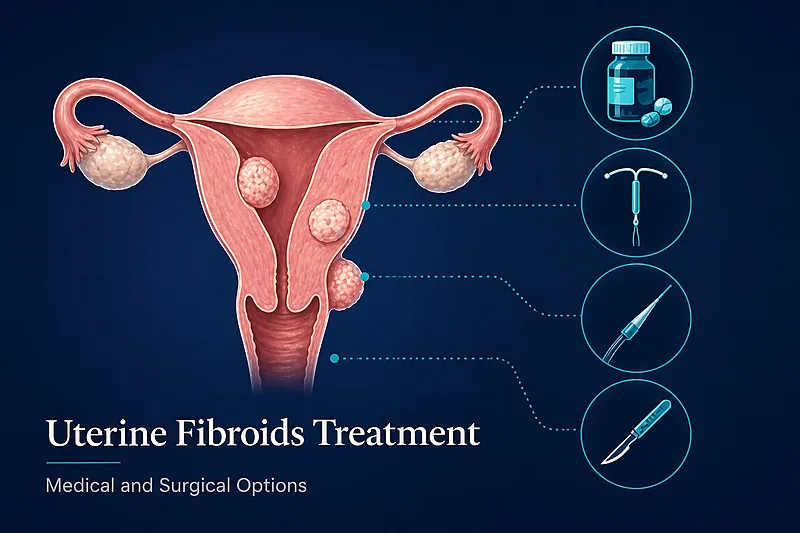
Uterine Fibroids Treatment: Medical and Surgical Options
Clinical Practice Update — Symptom-and-Size Triage, Medical Therapy, and Procedural Decisions for Symptomatic Fibroids
This is an original clinical education article informed by current guidelines and evidence. See References below for source documents.
- Clinical Focus
- Evidence-based uterine fibroids treatment in reproductive-age and perimenopausal women
- Target Audience
- OB-GYNs, primary care physicians, family medicine, trainees, interventional radiologists
- Setting
- Primary care, gynecology clinics, interventional radiology, operating theatre
- Source Evidence
- •ACOG Practice Bulletin 228 — Management of Symptomatic Uterine Leiomyomas (2021)
- •NICE Guideline NG88 — Heavy Menstrual Bleeding: Assessment and Management (2021 update)
- •LIBERTY 1 and 2 Trials — Relugolix Combination Therapy for Fibroid Symptoms (NEJM, 2021)
- •FIGO Leiomyoma Subclassification (PALM-COEIN, 2011)
- •Cochrane Review — Uterine Artery Embolization for Symptomatic Fibroids (2014)
Key Clinical Takeaways
Effective uterine fibroids treatment depends on three decisions made in sequence: confirm the diagnosis with imaging, classify the fibroid by FIGO location and size, and match the uterine fibroids treatment to the patient’s symptoms and reproductive goals. The rules below distil current evidence into actions you can apply in clinic.
- 1Confirm fibroids with pelvic ultrasound before any treatment — clinical examination alone misses submucosal disease → Triage
- 2Classify every fibroid by FIGO type (0–8) — location drives the choice of intervention more than size alone → Triage
- 3Offer tranexamic acid as the simplest first-line medical option for heavy bleeding without distortion of the cavity → Medical Options
- 4Consider the levonorgestrel intrauterine system when the uterine cavity is undistorted — it halves menstrual blood loss within 6 months → Medical Options
- 5Use GnRH antagonist combination therapy (relugolix-estradiol-norethisterone) for durable symptom control up to 24 months → Medical Options
- 6Perform hysteroscopic myomectomy for FIGO 0–2 submucosal fibroids — day-case, fertility-preserving, highly effective → Surgical Options
- 7Reserve hysterectomy for women who have completed childbearing and want a definitive cure → Surgical Options
- 8Offer uterine fibroid embolization (UFE) as a uterus-sparing alternative in women who prefer to avoid surgery → Surgical Options
- 9Prefer abdominal or laparoscopic myomectomy over UFE when fertility is a priority — UFE data on pregnancy remain limited → Fertility
- 10Avoid uncontained power morcellation in women with suspected malignancy — this is an FDA-flagged safety issue → Surgical Options
How to Triage by Symptoms and Fibroid Size
Triage is the single most important step before any uterine fibroids treatment because it determines whether medical therapy will be sufficient or whether procedural intervention is required. Two axes drive the decision: the dominant symptom (bleeding, bulk, pain, infertility) and the FIGO location of the lesion.
Perform transvaginal ultrasound as the first-line imaging investigation for any woman with suspected fibroids. It is sensitive, inexpensive, and widely available.
Strong Rec High Evidence ACOG 2021 NICE NG88Document each fibroid using the FIGO classification (types 0 through 8). This single step predicts which treatments are technically feasible.
Strong Rec Moderate Evidence FIGO 2011 ACOG 2021Consider saline-infusion sonohysterography or MRI when the cavity boundary is unclear or when planning myomectomy for large or multiple lesions.
Moderate Rec Moderate Evidence ACOG 2021Counsel patients that incidental, asymptomatic fibroids do not require any treatment — only surveillance at annual review.
Strong Rec Moderate Evidence ACOG 2021Check a full blood count in every woman presenting with heavy menstrual bleeding attributed to fibroids. Iron-deficiency anaemia is the most common and correctable complication.
Strong Rec High Evidence NICE NG88Matching Symptoms to the Likely Intervention
| Dominant Symptom | Helpful FIGO Types | First-Line Option | When to Escalate |
|---|---|---|---|
| Heavy bleeding only | Any (especially 0–2) | Tranexamic acid or LNG-IUS | Anaemia not correcting, failed 3 months medical |
| Bulk or pressure | 3–7 (intramural, subserosal) | GnRH antagonist combo or UFE | Hydronephrosis, obstructive symptoms |
| Subfertility | 0–2 and large intramural | Myomectomy (route depends on type) | Refer to reproductive medicine early |
| Acute pain | Pedunculated or degenerating | NSAIDs and hydration | Torsion suspected, persistent fever |
| Mixed symptoms | Multiple types | Individualise; often GnRH antagonist combo | Completed family and quality of life poor → hysterectomy |
Medical Options for Uterine Fibroids Treatment
Medical therapy is first-line in most women whose dominant symptom is bleeding, and is also useful as a bridge to surgery in women with large or anaemia-inducing fibroids. Options range from non-hormonal agents (tranexamic acid, NSAIDs) to progestin-containing devices and newer oral GnRH antagonist combinations.
Prescribe tranexamic acid 1 g orally four times daily on bleeding days as first-line non-hormonal uterine fibroids treatment for heavy menstrual bleeding. Simultaneously treat any iron deficiency anaemia.
Strong Rec High Evidence NICE NG88 ACOG 2021Offer the levonorgestrel intrauterine system (LNG-IUS 52 mg) to women whose uterine cavity is not distorted by submucosal fibroids. It reduces menstrual blood loss by over 70% in most users.
Strong Rec High Evidence NICE NG88 ACOG 2021Consider a combined oral contraceptive pill or cyclical progestogens when the LNG-IUS is declined or contraindicated. Evidence of efficacy specific to fibroid-related bleeding is weaker than for tranexamic acid or LNG-IUS.
Conditional Rec Low Evidence NICE NG88Initiate relugolix combination therapy (relugolix 40 mg, estradiol 1 mg, norethisterone acetate 0.5 mg, once daily) for women with moderate to severe fibroid-related heavy bleeding. Treatment can be continued for up to 24 months with bone density monitoring.
Strong Rec High Evidence LIBERTY 1 & 2 ACOG 2021Use a GnRH agonist (leuprorelin 3.75 mg IM monthly) short-term (up to 6 months) pre-operatively to shrink fibroids, correct anaemia, and facilitate a minimally invasive surgical route. Add-back therapy should be used if treatment extends beyond 3 months.
Moderate Rec Moderate Evidence ACOG 2021 NICE NG88Do not use ulipristal acetate for routine fibroid management because of concerns over idiosyncratic liver injury. Reserve its use for exceptional circumstances in line with current regulatory restrictions.
Against Moderate Evidence EMA 2020Medical Agents at a Glance: A Drug-by-Drug Guide
| Agent | Usual Dose | Best Suited For | Practical Tips and Caveats |
|---|---|---|---|
| Tranexamic acid | 1 g QDS on bleeding days (max 4 days) | Bleeding only, fertility preserved, no hormonal therapy wanted | Non-hormonal, cheap, safe. Avoid with active thromboembolic disease. |
| NSAIDs (mefenamic acid) | 500 mg TDS on bleeding days | Bleeding and dysmenorrhoea together | Take with food. Avoid with peptic ulcer disease. |
| LNG-IUS 52 mg | Single insertion, lasts 8 years | Undistorted cavity, long-acting preference | Expulsion rate higher when cavity is distorted. Counsel on irregular spotting for 3–6 months. |
| Combined oral contraceptive | Monophasic, cyclical or continuous | Young women needing contraception plus bleeding control | Avoid with migraine with aura, prior VTE, age > 35 and smoking. |
| Relugolix combo | 40 mg + E2 1 mg + NETA 0.5 mg PO daily | Moderate-severe bleeding, any cavity, up to 24 months | Oral, rapid onset. Monitor BMD yearly if used > 12 months. |
| Leuprorelin (GnRH agonist) | 3.75 mg IM monthly, max 6 months | Pre-operative shrinkage, anaemia correction | Add-back HRT after 3 months. Hot flushes and mood symptoms common. |
Surgical and Procedural Options in Uterine Fibroids Treatment
Procedural uterine fibroids treatment is indicated when medical therapy fails, is declined, or is unlikely to succeed (bulk symptoms, cavity-distorting disease affecting fertility). Choice of procedure depends on FIGO type, fibroid size and number, surgeon skill set, and — critically — the patient’s preference for uterine preservation.
Perform hysteroscopic myomectomy as first-line surgical treatment for FIGO type 0 and type 1 submucosal fibroids up to approximately 4–5 cm. It is uterus-preserving and typically day-case.
Strong Rec High Evidence ACOG 2021 AAGL 2012Offer laparoscopic or robotic myomectomy for intramural and subserosal fibroids in women who want to preserve their uterus, provided the surgeon has the relevant expertise and the fibroid burden is not prohibitive.
Strong Rec Moderate Evidence ACOG 2021Consider abdominal myomectomy for women with very large, multiple, or deep intramural fibroids where minimally invasive excision is not feasible and fertility preservation is a priority.
Moderate Rec Moderate Evidence ACOG 2021Offer uterine fibroid embolization (UFE) as a uterus-sparing alternative to surgery in women who want to avoid a procedure under general anaesthesia and are not actively trying to conceive.
Strong Rec High Evidence Cochrane 2014 ACOG 2021Do not use uncontained laparoscopic power morcellation in women with suspected malignancy or those who cannot be appropriately screened. When morcellation is needed, use a contained bag.
Against Moderate Evidence FDA 2020 ACOG 2021Offer hysterectomy as a definitive treatment option to women who have completed childbearing, have failed less invasive approaches, or explicitly prefer a one-off cure.
Strong Rec High Evidence ACOG 2021 NICE NG88Prefer vaginal or laparoscopic hysterectomy over abdominal hysterectomy whenever uterine size and fibroid anatomy permit. Minimally invasive routes halve hospital stay and speed recovery.
Strong Rec High Evidence Cochrane 2015Consider radiofrequency ablation (transcervical or laparoscopic) for selected symptomatic fibroids in women who want to preserve the uterus but are not suitable for myomectomy.
Conditional Rec Moderate Evidence ACOG 2021Procedure Comparison: UFE vs Myomectomy vs Hysterectomy
| Feature | UFE | Myomectomy | Hysterectomy |
|---|---|---|---|
| Uterus preserved | Yes | Yes | No |
| Fertility after | Possible, data limited | Best-preserved option | Not possible |
| Symptom recurrence risk | ~ 20–30% at 5 years | ~ 25% (new fibroids) | None |
| Average hospital stay | 1 day | 1–3 days (route-dependent) | 1–3 days (route-dependent) |
| Typical recovery | 1–2 weeks | 2–6 weeks (route-dependent) | 2–6 weeks (route-dependent) |
| Practical best fit | Symptomatic, uterus-sparing, family complete | Wants pregnancy, cavity-distorting disease | Completed family, wants definitive cure |
Clinical Decision Pathway
A practical, question-driven approach to uterine fibroids treatment decisions. Follow the questions in order to match the right intervention to the right patient.
Fertility-Preserving Options
When preserving or improving fertility is a goal, the chosen uterine fibroids treatment must balance symptom control against reproductive risk. Myomectomy is the best-studied fertility-preserving option; UFE data on subsequent pregnancy remain limited and largely observational. Careful counselling about risks and benefits should precede every uterine fibroids treatment decision in women planning pregnancy.
Offer hysteroscopic resection of FIGO type 0–2 submucosal fibroids to women with subfertility, recurrent pregnancy loss, or cavity distortion.
Strong Rec Moderate Evidence ACOG 2021Counsel women undergoing myomectomy that caesarean delivery will usually be recommended for any subsequent pregnancy if the uterine cavity was entered during surgery, to reduce the risk of uterine rupture.
Strong Rec Moderate Evidence ACOG 2021Avoid UFE as the preferred option in women who are actively trying to conceive. Myomectomy is associated with better-studied pregnancy outcomes, though both approaches carry reproductive considerations.
Moderate Rec Low Evidence ACOG 2021Consider short-course GnRH agonist pre-treatment before myomectomy when the patient is anaemic or the fibroid burden makes a minimally invasive route borderline. A 3-month course typically reduces fibroid volume by 30–40%.
Moderate Rec Moderate Evidence ACOG 2021Monitoring and Follow-Up After Uterine Fibroids Treatment
Follow-up after any uterine fibroids treatment has three jobs: confirm that bleeding and bulk symptoms have actually improved, correct any residual anaemia, and detect recurrence or treatment-related adverse effects early. The table below summarises what to check and when.
| Parameter | When to Check | What to Look For | Common Pitfalls |
|---|---|---|---|
| Haemoglobin and ferritin | 3 months after starting medical therapy, then 6-monthly | Correction of anaemia, replenishment of iron stores | Treating Hb alone without replacing iron stores leads to relapse. |
| Symptom score or PBAC | Baseline and at 3 months | Reduction in blood loss, improvement in quality of life | Relying on the patient’s vague impression rather than a measurable tool. |
| Bone mineral density | Yearly while on GnRH antagonist combo beyond 12 months | Loss of more than 3% from baseline | Forgetting to start vitamin D and calcium supplementation. |
| Pelvic ultrasound | 3 and 12 months post-procedure; yearly after UFE | Residual or recurrent fibroid, infarction on UFE | Imaging too early after UFE can misinterpret normal devascularisation. |
| Post-myomectomy counselling | At 6-week review | Wound healing, contraception, pregnancy timing | Failing to document whether the cavity was entered. |
Evidence in Context
Where the major guidelines and key trials on uterine fibroids treatment agree, where they differ, and what we still don’t know.
Where ACOG and NICE Agree
Both frameworks agree on the central role of FIGO classification, the value of tranexamic acid and the LNG-IUS as first-line medical options, and the principle that asymptomatic fibroids do not need any active uterine fibroids treatment. Both also endorse minimally invasive surgical routes wherever technically feasible.
Where ACOG and NICE Differ
Emphasis on UFE: ACOG endorses UFE as an established uterus-sparing option with robust mid-term data. NICE tends to position UFE as one of several options alongside myomectomy and hysterectomy, with emphasis on informed choice.
Relugolix combination therapy: ACOG has incorporated GnRH antagonist combination therapy into its menu for moderate to severe fibroid-related bleeding. NICE guidance on newer agents continues to evolve through its technology appraisal process.
LIBERTY Trials: Key Findings on Relugolix Combo
The two pivotal LIBERTY trials demonstrated that relugolix 40 mg combined with estradiol and norethisterone acetate reduced menstrual blood loss by 50% or more in roughly 70% of women, compared with 15% on placebo. Bone density was preserved at 24 weeks compared with relugolix monotherapy. The combination is now a mainstay oral medical option for moderate to severe fibroid bleeding.
UFE vs Surgery: The Long-Term Picture
Long-term follow-up of the EMMY and REST trials found that UFE produces comparable symptom relief to hysterectomy in the short term but is associated with a meaningful rate of re-intervention over 5–10 years (around 1 in 3). Women considering UFE should be counselled that symptom relief may be durable, but definitive cure is not guaranteed.
What We Still Don’t Know
High-quality pregnancy outcome data after UFE remain limited, and direct head-to-head RCTs against myomectomy in women seeking fertility are scarce. Long-term data on radiofrequency ablation and MRI-guided focused ultrasound, especially in women who subsequently conceive, are still maturing.
References
- 1.American College of Obstetricians and Gynecologists. ACOG Practice Bulletin No. 228: Management of Symptomatic Uterine Leiomyomas. Obstet Gynecol. 2021;137(6):e100–e115. doi:10.1097/AOG.0000000000004401
- 2.National Institute for Health and Care Excellence. Heavy menstrual bleeding: assessment and management. NICE Guideline NG88. London: NICE; 2018 (updated 2021). nice.org.uk/guidance/ng88
- 3.Al-Hendy A, Lukes AS, Poindexter AN, et al. Treatment of Uterine Fibroid Symptoms with Relugolix Combination Therapy. N Engl J Med. 2021;384(7):630–642. doi:10.1056/NEJMoa2008283
- 4.Munro MG, Critchley HOD, Broder MS, Fraser IS; FIGO Working Group on Menstrual Disorders. FIGO classification system (PALM-COEIN) for causes of abnormal uterine bleeding in non-gravid women of reproductive age. Int J Gynaecol Obstet. 2011;113(1):3–13. doi:10.1016/j.ijgo.2010.11.011
- 5.Gupta JK, Sinha A, Lumsden MA, Hickey M. Uterine artery embolization for symptomatic uterine fibroids. Cochrane Database Syst Rev. 2014;(12):CD005073. doi:10.1002/14651858.CD005073.pub4
How to Read the Evidence Tags
Every recommendation carries two tags for recommendation strength and evidence quality — Medaptly’s own simplified interpretations.
Recommendation Strength
| Tag | What It Means |
|---|---|
| Strong Rec | High-quality evidence broadly supports this action. |
| Moderate Rec | The weight of evidence favours this action. |
| Conditional Rec | The benefit is less certain — individualise. |
| Against | Evidence shows no benefit or potential harm. |
Evidence Quality
| Tag | What It Means |
|---|---|
| High Evidence | Multiple well-designed RCTs or high-quality meta-analyses. |
| Moderate Evidence | Single RCT or large observational studies. |
| Low Evidence | Expert consensus or small studies. |