
Peanut Allergy Prevention: 6 Proven LEAP Rules for Infants
Clinical Practice Update — Risk Stratification, Early Introduction, and the Role of Oral Immunotherapy in Established Disease
This is an original clinical education article informed by current guidelines and evidence. See References below for source documents.
- Clinical Focus
- Evidence-based peanut allergy prevention through early dietary introduction
- Target Audience
- Pediatricians, family physicians, pediatric allergists, nurse practitioners, dietitians
- Setting
- Primary care well-child visits, pediatric allergy clinics
- Source Evidence
- •LEAP Trial — Learning Early About Peanut Allergy (Du Toit et al., NEJM 2015)
- •LEAP-On Trial — Avoidance After Early Introduction (Du Toit et al., NEJM 2016)
- •NIAID Addendum Guidelines for the Prevention of Peanut Allergy (Togias et al., JACI 2017)
- •PALISADE Trial — AR101 (Palforzia) Oral Immunotherapy (NEJM 2018)
- •AAP/AAAAI Consensus Communication on Early Peanut Introduction
Key Clinical Takeaways
Peanut allergy prevention took a 180-degree turn after the LEAP trial. Decades of advising delay have been replaced by a firm recommendation to introduce peanut early — typically around 4 to 6 months — with the benefit concentrated in the infants at highest risk. The LEAP-On follow-up showed the protective effect persists even after a year of peanut avoidance. The points below distill the current framework for peanut allergy prevention into bedside rules for every well-child visit.
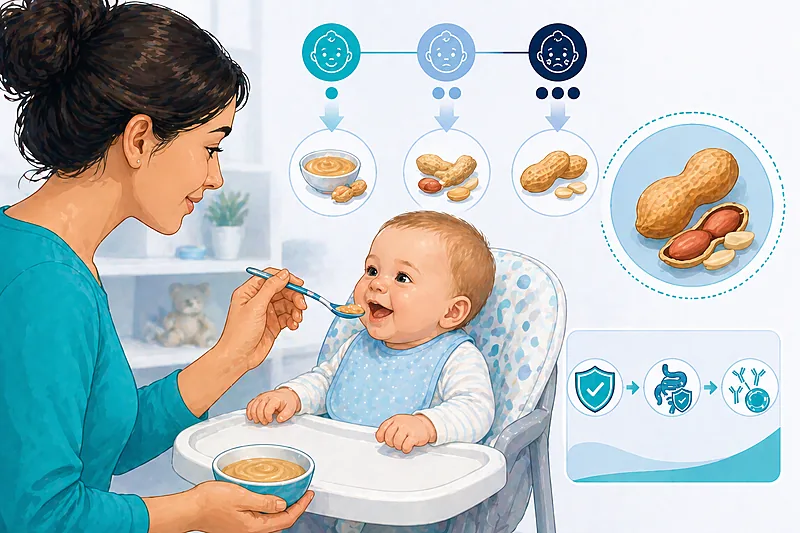
- 1Stratify every infant into high, moderate, or low risk for peanut allergy based on severe eczema, egg allergy, or neither → Risk Stratification
- 2Evaluate high-risk infants with peanut-specific IgE or a skin prick test before first introduction, starting at 4 to 6 months → Risk Stratification
- 3Introduce peanut-containing foods around 6 months for moderate-risk infants; no formal testing required before introduction → Introduction Timing
- 4Offer peanut-containing foods at a family’s discretion from around 6 months in low-risk infants, alongside other complementary foods → Introduction Timing
- 5Never give whole peanuts or large fragments to children under 4 years because of choking risk — use smooth peanut butter thinned with liquid, peanut puffs, or peanut flour → Introduction Timing
- 6Aim for around 2 grams of peanut protein (about 2 teaspoons of smooth peanut butter) at least 3 times per week to sustain tolerance → Introduction Timing
- 7Continue regular peanut consumption beyond the first year — LEAP-On showed sustained tolerance depends on ongoing dietary exposure → Follow-Up
- 8Refer infants with high peanut sIgE or a large positive skin test for supervised introduction or an oral food challenge before home feeding → Risk Stratification
- 9Prescribe a written action plan and ensure epinephrine access for any child with confirmed peanut allergy → Follow-Up
- 10Consider Palforzia oral immunotherapy in children aged 4 to 17 with confirmed peanut allergy to reduce the severity of accidental exposure reactions → Palforzia OIT
The Evidence Base for Peanut Allergy Prevention
Modern peanut allergy prevention is built on two landmark randomised trials. LEAP enrolled infants at high risk and compared early regular peanut consumption against strict avoidance; LEAP-On then asked whether the protection depended on continued exposure or whether a tolerance window had closed. Together these trials changed global practice.
LEAP and LEAP-On at a Glance
| Feature | LEAP (2015) | LEAP-On (2016) | Take-Home for the Clinic |
|---|---|---|---|
| Population | ~640 infants aged 4–11 months with severe eczema, egg allergy, or both | ~550 LEAP completers followed through 12 months of peanut avoidance | Applies most directly to the high-risk infant your practice will most worry about |
| Intervention | Regular peanut consumption (~6 g peanut protein/week) until age 5 | Complete peanut avoidance from age 5 to 6 | Dose and frequency matter — not just a single taste |
| Comparison | Strict peanut avoidance to age 5 | Continued peanut consumption | The question: does tolerance persist without ongoing exposure? |
| Key finding | About an 80% relative reduction in peanut allergy at age 5 | Protection was largely maintained after 12 months of avoidance | Tolerance is durable — but behaviour during the window matters |
| Limitation to note | Infants with very large baseline SPT were excluded; benefit not tested in already-reactive infants | Only 12 months of avoidance studied — longer absence not examined | Still advise continued regular peanut consumption beyond age 5 in most children |
Assess every infant at the 4-month well-child visit for the two criteria that define high risk for peanut allergy: severe eczema (requiring prescription topical therapy or persisting despite treatment) and/or confirmed egg allergy.
Strong Rec High Evidence NIAID 2017Counsel families that the absolute reduction in peanut allergy attributable to early introduction in high-risk infants is large — roughly 14 percentage points in LEAP. Low- and moderate-risk infants have lower baseline risk, so the absolute benefit is smaller but the intervention remains safe and supported.
Strong Rec High Evidence LEAP 2015 NIAID 2017Risk Stratification for Peanut Allergy Prevention
The NIAID addendum guidelines operationalise peanut allergy prevention into three categories based on visible eczema severity and known egg allergy. The categories decide whether to test before introduction and whether to introduce at home or under supervision.
Classify an infant as high-risk if they have severe eczema, egg allergy, or both — and arrange peanut-specific IgE measurement or a skin prick test before first introduction, ideally between 4 and 6 months of age.
Strong Rec High Evidence NIAID 2017Interpret peanut-specific IgE and skin prick test results using the addendum thresholds: sIgE under 0.35 kU/L or SPT wheal of 2 mm or less suggests low likelihood of reaction and allows home introduction; higher values require specialist evaluation with a supervised feed or oral food challenge.
Strong Rec Moderate Evidence NIAID 2017Classify infants with mild-to-moderate eczema and no egg allergy as moderate-risk for peanut allergy prevention purposes; routine pre-introduction testing is not required.
Strong Rec Moderate Evidence NIAID 2017Do not perform routine broad food allergy panels as part of peanut allergy prevention planning. Testing without a specific indication frequently identifies clinically irrelevant sensitisation and leads to unnecessary dietary restriction.
Against Moderate Evidence AAP/AAAAI ConsensusThe Three Risk Categories
| Risk Level | Defining Features | Pre-Introduction Testing | Practical Action |
|---|---|---|---|
| High | Severe eczema, egg allergy, or both | Peanut sIgE or SPT recommended before first introduction | Introduce between 4–6 months; supervised feed or OFC if sensitised |
| Moderate | Mild-to-moderate eczema, no egg allergy | Not required | Introduce around 6 months at home with usual precautions |
| Low | No eczema, no known food allergy | Not indicated | Introduce alongside other complementary foods at family discretion, around 6 months |
How and When to Introduce Peanut at Home
The “how” is as important as the “when.” Whole peanuts and peanut pieces remain choking hazards in children under 4 years. Acceptable forms are smooth peanut butter thinned with breastmilk, formula, water, or warm puree; peanut flour or peanut powder stirred into other foods; and dissolvable peanut puffs. Introduction should happen at home, in the morning, when the baby is well, with a responsible adult free to watch the child for at least 2 hours afterwards.
Introduce peanut only after the infant has tolerated a few other solid foods (e.g., iron-fortified cereals, pureed vegetables) — this confirms developmental readiness for solids and avoids attributing general feeding reactions to peanut.
Strong Rec Low Evidence NIAID 2017Coach families to watch for symptoms suggestive of allergy in the first 2 hours after feeding: hives, swelling of lips or face, vomiting, persistent cough or wheeze, lethargy, or limpness. Any signs of anaphylaxis demand immediate emergency response and intramuscular epinephrine.
Strong Rec High Evidence NIAID 2017 AAP/AAAAI ConsensusDo not offer whole peanuts, large pieces of nut, or dry nut butter spooned from the jar to a child under 4 years. Mechanical airway risk remains real regardless of allergy status.
Against Moderate Evidence AAP Red BookAge-Appropriate Peanut Products
| Form | Approximate Dose for ~2 g Peanut Protein | Age Range | Practical Tips |
|---|---|---|---|
| Smooth peanut butter thinned with liquid | About 2 teaspoons (10 g) peanut butter | From 4–6 months | Mix with warm breastmilk, formula, or water until smooth |
| Peanut flour / peanut powder | About 2 teaspoons stirred into puree or cereal | From 4–6 months | Ensure product contains only peanut — no added honey |
| Dissolvable peanut puffs (e.g., Bamba-style) | About 20–30 small puffs | From 7–8 months (once baby manages textured foods) | Dissolve in the mouth; supervise feeding |
| Whole peanuts / chunky peanut butter | — | Not before 4 years | Choking hazard regardless of allergy history |
Clinical Decision Pathway
A practical, question-based approach to the 4- to 6-month well-child visit.
Palforzia Oral Immunotherapy in Established Peanut Allergy
For children whose peanut allergy is already established, peanut allergy prevention shifts from primary avoidance of sensitisation to reducing the clinical severity of accidental exposure. Palforzia (AR101) is a standardised peanut-derived oral immunotherapy approved for children 4 through 17 years with confirmed peanut allergy, based primarily on the PALISADE trial.
Refer a child aged 4 to 17 years with confirmed peanut allergy and ongoing accidental-exposure anxiety for consideration of Palforzia oral immunotherapy with a trained allergy specialist. Palforzia reduces clinical reactivity during controlled challenges but does not cure peanut allergy.
Moderate Rec High Evidence PALISADE 2018Confirm the diagnosis of peanut allergy before initiating Palforzia — ideally with a documented history of reaction plus supportive testing, or a supervised oral food challenge. Do not start OIT in a child who has never reacted to peanut.
Strong Rec High Evidence FDA LabelCounsel families that Palforzia requires long-term daily dosing, an updosing phase of months in the specialist setting, and an ongoing maintenance phase — plus continued avoidance and epinephrine availability because reactions can still occur.
Strong Rec High Evidence FDA LabelDo not administer Palforzia in children with uncontrolled asthma, a history of eosinophilic gastrointestinal disease, or severe prior anaphylaxis without specialist reassessment. These groups were excluded from or are cautioned against in the pivotal trials.
Against Moderate Evidence FDA LabelFollow-Up and Sustained Tolerance
Successful introduction is only the start. LEAP-On showed that tolerance largely persisted after 12 months of avoidance in the previously-consuming group, but longer-duration data are limited — and the practical message remains that regular peanut consumption should continue into toddlerhood and beyond.
| Situation | Clinician Action | Pitfall |
|---|---|---|
| Uneventful first introduction | Advise 2 g peanut protein 3 times weekly; review at the next well-child visit | Families drop peanut from the diet without realising ongoing exposure matters |
| Mild reaction (isolated hives, no systemic features) | Stop further dosing; refer for allergy evaluation; do not restart until evaluated | Attributing transient skin redness to allergy without evaluation |
| Anaphylaxis | Administer IM epinephrine; 911/emergency transfer; follow with allergy referral and prescribed epinephrine auto-injectors | Observation without epinephrine; delay is the main driver of poor outcomes |
| Confirmed peanut allergy | Written action plan; two epinephrine auto-injectors; periodic re-evaluation; consider Palforzia OIT from age 4 | Out-of-date action plans; expired auto-injectors at school |
Evidence in Context
How the LEAP-era evidence reshaped practice, where international bodies align, and what questions remain open.
Why the Pre-LEAP Advice Went Wrong
Pre-LEAP advice to delay allergenic foods until age 3 in high-risk children was based on observational data and plausible immunology, not on randomised trials. Over the delay era, peanut allergy prevalence rose rather than fell. LEAP provided the randomised evidence that contradicted the avoidance strategy; food allergy testing alone could not have produced that answer.
Where International Bodies Agree and Differ
NIAID (US), AAP/AAAAI (US), the Canadian Paediatric Society, and Australian ASCIA all endorse early introduction of peanut in infancy and broadly align on the LEAP framework. The main differences are operational — whether to test before introduction in high-risk infants (recommended in the US), what size the introductory dose should be, and how strongly to recommend formal testing given variable access to specialist allergy services.
What EAT and Other Trials Added
The EAT (Enquiring About Tolerance) study in the general UK population supported early introduction but showed adherence is harder in unselected families. The key lesson across trials: the evidence for early introduction is strongest in high-risk infants, and success depends on practical feasibility of regular exposure as much as on the biology.
Palforzia vs Home-Measured Peanut OIT
Palforzia is a standardised, FDA-regulated product under a REMS program, which is the main distinction from home-measured peanut OIT protocols used by some allergists. Both approaches can desensitise many children; Palforzia offers dose consistency and a formal safety framework, while home protocols offer lower cost and flexibility. Choice depends on specialist preference, insurance, and local availability.
What We Still Don’t Know
The optimal maintenance dose and frequency after successful introduction, the true durability of tolerance across childhood and adolescence without ongoing exposure, and the role of adjunctive therapies such as biologics alongside OIT all remain open questions. Research also continues on whether the LEAP framework generalises to other allergenic foods at scale.
References
- 1.Du Toit G, Roberts G, Sayre PH, et al. Randomized Trial of Peanut Consumption in Infants at Risk for Peanut Allergy. N Engl J Med. 2015;372(9):803–813. doi:10.1056/NEJMoa1414850
- 2.Du Toit G, Sayre PH, Roberts G, et al. Effect of Avoidance on Peanut Allergy after Early Peanut Consumption (LEAP-On). N Engl J Med. 2016;374(15):1435–1443. doi:10.1056/NEJMoa1514209
- 3.Togias A, Cooper SF, Acebal ML, et al. Addendum Guidelines for the Prevention of Peanut Allergy in the United States: Report of the NIAID-Sponsored Expert Panel. J Allergy Clin Immunol. 2017;139(1):29–44. doi:10.1016/j.jaci.2016.10.010
- 4.PALISADE Group of Clinical Investigators. AR101 Oral Immunotherapy for Peanut Allergy. N Engl J Med. 2018;379(21):1991–2001. doi:10.1056/NEJMoa1812856
- 5.Fleischer DM, Chan ES, Venter C, et al. A Consensus Approach to the Primary Prevention of Food Allergy Through Nutrition. J Allergy Clin Immunol Pract. 2021;9(1):22–43. doi:10.1016/j.jaip.2020.11.002
How to Read the Evidence Tags
Every recommendation carries two Medaptly-specific tags for strength and evidence quality, plus a source tag. These are our own simplified interpretations — consult the original guidelines for their full classification systems.
Recommendation Strength
| Tag | What It Means |
|---|---|
| Strong Rec | High-quality evidence broadly supports this action. |
| Moderate Rec | The weight of evidence favours this action. |
| Conditional Rec | Benefit is less certain; individualise to the patient. |
| Against | Evidence shows no benefit or potential harm. |
Evidence Quality
| Tag | What It Means |
|---|---|
| High Evidence | Multiple well-designed RCTs or high-quality meta-analyses. |
| Moderate Evidence | Single RCT or large observational studies. |
| Low Evidence | Expert consensus or small studies. |