
Pediatric Atopic Dermatitis: 6 Proven 2026 Treatment Steps
Clinical Practice Update — Stepwise Therapy, Topical and Systemic Options, and Flare Control in Infants, Children, and Adolescents
This is an original clinical education article informed by current guidelines and evidence. See References below for source documents.
- Clinical Focus
- Evidence-based stepwise treatment of pediatric atopic dermatitis in ambulatory care
- Target Audience
- Pediatricians, family physicians, nurse practitioners, pediatric dermatologists, allergists
- Setting
- Primary care, pediatric dermatology, allergy clinics, urgent care
- Source Evidence
- •American Academy of Dermatology Guidelines of Care for Atopic Dermatitis (2014 & 2023–2024 updates)
- •NICE Guideline CG57 — Atopic Eczema in Children Under 12 Years
- •Paller AS et al. Dupilumab Pediatric Phase 3 Trials (JAAD, 2020)
- •European Guideline on Atopic Eczema (ETFAD/EADV, 2022)
- •FDA Label Updates — JAK Inhibitors for Pediatric Atopic Dermatitis
Key Clinical Takeaways
Effective management of pediatric atopic dermatitis rests on three moves done well: get the barrier right with daily emollient, match anti-inflammatory potency to disease severity and body site, and have a written flare plan ready before the next flare happens. Biologics and oral JAK inhibitors now sit firmly in the pediatric atopic dermatitis toolbox for moderate-to-severe disease that fails topical therapy. The points below distill the current evidence into bedside rules.
- 1Apply emollients liberally and daily — at least 200–500 g/week in older children — as the non-negotiable foundation of every regimen → Stepwise Treatment
- 2Match topical corticosteroid potency to severity and body site — low potency for face and folds, medium-to-high for thicker body skin → Topical Therapies
- 3Use topical calcineurin inhibitors (tacrolimus, pimecrolimus) as steroid-sparing agents for face, eyelids, and skinfolds → Topical Therapies
- 4Use proactive twice-weekly topical anti-inflammatory application to previously affected sites to prevent flares → Flare Control
- 5Escalate to wet wrap therapy for severe flares before considering systemic therapy — it can buy several days of control → Flare Control
- 6Start dupilumab for moderate-to-severe disease not controlled by optimised topicals in children as young as 6 months → Systemic Therapy
- 7Reserve oral JAK inhibitors (upadacitinib, abrocitinib) for adolescents whose disease fails or cannot tolerate dupilumab → Systemic Therapy
- 8Recognise and treat secondary bacterial superinfection promptly — staphylococcal colonisation drives many apparent flares → Flare Control
- 9Do not perform routine food allergy testing in children with atopic dermatitis unless there is a history of an immediate reaction → Diagnosis
- 10Provide every family with a written action plan showing what to apply when the skin flares → Monitoring
Diagnosing and Staging Pediatric Atopic Dermatitis
Pediatric atopic dermatitis is a clinical diagnosis supported by pattern recognition — pruritus, chronic-relapsing course, characteristic morphology and distribution by age, and a personal or family history of atopy. Severity drives treatment, not the label itself. A child with widespread disease and frequent sleep disruption belongs in a different therapeutic step from a child with isolated antecubital plaques.
Diagnose pediatric atopic dermatitis clinically using age-appropriate criteria: pruritus plus typical morphology (infants: cheeks, scalp, extensor limbs; children: flexural surfaces; adolescents: flexures, hands, periorbital). Skin biopsy and routine blood work are not required for diagnosis.
Strong Rec High Evidence AAD 2014 NICE CG57Stage severity at every visit using a structured tool (IGA 0–4, body surface area, and a question about sleep disturbance) rather than a global impression. Document severity in the chart to track response over time.
Strong Rec Moderate Evidence AAD 2023Do not perform routine food allergy testing in children with pediatric atopic dermatitis in the absence of a convincing immediate reaction after a specific food. Positive tests commonly reflect sensitisation, not clinically relevant allergy, and can lead to unnecessary dietary restrictions.
Against Moderate Evidence AAD 2014 NICE CG57Reassess for alternative diagnoses when the presentation is atypical: sharply demarcated plaques (think psoriasis), asymmetric distribution (think contact dermatitis), rapid onset without an atopic history (think scabies), or diffuse vesiculation (think eczema herpeticum).
Moderate Rec Low Evidence AAD 2014Severity Triage at a Glance
| Severity | What You See | Quality-of-Life Impact | Starting Step |
|---|---|---|---|
| Mild | Localised dry skin, faint erythema; BSA under 10% | Occasional itch; no sleep impact | Step 1–2: emollients plus low-potency topical steroid |
| Moderate | Multiple inflamed plaques; BSA 10–30%; excoriations | Frequent itch; some sleep disturbance | Step 2–3: medium-potency steroid plus TCI for face/folds |
| Severe | Widespread inflammation; BSA over 30%; lichenification | Daily itch; sleep loss; school absence | Step 4–5: optimise topicals, consider systemic therapy |
Stepwise Treatment of Pediatric Atopic Dermatitis
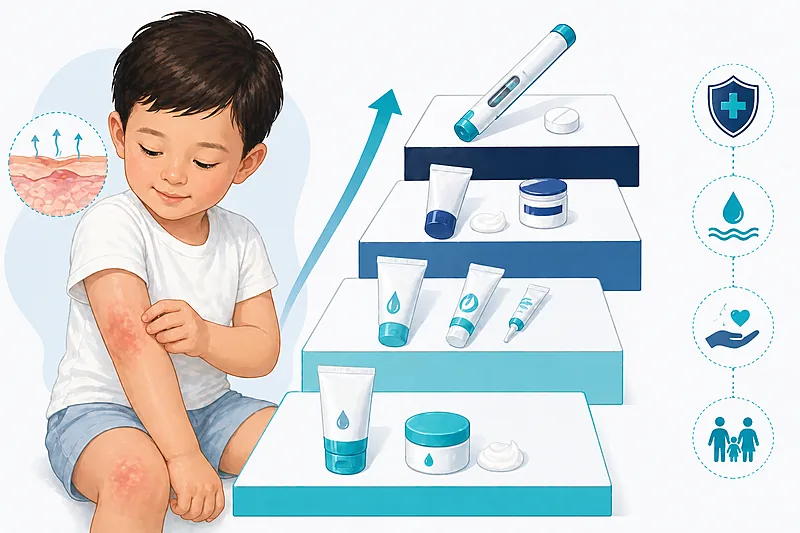
The stepwise treatment of pediatric atopic dermatitis begins with the barrier and escalates only when the response at a given step is inadequate after 2–4 weeks of optimised use. Steps are not rungs to climb in sequence regardless of severity — they are starting points. A child with severe disease starts at a higher step, not at step one.
The Six Treatment Steps
| Step | Intervention | Indication | Review At |
|---|---|---|---|
| Step 1 — Baseline | Daily emollient; trigger avoidance; non-soap cleansers | All children at every severity | Continues lifelong |
| Step 2 — Mild flare | Low-potency topical steroid (e.g., hydrocortisone 1%) once or twice daily for 5–14 days | Mild localised disease; face, folds, infant skin | 2 weeks |
| Step 3 — Moderate disease | Medium-potency topical steroid on body; low-potency or TCI on face; proactive twice-weekly maintenance | Moderate disease; frequent flares | 4 weeks |
| Step 4 — Severe flare | High-potency topical steroid (short course), wet wrap therapy, bleach baths, dermatology referral | Severe flare despite optimised step 3 | 1–2 weeks |
| Step 5 — Biologic | Dupilumab (age 6 months and older) with continued topical therapy | Moderate-to-severe, uncontrolled on optimised topicals | 16 weeks |
| Step 6 — JAK inhibitor or specialist systemic | Oral upadacitinib or abrocitinib (adolescents); specialist-led immunosuppressants in selected cases | Failure or intolerance of dupilumab; severe refractory disease | 12 weeks |
Apply liberal amounts of fragrance-free emollient (cream or ointment) at least twice daily to all skin, including uninvolved skin. Ointments are more effective than creams but acceptance can limit use — the best emollient is the one the child will accept.
Strong Rec High Evidence AAD 2014 NICE CG57Consider twice-weekly bleach baths (roughly 1/4 cup of household 6% bleach per full bathtub, diluted to about 0.005%) in children with moderate-to-severe pediatric atopic dermatitis and recurrent superinfection.
Conditional Rec Moderate Evidence AAD 2014Topical Therapies
Topical corticosteroids remain the mainstay anti-inflammatory treatment. Topical calcineurin inhibitors (tacrolimus, pimecrolimus) are the preferred steroid-sparing option for steroid-sensitive sites and for maintenance. PDE-4 inhibitors (crisaborole, roflumilast cream) add useful alternatives for mild-to-moderate disease.
Prescribe topical corticosteroids by fingertip unit dosing to achieve reproducible amounts: one fingertip unit (~0.5 g) covers two adult palm areas. Apply once or twice daily during flares; a 5–14 day course is typical.
Strong Rec High Evidence AAD 2023Use topical calcineurin inhibitors (tacrolimus 0.03% for ages 2–15, tacrolimus 0.1% from age 16, pimecrolimus 1% from age 2) as first-line anti-inflammatory treatment on the face, eyelids, and intertriginous folds.
Strong Rec High Evidence AAD 2023Consider crisaborole 2% ointment (age 3 months and older) or topical ruxolitinib (ages 12 and older) as non-steroid alternatives for mild-to-moderate disease when topical steroids are inappropriate, limited by site, or poorly accepted.
Moderate Rec Moderate Evidence AAD 2023Do not use ultra-high-potency topical corticosteroids (class I: clobetasol, halobetasol) in infants or on the face, eyelids, or genital skin at any age. Local atrophy, telangiectasia, and HPA suppression are real risks.
Against Moderate Evidence AAD 2023Topical Corticosteroid Potency for Pediatric Use
| Potency Class | Representative Examples | Safe Anatomic Use in Children | Practical Tips |
|---|---|---|---|
| Low potency (VI–VII) | Hydrocortisone 1%, 2.5%; desonide 0.05% | Face, eyelids, folds, infant body; any age | First-line for mild flares and sensitive sites |
| Medium potency (III–V) | Triamcinolone 0.1%; mometasone 0.1%; fluticasone 0.05% | Body skin from infancy onward; short courses | Workhorse of pediatric body-site therapy |
| High potency (II) | Betamethasone dipropionate 0.05%; fluocinonide 0.05% | Thick body skin; short courses in older children | Avoid face/folds; limit duration to 2 weeks |
| Ultra-high potency (I) | Clobetasol 0.05%; halobetasol 0.05% | Generally avoid in children; specialist use only | Not for routine prescribing from primary care |
Systemic Therapy for Moderate-to-Severe Pediatric Atopic Dermatitis
Systemic therapy has transformed the trajectory of moderate-to-severe pediatric atopic dermatitis. Dupilumab (anti-IL-4/IL-13 monoclonal antibody) has the longest pediatric safety and efficacy track record; two oral JAK inhibitors are approved for adolescents. Older immunosuppressants (methotrexate, cyclosporine, azathioprine, mycophenolate) remain specialist-led options for specific scenarios or where biologics are unavailable.
Start dupilumab in children with moderate-to-severe pediatric atopic dermatitis who are not adequately controlled on optimised topical therapy. Dupilumab is approved from 6 months of age. Continue topical anti-inflammatories during induction.
Strong Rec High Evidence Paller AS 2020 JAADCounsel families that dupilumab conjunctivitis develops in roughly 10–20% of treated children and is usually mild. Preservative-free lubricants and, if needed, short courses of topical steroid ophthalmic drops manage most cases without stopping the drug.
Strong Rec Moderate Evidence AAD 2023Consider upadacitinib or abrocitinib in adolescents 12 years and older who have failed or cannot tolerate dupilumab, after a careful risk discussion covering the FDA boxed warning for JAK inhibitors (serious infection, thromboembolism, malignancy, cardiovascular events).
Conditional Rec Moderate Evidence FDA Label AAD 2023Do not use long courses of systemic corticosteroids as a primary treatment strategy. Brief rescue bursts (5–7 days) may be appropriate for severe flares when bridging to a longer-term plan, but chronic systemic steroid use is harmful and produces rebound.
Against Moderate Evidence AAD 2014Systemic Agents Compared
| Agent | Mechanism | Approved From Age | Monitoring Priorities |
|---|---|---|---|
| Dupilumab | IL-4Rα monoclonal antibody (blocks IL-4 and IL-13) | 6 months | Conjunctivitis, injection site reactions; no routine labs required |
| Tralokinumab | IL-13 monoclonal antibody | 12 years | Conjunctivitis; no routine labs required |
| Upadacitinib | Oral JAK1 inhibitor | 12 years | CBC, LFTs, lipids; TB screen before start; FDA boxed warning |
| Abrocitinib | Oral JAK1 inhibitor | 12 years | CBC, platelets, LFTs; TB screen; FDA boxed warning |
| Methotrexate / Cyclosporine | Specialist-led immunosuppressants | Per specialist | Drug-specific labs; blood pressure for cyclosporine |
Clinical Decision Pathway
A practical, question-based approach to the child presenting with a flare or poorly controlled disease.
Flare Control and Proactive Maintenance
Flare control is the daily reality of pediatric atopic dermatitis. Families need two plans they can refer to without calling the clinic: a reactive plan for when skin flares, and a proactive maintenance plan to reduce how often that happens. Both belong in a single written document handed over at the visit.
Apply a proactive twice-weekly topical anti-inflammatory (medium-potency steroid or tacrolimus) to sites of recurrent flare for 8–16 weeks to prevent recurrence.
Strong Rec High Evidence AAD 2023 ETFAD 2022Treat clinical staphylococcal infection promptly with topical mupirocin for localised disease or oral cephalexin when more extensive. Do not routinely screen or decolonise the asymptomatic child.
Strong Rec Moderate Evidence AAD 2014Provide every family with a written eczema action plan at the first visit and update it at each subsequent visit. The plan names each product, where and how often to apply it in maintenance, what to switch to during a flare, and when to call for help.
Strong Rec Moderate Evidence AAD 2014Consider wet wrap therapy for acute severe flares: apply topical steroid, then a damp inner layer followed by a dry outer layer, typically for 2–48 hours. Wet wraps intensify topical steroid penetration; avoid prolonged use and pair with parent education.
Moderate Rec Moderate Evidence AAD 2014Treat nocturnal itch that disrupts sleep with behavioural sleep hygiene plus a short-term sedating antihistamine (hydroxyzine, diphenhydramine) during severe flares. Non-sedating antihistamines do not meaningfully reduce itch in pediatric atopic dermatitis.
Conditional Rec Low Evidence AAD 2014Monitoring Response and Red Flags
Review timing depends on severity and step of therapy. What matters most is that follow-up is scheduled before the family leaves and that response is measured, not just felt.
| Parameter | When to Assess | Goal | Common Pitfalls |
|---|---|---|---|
| Disease severity (IGA + BSA) | Every visit | Step down when IGA 0–1 sustained for 8 weeks | Relying on parent report without examining the skin |
| Itch and sleep | Every visit | No sleep disturbance; itch intensity under 3/10 | Not asking — families normalise chronic sleep loss |
| Quantity of topical product used | Every visit during active disease | Matches expected fingertip units for the affected area | Tubes lasting much longer than expected signals under-application |
| Growth, vision, HPA axis concerns | At least yearly; sooner if on high-potency therapy | Normal growth velocity; no new ocular symptoms | Rare at typical pediatric doses; don’t over-restrict |
| Vaccination status | Before starting and during systemic therapy | Up to date per current schedule; avoid live vaccines during some systemic therapies | Missed catch-up opportunities while on treatment |
Evidence in Context
What the evidence shows, where AAD and NICE align, and what remains uncertain in the evolving systemic-therapy landscape.
Where AAD, NICE, and ETFAD Agree
All three frameworks endorse daily emollient as baseline therapy, topical corticosteroids as first-line anti-inflammatories, topical calcineurin inhibitors as steroid-sparing alternatives for face and folds, and proactive twice-weekly maintenance for recurrent flares. Systemic therapy follows inadequate response to optimised topicals.
Where the Frameworks Differ
NICE stratifies severity into clear mild/moderate/severe bands with step-matched products, which some clinicians find more prescriptive. AAD guidelines emphasise clinical judgement and shared decision-making with less rigid banding. European guidelines place earlier emphasis on proactive maintenance. Differences are operational rather than philosophical.
The Evidence Behind Dupilumab in Children
Phase 3 trials across adolescent, school-age, and infant cohorts demonstrated substantial reductions in disease severity and itch with a favourable short-to-medium-term safety profile. Long-term open-label extensions suggest sustained response. The main treatment-emergent effect is conjunctivitis, which is usually manageable without drug discontinuation.
Where the Boxed Warning on JAK Inhibitors Comes From
The FDA’s class-wide boxed warning originated from a post-marketing rheumatoid arthritis safety trial of tofacitinib that showed increased risk of serious infection, major adverse cardiovascular events, and thromboembolism compared with TNF inhibitors. The pediatric atopic dermatitis population has different baseline risk, but the warning applies across indications and age groups until further data mature.
What We Still Don’t Know
How long biologic therapy should continue when remission is achieved, whether early systemic therapy modifies the atopic march (progression to asthma and rhinitis), and the comparative long-term safety of JAK inhibitors versus biologics in children are all open questions. Parallel work on contact dermatitis patterns in atopic skin continues to refine our understanding of flare triggers.
References
- 1.Eichenfield LF, Tom WL, Chamlin SL, et al. Guidelines of care for the management of atopic dermatitis: section 1. Diagnosis and assessment of atopic dermatitis. J Am Acad Dermatol. 2014;70(2):338–351. doi:10.1016/j.jaad.2013.10.010
- 2.Sidbury R, Davis DM, Cohen DE, et al. Guidelines of care for the management of atopic dermatitis: section 3. Management and treatment with phototherapy and systemic agents. J Am Acad Dermatol. 2014;71(2):327–349. doi:10.1016/j.jaad.2014.03.030
- 3.Paller AS, Siegfried EC, Thçi D, et al. Efficacy and safety of dupilumab with concomitant topical corticosteroids in children 6 to 11 years old with severe atopic dermatitis. J Am Acad Dermatol. 2020;83(5):1282–1293. doi:10.1016/j.jaad.2020.06.054
- 4.NICE Guideline [CG57]. Atopic Eczema in Under 12s: Diagnosis and Management. National Institute for Health and Care Excellence. nice.org.uk/guidance/cg57
- 5.Wollenberg A, Kinberger M, Arents B, et al. European guideline (EuroGuiDerm) on atopic eczema: part I — systemic therapy. J Eur Acad Dermatol Venereol. 2022;36(9):1409–1431. doi:10.1111/jdv.18345
How to Read the Evidence Tags
Every recommendation carries two Medaptly-specific tags for strength and evidence quality, plus a source tag. These are our own simplified interpretations — consult the original guidelines for their full classification systems.
Recommendation Strength
| Tag | What It Means |
|---|---|
| Strong Rec | High-quality evidence broadly supports this action. |
| Moderate Rec | The weight of evidence favours this action. |
| Conditional Rec | Benefit is less certain; individualise to the patient. |
| Against | Evidence shows no benefit or potential harm. |
Evidence Quality
| Tag | What It Means |
|---|---|
| High Evidence | Multiple well-designed RCTs or high-quality meta-analyses. |
| Moderate Evidence | Single RCT or large observational studies. |
| Low Evidence | Expert consensus or small studies. |