
Strep Throat in Children: 7 Essential 2026 Treatment Rules
Clinical Practice Update — Diagnosis, Testing, Antibiotic Selection, and Complication Prevention in Group A Streptococcal Pharyngitis
This is an original clinical education article informed by current guidelines and evidence. See References below for source documents.
- Clinical Focus
- Evidence-based diagnosis and management of strep throat in children
- Target Audience
- Pediatricians, family physicians, emergency physicians, nurse practitioners, physician assistants
- Setting
- Primary care, urgent care, pediatric emergency departments
- Source Evidence
- •IDSA Clinical Practice Guideline for GAS Pharyngitis (Shulman et al., 2012)
- •AHA Scientific Statement on Prevention of Rheumatic Fever (Gerber et al., 2009)
- •NICE Guideline NG84 — Sore Throat (Acute) Antimicrobial Prescribing (2018)
- •AAP Red Book: 2024–2027 Report of the Committee on Infectious Diseases
- •McIsaac WJ et al. Empirical Validation of Pharyngitis Guidelines (JAMA, 2004)
Key Clinical Takeaways
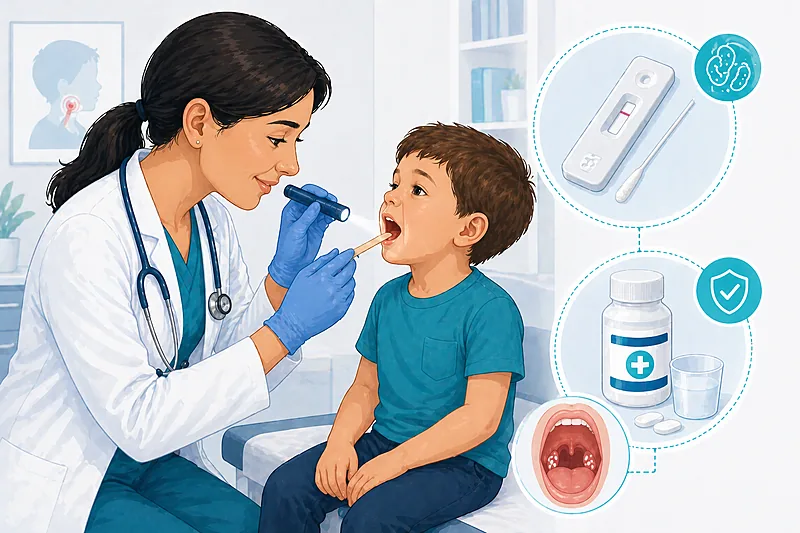
The practical challenge of strep throat in children is that most sore throats are viral, yet the consequences of missed group A streptococcal (GAS) infection — acute rheumatic fever, peritonsillar abscess, post-streptococcal glomerulonephritis — are serious. Good care in 2026 means testing selectively using validated clinical criteria, confirming GAS before antibiotics, and using penicillin or amoxicillin as the backbone of treatment. The points below distill the evidence into bedside rules.
- 1Apply the McIsaac-modified Centor criteria to decide who needs testing — a low score makes testing and treatment unnecessary → Diagnosis
- 2Do not routinely test or treat children younger than 3 years — GAS pharyngitis is uncommon and rheumatic fever is extremely rare in this group → Diagnosis
- 3Confirm strep throat in children with a rapid antigen detection test or nucleic acid amplification test — do not treat on clinical grounds alone → Testing
- 4Back up a negative rapid antigen test with throat culture in children — unless a molecular test (PCR/NAAT) was used, which does not require back-up → Testing
- 5Prescribe penicillin V or amoxicillin for 10 days as first-line treatment — amoxicillin is usually preferred for palatability → Treatment
- 6Use cephalexin in non-anaphylactic penicillin allergy; reserve clindamycin for severe allergy; avoid azithromycin unless unavoidable — macrolide resistance is rising → Treatment
- 7Initiate antibiotics within 9 days of symptom onset to prevent acute rheumatic fever — this is the central reason to treat → Complications
- 8Do not test asymptomatic household contacts or known chronic carriers — treating carriers rarely changes outcomes → Testing
- 9Do not perform a test-of-cure after treatment in a healthy child unless symptoms return or there is a personal or family history of rheumatic fever → Monitoring
- 10Return to school after 12–24 hours of appropriate antibiotics and when the child is clinically well → Monitoring
Diagnosing Strep Throat in Children
Most children with a sore throat do not have strep throat. Approximately 20–30% of pediatric pharyngitis cases are caused by group A streptococcus; the rest are largely viral. Overtesting turns carriers into “positive” results and leads to unnecessary antibiotic exposure. The McIsaac-modified Centor score — which adjusts the original Centor criteria for age — is the best validated tool to decide who benefits from testing.
Calculate the McIsaac score at every visit for sore throat in children 3 years and older: fever over 38°C, absence of cough, tender anterior cervical lymphadenopathy, tonsillar exudate or swelling, and age 3–14 (add 1 point); age 15–44 (0); over 44 (subtract 1). Use the total to decide testing.
Strong Rec High Evidence IDSA 2012 McIsaac 2004Do not routinely test or treat children under 3 years of age for strep throat. GAS pharyngitis is uncommon at this age and acute rheumatic fever is exceptionally rare. Limited testing is acceptable for a symptomatic toddler with an older sibling who has confirmed GAS.
Against Moderate Evidence IDSA 2012 AAP Red BookConsider alternative diagnoses when the presentation is atypical — cough, coryza, hoarseness, conjunctivitis, diarrhoea, and oral ulcers point to a viral cause; fatigue, posterior cervical lymphadenopathy, and splenomegaly suggest mononucleosis.
Moderate Rec Moderate Evidence IDSA 2012 NICE NG84Recognise the classic features that raise suspicion for strep throat in children: abrupt onset sore throat, headache, abdominal pain, fever 38–40°C, tonsillar erythema with exudate, palatal petechiae, strawberry tongue, and a fine sandpaper-like rash in scarlet fever.
Strong Rec Moderate Evidence IDSA 2012 AAP Red BookMcIsaac Score and Testing Decisions
| McIsaac Score | Approximate GAS Probability | Recommended Action | Common Pitfalls |
|---|---|---|---|
| 0 or negative | Under 5% | No testing; symptomatic care | Testing anyway finds carriers and leads to unnecessary antibiotics |
| 1 | 5–10% | No testing in most cases; consider testing if local prevalence is high | Don’t treat empirically |
| 2 | ~15% | Test — treat only if positive | Don’t start antibiotics while awaiting results |
| 3 | ~30% | Test — treat only if positive | Clinical picture is not reliable enough to treat empirically |
| 4 or 5 | ~50–60% | Test; some clinicians start antibiotics while awaiting the result and stop if negative | Still confirm — nearly half the highest-score children do not have GAS |
Testing for Strep Throat in Children
Laboratory confirmation is the rule for treating strep throat in children because clinical features alone are unreliable. Three options are available: rapid antigen detection tests (RADT), nucleic acid amplification tests (NAAT/PCR), and throat culture. Each has a role, and the choice affects whether a back-up culture is needed.
Collect the throat swab correctly — swab both tonsillar surfaces and the posterior pharynx, avoiding the tongue and cheeks. Technique affects sensitivity more than the test platform.
Strong Rec High Evidence IDSA 2012Back up a negative rapid antigen detection test with throat culture in children and adolescents. The reported sensitivity of RADT is 70–90% — a negative RADT in a child with high clinical suspicion should not close the case.
Strong Rec High Evidence IDSA 2012 AAP Red BookUse a molecular (PCR/NAAT) test as a stand-alone test — a negative result does not require back-up culture. Sensitivity and specificity both exceed 95%, although turnaround time and cost can limit availability.
Moderate Rec Moderate Evidence IDSA 2012Do not test asymptomatic household contacts routinely. Treating carriers rarely changes outcomes. Exceptions include households with a member who has had acute rheumatic fever, a known immunocompromised contact, or during a cluster of invasive GAS.
Against Moderate Evidence IDSA 2012 AAP Red BookComparing the Testing Options
| Test | Turnaround | Approximate Sensitivity | Practical Use |
|---|---|---|---|
| Rapid antigen (RADT) | 5–15 min | 70–90% | First-line in many clinics; requires back-up culture if negative in children |
| Molecular (PCR/NAAT) | 15 min–hours | Over 95% | Stand-alone test; no back-up culture needed; cost and access can limit |
| Throat culture | 24–48 hours | 90–95% (reference standard) | Used for back-up in children; initiate or defer antibiotics based on clinical judgement while awaiting result |
Antibiotic Treatment of Strep Throat
Group A streptococcus has retained complete penicillin susceptibility for more than seven decades. Penicillin V and amoxicillin are the first-line regimens for strep throat in children, with a standard course of 10 days. The main reason to complete the course is to prevent acute rheumatic fever; shorter courses achieve symptom control but have inferior rheumatic fever prevention data.
Prescribe amoxicillin 50 mg/kg once daily (maximum 1000 mg) or 25 mg/kg twice daily for 10 days as first-line treatment of GAS pharyngitis in children. Once-daily dosing improves adherence and is non-inferior to divided dosing.
Strong Rec High Evidence IDSA 2012 AAP Red BookConsider a single intramuscular dose of benzathine penicillin G (600,000 units if under 27 kg; 1.2 million units if 27 kg or heavier) when oral adherence is likely to be poor or in families with a history of acute rheumatic fever.
Moderate Rec High Evidence IDSA 2012 AHA 2009In children with a non-anaphylactic penicillin allergy, prescribe cephalexin 40 mg/kg/day divided every 12 hours (maximum 1 g/day) for 10 days. Cross-reactivity between penicillins and first-generation cephalosporins is low in the absence of an immediate-type reaction.
Strong Rec High Evidence IDSA 2012Reserve clindamycin (7 mg/kg three times daily, maximum 300 mg/dose) for children with severe (anaphylactic or Stevens-Johnson-type) penicillin allergy. Clindamycin maintains activity against GAS but carries a higher risk of Clostridioides difficile infection.
Moderate Rec Moderate Evidence IDSA 2012Avoid azithromycin as first-line alternative for strep throat in children. Macrolide resistance in GAS exceeds 10–20% in many regions and is rising — azithromycin should only be used when local susceptibility is known to be adequate and no alternative is available.
Against Moderate Evidence IDSA 2012 AAP Red BookAntibiotic Regimens for Children
| Drug | Pediatric Dose | Duration | When to Pick It |
|---|---|---|---|
| Amoxicillin | 50 mg/kg once daily or 25 mg/kg twice daily (max 1000 mg/day) | 10 days | First-line in most children; better taste than penicillin V |
| Penicillin V | 250 mg 2–3 times daily (under 27 kg); 500 mg 2–3 times daily (27 kg or more) | 10 days | Classic choice; narrower spectrum than amoxicillin |
| Benzathine penicillin G (IM) | 600,000 units (under 27 kg) or 1.2 million units (27 kg or more) | Single dose | Poor oral adherence; family history of rheumatic fever |
| Cephalexin | 40 mg/kg/day divided every 12 hours (max 1 g/day) | 10 days | Non-anaphylactic penicillin allergy |
| Clindamycin | 7 mg/kg three times daily (max 300 mg/dose) | 10 days | Severe penicillin allergy; C. difficile risk |
| Azithromycin | 12 mg/kg once daily (max 500 mg/day) | 5 days | Last resort; confirm local susceptibility |
Clinical Decision Pathway
A practical, question-based approach to the child presenting with a sore throat.
Complications and Rheumatic Fever Prevention
The strongest reason to treat GAS pharyngitis is to prevent acute rheumatic fever (ARF). Treatment started within 9 days of symptom onset prevents most cases. Post-streptococcal glomerulonephritis (PSGN), by contrast, is not prevented by antibiotic treatment of the preceding pharyngitis — its incidence is driven by circulating nephritogenic strains, not by whether the throat was treated.
Initiate antibiotic treatment within 9 days of symptom onset to prevent acute rheumatic fever. The primary-prevention window is generous, so delayed presentations still benefit from treatment.
Strong Rec High Evidence AHA 2009 IDSA 2012Recognise acute suppurative complications: peritonsillar abscess (unilateral muffled voice, trismus, uvular deviation), retropharyngeal abscess (neck stiffness, drooling in a young child), cervical lymphadenitis, and otitis media. Any of these needs prompt ENT or emergency evaluation.
Strong Rec Moderate Evidence AAP Red BookEvaluate for post-streptococcal glomerulonephritis when a child develops haematuria, oedema, or hypertension 1–3 weeks after GAS pharyngitis or skin infection. Treatment of the preceding infection does not reliably prevent PSGN; management is supportive.
Moderate Rec Moderate Evidence AAP Red BookDo not start long-term secondary prophylaxis against recurrent strep throat in children unless the child has confirmed acute rheumatic fever. Routine prophylaxis for recurrent tonsillitis is not supported by evidence.
Against Moderate Evidence AHA 2009 IDSA 2012Post-Streptococcal Complications Compared
| Complication | Typical Onset After GAS | Prevented by Treatment? | Clinical Clue |
|---|---|---|---|
| Peritonsillar abscess | Days | Partially | Muffled voice, trismus, uvular deviation |
| Scarlet fever | Concurrent | Yes | Sandpaper rash, strawberry tongue |
| Acute rheumatic fever | 2–4 weeks | Yes — if started within 9 days | Migratory arthritis, carditis, chorea |
| Post-streptococcal glomerulonephritis | 1–3 weeks | Not reliably | Haematuria, oedema, hypertension |
Monitoring and Follow-Up
Most children with strep throat improve within 48–72 hours of starting antibiotics. Specific follow-up is not needed in the healthy child who improves on schedule.
| Situation | Action | Pitfall |
|---|---|---|
| Improving at 48–72 hours | Complete the full 10-day course; no follow-up needed | Stopping early — incomplete courses reduce rheumatic fever prevention |
| Not improving at 48–72 hours | Reassess diagnosis; look for peritonsillar abscess, EBV, diphtheria; confirm adherence | Switching antibiotics reflexively instead of rechecking the diagnosis |
| Relapse within days of completing treatment | Retest; consider repeat treatment, oral clindamycin, or benzathine penicillin G | Carrier state may cause positive tests without true reinfection |
| Family history of acute rheumatic fever | Confirm clearance with test-of-cure after completion | Neglecting secondary prophylaxis in an established ARF patient |
| Return to school | After 12–24 hours of antibiotics AND clinically well | Returning while febrile risks transmission even on antibiotics |
Evidence in Context
What the evidence shows, where IDSA, NICE, and AAP align, and where they take different operational approaches.
Where the Major Frameworks Agree
IDSA, AAP, and NICE agree on three foundational points: most sore throats are viral; laboratory confirmation should precede antibiotics in most settings; and penicillin (or amoxicillin) is first-line when GAS is confirmed. All three emphasise avoiding antibiotic treatment of clinically diagnosed viral pharyngitis.
Where They Differ
NICE’s approach favours the FeverPAIN score and tends to treat based on clinical probability, given lower rheumatic fever incidence and different testing availability in UK primary care. IDSA and AAP both emphasise laboratory confirmation before treatment, reflecting higher testing availability and variable rheumatic fever incidence across US subpopulations. Both approaches are defensible in their respective health systems.
Could Shorter Antibiotic Courses Work?
Shorter-course regimens (5–7 days) achieve symptom resolution as reliably as 10 days, and patient-oriented outcomes are similar. The 10-day course persists because the rheumatic fever prevention data were generated on 10-day regimens. Until equivalent prevention data exist for shorter courses, 10 days remains standard.
The Rise of Invasive GAS
Public health agencies have reported increases in invasive GAS disease in children in several regions since 2022. The implications for pharyngitis management are limited — empiric treatment of sore throats is not an effective public health response — but clinicians should maintain vigilance for the red flags of invasive disease (unusual rapid progression, necrotising fasciitis features, toxic shock).
What We Still Don’t Know
The optimal management of the chronic GAS carrier, the best approach to recurrent pharyngitis in children without rheumatic fever history, and whether near-patient molecular testing should fully replace RADT-plus-culture remain areas where practice varies and evidence continues to accumulate. Streptococcal vaccines are in development but not yet available.
References
- 1.Shulman ST, Bisno AL, Clegg HW, et al. Clinical Practice Guideline for the Diagnosis and Management of Group A Streptococcal Pharyngitis: 2012 Update by the Infectious Diseases Society of America. Clin Infect Dis. 2012;55(10):e86–e102. doi:10.1093/cid/cis629
- 2.Gerber MA, Baltimore RS, Eaton CB, et al. Prevention of Rheumatic Fever and Diagnosis and Treatment of Acute Streptococcal Pharyngitis. A Scientific Statement From the American Heart Association. Circulation. 2009;119(11):1541–1551. doi:10.1161/CIRCULATIONAHA.109.191959
- 3.McIsaac WJ, Kellner JD, Aufricht P, Vanjaka A, Low DE. Empirical validation of guidelines for the management of pharyngitis in children and adults. JAMA. 2004;291(13):1587–1595. doi:10.1001/jama.291.13.1587
- 4.NICE Guideline [NG84]. Sore Throat (Acute): Antimicrobial Prescribing. National Institute for Health and Care Excellence. 2018. nice.org.uk/guidance/ng84
- 5.American Academy of Pediatrics Committee on Infectious Diseases. Group A Streptococcal Infections. In: Red Book: 2024–2027 Report of the Committee on Infectious Diseases. 33rd ed. Itasca, IL: American Academy of Pediatrics; 2024. publications.aap.org/redbook
How to Read the Evidence Tags
Every recommendation carries two Medaptly-specific tags for strength and evidence quality, plus a source tag. These are our own simplified interpretations — consult the original guidelines for their full classification systems.
Recommendation Strength
| Tag | What It Means |
|---|---|
| Strong Rec | High-quality evidence broadly supports this action. |
| Moderate Rec | The weight of evidence favours this action. |
| Conditional Rec | Benefit is less certain; individualise to the patient. |
| Against | Evidence shows no benefit or potential harm. |
Evidence Quality
| Tag | What It Means |
|---|---|
| High Evidence | Multiple well-designed RCTs or high-quality meta-analyses. |
| Moderate Evidence | Single RCT or large observational studies. |
| Low Evidence | Expert consensus or small studies. |