
Necrotizing Fasciitis: 8 Critical Surgical Rules
Clinical Practice Update — Recognition, LRINEC Pitfalls, Empiric Antibiotics, and Aggressive Debridement
This is an original clinical education article informed by current guidelines and evidence. See References below for source documents.
- Clinical Focus
- Evidence-based recognition, empiric therapy, and surgical management of necrotizing fasciitis in adults
- Target Audience
- Emergency physicians, general surgeons, plastic surgeons, intensivists, infectious disease physicians
- Setting
- Emergency department, operating theatre, intensive care unit, burns or plastic surgery unit
- Source Evidence
- •IDSA Practice Guidelines on Skin and Soft Tissue Infections (2014, updated commentary)
- •WSES / SIS Guidelines on Necrotizing Soft Tissue Infections (2022)
- •Surviving Sepsis Campaign Guidelines (2021)
- •INSTINCT Trial — Clindamycin in Invasive Group A Streptococcal Infection
- •Wong et al. — LRINEC Score Original Derivation (Crit Care Med, 2004)
Key Clinical Takeaways
Effective necrotizing fasciitis care depends on three actions that happen in parallel: suspect the diagnosis at the bedside, start broad-spectrum antibiotics within the hour, and get the patient to theatre for aggressive debridement — in hours, not overnight. The rules below summarise the evidence.
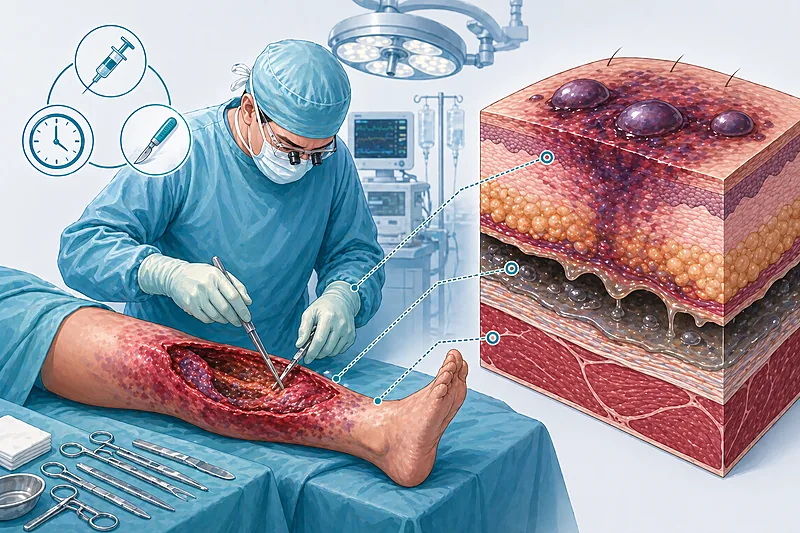
- 1Suspect necrotizing fasciitis in any patient with disproportionate pain, rapid progression, or unexplained sepsis — the LRINEC score can only support the diagnosis, never rule it out → Recognition
- 2Start broad-spectrum antibiotics within one hour of recognition — piperacillin-tazobactam or meropenem plus vancomycin plus clindamycin → Empiric Therapy
- 3Never delay theatre for imaging — CT is helpful in ambiguous cases but cannot be allowed to postpone surgery in a clinically obvious one → Imaging
- 4Take the patient to theatre within 6 hours — each hour of delay is associated with measurably worse outcomes → Timing
- 5Debride to bleeding, viable tissue — the margin is always wider than the skin suggests → Debridement
- 6Book the patient back to theatre at 24 hours for a planned second look — expect to return at least twice more → Re-exploration
- 7Continue clindamycin at least until clinical stabilisation — its anti-toxin effect is crucial in Group A strep infection → Antibiotic Stewardship
- 8Escalate to ICU-level support early — this is sepsis with a surgical wound, and both need full organ support → Post-Op Care
Recognising Necrotizing Fasciitis at the Bedside
Necrotizing fasciitis is a clinical diagnosis — one made at the bedside by a clinician who has seen the illness before. Early findings mimic cellulitis; the difference is the tempo of deterioration and a handful of red flags that appear before the skin changes become dramatic.
Suspect necrotizing fasciitis in any patient with a soft tissue infection accompanied by pain out of proportion to examination, rapid progression over hours, sepsis of unclear source, or skin changes such as bullae, ecchymosis, or anaesthesia.
Strong Rec Moderate Evidence IDSA 2014 WSES 2022Do not use the LRINEC score to exclude necrotizing fasciitis — a low score in a patient with strong clinical suspicion must not override surgical judgement.
Against Moderate Evidence WSES 2022 SIS 2021Perform a careful examination of the perineum, groin, and anal region in any patient with unexplained sepsis — Fournier’s gangrene is easy to miss in obese or heavily dressed patients.
Strong Rec Low Evidence WSES 2022Mark the leading edge of skin erythema at presentation and reassess within 30–60 minutes — visible progression inside that window is itself diagnostic of a necrotizing process.
Moderate Rec Low Evidence WSES 2022Bedside Red Flags That Should Trigger Surgical Consultation
| Red Flag | Why It Matters | How Easily Missed | Practical Action |
|---|---|---|---|
| Pain out of proportion | Deep fascial necrosis with minimal skin signs | Often attributed to cellulitis anxiety | Document opioid requirement; call surgery |
| Hemorrhagic bullae or ecchymosis | Small-vessel thrombosis from deep infection | Confused with friction or trauma | Photograph; get urgent surgical review |
| Skin anaesthesia within erythema | Cutaneous nerve destruction — late and ominous | Not tested unless specifically sought | Run a gauze across — compare to normal skin |
| Crepitus on palpation | Gas-forming organisms; diagnostic for gas gangrene | Subtle — easier to feel than hear | Immediate theatre; no further workup needed |
| Systemic toxicity (hypotension, tachycardia, confusion) | Streptococcal or clostridial toxin-mediated shock | Labelled “worsening cellulitis sepsis” | Start sepsis bundle; consider IVIG early |
LRINEC Score: Useful Support, Unsafe Rule-Out
The Laboratory Risk Indicator for Necrotizing Fasciitis (LRINEC) score combines six laboratory variables — CRP, total white cell count, haemoglobin, sodium, creatinine, and glucose. It was derived to support the clinical diagnosis, not to replace it.
Calculate a LRINEC score in every patient where necrotizing fasciitis is on the differential; use a score of 6 or greater to support the diagnosis, not to confirm it.
Moderate Rec Moderate Evidence WSES 2022Interpret a low LRINEC score with caution — modern validation studies show sensitivities as low as 60%, and a substantial minority of proven necrotizing fasciitis cases score below 6.
Strong Rec Moderate Evidence WSES 2022 SIS 2021Do not delay surgical exploration to repeat the LRINEC score after fluid resuscitation — haemodilution and early lactate dynamics will distort the inputs and provide false reassurance.
Against Low Evidence WSES 2022Imaging in Necrotizing Fasciitis: When and Why
Imaging has a role in ambiguous presentations and in defining the anatomical extent of necrotizing fasciitis in a stable patient. It has no role in a clinically obvious case — the CT scanner is a place where salvageable patients become unsalvageable.
Perform urgent contrast-enhanced CT in haemodynamically stable patients with diagnostic uncertainty — the findings most specific for necrotizing fasciitis are fascial gas and fascial thickening with non-enhancement.
Moderate Rec Moderate Evidence WSES 2022 SIS 2021Do not delay theatre to obtain imaging in a haemodynamically unstable patient or one with obvious physical signs — clinical judgement plus bedside exploration outperforms any scanner.
Against Moderate Evidence WSES 2022 IDSA 2014Consider plain radiographs only as a first screen in a resource-limited setting — subcutaneous gas on X-ray is highly specific but lacks sensitivity.
Conditional Rec Low Evidence WSES 2022Perform a bedside “finger test” under local anaesthesia when imaging is unavailable or unreliable and clinical suspicion remains — easy blunt dissection along fascial planes with “dishwater” fluid confirms the diagnosis.
Moderate Rec Low Evidence WSES 2022Empiric Antibiotic Therapy in Necrotizing Fasciitis
Empiric antibiotic therapy in necrotizing fasciitis must cover gram-positive cocci (including MRSA), gram-negative rods, anaerobes, and — crucially — include a protein-synthesis inhibitor such as clindamycin to suppress toxin production. Antibiotics do not replace surgery; they buy the patient hours.
Initiate broad-spectrum antibiotics within one hour of recognition — a beta-lactam/beta-lactamase inhibitor or carbapenem, plus an anti-MRSA agent, plus clindamycin for toxin suppression.
Strong Rec High Evidence IDSA 2014 WSES 2022Add clindamycin in every patient with suspected necrotizing fasciitis, even if an alternative gram-positive agent is already in place — its anti-toxin effect is independent of bacteriocidal activity.
Strong Rec Moderate Evidence IDSA 2014 INSTINCTAdd anti-pseudomonal and anti-Vibrio cover in patients with water exposure, immunocompromise, chronic liver disease, or injuries in coastal or brackish water — doxycycline plus a third-generation cephalosporin is the classic addition.
Moderate Rec Moderate Evidence IDSA 2014Consider intravenous immunoglobulin (IVIG) in patients with confirmed or suspected streptococcal toxic shock syndrome who are not responding to standard resuscitation and source control.
Conditional Rec Low Evidence WSES 2022De-escalate the antibiotic regimen based on intraoperative cultures and clinical trajectory — continue therapy until the patient is afebrile, haemodynamically stable, and no further debridement is needed.
Strong Rec Moderate Evidence IDSA 2014 WSES 2022Empiric Regimens by Clinical Scenario
| Scenario | Beta-lactam Backbone | Gram-positive / MRSA | Toxin + Special Cover |
|---|---|---|---|
| Standard limb/trunk presentation | Piperacillin-tazobactam 4.5 g IV q6h | Vancomycin 25–30 mg/kg load | Clindamycin 900 mg IV q8h |
| Severe sepsis or unstable | Meropenem 1 g IV q8h | Linezolid 600 mg IV q12h (suppresses toxin too) | Clindamycin 900 mg IV q8h |
| Perineal / Fournier’s | Piperacillin-tazobactam or meropenem | Vancomycin | Clindamycin; consider antifungal if immunocompromised |
| Water-exposure wound / coastal injury | Ceftriaxone 2 g IV q12h | Vancomycin | Doxycycline 100 mg IV q12h + clindamycin |
| Suspected clostridial (crepitus) | Piperacillin-tazobactam or meropenem | Vancomycin | Clindamycin 900 mg IV q8h (essential) |
Surgical Debridement in Necrotizing Fasciitis: First Principles
Aggressive surgical debridement is the only intervention that reliably changes mortality in necrotizing fasciitis. Timing, completeness, and planned re-exploration are the three determinants of outcome.
Take every patient with diagnosed or strongly suspected necrotizing fasciitis to theatre within 6 hours of presentation — and ideally within 3.
Strong Rec High Evidence WSES 2022 SIS 2021Debride widely to the margin of bleeding, viable-looking tissue — the disease extends further than the visible skin change; inadequate first debridement is the commonest reason for early mortality.
Strong Rec High Evidence WSES 2022Plan a second-look procedure at 24 hours regardless of the intraoperative findings, and continue daily returns until two consecutive operations show no further necrosis — the same principle applies in Fournier’s gangrene of the perineum.
Strong Rec Moderate Evidence WSES 2022 SIS 2021Send multiple deep tissue samples for Gram stain, aerobic and anaerobic culture, and histopathology — superficial swabs do not represent the causative organisms.
Strong Rec Moderate Evidence IDSA 2014Consider early diverting colostomy in Fournier’s gangrene with extensive perineal or anorectal involvement — it protects the wound and simplifies subsequent reconstruction.
Moderate Rec Low Evidence WSES 2022Do not delay amputation when a limb is non-salvageable — early above-the-level-of-necrosis amputation improves survival in overwhelming infection with limb ischaemia or gas gangrene.
Strong Rec Moderate Evidence WSES 2022Post-Operative Care and ICU Management
These patients almost always need critical care. Septic shock, acute kidney injury, ARDS, coagulopathy, and protracted wound management define the next 1–2 weeks. A structured approach avoids the commonest pitfalls.
Admit every patient to critical care after index debridement — monitor haemodynamics, renal function, lactate, and coagulation; expect multi-organ support.
Strong Rec Moderate Evidence Surviving Sepsis 2021 WSES 2022Apply a full sepsis bundle in parallel with surgical care: balanced crystalloids, early vasopressors, central venous access, lactate-guided resuscitation, and culture-directed antimicrobial refinement.
Strong Rec High Evidence Surviving Sepsis 2021Start structured wound care with negative pressure therapy between debridements once the wound bed is stable — it reduces dressing changes, improves granulation, and simplifies eventual reconstruction.
Moderate Rec Moderate Evidence WSES 2022Refer early to plastic or reconstructive surgery for skin grafting or flap planning once the infection is controlled and the patient is metabolically stable.
Moderate Rec Low Evidence WSES 2022Do not routinely use hyperbaric oxygen therapy — the evidence base remains weak and it must never delay or substitute for surgical debridement.
Against Low Evidence WSES 2022 IDSA 2014Clinical Decision Pathway
A practical, question-based approach to the patient in front of you with a potentially necrotizing soft tissue infection. Work through the questions in order.
Monitoring and Follow-Up
| Parameter | When to Check | Action Threshold | Common Pitfalls |
|---|---|---|---|
| Wound margins | Every operation, and at each dressing change | New necrosis or dishwater drainage → back to theatre | Assuming granulation means infection is controlled |
| Lactate & haemodynamics | Hourly in ICU for first 24 h | Rising lactate → re-explore the wound | Blaming fluid resuscitation when surgical source persists |
| Creatinine / urine output | Daily | AKI → early nephrology input; adjust vancomycin | Under-dosing antibiotics on renal replacement |
| Temperature & WCC | Daily | Persistent fever → re-image or re-explore | Calling a slowly-resolving fever “drug fever” too early |
| Nutrition / catabolism | From day 2 onward | Aim for 25–30 kcal/kg/day; high protein | Waiting to start feeding until off vasopressors |
Evidence in Context
What the evidence shows, where the major guidelines agree, and where honest gaps remain.
Where IDSA, WSES, and SIS Agree
All three frameworks agree that necrotizing fasciitis is a clinical diagnosis, that surgical debridement within hours of recognition is the primary determinant of outcome, that empiric antibiotic therapy must be broad-spectrum and include a protein-synthesis inhibitor such as clindamycin, and that planned re-exploration is the standard of care.
The LRINEC Score in Modern Validation
The LRINEC score was derived by Wong and colleagues in a single-centre case-control study and has been widely validated. Prospective validation has been less favourable than the original derivation: sensitivity is often under 70% and a meaningful minority of proven cases score below 6.
The message is consistent across every modern guideline: use LRINEC as supporting evidence only. A low score never overrides clinical suspicion.
Clindamycin and the INSTINCT Evidence
The addition of clindamycin to beta-lactam therapy in invasive Group A streptococcal infection is supported by consistent observational data and by mechanistic studies demonstrating suppression of exotoxin production.
The INSTINCT registry and other cohort analyses show lower mortality when clindamycin is added early; randomised data are unlikely to emerge given the ethical challenge of withholding a mechanistically plausible and low-harm intervention.
Adjunctive Therapies: IVIG and HBO
IVIG: Observational and registry data support a role in streptococcal toxic shock syndrome; there is no randomised trial demonstrating unequivocal mortality benefit. Most guidelines endorse consideration in toxic shock rather than routine use.
Hyperbaric oxygen: Evidence is weaker still. It may benefit selected patients in centres with ready access, but it must never delay or compete with surgical debridement.
Evidence Gaps We Still Face
Rigorous randomised evidence for debridement strategies, wound care technology, and reconstruction pathways in necrotizing fasciitis is sparse and unlikely to grow given the rarity and severity of the disease. Decisions rest on mechanistic reasoning, observational series, and expert consensus — which is why time-critical bedside judgement matters so much.
References
- 1. Stevens DL, Bisno AL, Chambers HF, et al. Practice Guidelines for the Diagnosis and Management of Skin and Soft Tissue Infections: 2014 Update by the Infectious Diseases Society of America. Clin Infect Dis. 2014;59(2):e10–e52. doi:10.1093/cid/ciu444
- 2. Sartelli M, Coccolini F, Kluger Y, et al. WSES/GAIS/WSIS/SIS-E/AAST global clinical pathways for patients with skin and soft tissue infections. World J Emerg Surg. 2022;17:3. doi:10.1186/s13017-022-00406-2
- 3. Wong CH, Khin LW, Heng KS, Tan KC, Low CO. The LRINEC (Laboratory Risk Indicator for Necrotizing Fasciitis) score: a tool for distinguishing necrotizing fasciitis from other soft tissue infections. Crit Care Med. 2004;32(7):1535–1541. doi:10.1097/01.CCM.0000129486.35458.7D
- 4. Evans L, Rhodes A, Alhazzani W, et al. Surviving Sepsis Campaign: International Guidelines for Management of Sepsis and Septic Shock 2021. Crit Care Med. 2021;49(11):e1063–e1143. doi:10.1097/CCM.0000000000005337
- 5. Babiker A, Li X, Lai YL, et al. Effectiveness of adjunctive clindamycin in beta-lactam antibiotic-treated patients with invasive beta-haemolytic streptococcal infections (INSTINCT). Lancet Infect Dis. 2021;21(5):697–710. doi:10.1016/S1473-3099(20)30523-5
How to Read the Evidence Tags
Every recommendation in this article carries two tags — recommendation strength and evidence quality. These are Medaptly’s simplified interpretations, designed for bedside use.
Recommendation Strength
| Tag | What It Means |
|---|---|
| Strong Rec | High-quality evidence broadly supports this action. |
| Moderate Rec | Evidence favours this action for most patients. |
| Conditional Rec | Benefit is less certain — individualise based on patient factors. |
| Against | Evidence shows no benefit or potential harm. |
Evidence Quality
| Tag | What It Means |
|---|---|
| High Evidence | Multiple well-designed RCTs or high-quality meta-analyses. |
| Moderate Evidence | Single RCT or large observational studies. |
| Low Evidence | Expert consensus or small studies. |