
Cervical Cancer Screening: 6 Key Practice Considerations
An evidence synthesis on cervical cancer screening with HPV primary testing, self-collection, age-stratified intervals, and ACOG/ASCCP risk-based management.
One-Minute Takeaway on Cervical Cancer Screening
One-Minute Takeaway
- Cervical cancer screening with primary high-risk HPV testing reduced invasive cervical cancer incidence by approximately 60–70% compared with cytology in pooled European randomized data over follow-up of about 6.5 years.
- Five-year intervals after a negative HPV test are supported by long-term cohort risk estimates from more than 1.5 million screening encounters.
- Self-collected vaginal samples for high-risk HPV testing show pooled sensitivity for CIN2+ that overlaps clinician-collected samples when validated PCR assays are used.
- The 2019 ASCCP Risk-Based Management Consensus Guidelines stratify post-screen decisions by 5-year CIN3+ risk thresholds rather than by the index test result alone.
- The strongest evidence gap remains direct comparative trials of post-HPV-positive triage strategies (reflex cytology vs dual stain vs partial genotyping).
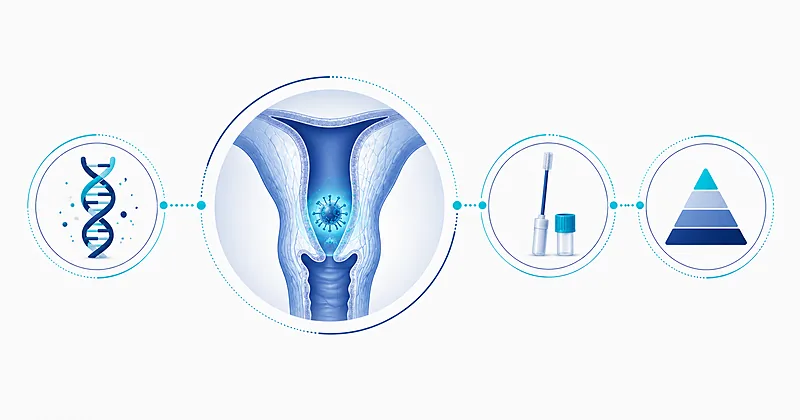
Why Cervical Cancer Screening Matters
Cervical cancer screening prevents an estimated 80% of cervical cancer cases when applied at population scale. Despite this, more than 11,000 invasive cervical cancers are diagnosed annually in the United States, and roughly 4,000 women die from the disease each year. Most incident cases occur in women who were never screened or who were inadequately screened.
The 2024 USPSTF draft recommendation reaffirmed high-risk HPV testing as the cervical cancer screening modality with the strongest evidence base for women aged 30 to 65. This represents a fundamental shift from a cytology-anchored model toward a molecular detection framework targeting the causative agent. The shift is supported by four pooled European randomized trials and the HPV FOCAL trial in Canada.
Self-collection of vaginal samples for high-risk HPV testing was endorsed by the FDA in 2024 for use in clinical settings. This option opens a new pathway for cervical cancer screening among women who decline pelvic examination. It is particularly relevant for underscreened populations, who account for the majority of incident cervical cancer cases in the United States.
Risk-based management algorithms from the 2019 ASCCP guidelines and aligned ACOG practice advisories further refine triage decisions after a positive screen. Together, these frameworks create a layered cervical cancer screening pathway in which the index test, prior history, and current result are integrated into a single risk estimate before colposcopy referral.
What Evidence Was Reviewed
This synthesis draws on four European randomized controlled trials of HPV-based cervical cancer screening (ARTISTIC, POBASCAM, NTCC, Swedescreen) pooled by the Ronco 2014 meta-analysis, the HPV FOCAL trial in Canada, the ATHENA registration trial in the United States, the Compass pilot in Australia, the IMPROVE self-collection non-inferiority trial, and Kaiser Permanente Northern California cohort data informing the 2019 ASCCP risk-based framework.
Across the included studies, more than 250,000 women contributed data over screening rounds spanning 8 to 14 years. Outcomes assessed include detection of cervical intraepithelial neoplasia grade 3 or worse (CIN3+), invasive cancer incidence, sensitivity and specificity for CIN2+, colposcopy referral rates, and patient-centered acceptability of self-collection.
| Study / Source | Design | n | Comparison | Primary Outcome |
|---|---|---|---|---|
| Ronco 2014 (pooled European RCTs) | Pooled analysis of 4 RCTs | 176,464 | HPV vs cytology | Invasive cancer incidence at 6.5 yr |
| HPV FOCAL (Ogilvie 2018) | RCT | 19,009 | Primary HPV vs cytology | CIN3+ detection at 48 mo |
| ATHENA (Wright 2015) | Prospective registration cohort | 42,209 | HPV first-line vs cytology | CIN2+/CIN3+ detection |
| POBASCAM (Rijkaart 2012) | RCT | 44,938 | HPV+cytology vs cytology | CIN3+ across two rounds |
| ARTISTIC (Kitchener 2009) | RCT | 24,510 | HPV vs cytology | CIN3+ detection |
| Compass pilot (Canfell 2017) | RCT (vaccinated cohort) | 4,995 | 5-yr HPV vs 2.5-yr cytology | CIN2+ at first round |
| IMPROVE (Polman 2019) | Paired non-inferiority RCT | 13,925 | Self vs clinician HPV | CIN2+ detection |
| Arbyn 2018 meta-analysis | SR/MA, 56 accuracy studies | NR (pooled) | Self vs clinician HPV | Pooled sensitivity/specificity |
| Kaiser Permanente cohort (Egemen 2020) | Retrospective cohort | >1,500,000 | Risk by test history | 5-yr CIN3+ risk estimates |
| Portland Kaiser Cohort (Schiffman 2011) | Prospective cohort | ~20,000 | HPV genotype natural history | Type-specific CIN3+ risk |
Key Findings — Synthesised by Theme
Theme 1 — HPV Primary Testing Detects More High-Grade Disease Earlier
Across the four pooled European RCTs, cervical cancer screening with primary HPV testing reduced invasive cervical cancer incidence by approximately 60–70% compared with cytology over follow-up of 6.5 years (Ronco 2014). Detection of CIN3+ was higher in the first screening round with HPV testing, indicating earlier identification of prevalent disease.
The HPV FOCAL trial in Canada confirmed this pattern at 48 months. Round-one CIN3+ detection was approximately 4-fold higher with primary HPV testing (rate 7.5 per 1,000) than with cytology (rate 2.0 per 1,000), followed by lower round-two detection. This pattern is consistent with the lead-time gain expected from a more sensitive primary test.
Theme 2 — Screening Intervals Can Be Safely Extended
Cervical cancer screening intervals can be safely extended when high-risk HPV testing is the primary modality. Long-term data from Kaiser Permanente Northern California and the Portland Kaiser Cohort show that the 5-year cumulative incidence of CIN3+ following a negative HPV test is lower than the 3-year risk after a negative cytology result.
This empirical risk equivalence underpins the 2024 USPSTF and ACOG recommendation of every-5-year primary HPV testing for women aged 30 to 65. The framework replaces the every-3-year cytology cadence used historically and reduces both clinician and patient burden without raising 5-year CIN3+ risk above the cytology baseline.
Clinical pearl — A negative high-risk HPV test confers a 5-year CIN3+ risk of approximately 0.07–0.15% in the Kaiser Permanente cohort, which is lower than the 0.26% 3-year risk after negative cytology. This is the empirical anchor for the longer interval.
Theme 3 — Self-Collection Performs Comparably for High-Risk HPV Detection
Self-collected vaginal samples perform comparably to clinician-collected cervical samples for high-risk HPV detection when validated PCR-based assays are used. The Arbyn 2018 meta-analysis pooled 56 accuracy studies and reported pooled sensitivity for CIN2+ of approximately 96% for clinician-collected versus 99% for self-collected on PCR platforms, with overlapping confidence intervals.
The IMPROVE trial (Polman 2019) demonstrated non-inferiority of self-sampling for CIN2+ detection in a paired randomized design of nearly 14,000 women. Signal-amplification platforms (such as hybrid capture 2) showed lower self-sample accuracy in the pooled meta-analysis, so platform validation is a prerequisite before deploying self-collection in cervical cancer screening programs.
Theme 4 — Risk-Based Management Refines Triage of Positive Screens
Risk-based management algorithms from the 2019 ASCCP Consensus Guidelines stratify follow-up decisions based on current and prior test results rather than the screening result alone. The framework uses 5-year CIN3+ risk thresholds — immediate colposcopy at 4% or higher, 1-year repeat at 0.55% to 4%, and 3-year repeat at 0.15% to 0.54%.
These thresholds are derived from the Kaiser Permanente cohort of more than 1.5 million screening encounters (Egemen 2020). The “equal management for equal risk” approach reduces unnecessary colposcopy in low-risk patients while ensuring prompt evaluation when risk is elevated. ACOG and ASCCP both endorse this framework as the preferred triage pathway after positive cervical cancer screening tests.
Theme 5 — Age-Stratified Approach Remains Central
Cervical cancer screening evidence supports age-stratified strategies because HPV prevalence and natural history differ substantially across age groups. In women under 30, transient HPV infection is common and clears spontaneously in the majority of cases; primary HPV testing in this group would yield high false-positive rates and excessive colposcopy.
The USPSTF, ACOG, and ACS converge on cytology every 3 years for ages 21–29 and primary HPV testing every 5 years for ages 30–65, with discontinuation after age 65 in adequately screened women. ACS guidance allows primary HPV testing starting at 25 in some scenarios, reflecting earlier vaccinated cohorts.
Round-one CIN3+ detection ratios for HPV vs cytology ranged from 1.40 to 2.85 across ARTISTIC, POBASCAM, NTCC, and Swedescreen. The Ronco 2014 pooled estimate for invasive cancer incidence was a relative rate of 0.45 (95% CI 0.25–0.81) in HPV arms during round-two follow-up. Heterogeneity reflected differences in cytology baseline performance, age range, and follow-up duration rather than fundamental disagreement about direction of effect.
The 2019 ASCCP guidelines endorse expedited treatment (excisional procedure without preceding biopsy) when immediate CIN3+ risk exceeds 60%, which typically applies to HPV 16-positive patients with high-grade cytology and prior abnormal results. Expedited treatment is acceptable but not preferred at risk of 25–60%, and not recommended below 25%. The pathway aims to reduce loss-to-follow-up between biopsy and definitive management.
Partial genotyping for HPV 16 and 18 is built into FDA-approved primary HPV cervical cancer screening assays. HPV 16-positive results carry the highest type-specific 5-year CIN3+ risk (approximately 14% in the Kaiser Permanente cohort) and trigger immediate colposcopy regardless of cytology. HPV 18-positive results carry intermediate risk. Pooled “other high-risk” results trigger reflex cytology, with colposcopy if cytology is ASC-US or higher.
HPV vaccination does not eliminate the need for cervical cancer screening, but it changes the pretest probability of disease. Compass pilot data show lower CIN2+ detection in vaccinated cohorts, supporting longer intervals and later screening initiation in vaccinated populations. Current US guidelines do not yet differentiate screening protocols by vaccination status, but several modeling studies suggest this is the next likely area of guideline evolution.
Quality & Consistency of the Evidence
Evidence quality across the cervical cancer screening literature is high for the core questions of HPV primary testing efficacy. The four pooled European RCTs and the HPV FOCAL trial provide concordant Tier 1 evidence on cancer prevention. Self-collection accuracy data are Tier 1 for PCR-based assays and Tier 2 for signal-amplification platforms.
What the Evidence Does Not Show
Several specific gaps remain in the cervical cancer screening evidence base. Naming these gaps explicitly is more useful than the generic “more research is needed” framing.
Specific evidence gaps
- Head-to-head trials of HPV testing intervals beyond 5 years are limited; the safe upper bound for extended intervals in HPV-vaccinated cohorts is not yet established by RCT-level data.
- Direct comparative trials of post-HPV-positive triage strategies — reflex cytology vs dual stain (p16/Ki-67) vs partial genotyping — are scarce. Each has different sensitivity-specificity profiles in registration studies.
- Real-world implementation data for self-collection outside research settings are still emerging, particularly for the underscreened populations where the intervention is most likely to provide marginal benefit.
- Optimal cervical cancer screening protocols specifically for HPV-vaccinated cohorts (start age, interval, exit age) are an active modeling area but not yet codified by RCT.
- Performance of cervical cancer screening in immunocompromised populations (HIV, transplant, autoimmune therapy) requires intensified protocols not directly tested in the pivotal HPV vs cytology trials.
In addition, evidence on optimal post-treatment surveillance after CIN2/3 excision continues to evolve. The 2019 ASCCP framework recommends co-testing at 6 months and annually until three negative results, but the comparative benefit of HPV-only versus co-testing in this surveillance window is not well characterized by randomized data.
Practical Implications for Cervical Cancer Screening
Based on the current evidence, the following considerations may inform cervical cancer screening practice. These are framed as evidence-based considerations rather than directive recommendations; clinical judgement and patient-specific factors should guide individual decisions.
Implementation of these considerations should be tailored to local laboratory capacity, payer coverage of primary HPV testing, and patient-shared decision-making preferences. The shift from cytology-anchored to HPV-anchored cervical cancer screening pathways requires updated lab workflows and triage logic that may take time to operationalize across diverse care settings.
Evidence Grade & Bottom Line
Overall Evidence Grade — Strong (for the core HPV primary testing question). The body of evidence supporting primary high-risk HPV testing as the preferred cervical cancer screening modality for women aged 30–65 is unlikely to change with future research. Evidence on self-collection accuracy is moderate-to-strong; evidence on optimal post-positive triage is moderate with active areas of refinement.
Bottom Line
- Primary high-risk HPV testing every 5 years is supported by pooled RCT and large cohort evidence as the preferred cervical cancer screening modality for women aged 30 to 65.
- Cytology every 3 years remains the preferred approach for ages 21 to 29, and discontinuation after 65 is supported when prior screening has been adequate.
- Validated PCR-based self-collection shows comparable accuracy to clinician-collected sampling and expands access in patients who decline pelvic examination.
- The 2019 ASCCP risk-based management framework integrates current and prior results into a unified 5-year CIN3+ risk estimate that drives triage decisions.
- Open evidence questions include optimal post-HPV-positive triage strategy, screening protocols in vaccinated cohorts, and real-world performance of self-collection in underscreened populations.
Article Information & References
For Educational Purposes Only
This is an original evidence synthesis informed by the studies listed below. It does not replace clinical judgement. Drug dosages and screening protocols should be verified against current prescribing information and the most recent USPSTF, ACOG, ACS, and ASCCP statements.
References
- Ronco G, Dillner J, Elfström KM, et al. Efficacy of HPV-based screening for prevention of invasive cervical cancer: follow-up of four European randomised controlled trials. Lancet. 2014;383(9916):524–532. DOI: 10.1016/S0140-6736(13)62218-7
- Ogilvie GS, van Niekerk D, Krajden M, et al. Effect of Screening With Primary Cervical HPV Testing vs Cytology Testing on High-grade Cervical Intraepithelial Neoplasia at 48 Months: The HPV FOCAL Randomized Clinical Trial. JAMA. 2018;320(1):43–52. DOI: 10.1001/jama.2018.7464
- Wright TC Jr, Stoler MH, Behrens CM, et al. Primary cervical cancer screening with human papillomavirus: end of study results from the ATHENA study using HPV as the first-line screening test. Gynecol Oncol. 2015;136(2):189–197. DOI: 10.1016/j.ygyno.2014.11.076
- Arbyn M, Smith SB, Temin S, et al. Detecting cervical precancer and reaching underscreened women by using HPV testing on self samples: updated meta-analyses. BMJ. 2018;363:k4823. DOI: 10.1136/bmj.k4823
- Polman NJ, Ebisch RMF, Heideman DAM, et al. Performance of human papillomavirus testing on self-collected versus clinician-collected samples for the detection of cervical intraepithelial neoplasia of grade 2 or worse: a randomised, paired screen-positive, non-inferiority trial. Lancet Oncol. 2019;20(2):229–238. DOI: 10.1016/S1470-2045(18)30763-0
- Perkins RB, Guido RS, Castle PE, et al. 2019 ASCCP Risk-Based Management Consensus Guidelines for Abnormal Cervical Cancer Screening Tests and Cancer Precursors. J Low Genit Tract Dis. 2020;24(2):102–131. DOI: 10.1097/LGT.0000000000000525
- Egemen D, Cheung LC, Chen X, et al. Risk Estimates Supporting the 2019 ASCCP Risk-Based Management Consensus Guidelines. J Low Genit Tract Dis. 2020;24(2):132–143. DOI: 10.1097/LGT.0000000000000529
- Kitchener HC, Almonte M, Gilham C, et al. ARTISTIC: a randomised trial of human papillomavirus (HPV) testing in primary cervical screening. Health Technol Assess. 2009;13(51):1–150. DOI: 10.3310/hta13510
- Rijkaart DC, Berkhof J, Rozendaal L, et al. Human papillomavirus testing for the detection of high-grade cervical intraepithelial neoplasia and cancer: final results of the POBASCAM randomised controlled trial. Lancet Oncol. 2012;13(1):78–88. DOI: 10.1016/S1470-2045(11)70296-0
- Canfell K, Caruana M, Gebski V, et al. Cervical screening with primary HPV testing or cytology in a population of women in which those aged 33 years or younger had previously been offered HPV vaccination: results of the Compass pilot randomised trial. PLoS Med. 2017;14(9):e1002388. DOI: 10.1371/journal.pmed.1002388
- Schiffman M, Glass AG, Wentzensen N, et al. A long-term prospective study of type-specific human papillomavirus infection and risk of cervical neoplasia among 20,000 women in the Portland Kaiser Cohort Study. Cancer Epidemiol Biomarkers Prev. 2011;20(7):1398–1409. DOI: 10.1158/1055-9965.EPI-11-0206
- Fontham ETH, Wolf AMD, Church TR, et al. Cervical cancer screening for individuals at average risk: 2020 guideline update from the American Cancer Society. CA Cancer J Clin. 2020;70(5):321–346. DOI: 10.3322/caac.21628
- US Preventive Services Task Force; Curry SJ, Krist AH, Owens DK, et al. Screening for Cervical Cancer: US Preventive Services Task Force Recommendation Statement. JAMA. 2018;320(7):674–686. DOI: 10.1001/jama.2018.10897
- Demarco M, Hyun N, Carter-Pokras O, et al. A Study of Type-Specific HPV Natural History and Implications for Contemporary Cervical Cancer Screening Programs. EClinicalMedicine. 2020;22:100293. DOI: 10.1016/j.eclinm.2020.100293