
Postpartum Depression Treatment: 3 Key Approaches Compared
An evidence synthesis on postpartum depression treatment comparing neuroactive steroids (zuranolone, brexanolone), SSRIs in breastfeeding, and structured psychotherapy, anchored to the 2023 ACOG Clinical Practice Guideline.
One-Minute Takeaway on Postpartum Depression Treatment
One-Minute Takeaway
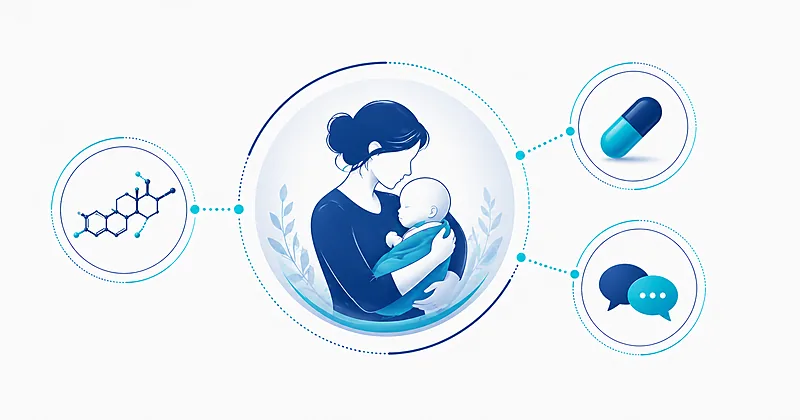
- Postpartum depression treatment options now span three distinct classes: neuroactive steroids (zuranolone, brexanolone), SSRIs, and structured psychotherapy.
- Zuranolone (oral, 14-day course) and brexanolone (60-hour intravenous infusion) demonstrated significant Hamilton Depression Rating Scale reductions versus placebo within days, with effects sustained through day 30 to 45.
- Sertraline remains the SSRI with the strongest accumulated breastfeeding safety data and is widely recommended for moderate cases requiring pharmacotherapy.
- Psychotherapy (interpersonal therapy, cognitive behavioral therapy) is supported as first-line for mild presentations and as an adjunct in moderate-to-severe disease.
- Treatment selection in the 2023 ACOG Clinical Practice Guideline is anchored to severity, breastfeeding status, prior treatment response, and patient preference.
Why Postpartum Depression Treatment Matters
Postpartum depression affects an estimated 13 to 15% of women in the year following childbirth and is a leading contributor to maternal morbidity in the United States. The condition is associated with adverse infant attachment, child developmental outcomes, and rare but serious risks including suicidal ideation. Effective postpartum depression treatment is therefore a maternal-child health priority.
Until recently, the mainstay of postpartum depression treatment mirrored the approach to non-postpartum major depression: SSRIs and structured psychotherapy. The 2018 FDA approval of intravenous brexanolone and the 2023 approval of oral zuranolone introduced a new class — neuroactive steroids — that demonstrate measurable antidepressant effects within days rather than weeks.
This shift is clinically meaningful because the postpartum window is unforgiving. Each week of untreated maternal depression occurs at a developmentally critical period for the infant, and many women face barriers to engaging with longer-acting medications during the early postpartum months. Rapid-acting options expand the postpartum depression treatment armamentarium meaningfully.
The Edinburgh Postnatal Depression Scale (EPDS) is the most validated screening instrument for perinatal depression and is endorsed by ACOG, the USPSTF, and most obstetric professional bodies. The 2023 ACOG Clinical Practice Guideline No. 4 provides a unified framework for screening, treatment selection, and breastfeeding considerations across pregnancy and postpartum.
Comparative evidence across the three principal treatment approaches — neuroactive steroids, SSRIs, and structured psychotherapy — has matured substantially in the last five years. The synthesis below organises the comparative evidence by mechanism, onset of action, breastfeeding compatibility, and severity-matched use.
What Evidence Was Reviewed
This synthesis draws on the Meltzer-Brody 2018 pooled phase 3 brexanolone trials, the ROBIN and SKYLARK randomized trials of zuranolone, the Wisner 2006 sertraline-versus-nortriptyline RCT, the 2021 Brown Cochrane review of antidepressants in postnatal depression, the Sockol meta-analyses of psychotherapy for perinatal depression, the Levis 2020 BMJ individual participant data meta-analysis of EPDS accuracy, and the 2023 ACOG Clinical Practice Guideline No. 4.
Together these sources include more than 15,000 women across screening accuracy studies, more than 600 women in pivotal neuroactive steroid trials, and pooled randomized data on SSRIs and psychotherapy specifically in postpartum depression treatment. Outcomes assessed include Hamilton Depression Rating Scale (HAM-D) and EPDS reductions, response rates, remission rates, and breastfeeding compatibility.
| Study / Source | Design | n | Comparison | Primary Outcome |
|---|---|---|---|---|
| Meltzer-Brody 2018 (Lancet) | Pooled phase 3 RCTs | 246 | Brexanolone vs placebo (60-hr IV) | HAM-D-17 change at hour 60 |
| ROBIN (Deligiannidis 2021) | RCT | 153 | Zuranolone 30 mg vs placebo (14 d) | HAM-D-17 change at day 15 |
| SKYLARK (Deligiannidis 2023) | RCT | 200 | Zuranolone 50 mg vs placebo (14 d) | HAM-D-17 change at day 15 |
| Wisner 2006 | RCT | 109 | Sertraline vs nortriptyline | Response and remission |
| RESPOND (Sharp 2010) | Pragmatic RCT | 254 | SSRI vs psychosocial intervention | EPDS at 4 and 18 weeks |
| Brown 2021 (Cochrane) | SR/MA | ~3,000 (11 trials) | Antidepressants vs placebo / other | Symptom score reduction |
| O’Hara 2000 | RCT | 120 | IPT vs waitlist | HAM-D and BDI |
| Sockol meta-analyses | SR/MA of psychotherapy | NR (multiple trials pooled) | Psychotherapy vs control | Pooled effect size on depression |
| Levis 2020 (BMJ, IPDMA) | Individual participant data MA | 15,557 | EPDS vs reference standard | Sensitivity / specificity for MDD |
| Cox 1987 | Validation cohort | 84 | EPDS development | Detection of postnatal depression |
| USPSTF 2019 (perinatal) | Recommendation statement | Evidence review | Prevention interventions | Recommendation grade |
| ACOG CPG No. 4 (2023) | Clinical practice guideline | Synthesis of literature | Stepped-care framework | Treatment recommendations |
Key Findings — Synthesised by Theme
Theme 1 — Neuroactive Steroids Show Rapid Antidepressant Effects
Brexanolone and zuranolone are positive allosteric modulators of the GABA-A receptor that demonstrate rapid antidepressant effects in postpartum depression treatment. The 2018 Meltzer-Brody pooled phase 3 trials randomized 246 women across three studies to brexanolone 60-hour intravenous infusion versus placebo. At hour 60, mean HAM-D-17 reduction was significantly greater with brexanolone than placebo, with response and remission sustained through day 30.
Zuranolone, an oral analogue, was studied in the ROBIN trial (n=153, 30 mg dose) and the SKYLARK trial (n=200, 50 mg dose) over a 14-day course. SKYLARK demonstrated a placebo-adjusted HAM-D-17 reduction of approximately 4 points at day 15, with statistically significant separation from placebo evident as early as day 3. Effects persisted through day 45 in both trials, supporting durability beyond the active dosing period.
The mechanism is distinct from SSRIs. Whereas SSRIs require 4 to 6 weeks of titration to achieve serotonergic adaptation, neuroactive steroids modulate GABAergic tone within hours. This pharmacological distinction underpins both the rapid-onset advantage and the open question of optimal sequencing relative to SSRIs in postpartum depression treatment pathways.
Theme 2 — SSRIs Offer Robust Efficacy and the Strongest Breastfeeding Safety Data
SSRIs remain a foundation of postpartum depression treatment with the strongest accumulated efficacy and safety data, particularly during breastfeeding. The 2021 Brown Cochrane review of antidepressants in postnatal depression found moderate-quality evidence that SSRIs are more effective than placebo for symptom reduction at 4 to 25 weeks. The number of randomized trials specifically in postpartum depression remains smaller than for general adult major depression.
Sertraline is the preferred SSRI in lactation because of its low milk-to-plasma ratio and minimal detectable infant serum concentrations. Paroxetine is an acceptable alternative with similarly low infant exposure. Fluoxetine has a longer half-life and active metabolites, which may produce higher infant exposure and is generally avoided as first-line in breastfeeding patients.
The Wisner 2006 randomized comparison of sertraline versus nortriptyline in postpartum depression found similar response rates between agents, but sertraline had a more favorable side-effect profile. SSRI onset of action typically requires 4 to 6 weeks, which can be a clinically meaningful limitation in postpartum settings where rapid recovery is desired.
Theme 3 — Psychotherapy Is Effective Alone or as Adjunct
Psychotherapy — particularly interpersonal therapy (IPT) and cognitive behavioral therapy (CBT) — is effective for postpartum depression treatment as monotherapy in mild-to-moderate cases or as an adjunct in moderate-to-severe presentations. The Sockol meta-analyses of perinatal depression treatments reported pooled effect sizes (Cohen’s d) in the range of 0.6 to 0.7 for psychotherapy versus control, comparable to effect sizes seen in pharmacotherapy trials.
The O’Hara 2000 randomized trial established IPT efficacy specifically in postpartum depression: 12 weekly sessions produced higher response rates than waitlist control with sustained benefit at 18 months. CBT has accumulated similar evidence in the perinatal context. The 2023 ACOG Clinical Practice Guideline endorses psychotherapy as first-line for mild postpartum depression and as a component of stepped care for moderate-to-severe presentations.
Theme 4 — EPDS Screening Identifies Cases That Benefit From Treatment
EPDS screening identifies postpartum depression cases that benefit from treatment. The 2020 Levis individual participant data meta-analysis (BMJ) pooled 58 primary studies with 15,557 women and validated EPDS performance against gold-standard diagnostic interviews. At a cutoff of 11 or higher, sensitivity for major depression was approximately 81% and specificity 88%; the cutoff of 13 increases specificity at the cost of sensitivity.
ACOG endorses screening at the postpartum visit and at well-child visits during the first year. The 2019 USPSTF recommendation reaffirmed routine perinatal depression screening with adequate referral systems in place. Without robust referral pathways, screening alone has not been shown to improve outcomes — the screen-treat link is essential to realising any benefit from postpartum depression treatment programs.
Theme 5 — Treatment Selection Anchored to Severity and Breastfeeding
Treatment selection in postpartum depression treatment is anchored to severity, breastfeeding status, prior treatment history, and access. The 2023 ACOG Clinical Practice Guideline No. 4 provides a stepped-care framework: psychotherapy first-line for mild presentations, SSRI plus psychotherapy for moderate, and consideration of neuroactive steroids or combined approaches for severe or treatment-resistant cases.
For breastfeeding patients, sertraline is the SSRI with the most robust safety data. Brexanolone requires a 60-hour inpatient infusion under monitoring for sedation and is therefore reserved for severe cases where rapid recovery is critical. Zuranolone provides an oral alternative without inpatient monitoring, but breastfeeding safety data remain limited; current labeling recommends shared decision-making between patient and clinician.
Clinical pearl — The dominant clinical question in modern postpartum depression treatment is no longer “does pharmacotherapy work” — it is “which agent matches this patient’s severity, timeline, and breastfeeding goals.” The 2023 ACOG framework structures this decision explicitly.
Brexanolone is intravenous allopregnanolone administered as a 60-hour continuous infusion under inpatient monitoring with REMS-mandated sedation surveillance. Zuranolone is an oral analogue dosed at 50 mg once daily for 14 days without inpatient monitoring requirements. Both modulate the GABA-A receptor and demonstrate rapid antidepressant effect in pivotal trials. Practical use favors zuranolone for outpatient management; brexanolone retains a niche role for severe cases where inpatient supervision is appropriate.
Sertraline is the preferred SSRI during breastfeeding based on the largest body of pharmacokinetic and clinical safety data. Reported milk-to-plasma ratios are low and infant serum concentrations are typically undetectable. Paroxetine is an acceptable alternative with similarly favorable infant exposure data. Fluoxetine, citalopram, and escitalopram have longer half-lives or active metabolites that increase relative infant exposure and are generally not first-line for breastfeeding postpartum depression treatment.
Combination therapy is supported in moderate-to-severe postpartum depression by meta-analytic evidence from general adult depression and by smaller perinatal-specific trials. Combined treatment generally produces larger effect sizes than monotherapy, though direct comparative data in postpartum depression are limited. The 2023 ACOG Clinical Practice Guideline endorses combined treatment for moderate-to-severe presentations and for those with prior treatment history.
The Levis 2020 IPDMA established that the cutoff of 11 or higher maximises sensitivity for major depression (approximately 81%) at acceptable specificity (88%). The cutoff of 13 increases specificity at the expense of sensitivity and may be preferred where confirmatory diagnostic capacity is limited. Item 10 (suicidal ideation) requires immediate evaluation regardless of total score. ACOG endorses cutoff selection based on local referral capacity and the trade-off between false positives and missed cases.
ACOG Clinical Practice Guideline No. 4 (2023) consolidates fragmented prior committee opinions into a single stepped-care framework for perinatal mental health. Key changes include explicit recognition of neuroactive steroids as a treatment option, formalisation of the screen-treat-refer pathway, integration of breastfeeding-specific drug selection guidance, and a unified approach to mental health conditions across pregnancy and the postpartum year. It is now the central reference document for postpartum depression treatment in obstetric practice.
Quality & Consistency of the Evidence
Evidence quality across the postpartum depression treatment literature is high for the central efficacy questions of brexanolone and zuranolone versus placebo, moderate-to-strong for SSRIs and psychotherapy, and high for EPDS screening accuracy. The pivotal neuroactive steroid trials, the Brown Cochrane review, the Levis IPDMA, and the Sockol meta-analyses provide the principal evidence base.
What the Evidence Does Not Show
Several specific gaps remain in the postpartum depression treatment evidence base. Naming these gaps explicitly is more useful than the generic “more research is needed” framing.
Specific evidence gaps
- Direct head-to-head trials of zuranolone versus SSRIs are not available; comparative effectiveness rests on indirect evidence and trial-to-trial extrapolation.
- Long-term outcomes beyond day 45 for zuranolone — including relapse rates and need for sequential pharmacotherapy — are not well characterized in published data.
- Breastfeeding safety data for zuranolone are limited to small pharmacokinetic studies; pivotal trials largely excluded breastfeeding participants and current labeling reflects this uncertainty.
- Optimal sequencing (which agent first, when to switch, when to combine) lacks randomized data and is currently driven by expert consensus and patient preference.
- Real-world effectiveness of zuranolone outside controlled trial conditions is still emerging since FDA approval in 2023.
- Long-term infant neurodevelopmental outcomes after intrauterine or breastfeeding exposure to neuroactive steroids are not yet characterized.
In addition, comparative effectiveness in specific subgroups — postpartum patients with prior history of treatment-resistant depression, those with perinatal anxiety comorbidity, and those with bipolar spectrum disorder presenting in the postpartum window — is poorly characterized. Pivotal trials largely enrolled patients with isolated postpartum major depressive disorder, leaving generalizability to comorbid presentations an inferential exercise.
Practical Implications for Postpartum Depression Treatment
Based on the current evidence, the following considerations may inform postpartum depression treatment practice. These are framed as evidence-based considerations rather than directive recommendations; clinical judgement, severity assessment, breastfeeding status, prior treatment response, and patient preference should guide individual decisions.
Implementation should be tailored to local mental health referral capacity, payer coverage of neuroactive steroids, and the patient’s breastfeeding goals. Postpartum depression treatment is a stepped, longitudinal process — initial agent selection is one component of a treatment plan that typically extends across the first postpartum year and beyond.
Evidence Grade & Bottom Line
Overall Evidence Grade — Strong (for class-level efficacy and EPDS screening); Moderate (for SSRI postpartum-specific efficacy and psychotherapy); Limited (for direct head-to-head class comparisons and zuranolone breastfeeding safety). The body of evidence supporting neuroactive steroids, SSRIs, and structured psychotherapy as effective postpartum depression treatment options is unlikely to change with future research. Class-comparison and breastfeeding safety questions are active areas where guidance may evolve.
Bottom Line
- Three approaches with distinct mechanisms now anchor postpartum depression treatment: neuroactive steroids, SSRIs, and structured psychotherapy.
- Zuranolone and brexanolone show rapid antidepressant effect within days, with sustained benefit through day 30 to 45 in pivotal trials.
- Sertraline remains the preferred SSRI for breastfeeding patients given the strongest accumulated infant exposure safety data.
- Psychotherapy is supported as first-line for mild presentations and as adjunct for moderate-to-severe disease.
- Direct comparative trials across classes and breastfeeding safety data for zuranolone are the principal open evidence questions.
Article Information & References
For Educational Purposes Only
This is an original evidence synthesis informed by the studies listed below. It does not replace clinical judgement. Drug dosages, indications, and breastfeeding considerations should be verified against current prescribing information and the most recent ACOG clinical practice guidelines.
References
- Meltzer-Brody S, Colquhoun H, Riesenberg R, et al. Brexanolone injection in post-partum depression: two multicentre, double-blind, randomised, placebo-controlled, phase 3 trials. Lancet. 2018;392(10152):1058–1070. DOI: 10.1016/S0140-6736(18)31551-4
- Deligiannidis KM, Meltzer-Brody S, Gunduz-Bruce H, et al. Effect of Zuranolone vs Placebo in Postpartum Depression: A Randomized Clinical Trial. JAMA Psychiatry. 2021;78(9):951–959. DOI: 10.1001/jamapsychiatry.2021.1559
- Deligiannidis KM, Meltzer-Brody S, Maximos B, et al. Zuranolone for the Treatment of Postpartum Depression. Am J Psychiatry. 2023;180(9):668–675. DOI: 10.1176/appi.ajp.20220785
- Wisner KL, Hanusa BH, Perel JM, et al. Postpartum depression: a randomized trial of sertraline versus nortriptyline. J Clin Psychopharmacol. 2006;26(4):353–360. DOI: 10.1097/01.jcp.0000227706.56870.dd
- Sharp DJ, Chew-Graham C, Tylee A, et al. A pragmatic randomised controlled trial to compare antidepressants with a community-based psychosocial intervention for the treatment of women with postnatal depression: the RESPOND trial. Health Technol Assess. 2010;14(43):iii–xi,1–153. DOI: 10.3310/hta14430
- Brown JVE, Wilson CA, Ayre K, et al. Antidepressant treatment for postnatal depression. Cochrane Database Syst Rev. 2021;(2):CD013560. DOI: 10.1002/14651858.CD013560.pub2
- Sockol LE. A systematic review and meta-analysis of interpersonal psychotherapy for perinatal women. J Affect Disord. 2018;232:316–328. DOI: 10.1016/j.jad.2018.01.018
- O’Hara MW, Stuart S, Gorman LL, Wenzel A. Efficacy of interpersonal psychotherapy for postpartum depression. Arch Gen Psychiatry. 2000;57(11):1039–1045. DOI: 10.1001/archpsyc.57.11.1039
- Cox JL, Holden JM, Sagovsky R. Detection of postnatal depression: development of the 10-item Edinburgh Postnatal Depression Scale. Br J Psychiatry. 1987;150:782–786. DOI: 10.1192/bjp.150.6.782
- Levis B, Negeri Z, Sun Y, Benedetti A, Thombs BD; DEPRESsion Screening Data (DEPRESSD) EPDS Group. Accuracy of the Edinburgh Postnatal Depression Scale (EPDS) for screening to detect major depression among pregnant and postpartum women: systematic review and meta-analysis of individual participant data. BMJ. 2020;371:m4022. DOI: 10.1136/bmj.m4022
- US Preventive Services Task Force; Curry SJ, Krist AH, Owens DK, et al. Interventions to Prevent Perinatal Depression: US Preventive Services Task Force Recommendation Statement. JAMA. 2019;321(6):580–587. DOI: 10.1001/jama.2019.0007
- American College of Obstetricians and Gynecologists’ Clinical Practice Guideline No. 4. Treatment and Management of Mental Health Conditions During Pregnancy and Postpartum. Obstet Gynecol. 2023;141(6):1262–1288. DOI: 10.1097/AOG.0000000000005202
- American College of Obstetricians and Gynecologists. ACOG Committee Opinion No. 757: Screening for Perinatal Depression. Obstet Gynecol. 2018;132(5):e208–e212. DOI: 10.1097/AOG.0000000000002927