
Differentiated Thyroid Cancer: 5 Key Clinical Insights
Synthesizing evidence on the thyroidectomy versus lobectomy decision, the 2015 ATA guideline shift, molecular profiling, and recurrence outcomes in differentiated thyroid cancer.
One-Minute Takeaway on Differentiated Thyroid Cancer Surgery
One-Minute Takeaway
- Differentiated thyroid cancer management has shifted toward thyroid lobectomy for low-risk tumors up to 4 cm following the 2015 ATA guideline update.
- Large registry analyses including the Adam NCDB study show comparable overall survival between lobectomy and total thyroidectomy for selected differentiated thyroid cancer patients.
- Lobectomy reduces surgical morbidity (hypoparathyroidism, recurrent laryngeal nerve injury) compared with total thyroidectomy and avoids lifelong levothyroxine in many patients.
- Molecular markers including BRAF V600E and TERT promoter mutations identify higher-risk differentiated thyroid cancer subgroups that may benefit from total thyroidectomy.
- Surveillance after lobectomy relies on ultrasound and thyroglobulin trajectories rather than the simpler post-thyroidectomy thyroglobulin paradigm.
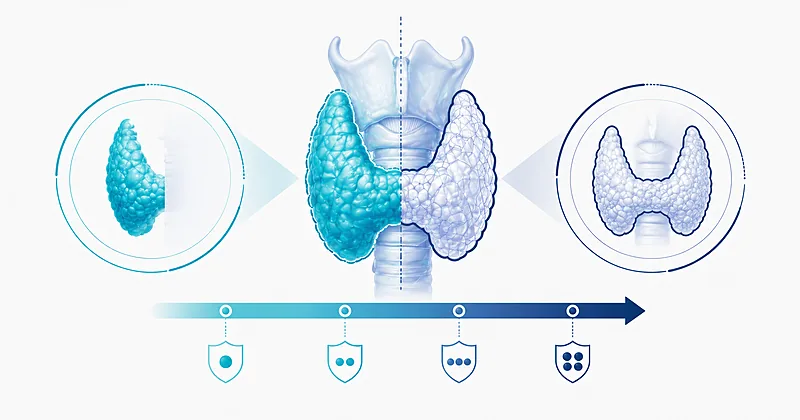
Why Differentiated Thyroid Cancer Surgery Matters Today
Thyroid cancer incidence has increased substantially over recent decades, with most of the rise attributable to small papillary differentiated thyroid cancers detected through expanded imaging. The vast majority are well-differentiated and carry an excellent prognosis. The question of how much surgery to perform has therefore become central to balancing oncologic safety against operative morbidity.
Historically, total thyroidectomy was the default approach for differentiated thyroid cancer larger than 1 cm, supported by registry analyses suggesting modest survival benefit (the Bilimoria 2007 NCDB analysis). The 2015 ATA Guidelines fundamentally reframed this paradigm, expanding lobectomy as an acceptable option for tumors up to 4 cm in selected low-risk patients.
Three forces continue to drive evolution in differentiated thyroid cancer surgery. First, larger and more granular registry analyses suggest survival is comparable across surgical approaches in low-risk patients. Second, molecular profiling (BRAF V600E, TERT promoter, RAS mutations) refines risk stratification. Third, patient-reported outcome research highlights the morbidity costs of total thyroidectomy.
The contemporary differentiated thyroid cancer surgical decision integrates tumor size, multifocality, lymph node status, extrathyroidal extension, molecular profile, and patient preference. This evidence synthesis examines five clinical insights that anchor current practice and the ongoing evolution of operative decision-making for endocrine surgeons.
Differentiated Thyroid Cancer: What Evidence Was Reviewed
This evidence synthesis examines literature spanning the differentiated thyroid cancer surgical extent decision: the 2015 ATA Management Guidelines, large registry analyses (NCDB, SEER), institutional cohort studies from major endocrine surgical centers, meta-analyses comparing lobectomy with total thyroidectomy, and molecular biomarker investigations.
Priority is given to the 2015 ATA Guidelines as the contemporary practice anchor, the Adam NCDB analysis that influenced the guideline shift, and large institutional series (Memorial Sloan Kettering, Mayo Clinic, Kuma Hospital) reporting long-term lobectomy outcomes. Molecular evidence draws from Xing’s BRAF mortality analysis and TERT mutation cohorts.
Where direct head-to-head randomized trials of surgical extent are unavailable, contemporary practice rests on consistently designed observational studies, multi-institutional cohort analyses, and guideline-level evidence syntheses informing differentiated thyroid cancer decision-making.
| Study / Year | Design | n | Comparison / Focus | Key Finding |
|---|---|---|---|---|
| Haugen 2015 ATA Guidelines | Consensus / SR | n/a | DTC management framework | Lobectomy expanded as option for tumors ≤4 cm in selected low-risk patients without aggressive features |
| Adam 2014 (NCDB) | Registry analysis | 61,775 | Lobectomy vs total thyroidectomy in PTC | Extent of surgery NOT associated with overall survival after risk adjustment |
| Bilimoria 2007 (NCDB) | Registry analysis | ~52,000 | Lobectomy vs total thyroidectomy in PTC | Modest survival benefit for total thyroidectomy in tumors >1 cm; influenced earlier guidelines |
| Nixon 2012 (MSKCC) | Institutional cohort | ~889 | Lobectomy in well-differentiated intrathyroid disease | Comparable recurrence-free survival between lobectomy and total thyroidectomy in matched low-risk patients |
| Matsuzu 2014 (Kuma) | Institutional cohort | 1,088 | Lobectomy long-term follow-up in PTC | Low recurrence and excellent disease-specific survival at extended follow-up |
| Hay 2002 (Mayo Clinic) | Institutional cohort | 2,444 | Six-decade PTC outcomes | Excellent long-term outcomes; informed risk stratification frameworks (MACIS score) |
| Xing 2013 (BRAF) | Multicenter cohort | 1,849 | BRAF V600E and PTC mortality | BRAF V600E associated with higher disease-specific mortality, particularly with other adverse features |
| Macedo 2015 | Meta-analysis | Pooled cohorts | TT vs lobectomy in small unilateral PTC | Comparable recurrence and survival in small unilateral disease |
| Yu 2011 (SEER) | Registry analysis | 18,445 | PTC microcarcinoma management | No survival difference between lobectomy and TT in microcarcinoma; questioned aggressive treatment |
| Vargas-Pinto 2019 | Systematic review | Pooled cohorts | Lobectomy in low-risk PTC | Comparable oncologic outcomes; lower morbidity with lobectomy |
Key Findings on Differentiated Thyroid Cancer Surgery
Across the five insights examined, the contemporary picture of differentiated thyroid cancer surgery emerges as a graduated risk-adapted approach: lobectomy for low-risk small intrathyroidal disease, total thyroidectomy for higher-risk features, and individualized decisions in the intermediate zone where molecular markers and patient preference become decisive.
Insight 1 — The 2015 ATA Shift Expanded Lobectomy Indications
Pre-2015 ATA guidance recommended total thyroidectomy for differentiated thyroid cancer larger than 1 cm, primarily based on the Bilimoria NCDB analysis suggesting modest survival benefit. The 2015 ATA Guidelines fundamentally restructured this approach, designating lobectomy as appropriate for unifocal intrathyroidal differentiated thyroid cancer up to 4 cm without lymph node involvement, extrathyroidal extension, or aggressive histology.
This expanded the lobectomy-eligible population dramatically — bringing T1b (1–2 cm) and T2 (2–4 cm) tumors into the lobectomy category. The shift reflected accumulated evidence that the earlier survival signal was modest, attenuated in larger contemporary cohorts, and likely confounded by patient selection.
The guideline reframe represents one of the most consequential paradigm shifts in modern endocrine surgery and continues to evolve as additional data accumulate.
Insight 2 — Tumor Size and Risk Stratification Drive Decisions
The Adam NCDB analysis of 61,775 patients found that extent of surgery was not associated with overall survival in differentiated thyroid cancer once contemporary risk factors were controlled. This finding directly contributed to the 2015 ATA reframe of acceptable surgical options.
Risk stratification has shifted from size alone to a composite of size, extrathyroidal extension, vascular invasion, lymph node involvement, multifocality, and aggressive histologic variants (tall cell, columnar, hobnail). Patients with isolated small intrathyroidal disease are now considered low-risk regardless of size up to 4 cm in current guidelines.
Larger tumors (>4 cm), gross extrathyroidal extension, clinically positive lymph nodes, distant metastases, and aggressive histologic variants remain accepted indications for total thyroidectomy under current guidance.
Insight 3 — Recurrence Outcomes Are Comparable in Selected Patients
The Matsuzu Kuma Hospital series of 1,088 lobectomies for papillary differentiated thyroid cancer with long-term follow-up reported low recurrence rates and excellent disease-specific survival, supporting lobectomy as oncologically sound in carefully selected low-risk disease.
The Nixon MSKCC analysis comparing lobectomy with total thyroidectomy in matched low-risk patients found comparable recurrence-free survival. The Macedo 2015 meta-analysis pooling small unilateral papillary differentiated thyroid cancer cohorts reached similar conclusions, with comparable recurrence between approaches in well-selected patients.
Recurrence patterns differ between approaches: lobectomy patients can develop disease in the contralateral lobe (typically managed with completion thyroidectomy), while total thyroidectomy patients may develop nodal or distant recurrence requiring more complex management.
Insight 4 — Lobectomy Reduces Surgical Morbidity
Surgical morbidity favors lobectomy for differentiated thyroid cancer. Hypoparathyroidism — the most common total thyroidectomy complication — is essentially eliminated with lobectomy because the contralateral parathyroids remain in situ. Recurrent laryngeal nerve injury risk is approximately halved (one nerve at risk versus two).
Most lobectomy patients achieve euthyroidism without supplementation, whereas total thyroidectomy mandates lifelong levothyroxine. Long-term thyroid hormone management is consistent but not without consequence: dose adjustment, monitoring, and cardiovascular and bone effects of suppressive therapy when used.
Patient-reported outcome research highlights ongoing quality-of-life implications of total thyroidectomy beyond perioperative complications, supporting the inclusion of patient preference in shared decision-making for differentiated thyroid cancer surgery.
Insight 5 — Molecular Profiling Is Refining Surveillance and Selection
Molecular profiling has refined risk stratification beyond size and histology. The Xing BRAF analysis of 1,849 patients reported higher mortality in BRAF V600E-mutated papillary differentiated thyroid cancer, particularly when combined with other adverse features.
TERT promoter mutations identify a higher-risk subgroup associated with worse disease-specific survival. RAS mutations are generally associated with follicular variants and lower aggressiveness. The 2015 ATA Guidelines incorporate molecular markers into intermediate-risk classification.
Surveillance after lobectomy relies on ultrasound and serum thyroglobulin trajectories with stimulation as needed; the absence of complete thyroid ablation makes the simpler thyroglobulin paradigm of post-thyroidectomy follow-up less applicable.
Across the 5 insights, the consistent signal in differentiated thyroid cancer evidence is that surgical extent should match risk profile — lobectomy for low-risk small intrathyroidal disease, total thyroidectomy for higher-risk features — with molecular markers increasingly informing the intermediate zone.
The 2015 ATA Guidelines stratify differentiated thyroid cancer patients into three risk categories based on a composite of clinical, pathologic, and molecular factors:
Low risk: Intrathyroidal disease without vascular invasion, gross extrathyroidal extension, aggressive histology, or clinically apparent nodal metastases. Up to 5 small (<2 mm) lymph node micrometastases acceptable.
Intermediate risk: Microscopic extrathyroidal extension, aggressive histologic variant (tall cell, hobnail, columnar), vascular invasion, more than 5 nodes ≥0.2 cm, or BRAF V600E mutation in some applications.
High risk: Gross extrathyroidal extension, incomplete tumor resection, distant metastases, lymph node ≥3 cm, TERT promoter mutation, or postoperative thyroglobulin suggesting persistent disease.
The categories guide both initial surgical extent decisions and the role of postoperative radioactive iodine therapy.
Lobectomy may be appropriate when:
- Unifocal differentiated thyroid cancer ≤4 cm
- No clinically apparent lymph node metastases (cN0)
- No prior head/neck radiation history
- No distant metastases
- No clinically aggressive histologic variant
- Patient understands surveillance requirements
Total thyroidectomy is generally indicated when:
- Tumor >4 cm
- Gross extrathyroidal extension
- Clinically positive lymph nodes (cN1)
- Distant metastases
- Bilateral or multifocal differentiated thyroid cancer
- High-risk molecular profile in selected applications
- Patient preference for definitive single procedure
- Inability to perform reliable surveillance
BRAF V600E mutation: Most common in classical papillary thyroid cancer. Associated with extrathyroidal extension and lymph node spread. The Xing JAMA analysis reported higher disease-specific mortality, particularly in combination with other adverse features. Independent prognostic signal but modest absolute risk increase in low-risk disease.
TERT promoter mutations: Strong independent prognostic marker. Associated with worse disease-specific survival. Combined BRAF + TERT confers highest risk among molecular profiles. Found in approximately 10% of papillary differentiated thyroid cancer.
RAS mutations: More common in follicular variant and follicular cancers. Generally associated with less aggressive behavior. May suggest follicular biology in cytologically indeterminate nodules.
Clinical applications: Indeterminate cytology (Bethesda III/IV), risk stratification of confirmed differentiated thyroid cancer, and refining surgical extent decisions in intermediate-risk patients.
After total thyroidectomy (with or without RAI): Stimulated or suppressed thyroglobulin (Tg) is the primary biochemical marker. Tg below assay threshold on TSH suppression generally indicates excellent biochemical response. Neck ultrasound at 6–12 months and periodically thereafter. TgAb monitoring remains essential since antibodies interfere with the Tg assay.
After lobectomy: Tg interpretation is more complex because residual normal thyroid tissue produces baseline Tg. Absolute Tg level is less informative; trajectory matters more. Stimulated Tg may be used to assess remaining tissue activity. Neck ultrasound remains the primary imaging modality.
Threshold for completion thyroidectomy includes rising Tg trends, new contralateral disease, or aggressive features in the original specimen identified on final pathology. Patient education on warning signs is central to successful long-term surveillance.
Quality of Evidence on Differentiated Thyroid Cancer Surgery
Evidence quality varies across the five insights examined in this differentiated thyroid cancer surgery synthesis. Registry analyses provide population-scale findings on extent-of-surgery outcomes but cannot replace randomized comparison. Institutional series provide detailed long-term follow-up but with selection bias. Molecular evidence is rapidly evolving with consistent prognostic signals.
- 2015 ATA Guidelines — Robust consensus document with extensive systematic review; lacks RCT-level evidence but reflects best available synthesis.
- Registry survival analyses (Adam, Bilimoria, Yu) — Large samples, population-level inference, but observational with potential confounding by indication.
- Institutional lobectomy series (Matsuzu, Hay, Nixon) — Detailed long-term follow-up data; selection bias from referral patterns and institutional expertise.
- Surgical morbidity comparisons — Consistent across multiple sources; mechanistically anchored in fewer structures at risk during lobectomy.
- Molecular marker prognostic value — Strong consistent prognostic association (BRAF, TERT); predictive validation for surgical extent decisions less mature.
- Lobectomy surveillance protocols — Consensus-driven; head-to-head comparative data on surveillance algorithm efficacy limited.
- Randomized comparisons of surgical extent — Absent; ethical and practical barriers preclude conventional RCTs in this population.
What the Evidence Does Not Show
Specific Evidence Gaps
Several specific evidence gaps limit confident differentiated thyroid cancer surgical extent recommendations across the five insights examined.
No randomized comparison: Surgical extent has not been directly compared in adequately powered randomized trials. All current evidence is observational, with selection bias an inherent limitation that risk-adjustment imperfectly addresses.
Molecular-driven decisions: Whether BRAF V600E or TERT promoter mutations should drive extension to total thyroidectomy in otherwise low-risk patients is not validated by comparative outcome data. The predictive validity of molecular markers for surgical extent decisions remains hypothesis-generating.
Optimal lobectomy surveillance: The most efficient surveillance algorithm after lobectomy — particularly thyroglobulin thresholds, imaging frequency, and timing of contralateral evaluation — lacks comparative protocol-level evidence.
Long-term follow-up beyond 15–20 years: Most lobectomy series report intermediate follow-up; very long-term recurrence trajectories are less well characterized.
Patient-reported outcomes integration: How to systematically incorporate patient preferences into the differentiated thyroid cancer extent decision lacks standardized decision aids with validated outcomes.
Practical Implications for Differentiated Thyroid Cancer Surgery
Based on the current evidence, five practice-relevant considerations emerge for differentiated thyroid cancer surgical planning. These are framed as evidence-supported considerations rather than directive recommendations and require individualization to tumor characteristics, patient preferences, and institutional context.
Lobectomy Is Acceptable for Selected Low-Risk Disease
Evidence supports lobectomy for unifocal intrathyroidal differentiated thyroid cancer up to 4 cm without aggressive features. Risk stratification using 2015 ATA criteria identifies appropriate candidates with comparable oncologic outcomes.
Total Thyroidectomy Remains Appropriate for High-Risk Features
Tumors >4 cm, gross extrathyroidal extension, clinically positive nodes, distant metastases, and aggressive histologic variants remain indications for total thyroidectomy under current ATA guidance.
Molecular Markers Inform Intermediate-Risk Decisions
BRAF V600E and TERT promoter mutations identify higher-risk subgroups. Molecular profiling has utility in indeterminate cytology and in refining surgical extent decisions for intermediate-risk patients.
Patient Preference Is a Legitimate Decision Factor
When oncologic outcomes are comparable, patient values regarding lifelong levothyroxine, surveillance complexity, and preference for definitive single procedure appropriately influence the decision.
Surveillance Differs Meaningfully Between Approaches
Post-lobectomy surveillance requires nuanced thyroglobulin interpretation and ultrasound-anchored monitoring. Counsel patients on differences and indications for completion thyroidectomy.
These considerations apply most directly to elective initial surgery in differentiated thyroid cancer. Recurrent disease, anaplastic transformation, and pediatric cases warrant separate evidence frameworks and multidisciplinary specialist input that may diverge from the patterns in adult elective practice.
Evidence Grade and Bottom Line
Overall Evidence Grade: Moderate for the lobectomy-versus-total-thyroidectomy decision in low-risk disease (large registry and institutional series, no RCTs); Moderate for the 2015 ATA framework as a whole; Moderate for surgical morbidity comparisons; Moderate-to-Limited for molecular marker-driven extent decisions; Limited for optimal lobectomy surveillance protocols.
Bottom Line
- Evidence supports thyroid lobectomy as an oncologically acceptable option for selected low-risk differentiated thyroid cancer up to 4 cm without aggressive features.
- Total thyroidectomy remains appropriate for tumors >4 cm, gross extrathyroidal extension, clinically positive lymph nodes, distant metastases, or aggressive histologic variants.
- Lobectomy reduces hypoparathyroidism and recurrent laryngeal nerve injury risk and avoids lifelong levothyroxine in many patients.
- Molecular profiling (BRAF V600E, TERT promoter mutations) refines risk stratification and informs intermediate-risk decision-making but lacks predictive validation for surgical extent.
- No randomized trial directly compares surgical extent in differentiated thyroid cancer; current practice rests on consistently designed observational evidence and guideline consensus.
Article Information & References
Disclaimer
For Educational Purposes Only. This is an original evidence synthesis informed by the studies listed below. It does not replace clinical judgement. Drug dosages should be verified against current prescribing information.
References
- Haugen BR, Alexander EK, Bible KC, et al. 2015 American Thyroid Association Management Guidelines for Adult Patients with Thyroid Nodules and Differentiated Thyroid Cancer. Thyroid. 2016;26(1):1-133. DOI: 10.1089/thy.2015.0020
- Adam MA, Pura J, Gu L, et al. Extent of surgery for papillary thyroid cancer is not associated with survival: an analysis of 61,775 patients. Ann Surg. 2014;260(4):601-605. DOI: 10.1097/SLA.0000000000000925
- Bilimoria KY, Bentrem DJ, Ko CY, et al. Extent of surgery affects survival for papillary thyroid cancer. Ann Surg. 2007;246(3):375-381. DOI: 10.1097/SLA.0b013e31814697d9
- Nixon IJ, Ganly I, Patel SG, et al. Thyroid lobectomy for treatment of well differentiated intrathyroid malignancy. Surgery. 2012;151(4):571-579. DOI: 10.1016/j.surg.2011.08.016
- Matsuzu K, Sugino K, Masudo K, et al. Thyroid lobectomy for papillary thyroid cancer: long-term follow-up study of 1,088 cases. World J Surg. 2014;38(1):68-79. DOI: 10.1007/s00268-013-2224-1
- Hay ID, Thompson GB, Grant CS, et al. Papillary thyroid carcinoma managed at the Mayo Clinic during six decades (1940-1999): temporal trends in initial therapy and long-term outcome in 2444 consecutively treated patients. World J Surg. 2002;26(8):879-885. DOI: 10.1007/s00268-002-6612-1
- Xing M, Alzahrani AS, Carson KA, et al. Association between BRAF V600E mutation and mortality in patients with papillary thyroid cancer. JAMA. 2013;309(14):1493-1501. DOI: 10.1001/jama.2013.3190
- Liu R, Xing M. TERT promoter mutations in thyroid cancer. Endocr Relat Cancer. 2016;23(3):R143-R155. DOI: 10.1530/ERC-15-0533
- Macedo FI, Mittal VK. Total thyroidectomy versus lobectomy as initial operation for small unilateral papillary thyroid carcinoma: a meta-analysis. Surg Oncol. 2015;24(2):117-122. DOI: 10.1016/j.suronc.2015.04.005
- Yu XM, Wan Y, Sippel RS, Chen H. Should all papillary thyroid microcarcinomas be aggressively treated? An analysis of 18,445 cases. Ann Surg. 2011;254(4):653-660. DOI: 10.1097/SLA.0b013e318230036d
- Vargas-Pinto S, Romero Arenas MA. Lobectomy compared to total thyroidectomy for low-risk papillary thyroid cancer: a systematic review. J Surg Res. 2019;242:244-251. DOI: 10.1016/j.jss.2019.04.036
- Nickel B, Brito JP, Moynihan R, Barratt A, Jordan S, McCaffery K. Patients’ experiences of diagnosis and management of papillary thyroid microcarcinoma: a qualitative study. BMC Cancer. 2018;18(1):242. DOI: 10.1186/s12885-018-4152-9