
Inguinal Hernia Repair: 10-Year Outcomes Robustly Reviewed
Synthesizing long-term evidence on watchful waiting, Lichtenstein mesh repair, laparoscopic and robotic TAPP/TEP approaches, and chronic post-operative pain outcomes after inguinal hernia repair.
One-Minute Takeaway on Inguinal Hernia Repair
One-Minute Takeaway
- Inguinal hernia repair evidence supports watchful waiting as a safe initial strategy in asymptomatic or minimally symptomatic men based on the landmark Fitzgibbons RCT.
- Most patients managed with watchful waiting eventually require operation for symptom progression; the strategy delays rather than avoids surgery.
- Open Lichtenstein mesh repair and laparoscopic TAPP/TEP show comparable long-term recurrence; laparoscopic approaches reduce chronic pain and accelerate return to activity.
- Chronic post-operative pain develops in approximately 10–15% of inguinal hernia repair patients and represents the most consequential long-term morbidity.
- Robotic TAPP repair offers ergonomic advantages and a flatter learning curve but lacks demonstrated outcome superiority over conventional laparoscopic repair.
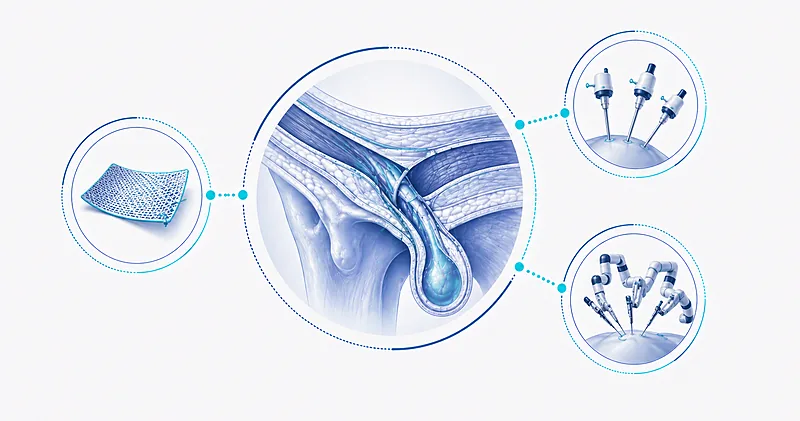
Why Inguinal Hernia Repair Decisions Matter
Inguinal hernia repair is among the most common general surgical operations worldwide, with over 800,000 procedures performed annually in the United States and approximately 20 million globally. The lifetime risk of inguinal hernia in men approaches 27%; in women it is closer to 3%.
Three forces have shaped contemporary inguinal hernia repair practice. The first is the Fitzgibbons watchful waiting trial demonstrating that observation is safe in minimally symptomatic patients. The second is the maturation of laparoscopic approaches showing benefits in chronic pain and recovery time.
The third force is the emergence of robotic platforms with uncertain incremental value. Despite high operative volume, controversy persists: watchful waiting safety in different patient populations remains contested, and approach selection between open Lichtenstein and laparoscopic repair varies markedly across regions and surgeons.
Long-term outcomes — particularly recurrence rates beyond 5 years and chronic post-operative pain — are essential to understanding inguinal hernia repair value. The Fitzgibbons trial and major laparoscopic versus open trials have follow-up windows that allow meaningful comparison.
This evidence synthesis examines 10-year outcomes across the inguinal hernia repair landscape, integrating randomized trial data, large registries, and HerniaSurge international guidelines to support contemporary surgical decisions.
Inguinal Hernia Repair: What Evidence Was Reviewed
This evidence synthesis examines literature spanning 10-year outcomes in inguinal hernia repair: the Fitzgibbons watchful waiting RCT and its long-term follow-up, the Veterans Affairs Cooperative trial comparing open mesh with laparoscopic repair, the O’Dwyer UK observation trial, large European hernia registries, and the HerniaSurge international guidelines.
The evidence base draws from randomized controlled trials with extended follow-up, multi-institutional registries, systematic reviews of robotic versus conventional laparoscopic approaches, and consensus syntheses. Where direct head-to-head trials of robotic versus laparoscopic repair are limited, observational and cost-effectiveness analyses provide supporting context for inguinal hernia repair decisions.
Studies were prioritized for currency, methodological quality, and direct relevance to active practice. Particular attention was given to evidence with at least 5-year follow-up to support meaningful comparison of long-term recurrence and chronic pain outcomes.
| Study / Year | Design | n | Comparison / Focus | Key Finding |
|---|---|---|---|---|
| Fitzgibbons 2006 (JAMA) | RCT | 366 | Watchful waiting vs surgical repair | No significant pain difference at 2 years; watchful waiting safe initial strategy in minimally symptomatic men |
| Fitzgibbons 2013 (Ann Surg) | RCT long-term follow-up | 366 | Watchful waiting long-term outcomes | Crossover to repair ~70% at extended follow-up; acute incarceration rare (<1%/year) |
| O’Dwyer 2006 (Ann Surg) | RCT | 160 | Observation vs repair (UK trial) | Confirmed watchful waiting safety in asymptomatic men; high crossover rate |
| Neumayer 2004 (NEJM — VA) | Multicenter RCT | 2,164 | Open mesh vs laparoscopic repair | 2-year recurrence higher with laparoscopic (10.1% vs 4.9%); strongly modulated by surgeon experience |
| Eklund 2010 (SMIL) | RCT 5-year follow-up | ~1,400 | Laparoscopic vs Lichtenstein | Chronic pain less common after laparoscopic at 5 years; recurrence comparable |
| HerniaSurge 2018 (Simons) | International guidelines | n/a | Comprehensive groin hernia management | Approach selection algorithm; lap preferred for bilateral/recurrent; mesh standard of care |
| Bittner 2015 (IEHS) | Consensus / SR | n/a | Laparoscopic TAPP/TEP guidelines | Detailed technique recommendations and learning curve estimates for laparoscopic repair |
| Bisgaard 2008 (Danish) | National registry | ~1,400 | Re-recurrence by repair type | Lower re-recurrence after laparoscopic repair of recurrent hernia previously fixed by open |
| Aiolfi 2021 (Ann Surg) | Network meta-analysis | Pooled RCTs | Open vs lap vs robotic repair | Robotic not superior to laparoscopic for primary unilateral; comparable recurrence/chronic pain |
| Köckerling 2019 (Herniamed) | Registry analysis | ~80,000 | Real-world outcomes by approach | Outcome variation strongly modulated by surgeon volume and case complexity |
Key Findings on Inguinal Hernia Repair Outcomes
Across the 10-year evidence horizon examined, inguinal hernia repair outcomes show distinct patterns: watchful waiting is initially safe but most patients eventually undergo surgery; mesh repair remains standard; chronic pain persists as the dominant long-term concern; and robotic repair has limited demonstrated outcome advantage.
Theme 1 — Watchful Waiting Findings from the Fitzgibbons Trial
The Fitzgibbons JAMA 2006 trial randomized 366 men with asymptomatic or minimally symptomatic inguinal hernias to watchful waiting or surgical repair. At 2-year follow-up, pain and hernia-related symptoms did not differ significantly between groups.
The 2013 long-term Ann Surg follow-up reported crossover from watchful waiting to surgical repair in approximately 70% of patients at extended follow-up, primarily for symptom progression. Acute incarceration with strangulation was rare (less than 1% per year).
The trial established watchful waiting as a safe initial strategy but most patients eventually require operation for symptom progression. The choice is therefore between earlier and later inguinal hernia repair rather than between repair and no repair indefinitely.
Theme 2 — Open Lichtenstein Repair: Decades of Reliable Outcomes
Open Lichtenstein tension-free mesh repair has been the most widely performed approach since its description in 1989. Long-term registry data report recurrence rates of approximately 1–3% at 5–10 years in unselected populations, with lower rates in specialized hernia centers.
The technique is well-suited to local anesthesia, has a relatively short learning curve, and remains the procedure of choice for many surgeons globally. HerniaSurge guidance recommends open Lichtenstein as primary unilateral approach when laparoscopic expertise is unavailable.
Disadvantages include slower return to activity than laparoscopic repair and potentially higher chronic pain incidence in some comparative trials, though absolute differences are modest in contemporary series of inguinal hernia repair.
Theme 3 — Laparoscopic TAPP/TEP: Less Chronic Pain, Faster Recovery
The Veterans Affairs Cooperative trial (Neumayer NEJM 2004) randomized 2,164 men to open mesh versus laparoscopic repair. Two-year recurrence was higher with laparoscopic repair (10.1% vs 4.9%); however, results were strongly modulated by surgeon experience and were comparable in high-volume surgeons.
The Eklund Swedish Multicentre trial reported that at 5 years, chronic pain was significantly less common after laparoscopic repair than after Lichtenstein repair. Recurrence rates were similar between approaches in experienced hands at this longer follow-up window.
HerniaSurge 2018 guidelines support laparoscopic repair (TAPP or TEP) as preferred for bilateral and recurrent inguinal hernias and as an acceptable option for unilateral primary hernia in experienced hands. The trade-off is a longer learning curve.
Theme 4 — Chronic Post-Operative Pain: The Dominant Long-Term Morbidity
Chronic pain following inguinal hernia repair (defined as pain persisting beyond 3 months) develops in approximately 10–15% of patients and represents the most consequential long-term morbidity in contemporary practice. A smaller subset experience clinically severe pain limiting daily activity.
Risk factors identified across cohort studies include younger age, female sex, pre-operative pain, recurrent hernia, and open versus laparoscopic approach. Mechanisms include nerve entrapment (ilioinguinal, iliohypogastric, genital branch of genitofemoral), neuroma formation, and meshoma.
HerniaSurge prevention strategies include identification and protection of all three inguinal nerves during open repair, avoiding aggressive mesh fixation, and considering laparoscopic approach for higher-risk patients. Treatment of established pain spans pharmacology, nerve blocks, neurectomy, and selective mesh removal.
Theme 5 — Robotic TAPP: Ergonomic Gains Without Outcome Advantage
Robotic TAPP inguinal hernia repair has expanded substantially over the past decade. Proponents cite ergonomic advantages, improved visualization, and a potentially flatter learning curve in transitioning surgeons. Detractors point to longer operative times and substantially higher procedural costs.
The Aiolfi network meta-analysis and other systematic reviews have not demonstrated outcome superiority of robotic over conventional laparoscopic repair for primary unilateral hernias. Recurrence and chronic pain rates are similar between approaches in published comparisons to date.
Robotic platforms may offer specific advantages in complex recurrent cases or where surgeon ergonomic considerations affect career longevity. Cost-effectiveness analyses generally do not support routine robotic use for primary cases given comparable conventional laparoscopic outcomes.
Across the 10-year evidence horizon, the consistent signal in inguinal hernia repair is that approach selection should match patient profile and surgeon expertise — with chronic pain prevention now equal in importance to recurrence as a quality outcome.
The Fitzgibbons trial enrolled 366 men with asymptomatic or minimally symptomatic inguinal hernias across multiple US centers, randomizing to watchful waiting or standard mesh repair. Primary outcomes included pain interfering with usual activities and hernia-related symptoms at 2 years.
Initial results published in JAMA 2006 showed no significant difference in pain or hernia-related symptoms between groups at 2 years. Crossover from watchful waiting to repair occurred steadily over time.
Long-term follow-up published in Ann Surg 2013 (median follow-up over 7 years) reported approximately 70% crossover to surgical repair, with most crossovers driven by symptom progression rather than acute complications. The annual rate of acute incarceration was less than 1%.
The trial reframed inguinal hernia repair counseling: watchful waiting is safe as initial strategy in minimally symptomatic men, but most patients eventually undergo surgery, supporting individualized timing rather than a binary repair-versus-no-repair framing.
The HerniaSurge International Guidelines (2018) integrate evidence and expert consensus across all aspects of groin hernia management. Approach selection recommendations include:
- Primary unilateral hernia (men): Either open Lichtenstein or laparoscopic (TAPP/TEP) acceptable; choice depends on surgeon expertise and patient factors
- Bilateral hernias: Laparoscopic approach preferred (single procedure access)
- Recurrent hernia: Laparoscopic preferred when prior repair was open; open preferred when prior repair was laparoscopic
- Female patients: Laparoscopic preferred (higher femoral hernia rate; better access)
- Asymptomatic/minimally symptomatic men: Watchful waiting an acceptable initial strategy with appropriate counseling
- Mesh: Standard of care for adult inguinal hernia repair
The guidelines emphasize that high-volume surgeons and structured training programs are key determinants of outcome regardless of approach.
Pre-operative risk factors for chronic pain:
- Younger age (under 40)
- Female sex
- Pre-operative pain at the hernia site
- Recurrent hernia
- High pain catastrophizing or anxiety scores
- Prior chronic pain syndromes
Intra-operative prevention strategies:
- Identification and preservation of all three inguinal nerves during open repair (ilioinguinal, iliohypogastric, genital branch of genitofemoral)
- Pragmatic neurectomy if a nerve is encountered in the dissection field
- Avoiding tacks or staples near nerves in laparoscopic repair
- Light-weight mesh and minimal mesh fixation when feasible
- Avoiding mesh contact with the spermatic cord structures
Patient counseling about chronic pain incidence and risk factors is now considered standard of care prior to elective inguinal hernia repair.
Comparative evidence (Aiolfi network meta-analysis and others) consistently shows comparable recurrence and chronic pain between robotic and conventional laparoscopic repair for primary unilateral inguinal hernia. Robotic repair adds operative time and cost without demonstrated outcome benefit in primary cases.
Settings where robotic platforms may offer specific value:
- Complex recurrent hernia after prior preperitoneal repair (improved visualization in scarred fields)
- Concurrent procedures sharing the robotic platform (e.g., abdominal wall reconstruction components)
- Surgeon ergonomic considerations affecting career longevity
- Training environments where laparoscopic experience is limited
For primary unilateral cases, current cost-effectiveness analyses do not support robotic repair as the default approach. Decisions should be individualized to patient factors, surgeon expertise, and institutional context for inguinal hernia repair.
Quality of Evidence on Inguinal Hernia Repair
Evidence quality is generally high across the inguinal hernia repair domains examined. Multiple randomized trials with extended follow-up support the watchful waiting and laparoscopic versus open comparisons. Robotic comparisons rely on smaller trials and observational data with shorter follow-up.
- Watchful waiting safety — Two RCTs with long-term follow-up (Fitzgibbons, O’Dwyer); concordant findings on safety and high crossover rate.
- Laparoscopic vs open mesh outcomes — Multiple RCTs (VA Cooperative, SMIL) and meta-analyses with extended follow-up; consistent direction of effect.
- Mesh as standard of care — Robust evidence across decades supporting mesh repair over tissue repair for adult inguinal hernia.
- HerniaSurge 2018 guidelines — Comprehensive consensus document with extensive systematic review; reflects best available evidence integration.
- Chronic pain risk factors and prevention — Consistent observational findings; intervention-level evidence for prevention strategies less mature.
- Robotic vs laparoscopic outcomes — Smaller RCTs and observational data with shorter follow-up; no demonstrated outcome superiority for routine cases.
- Long-term outcomes beyond 10 years — Limited reporting; very long-term recurrence trajectories incompletely characterized for newer approaches.
What the Evidence Does Not Show
Specific Evidence Gaps
Several specific evidence gaps limit confident inguinal hernia repair recommendations across the 10-year horizon examined.
Watchful waiting in women and asymptomatic femoral hernias: The Fitzgibbons and O’Dwyer trials enrolled men with inguinal (not femoral) hernias. Femoral hernias carry higher incarceration risk and are generally repaired regardless of symptoms; watchful waiting safety in women has not been adequately studied.
Robotic vs open or laparoscopic head-to-head: Adequately powered randomized comparisons of robotic versus conventional laparoscopic repair with chronic pain as a primary outcome remain limited. Cost-effectiveness in specific populations is incompletely defined.
Optimal chronic pain prevention: Specific intra-operative strategies (nerve identification, mesh weight, fixation method) lack head-to-head trials with chronic pain endpoints in adequately powered designs.
Mesh material long-term performance: Long-term comparative data on light-weight versus standard polypropylene, biologic, and biosynthetic meshes beyond 5–10 years remain sparse.
Specific patient subgroups: Outcomes in elderly patients, those on anticoagulation, patients with significant comorbidity, and obese populations are incompletely characterized for newer approaches.
Practical Implications for Inguinal Hernia Repair
Based on the current 10-year evidence, five practice-relevant considerations emerge for inguinal hernia repair planning. These are framed as evidence-supported considerations rather than directive recommendations and require individualization to symptoms, anatomy, surgeon expertise, and patient values.
Watchful Waiting Is Safe Initial Strategy in Selected Patients
Asymptomatic or minimally symptomatic men can be counseled that watchful waiting is safe initially. Most patients eventually undergo surgery for symptom progression, but acute incarceration is rare.
Mesh Repair Remains Standard of Care
Tissue repairs are no longer routinely supported for adult inguinal hernia repair given consistently lower recurrence with mesh. Mesh selection should consider weight, fixation, and patient factors.
Approach Selection Should Match Profile
Open Lichtenstein remains appropriate for many primary unilateral cases. Laparoscopic repair is preferred for bilateral, recurrent (after prior open), and many female patients per HerniaSurge guidance.
Chronic Pain Prevention Is Essential
Identification and protection of inguinal nerves during open repair, avoiding aggressive mesh fixation, and counseling patients about chronic pain risk are core elements of contemporary practice.
Robotic Repair Is Not Routinely Indicated
Robotic platforms have not demonstrated outcome superiority over conventional laparoscopic repair for primary unilateral inguinal hernia. Reserve for selected complex cases or specific institutional contexts.
These considerations apply most directly to elective inguinal hernia repair in non-emergent settings. Acute incarceration, strangulation, scrotal hernias with bowel involvement, and complex recurrent hernias warrant individualized approach selection that may diverge from standard elective pathways.
Evidence Grade and Bottom Line
Overall Evidence Grade: Strong for watchful waiting safety (multiple RCTs with long-term follow-up); Strong for mesh as standard of care; Strong for laparoscopic versus open comparison (multiple RCTs and meta-analyses); Moderate for HerniaSurge approach-selection algorithm; Moderate-to-Limited for robotic versus laparoscopic comparative effectiveness; Moderate for chronic pain prevention strategies.
Bottom Line
- Watchful waiting is a safe initial strategy in asymptomatic or minimally symptomatic men, but approximately 70% eventually undergo inguinal hernia repair for symptom progression.
- Open Lichtenstein and laparoscopic TAPP/TEP show comparable long-term recurrence in experienced hands; laparoscopic approaches reduce chronic pain and accelerate recovery.
- Chronic post-operative pain in 10–15% of patients is the dominant long-term morbidity; nerve identification and mesh fixation strategies meaningfully affect this risk.
- Robotic TAPP repair has not demonstrated outcome superiority over conventional laparoscopic repair for primary unilateral cases at this time.
- Approach selection should integrate patient profile (laterality, recurrence, sex), surgeon expertise, and institutional context per HerniaSurge guidance.
Article Information & References
Disclaimer
For Educational Purposes Only. This is an original evidence synthesis informed by the studies listed below. It does not replace clinical judgement. Drug dosages should be verified against current prescribing information.
References
- Fitzgibbons RJ Jr, Giobbie-Hurder A, Gibbs JO, et al. Watchful waiting vs repair of inguinal hernia in minimally symptomatic men: a randomized clinical trial. JAMA. 2006;295(3):285-292. DOI: 10.1001/jama.295.3.285
- Fitzgibbons RJ Jr, Ramanan B, Arya S, et al. Long-term results of a randomized controlled trial of a nonoperative strategy (watchful waiting) for men with minimally symptomatic inguinal hernias. Ann Surg. 2013;258(3):508-515. DOI: 10.1097/SLA.0b013e3182a19725
- O’Dwyer PJ, Norrie J, Alani A, Walker A, Duffy F, Horgan P. Observation or operation for patients with an asymptomatic inguinal hernia: a randomized clinical trial. Ann Surg. 2006;244(2):167-173. DOI: 10.1097/01.sla.0000217637.69699.ef
- Neumayer L, Giobbie-Hurder A, Jonasson O, et al. Open mesh versus laparoscopic mesh repair of inguinal hernia. N Engl J Med. 2004;350(18):1819-1827. DOI: 10.1056/NEJMoa040093
- Eklund A, Montgomery A, Bergkvist L, Rudberg C; SMIL study group. Chronic pain 5 years after randomized comparison of laparoscopic and Lichtenstein inguinal hernia repair. Br J Surg. 2010;97(4):600-608. DOI: 10.1002/bjs.6904
- HerniaSurge Group. International guidelines for groin hernia management. Hernia. 2018;22(1):1-165. DOI: 10.1007/s10029-017-1668-x
- Bittner R, Montgomery MA, Arregui E, et al. Update of guidelines on laparoscopic (TAPP) and endoscopic (TEP) treatment of inguinal hernia (International Endohernia Society). Surg Endosc. 2015;29(2):289-321. DOI: 10.1007/s00464-014-3917-8
- Bisgaard T, Bay-Nielsen M, Kehlet H. Re-recurrence after operation for recurrent inguinal hernia: a nationwide 8-year follow-up study on the role of type of repair. Ann Surg. 2008;247(4):707-711. DOI: 10.1097/SLA.0b013e31816b18e3
- Aiolfi A, Cavalli M, Ferraro SD, et al. Treatment of inguinal hernia: systematic review and updated network meta-analysis of randomized controlled trials. Ann Surg. 2021;274(6):954-961. DOI: 10.1097/SLA.0000000000004735
- Köckerling F, Simons MP. Current concepts of inguinal hernia repair. Visc Med. 2018;34(2):145-150. DOI: 10.1159/000487278
- Lichtenstein IL, Shulman AG, Amid PK, Montllor MM. The tension-free hernioplasty. Am J Surg. 1989;157(2):188-193. DOI: 10.1016/0002-9610(89)90526-6