
Low Back Pain: 4 Major Approaches Compared
An evidence synthesis of ACP guideline-directed care for acute, subacute, and chronic low back pain — covering non-pharmacologic first-line therapy, NSAIDs, second-line agents, and imaging decisions for family medicine practice.
One-Minute Takeaway on Low Back Pain Management
One-Minute Takeaway
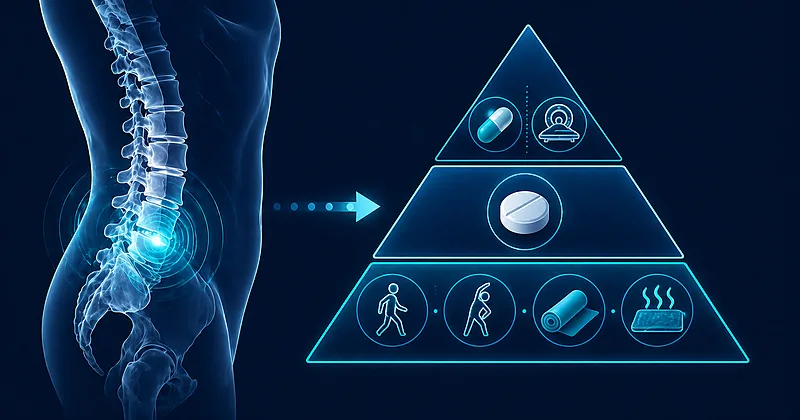
- Low back pain is best managed with non-pharmacologic interventions as first-line therapy across acute, subacute, and chronic phases per the American College of Physicians 2017 guideline (strong recommendation).
- If pharmacotherapy is desired, NSAIDs are first-line; acetaminophen is no longer recommended after the PACE trial showed it was no better than placebo for acute low back pain.
- Duloxetine and tramadol are second-line options for chronic low back pain when NSAIDs are inadequate; opioids should be avoided based on SPACE trial data showing no superiority over non-opioid regimens.
- Imaging is rarely indicated within the first six weeks in the absence of red flags; degenerative findings on MRI are highly prevalent in asymptomatic adults and frequently misattributed.
- Exercise therapy, multidisciplinary rehabilitation, and behavioral interventions (CBT, mindfulness-based stress reduction) have the strongest evidence base for chronic low back pain.
Why Low Back Pain Management Has Shifted to Non-Pharmacologic First-Line
Low back pain is one of the most common reasons for primary care visits and the leading cause of years lived with disability worldwide. The Lancet 2018 Low Back Pain Series highlighted that the global burden continues to grow, while overuse of imaging, opioids, and surgery has not produced corresponding improvements in outcomes.
Against this backdrop, the American College of Physicians issued a paradigm-shifting clinical practice guideline in 2017 that placed non-pharmacologic interventions as first-line therapy for acute, subacute, and chronic low back pain. The guideline explicitly downgraded acetaminophen and opioids while elevating exercise, behavioral therapies, and manual approaches.
For family physicians, this evidence base reframes the routine office visit for low back pain. Reflexive imaging, blanket opioid prescriptions, and acetaminophen-as-default approaches no longer reflect best evidence. The challenge is operationalizing guideline-directed care within typical primary care visit constraints.
What Evidence Was Reviewed
This synthesis of low back pain treatment evidence draws on the seminal ACP 2017 clinical practice guideline and its underpinning systematic reviews on non-pharmacologic and pharmacologic interventions, the AHRQ 2020 noninvasive nonpharmacological treatment update, key Cochrane reviews on exercise therapy and motor control, the Lancet 2018 Low Back Pain Series, and pivotal randomized trials of acetaminophen and opioid versus non-opioid therapy. Studies are anchored to randomized evidence and high-quality systematic reviews.
| Study (Year) | Design | Population | n | Intervention / Comparator | Key Outcomes |
|---|---|---|---|---|---|
| Qaseem ACP CPG (2017) | Clinical practice guideline (GRADE) | Adults with acute, subacute, or chronic LBP | SR + 2 evidence reports | Non-pharm vs pharm vs usual care | Strong recommendation: non-pharm first-line for all phases |
| Chou Non-Pharm SR (2017) | Systematic review | Adults with acute or chronic LBP | 114 RCTs / SRs | Multiple non-pharm interventions vs control | Exercise, MBSR, acupuncture, manipulation: moderate-quality benefit |
| Chou Pharm SR (2017) | Systematic review | Adults with acute or chronic LBP | 46 RCTs | NSAIDs, opioids, duloxetine, etc. vs placebo | Modest short-term benefit; harms vary by class |
| Skelly AHRQ (2020) | Comparative effectiveness review update | Adults with chronic pain conditions | 233 trials | Non-pharm interventions vs control | Exercise, psychological therapies, mind-body show benefit |
| Hayden Cochrane Exercise (2021) | Cochrane systematic review | Adults with chronic LBP | 249 trials, n = 24,486 | Exercise vs no treatment / other interventions | Exercise reduces pain and improves function vs control |
| Saragiotto Cochrane Motor Control (2016) | Cochrane systematic review | Adults with nonspecific chronic LBP | 29 RCTs, n = 2,431 | Motor control exercise vs other interventions | Modest pain and function benefit; effect sizes small to moderate |
| Cherkin (2016) — MBSR vs CBT | Pragmatic RCT | Adults with chronic LBP | 342 | MBSR vs CBT vs usual care | Both MBSR and CBT improved pain/function vs usual care at 26 wks |
| Williams PACE Trial (2014) | Double-blind RCT | Adults with acute LBP | 1,652 | Paracetamol regular/PRN vs placebo | No difference in recovery time or function |
| Krebs SPACE Trial (2018) | Pragmatic RCT | VA patients with chronic back/hip/knee pain | 240 | Opioid vs non-opioid pharmacotherapy | Opioids not superior; more adverse events |
| Foster / Lancet LBP Series (2018) | Narrative synthesis / call for action | Global LBP population | — | Status of evidence and care gaps | Highlights mismatch between evidence and practice |
| Brinjikji (2015) | Systematic review of imaging | Asymptomatic adults | 33 articles, n = 3,110 | Spine MRI/CT findings by age | Disk degeneration in 37% at age 20, 96% at age 80 |
| NICE NG59 (2016) | Clinical practice guideline | Adults with LBP and sciatica | SR-based | Multiple interventions reviewed | Non-pharm first; restricted role for pharmacotherapy |
Key Findings From the Low Back Pain Evidence Base
Approach 1 — Non-Pharmacologic Interventions Are First-Line for All Phases
The ACP 2017 guideline issued strong recommendations placing non-pharmacologic interventions first across acute, subacute, and chronic phases. For acute and subacute presentations, recommended options include superficial heat (moderate-quality evidence), massage, acupuncture, and spinal manipulation (low-quality evidence). The overall principle is conservative, time-limited, low-risk care.
For chronic LBP, the recommended first-line non-pharmacologic options expand substantially. Exercise, multidisciplinary rehabilitation, acupuncture, and mindfulness-based stress reduction carry moderate-quality evidence; tai chi, yoga, motor control exercise, progressive relaxation, electromyography biofeedback, low-level laser, operant therapy, cognitive behavioral therapy, and spinal manipulation carry low-quality evidence.
Approach 2 — Exercise and Rehabilitation Have the Strongest Non-Pharm Evidence
Among non-pharmacologic interventions for chronic LBP, exercise therapy has the most robust evidence base. The 2021 Cochrane review pooled 249 trials enrolling more than 24,000 participants and concluded that exercise reduces pain and improves function compared with no treatment or usual care. No single exercise modality has demonstrated clear superiority.
Multidisciplinary biopsychosocial rehabilitation — combining physical, psychological, and occupational components — produces larger effect sizes than physical therapy alone in chronic LBP, particularly for patients with significant disability or psychosocial distress. The Cherkin trial demonstrated that MBSR and CBT each outperformed usual care at 26 weeks for both pain and function, with effects sustained at one year.
Approach 3 — NSAIDs Are First-Line Pharmacotherapy When Drugs Are Needed
When pharmacotherapy is selected, NSAIDs carry the strongest evidence among first-line agents. The ACP guideline issued a weak recommendation for NSAIDs as initial pharmacologic therapy for acute or subacute LBP. Multiple head-to-head trials show no clear superiority of one NSAID over another, and COX-2-selective and nonselective agents perform similarly.
Acetaminophen, in contrast, is no longer recommended. The PACE trial randomized 1,652 adults with acute LBP to regular paracetamol, as-needed paracetamol, or placebo and found no difference in recovery time, pain, function, or sleep. This evidence shifted multiple international guidelines away from acetaminophen as first-line pharmacotherapy.
Skeletal muscle relaxants are conditionally recommended for short-term use in acute LBP, with sedation as the primary limiting factor. Use should be brief and matched to pattern (e.g., paraspinal spasm) rather than reflexive.
Approach 4 — Second-Line Pharmacotherapy and Opioid Avoidance
When NSAIDs are inadequate or contraindicated for chronic LBP, the ACP guideline issues weak recommendations for tramadol or duloxetine as second-line options. Duloxetine has demonstrated modest pain and function benefit in chronic LBP, particularly when a neuropathic component is present.
Opioids are not recommended as routine therapy. The SPACE pragmatic trial randomized 240 patients with chronic back, hip, or knee pain to opioid versus non-opioid medication regimens and found that opioids did not produce superior pain-related function over 12 months while generating more medication-related symptoms. Combined with the harms documented in the opioid epidemic, this evidence has reframed opioid use as a last-resort, time-limited option for select patients.
Approach 5 — Imaging Is Rarely Indicated Without Red Flags
Imaging within the first six weeks of acute LBP in the absence of red flags is consistently recommended against by ACP, the American College of Radiology, and Choosing Wisely. Imaging does not improve clinical outcomes in this setting and frequently identifies findings of uncertain clinical significance.
A systematic review of MRI findings in asymptomatic adults found disk degeneration in 37% at age 20 and 96% at age 80, with similarly high prevalence of disk bulges and other findings. Reflexive imaging risks attributing symptoms to incidental findings, escalating workup, and reinforcing biomedical framing in a condition where psychosocial factors are major drivers.
Clinical Pearl. The most common error in low back pain primary care is not under-treating but over-investigating. The patient who receives a thorough history, focused exam, education, and a structured non-pharmacologic plan typically does better than the patient who receives an early MRI, an opioid, and unfocused referral.
Quality and Consistency of the Evidence
The low back pain evidence base is unusually consistent in direction even where individual effect sizes are modest. Multiple major guideline-issuing bodies (ACP, NICE, APTA, VA/DoD) converge on non-pharmacologic first-line therapy. Where uncertainty persists, it concerns selection between non-pharmacologic options and the role of newer agents rather than the overall hierarchy.
What the Evidence Does Not Show
Specific Gaps in the Low Back Pain Evidence Base
- Evidence for noninvasive treatments specifically in radicular LBP remains insufficient; the ACP guideline explicitly excluded radicular presentations from its main recommendations.
- Comparative effectiveness data among non-pharmacologic interventions (e.g., yoga vs tai chi vs MBSR) are sparse; few high-quality head-to-head trials exist.
- Stratified care models that match specific patients to specific non-pharmacologic interventions have not been validated in routine primary care settings.
- Long-term outcomes beyond 12 months — including recurrence, work productivity, and healthcare utilization — remain inadequately characterized for most LBP interventions.
- The optimal duration, intensity, and modality of exercise therapy for chronic LBP has not been established.
- Real-world implementation data — including cost-effectiveness, access disparities, and integration into busy primary care visits — are limited.
Closing these gaps will require pragmatic randomized trials embedded in primary care, head-to-head comparisons of non-pharmacologic interventions, and validated stratified care models. An ongoing American Academy of Pain Medicine acute low back pain guideline (in development) is expected to refine acute-phase recommendations.
Practical Implications for Low Back Pain in Family Medicine
Based on the current evidence, the family physician’s task is to translate guideline-directed care into a feasible primary care workflow that respects time constraints, patient values, and access realities. The four cards below describe what the evidence supports rather than directive prescribing rules.
Evidence Supports Non-Pharmacologic First-Line for All Phases
For acute, subacute, and chronic phases of LBP, non-pharmacologic interventions are the strongly recommended first step. Heat, brief activity advice, and structured exercise referral form the practical core in primary care.
NSAIDs Selectively When Pharmacotherapy Is Needed
Evidence supports NSAIDs as first-line pharmacotherapy at lowest effective dose for shortest reasonable duration. Acetaminophen no longer carries supporting evidence for acute LBP.
Reserve Second-Line Agents and Avoid Routine Opioids
For chronic LBP unresponsive to NSAIDs, evidence supports duloxetine or tramadol as second-line. Opioids are not supported by SPACE trial data and should be reserved for select cases with structured monitoring.
Image Only With Red Flags or After Failed Conservative Trial
Evidence does not support imaging within the first six weeks in the absence of red flags. Reserve MRI for cases with neurologic deficit, suspected systemic disease, trauma, or persistent symptoms beyond 4–6 weeks of conservative care.
The following findings warrant expedited evaluation, imaging, or specialist referral in the patient presenting with low back pain:
- Cancer concern: history of malignancy (especially breast, lung, prostate, kidney, thyroid), unexplained weight loss, age over 50 with new onset of nocturnal pain.
- Infection concern: fever, intravenous drug use, immunosuppression, recent spinal procedure, indwelling catheter.
- Cauda equina syndrome: saddle anesthesia, urinary retention or incontinence, fecal incontinence, bilateral lower extremity weakness — emergent imaging and surgical consultation.
- Significant trauma: high-energy injury at any age; minor trauma in older adults or those with osteoporosis.
- Progressive neurologic deficit: progressive motor weakness, dermatomal sensory loss, or new bowel/bladder symptoms.
- Inflammatory features: morning stiffness, improvement with activity, age under 40 — consider axial spondyloarthritis.
The evidence supports a sequenced approach for acute and subacute low back pain in the typical 15-minute primary care visit:
- Assess. Focused history, red flag screen, brief neurologic exam (gait, strength, sensation, reflexes), straight-leg raise. Document expectation that most acute episodes resolve.
- Educate. Reassure regarding favorable natural history, advise staying active, advise against bed rest, set expectations about non-immediate improvement.
- Treat non-pharmacologically. Superficial heat, brief functional advice; consider massage, acupuncture, or spinal manipulation if accessible and patient prefers.
- Selectively prescribe. NSAIDs at lowest effective dose; consider muscle relaxant short-term if spasm dominant. Avoid acetaminophen as monotherapy and avoid first-line opioids.
- Reassess. Schedule follow-up in 4 to 6 weeks; image only if red flags emerge, neurologic deficit develops, or symptoms persist after a structured conservative trial.
For chronic LBP (≥12 weeks), the evidence supports a structured non-pharmacologic core with judicious pharmacotherapy:
- Anchor on exercise. Refer for structured exercise (physical therapy, GLA:D Back, Pilates, yoga, or tai chi based on access and preference). Frame exercise as the primary intervention, not adjunctive.
- Address psychosocial drivers. Screen for depression, anxiety, and fear-avoidance beliefs; consider CBT or MBSR referral, particularly for patients with substantial disability.
- Time-limited NSAIDs. Use NSAIDs for flares rather than continuously; review GI, cardiovascular, and renal risks at every prescription.
- Second-line agents selectively. Duloxetine for patients with significant comorbid depression or neuropathic features; tramadol with explicit monitoring; reserve other opioids for select cases.
- Multidisciplinary referral for patients with significant disability, prolonged work absence, or failure of structured primary care management.
Evidence Grade and Bottom Line
Evidence Grade — Strong (non-pharmacologic first-line across phases); Moderate (NSAIDs as first-line pharmacotherapy when needed); Limited (specific stratified-care matching, radicular LBP, long-term outcomes). The convergence of major guideline-issuing bodies on non-pharmacologic first-line therapy is one of the most consistent recommendation hierarchies in primary care musculoskeletal medicine.
Bottom Line
- Non-pharmacologic interventions are first-line for low back pain across all phases per the ACP 2017 guideline, with exercise and behavioral therapies carrying the strongest evidence in chronic presentations.
- When pharmacotherapy is needed, NSAIDs are first-line; acetaminophen lacks evidence for acute LBP after the PACE trial showed no benefit over placebo.
- Duloxetine and tramadol are second-line options for chronic LBP unresponsive to NSAIDs; opioids should be reserved for select patients given the SPACE trial showing no superiority over non-opioid regimens.
- Imaging is rarely indicated within the first six weeks of acute LBP absent red flags; degenerative findings on MRI are highly prevalent in asymptomatic adults and prone to misattribution.
- Important uncertainties remain about radicular low back pain, comparative effectiveness among non-pharmacologic options, and stratified care matching — the existing evidence base supports a clear treatment hierarchy without resolving every selection question.
Article Information and References
For Educational Purposes Only. This is an original evidence synthesis informed by the studies listed below. It does not replace clinical judgement. Drug dosages should be verified against current prescribing information.
References
- Qaseem A, Wilt TJ, McLean RM, Forciea MA; Clinical Guidelines Committee of the American College of Physicians. Noninvasive Treatments for Acute, Subacute, and Chronic Low Back Pain: A Clinical Practice Guideline From the American College of Physicians. Ann Intern Med. 2017;166(7):514–530. DOI: 10.7326/M16-2367
- Chou R, Deyo R, Friedly J, et al. Nonpharmacologic Therapies for Low Back Pain: A Systematic Review for an American College of Physicians Clinical Practice Guideline. Ann Intern Med. 2017;166(7):493–505. DOI: 10.7326/M16-2459
- Chou R, Deyo R, Friedly J, et al. Systemic Pharmacologic Therapies for Low Back Pain: A Systematic Review for an American College of Physicians Clinical Practice Guideline. Ann Intern Med. 2017;166(7):480–492. DOI: 10.7326/M16-2458
- Skelly AC, Chou R, Dettori JR, et al. Noninvasive Nonpharmacological Treatment for Chronic Pain: A Systematic Review Update. AHRQ Comparative Effectiveness Review No. 227. Rockville, MD: Agency for Healthcare Research and Quality; 2020. DOI: 10.23970/AHRQEPCCER227
- Hayden JA, Ellis J, Ogilvie R, Malmivaara A, van Tulder MW. Exercise therapy for chronic low back pain. Cochrane Database Syst Rev. 2021;9(9):CD009790. DOI: 10.1002/14651858.CD009790.pub2
- Saragiotto BT, Maher CG, Yamato TP, et al. Motor control exercise for nonspecific low back pain: a Cochrane Review. Spine (Phila Pa 1976). 2016;41(16):1284–1295. DOI: 10.1097/BRS.0000000000001645
- Cherkin DC, Sherman KJ, Balderson BH, et al. Effect of Mindfulness-Based Stress Reduction vs Cognitive Behavioral Therapy or Usual Care on Back Pain and Functional Limitations in Adults With Chronic Low Back Pain: A Randomized Clinical Trial. JAMA. 2016;315(12):1240–1249. DOI: 10.1001/jama.2016.2323
- Williams CM, Maher CG, Latimer J, et al. Efficacy of paracetamol for acute low-back pain: a double-blind, randomised controlled trial (PACE). Lancet. 2014;384(9954):1586–1596. DOI: 10.1016/S0140-6736(14)60805-9
- Krebs EE, Gravely A, Nugent S, et al. Effect of Opioid vs Nonopioid Medications on Pain-Related Function in Patients With Chronic Back Pain or Hip or Knee Osteoarthritis Pain: The SPACE Randomized Clinical Trial. JAMA. 2018;319(9):872–882. DOI: 10.1001/jama.2018.0899
- Foster NE, Anema JR, Cherkin D, et al. Prevention and treatment of low back pain: evidence, challenges, and promising directions. Lancet. 2018;391(10137):2368–2383. DOI: 10.1016/S0140-6736(18)30489-6
- Hartvigsen J, Hancock MJ, Kongsted A, et al. What low back pain is and why we need to pay attention. Lancet. 2018;391(10137):2356–2367. DOI: 10.1016/S0140-6736(18)30480-X
- Brinjikji W, Luetmer PH, Comstock B, et al. Systematic literature review of imaging features of spinal degeneration in asymptomatic populations. AJNR Am J Neuroradiol. 2015;36(4):811–816. DOI: 10.3174/ajnr.A4173
- National Institute for Health and Care Excellence. Low back pain and sciatica in over 16s: assessment and management (NG59). London: NICE; 2016 (updated 2020). Available: https://www.nice.org.uk/guidance/ng59
- Schukro RP, Oehmke MJ, Geroldinger A, Heinze G, Kress HG, Pramhas S. Efficacy of Duloxetine in Chronic Low Back Pain with a Neuropathic Component: A Randomized, Double-blind, Placebo-controlled Crossover Trial. Anesthesiology. 2016;124(1):150–158. DOI: 10.1097/ALN.0000000000000902