
Diabetic Foot Ulcer: An Evidence Synthesis on Classification, Revascularization, Offloading, and Multidisciplinary Limb Salvage
An evidence synthesis spanning the BEST-CLI and BASIL revascularization trials, IWGDF and SVS classification systems, offloading evidence, and multidisciplinary outcome data for clinically distinct diabetic foot subgroups.
One-Minute Takeaway on Diabetic Foot Ulcer Care
One-Minute Takeaway
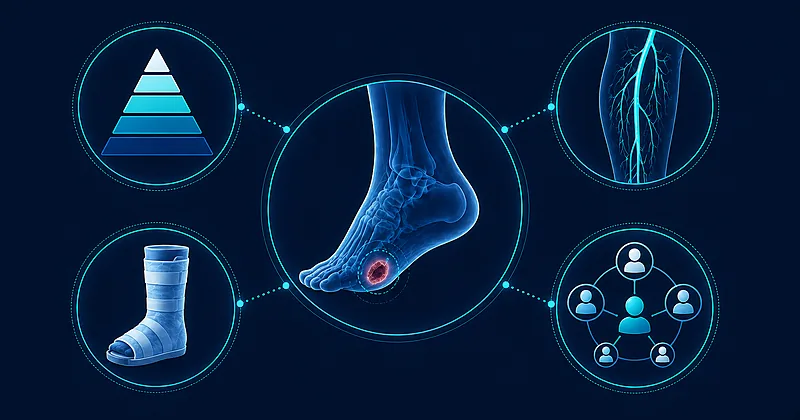
- Diabetic foot ulcer management is fundamentally stratified by four clinically distinct subgroups: pure neuropathic, neuroischemic, infected, and chronic limb-threatening ischemia (CLTI).
- Total contact casting remains the gold-standard offloading method for plantar neuropathic ulcers, with healing rates roughly double those of removable devices in randomised trials.
- BEST-CLI demonstrated that surgical bypass with adequate single-segment great saphenous vein is superior to endovascular therapy for major adverse limb events or death in CLTI patients with suitable conduit.
- Multidisciplinary diabetic foot teams reduce major amputation rates by 40–80% across observational and quasi-experimental studies, with consistent direction of effect.
- Important uncertainties remain regarding optimal endovascular strategy, drug-coated technology safety, advanced wound therapies, and the right intensity of post-healing surveillance.
Why Diabetic Foot Ulcer Outcomes Matter
A diabetic foot ulcer carries a lifetime risk of approximately 19–34% in adults with diabetes, and once an ulcer occurs the 5-year mortality approaches that of several common cancers. Major amputation continues to occur in roughly 5–8% of patients with a chronic diabetic foot ulcer despite advances in revascularization, antibiotics, and team-based care.
Three forces shape modern diabetic foot ulcer practice: validated classification systems that stratify risk and guide intervention; the BEST-CLI trial that has refined revascularization choice in CLTI; and accumulating evidence that multidisciplinary teams reduce major amputation across health systems. Each force is examined in the synthesis below.
Despite this evidence base, practice variation remains substantial. Time to specialist referral, access to vascular imaging, and adherence to evidence-based offloading vary widely between centres. Aligning surgical and primary-care decision-making with the strongest available evidence is one of the highest-leverage interventions available to reduce diabetic foot ulcer-related amputation.
What Evidence Was Reviewed
This synthesis draws on landmark randomised revascularization trials (BEST-CLI, BASIL), validated classification systems (Wagner, IWGDF/PEDIS, SVS WIfI), the IWGDF and SVS practice guidelines, randomised offloading trials, large prospective cohorts including Eurodiale, and mortality and recurrence outcome data from the modern diabetic foot ulcer evidence base.
Studies were selected for design strength, duration of follow-up, and direct relevance to subgroup-stratified diabetic foot ulcer decision-making. Priority was given to multicentre randomised trials, systematic guideline updates from IWGDF and SVS, and patient-level cohort studies that anchor population estimates of healing, amputation, and mortality.
| Study / Source | Design | Population (n) | Comparison / Question | Key Outcome |
|---|---|---|---|---|
| BEST-CLI (Farber 2022) | Phase 3 RCT | 1,830 (Cohort 1: 1,434; Cohort 2: 396) | Bypass vs endovascular for CLTI | Cohort 1 MALE/death HR 0.68 favouring bypass |
| BASIL (Adam 2005) | Multicentre RCT | 452 | Bypass-first vs angioplasty-first in CLTI | Equivalent AFS at 2 yr; bypass favoured beyond 2 yr |
| Armstrong 2017 (NEJM review) | Narrative review of RCTs/cohorts | — | DFU and recurrence overview | ~40% 1-yr recurrence; 60% by 3 yr |
| IWGDF Practical Guidelines (Schaper 2024) | Consensus / SR | — | Comprehensive DFU management | Subgroup-based recommendations |
| SVS WIfI (Mills 2014) | Classification framework | — | Wound, Ischemia, foot Infection score | Validated 1-yr amputation risk stratification |
| SVS Diabetic Foot Guidelines (Hingorani 2016) | Guideline | — | Comprehensive surgical perspective | Multidisciplinary care recommendations |
| IWGDF Offloading Update (Bus 2024) | Guideline / SR-MA | Multiple RCTs | TCC vs removable offloading | TCC superior for healing of plantar neuropathic ulcer |
| IWGDF Infection Guidelines (Senneville 2024) | Guideline / SR | — | DFU infection diagnosis and treatment | Severity-stratified antibiotic and surgical approach |
| Eurodiale (Prompers 2007) | Prospective multicentre cohort | 1,229 across 14 centres | DFU outcome predictors | Severity, infection, ischemia drive non-healing |
| Apelqvist multidisciplinary cohort | Observational longitudinal | >1,000 | Team-based DFU care | ~50% reduction in major amputation |
| NICE NG19 Diabetic Foot | National guideline | — | UK pathway for DFU and CLTI | Multidisciplinary referral within 24 h for active foot disease |
| Conte 2019 Global Vascular Guidelines | Joint society guideline | — | CLTI management framework | WIfI-based revascularization decisions |
Key Findings on Diabetic Foot Ulcer Subgroups Synthesised by Theme
Five themes emerge from the synthesis of randomised trials, guideline statements, and prospective cohorts on diabetic foot ulcer outcomes. They span classification, the four core clinical subgroups (pure neuropathic, neuroischemic, infected, and CLTI), and multidisciplinary care delivery.
Theme 1 — Classification Drives Subgroup-Based Care
Three classification systems anchor modern diabetic foot ulcer practice: the Wagner grade (ulcer depth and gangrene, 0–5); the IWGDF/PEDIS framework (perfusion, extent, depth, infection, and sensation); and the SVS WIfI score (1-year amputation risk via Wound, Ischemia, and foot Infection severity).
WIfI has been externally validated in cohorts spanning continents and predicts both 1-year amputation and benefit from revascularization. Routine documentation of WIfI at first presentation aligns surgical decision-making with the published evidence base and is endorsed by the SVS, ESVS, and WFVS Global Vascular Guidelines for CLTI.
Theme 2 — Pure Neuropathic Ulcer: Offloading is Decisive
For plantar neuropathic ulcers without significant ischemia or deep infection, offloading is the decisive intervention. Total contact casting (TCC) achieves 12-week healing rates of approximately 85–90% in randomised trials, compared with 50–65% for removable cast walkers and below 20% for unsupported footwear. The IWGDF 2024 update reaffirms TCC or non-removable knee-high devices as first-line.
Adherence is the modifiable lever. Removable devices show large efficacy-effectiveness gaps because patients remove them, sometimes for the majority of waking hours. Rendering a removable walker non-removable closes most of this gap and is one of the highest-yield interventions available in routine diabetic foot ulcer care.
Theme 3 — Neuroischemic Ulcer: Vascular Assessment First
When peripheral arterial disease is suspected, prompt non-invasive testing is essential. Toe-brachial index, transcutaneous oximetry, and skin perfusion pressure are more reliable than ankle-brachial index in calcified vessels. Patients with significant ischemia should be considered for revascularization within days to weeks, not months.
A neuroischemic diabetic foot ulcer that does not progress toward healing within 4–6 weeks despite appropriate offloading and infection control should trigger vascular reassessment. Failure to progress is itself a clinical sign that the perfusion-demand mismatch is exceeding the healing reserve and that revascularization may be required.
Theme 4 — Infected Diabetic Foot Ulcer: Severity-Based Approach
Infection is graded by IWGDF/IDSA criteria into mild, moderate, severe, and severe-with-systemic-toxicity, mirroring the PEDIS infection classification. Mild infections are typically treated as outpatients with oral antibiotics targeting Gram-positive cocci. Moderate-to-severe infections warrant inpatient evaluation, broad-spectrum coverage, and prompt surgical drainage when collections are present.
Suspected diabetic foot osteomyelitis is best diagnosed with bone biopsy when feasible; probe-to-bone testing has high specificity in high-prevalence settings. Antibiotic durations have shortened in recent trials: 6 weeks of targeted therapy is supported for most osteomyelitis cases when surgical debridement is adequate, with even shorter durations under investigation.
Theme 5 — CLTI: BEST-CLI Refines Revascularization Choice
BEST-CLI randomised 1,830 patients with CLTI to bypass-first or endovascular-first revascularization. In Cohort 1 (patients with adequate single-segment great saphenous vein, n=1,434), bypass surgery reduced the composite of major adverse limb event or death (HR 0.68; 95% CI 0.59–0.79). In Cohort 2 (no suitable GSV, n=396), bypass and endovascular therapy did not differ significantly.
BASIL had earlier suggested a similar pattern over the longer term: equivalence at 2 years, with bypass favoured beyond 2 years in patients expected to live more than 2 years. Together, these trials support a vein-first surgical approach in fit CLTI patients with adequate conduit, with endovascular therapy preferred when conduit is inadequate, life expectancy is short, or surgical risk is prohibitive.
Synthesis pearl: Modern diabetic foot ulcer decisions answer four sequential questions: (1) which subgroup is this — pure neuropathic, neuroischemic, infected, or CLTI? (2) is perfusion adequate to heal, or is revascularization needed? (3) is the offloading device truly non-removable in practice? (4) is the patient enrolled in a multidisciplinary pathway with rapid escalation when progress stalls?
Quality & Consistency of Evidence
The evidence base supporting modern diabetic foot ulcer practice is uneven across the four subgroups. Revascularization and offloading rest on robust randomised foundations, while many adjuncts (advanced dressings, growth factors, hyperbaric oxygen) have less convincing data. The colored ratings below reflect study design strength, replication, and consistency of effect across populations.
What the Evidence Does Not Show
Despite mature evidence in core areas, several clinically important questions about diabetic foot ulcer care remain unsettled. Acknowledging these gaps protects against overconfident extrapolation and frames where active research is most needed.
The open questions cluster around adjunctive therapies, endovascular technology choice, post-healing surveillance intensity, and care delivery in resource-limited settings where the burden of advanced diabetic foot ulcer disease is rising fastest.
Specific Knowledge Gaps
- Optimal endovascular strategy in BEST-CLI Cohort 2 patients. When suitable GSV is unavailable, the comparative effectiveness of stent platforms, drug-coated devices, and arterial-flow technologies remains an active debate.
- Drug-coated device safety signals. Earlier paclitaxel-related mortality concerns are now considered substantially attenuated by subsequent evidence, but durability versus contemporary alternatives requires ongoing surveillance.
- Antibiotic duration in osteomyelitis after surgical resection. Trials suggest shorter durations may suffice when bone is fully resected, but the threshold of “adequate resection” is operator-dependent.
- Surveillance intensity after healing. The 40% 1-year recurrence rate suggests intensive surveillance is warranted, but the optimal frequency, footwear strategy, and digital-monitoring role lack definitive trials.
- Adjunctive therapies in non-healing ulcers. Negative-pressure wound therapy, cellular and tissue-based products, and growth factors lack adequately powered head-to-head comparisons in well-defined diabetic foot ulcer subgroups.
- Care models in low- and middle-income settings. Most outcome data come from high-resource centres; the most cost-effective minimum-viable team structure for low-resource settings is poorly defined.
Practical Implications for Diabetic Foot Ulcer Management
Based on the current evidence, contemporary diabetic foot ulcer decisions can be framed as evidence-supported considerations rather than rigid algorithms. Patient-level factors — comorbidity, mobility, cognitive status, social support, and access to follow-up — always modify the synthesised positions below.
The four cards summarise the highest-confidence applications. The accordions that follow address adjacent operational issues — initial assessment workflow, wound-care fundamentals, and post-healing surveillance — that recur in routine diabetic foot ulcer practice.
The first encounter for an active diabetic foot ulcer should generate four pieces of information: ulcer characteristics (depth, area, location, exposed structures); perfusion status (palpable pulses, ABI/TBI, transcutaneous oximetry where indicated); infection severity (IWGDF/IDSA grade); and a calculated WIfI score.
Imaging should be tailored: plain radiographs to assess for osteomyelitis or foreign body; MRI when osteomyelitis is suspected and bone biopsy is being considered; CT angiography or duplex imaging when vascular intervention is being planned. A delay of more than 24–48 hours in active foot disease referral is associated with worse outcomes.
Wound bed preparation hinges on adequate sharp debridement at each clinical encounter, with judgement to avoid debridement of dry, stable eschar in critically ischemic limbs prior to revascularization. Moist wound healing principles apply, with dressing choice driven by exudate volume rather than brand.
Routine systemic antibiotics for clinically uninfected ulcers do not improve healing and contribute to resistance. Topical antiseptics are reserved for clinically infected wounds with biofilm features. Glycemic control, smoking cessation, and nutritional optimisation are inseparable from local wound care.
The first year after healing carries a recurrence risk of approximately 40%. Custom-moulded therapeutic footwear, regular podiatric review, and patient and family education are the cornerstones of secondary prevention. Home temperature monitoring and digital surveillance show promise but lack definitive randomised support.
Charcot neuroarthropathy must be considered in any patient who develops a warm, swollen foot after healing, particularly after revascularization. Early immobilisation prevents the deformity that drives subsequent ulceration and amputation in this neuropathic subgroup.
Evidence Grade & Bottom Line
Evidence Grade — Strong (BEST-CLI for revascularization choice in suitable conduit; total contact casting for plantar neuropathic ulcer; IWGDF infection severity grading); Moderate (WIfI predictive validity; multidisciplinary care reducing amputation); Limited (advanced wound therapies; hyperbaric oxygen; optimal endovascular strategy when conduit is inadequate).
Bottom Line
- Diabetic foot ulcer management is fundamentally subgroup-stratified; pure neuropathic, neuroischemic, infected, and CLTI ulcers each have distinct evidence-based pathways.
- Total contact casting or non-removable knee-high offloading remains the standard for plantar neuropathic ulcers, with adherence the principal modifiable determinant of healing.
- In CLTI with adequate single-segment GSV, BEST-CLI supports bypass surgery as preferred over endovascular therapy for the composite of major adverse limb events or death.
- Multidisciplinary diabetic foot teams are consistently associated with substantial reductions in major amputation across observational and quasi-experimental studies.
- Persistent gaps include optimal endovascular strategy without GSV, the role of advanced wound adjuncts, and surveillance intensity after healing — areas where individualised judgment supplements published evidence.
Article Information & References
Disclaimer
For Educational Purposes Only. This is an original evidence synthesis informed by the studies listed below. It does not replace clinical judgement. Drug dosages should be verified against current prescribing information.
References
- Farber A, Menard MT, Conte MS, et al. Surgery or Endovascular Therapy for Chronic Limb-Threatening Ischemia (BEST-CLI). N Engl J Med. 2022;387(25):2305-2316. DOI: 10.1056/NEJMoa2207899
- Adam DJ, Beard JD, Cleveland T, et al. Bypass versus angioplasty in severe ischaemia of the leg (BASIL): multicentre, randomised controlled trial. Lancet. 2005;366(9501):1925-1934. DOI: 10.1016/S0140-6736(05)67704-5
- Armstrong DG, Boulton AJM, Bus SA. Diabetic Foot Ulcers and Their Recurrence. N Engl J Med. 2017;376(24):2367-2375. DOI: 10.1056/NEJMra1615439
- Schaper NC, van Netten JJ, Apelqvist J, et al. Practical guidelines on the prevention and management of diabetes-related foot disease (IWGDF 2023 update). Diabetes Metab Res Rev. 2024;40(3):e3657. DOI: 10.1002/dmrr.3657
- Mills JL Sr, Conte MS, Armstrong DG, et al. The Society for Vascular Surgery Lower Extremity Threatened Limb Classification System: Risk stratification based on Wound, Ischemia, and foot Infection (WIfI). J Vasc Surg. 2014;59(1):220-234.e2. DOI: 10.1016/j.jvs.2013.08.003
- Hingorani A, LaMuraglia GM, Henke P, et al. The management of diabetic foot: A clinical practice guideline by the Society for Vascular Surgery in collaboration with the American Podiatric Medical Association and the Society for Vascular Medicine. J Vasc Surg. 2016;63(2 Suppl):3S-21S. DOI: 10.1016/j.jvs.2015.10.003
- Bus SA, Armstrong DG, Crews RT, et al. Guidelines on offloading foot ulcers in persons with diabetes (IWGDF 2023 update). Diabetes Metab Res Rev. 2024;40(3):e3647. DOI: 10.1002/dmrr.3647
- Senneville É, Albalawi Z, van Asten SA, et al. IWGDF/IDSA guidelines on the diagnosis and treatment of diabetes-related foot infections (IWGDF 2023 update). Diabetes Metab Res Rev. 2024;40(3):e3687. DOI: 10.1002/dmrr.3687
- Prompers L, Schaper N, Apelqvist J, et al. Prediction of outcome in individuals with diabetic foot ulcers: focus on the differences between individuals with and without peripheral arterial disease. The EURODIALE Study. Diabetologia. 2008;51(5):747-755. DOI: 10.1007/s00125-008-0940-0
- Conte MS, Bradbury AW, Kolh P, et al. Global Vascular Guidelines on the Management of Chronic Limb-Threatening Ischemia. J Vasc Surg. 2019;69(6S):3S-125S.e40. DOI: 10.1016/j.jvs.2019.02.016
- Lipsky BA, Senneville É, Abbas ZG, et al. Guidelines on the diagnosis and treatment of foot infection in persons with diabetes (IWGDF 2019 update). Diabetes Metab Res Rev. 2020;36(S1):e3280. DOI: 10.1002/dmrr.3280
- Apelqvist J, Larsson J. What is the most effective way to reduce incidence of amputation in the diabetic foot? Diabetes Metab Res Rev. 2000;16 Suppl 1:S75-83. DOI: 10.1002/1520-7560(200009/10)16:1+<::AID-DMRR113>3.0.CO;2-8