
Pediatric UTI Follow-Up: Imaging, Reflux Workup, and Prophylaxis Decisions
Clinical Practice Update — Renal Ultrasound, VCUG, and Antibiotic Prophylaxis After a First Febrile UTI in Children
This is an original clinical education article informed by current guidelines and evidence. See References below for source documents.
- Clinical Focus
- Post-UTI imaging, reflux workup, and antibiotic prophylaxis decisions in children
- Target Audience
- Pediatricians, family physicians, pediatric residents, nurse practitioners, pediatric urologists
- Setting
- Outpatient primary care, pediatric emergency, post-discharge follow-up
- Source Evidence
- •AAP Clinical Practice Guideline: UTI in Febrile Infants 2–24 Months (2011, reaffirmed 2016)
- •NICE Guideline NG224 — Urinary Tract Infection in Under 16s (2022)
- •RIVUR Trial — Antimicrobial Prophylaxis for Vesicoureteral Reflux (NEJM, 2014)
- •EAU/ESPU Guidelines on Pediatric Urology (2024)
Key Clinical Takeaways
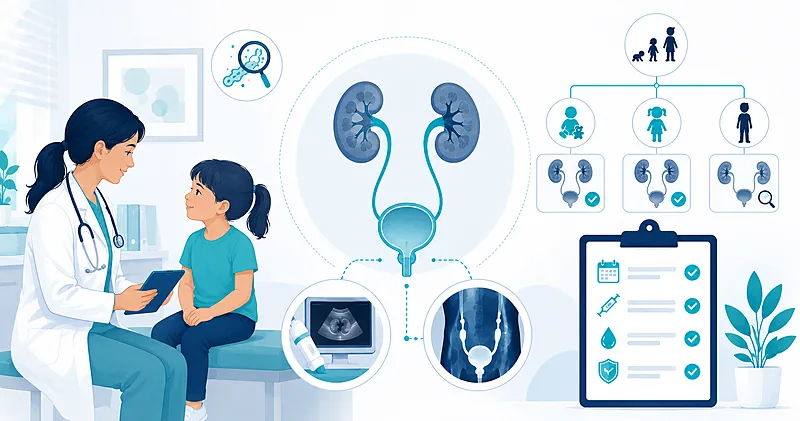
Effective pediatric UTI follow-up after a first febrile UTI rests on three decisions made in sequence: who needs imaging, who needs reflux assessment, and who needs prophylaxis. The points below distill current AAP, NICE, and EAU/ESPU guidance — together with the practice-changing RIVUR trial — into a clear bedside workflow.
- 1Order a renal-bladder ultrasound (RBUS) for every child aged 2–24 months after a first febrile UTI — this is the universal starting point.
- 2Do not perform routine VCUG after a first uncomplicated febrile UTI when the ultrasound is normal in the 2–24 month group.
- 3Trigger a VCUG when imaging shows hydronephrosis, scarring, or obstruction — or after a second febrile UTI.
- 4In children older than 2 years, individualise imaging by clinical features — routine RBUS is not mandatory.
- 5Reserve continuous antibiotic prophylaxis for children with grade III–V reflux or recurrent febrile UTI — not as a default after a single infection.
- 6When prophylaxis is indicated, prescribe trimethoprim-sulfamethoxazole at 2 mg/kg once daily as the preferred agent beyond infancy.
- 7Reassess prophylaxis annually — most courses run 12–24 months, longer if reflux persists past toilet training.
- 8Identify and treat constipation and dysfunctional voiding — the most overlooked contributors to recurrence.
- 9Counsel families that prophylaxis reduces recurrence but does not prevent renal scarring on long-term imaging.
- 10Document baseline blood pressure and renal function before starting prophylaxis and at every annual review.
Imaging After a First Pediatric UTI
Renal-bladder ultrasound is the cornerstone of pediatric UTI follow-up because it is non-invasive, radiation-free, and sensitive to the structural abnormalities most likely to alter management — hydronephrosis, duplex systems, posterior urethral valves, and renal size discordance. Both the AAP and NICE position RBUS as first-line, though they diverge on whether universal ultrasound is needed in older children.
Perform a renal-bladder ultrasound in every child aged 2–24 months after a first febrile UTI, regardless of clinical response to antibiotics.
Strong Rec High Evidence AAP 2011/2016Perform RBUS during the acute illness (within 48–72 hours) whenever the course is atypical UTI — failure to respond by 48 hours, sepsis, non-E. coli organism, palpable abdominal mass, hypertension, or raised creatinine.
Strong Rec Moderate Evidence NICE NG224 2022For typical first febrile UTI with prompt clinical response, schedule the RBUS within 2 weeks of completing antibiotics — acute inflammation can falsely enlarge the kidneys.
Moderate Rec Low Evidence EAU/ESPU 2024In children older than 2 years presenting with a first uncomplicated febrile UTI, do not order routine RBUS unless atypical features or recurrence are present.
Moderate Rec Moderate Evidence NICE NG224 2022Repeat the ultrasound after any second febrile UTI at any age — even when the first study was normal — because recurrence raises the pre-test probability of structural abnormality.
Strong Rec Moderate Evidence AAP 2011/2016 NICE NG224 2022Document on the imaging request whether the study is for “first febrile UTI screening” or “post-recurrence assessment” — this changes the radiologist’s emphasis and report quality.
Conditional Rec Low Evidence Expert ConsensusWhen to Order VCUG in Pediatric UTI Follow-Up
Voiding cystourethrography is the gold standard for diagnosing and grading vesicoureteral reflux, but it is invasive, involves catheterisation, and exposes the child to fluoroscopic radiation. The major shift in pediatric UTI follow-up over the last decade has been to move away from automatic VCUG after a first infection — the AAP made this explicit in 2011 and the evidence base has only strengthened since.
Do not perform VCUG routinely after a first febrile UTI in a child aged 2–24 months whose RBUS is normal and whose clinical course was uncomplicated.
Against High Evidence AAP 2011/2016Order VCUG when the RBUS shows hydronephrosis, renal scarring, ureteric dilatation, or any other finding that suggests high-grade vesicoureteral reflux or obstructive uropathy.
Strong Rec High Evidence AAP 2011/2016 EAU/ESPU 2024Perform VCUG after a second febrile UTI in a child aged 2–24 months even when the RBUS is normal — recurrence is itself an indication.
Strong Rec Moderate Evidence AAP 2011/2016Consider VCUG in any child with a family history of high-grade reflux, antenatally detected hydronephrosis, or known renal anomaly — even after a first UTI.
Moderate Rec Moderate Evidence EAU/ESPU 2024Consider contrast-enhanced voiding urosonography (ceVUS) as a radiation-free alternative to fluoroscopic VCUG when locally available and the clinician is experienced with the modality.
Conditional Rec Moderate Evidence EAU/ESPU 2024Counsel parents on what to expect from VCUG — catheter placement, brief filling discomfort, and the short fluoroscopy time — and offer oral midazolam premedication for older infants and toddlers.
Moderate Rec Low Evidence Expert ConsensusProphylaxis Decisions in Pediatric UTI Follow-Up
The role of continuous antibiotic prophylaxis is the most contested area of pediatric UTI follow-up. The RIVUR trial — the largest randomized study to date — showed that daily trimethoprim-sulfamethoxazole roughly halved the rate of febrile UTI recurrence in children with vesicoureteral reflux, but did not reduce renal scarring on DMSA imaging at two years. That single finding has reshaped how clinicians position prophylaxis: useful for recurrence reduction, but no longer marketed as a kidney-saving strategy.
Who Should Receive Prophylaxis?
Do not routinely prescribe continuous antibiotic prophylaxis after a first febrile UTI with normal RBUS and no reflux demonstrated.
Against High Evidence RIVUR 2014 AAP 2011/2016Consider continuous prophylaxis for children with grade III–V vesicoureteral reflux, particularly when associated with bladder and bowel dysfunction or a prior febrile UTI.
Moderate Rec Moderate Evidence EAU/ESPU 2024Consider prophylaxis after a second or third febrile UTI even when reflux has not been demonstrated — the recurrence pattern alone justifies a trial.
Conditional Rec Low Evidence Expert ConsensusChoosing the Prophylactic Agent
Prescribe trimethoprim-sulfamethoxazole 2 mg/kg (of the TMP component) once daily at bedtime as the first-line prophylactic agent for children older than 2 months.
Strong Rec High Evidence RIVUR 2014Use nitrofurantoin 1–2 mg/kg once daily as an alternative when sulfonamides are contraindicated or poorly tolerated — avoid in infants under 3 months and in renal impairment.
Moderate Rec Moderate Evidence EAU/ESPU 2024Do not use amoxicillin, ampicillin, or oral cephalosporins for routine prophylaxis — resistance rates among community uropathogens are too high to justify them as first or second choice.
Against Moderate Evidence NICE NG224 2022 EAU/ESPU 2024Reassess prophylaxis at every 6–12 month review — weight the recurrence-prevention benefit against the cumulative resistance pressure on the child’s microbiome.
Strong Rec Moderate Evidence RIVUR 2014Plan a typical prophylaxis duration of 12–24 months — continue longer only if reflux persists past toilet training or febrile UTIs recur on therapy.
Moderate Rec Moderate Evidence EAU/ESPU 2024Stop prophylaxis when follow-up VCUG shows reflux resolution, or in toilet-trained children older than 5 years with no recurrence on therapy.
Moderate Rec Low Evidence Expert ConsensusCounsel families that prophylaxis halves the rate of recurrent febrile UTI but does not reduce renal scarring on long-term DMSA imaging.
Strong Rec High Evidence RIVUR 2014Clinical Decision Pathway
A question-based workflow for the child returning to clinic after a first febrile UTI. Work through the questions in order — each answer determines the next investigation.
Imaging and Prophylaxis at a Glance
Two clinic-ready tables for pediatric UTI follow-up — the first matches clinical scenarios to imaging decisions, the second covers prophylactic agent selection by patient profile.
Table 1: Imaging Decisions by Clinical Scenario
| Clinical Scenario | RBUS | VCUG | DMSA | Common Pitfall |
|---|---|---|---|---|
| First febrile UTI, 2–24 mo, typical course | Yes — within 2 weeks of antibiotic completion | No (unless RBUS abnormal) | No | Ordering VCUG by default and exposing the child to unnecessary catheterisation |
| First febrile UTI, atypical features at any age | Yes — during acute illness (within 48–72 h) | If RBUS abnormal | At 4–6 months to assess scarring | Waiting until “after antibiotics” delays detection of obstruction |
| Second febrile UTI, any age | Yes — repeat even if prior was normal | Yes | Consider | Assuming a normal prior RBUS rules out reflux — it does not |
| First febrile UTI, > 2 years, otherwise well | Individualise | No | No | Over-imaging an otherwise healthy school-aged child |
| Antenatal hydronephrosis with first UTI | Yes — compare to antenatal series | Yes | Baseline scan | Not reviewing the antenatal imaging first |
Table 2: Prophylactic Antibiotic Choice by Patient Profile
| Agent | Dose | Best Suited For | Cautions | Clinical Tip |
|---|---|---|---|---|
| Trimethoprim-sulfamethoxazole | 2 mg/kg (TMP) once daily | Children > 2 months; preferred first-line | Avoid < 2 months (bilirubin), G6PD deficiency, severe sulfa allergy | Give at bedtime to maintain overnight bladder concentration |
| Nitrofurantoin | 1–2 mg/kg once daily | Sulfa-intolerant children > 3 months | Avoid in CrCl < 60 mL/min, neonates, and G6PD deficiency | Liquid is bitter; counsel families and offer flavoured suspension |
| Cephalexin | 10 mg/kg once daily | Short-term bridge in infants < 2 months | Rising community resistance; not first-line beyond infancy | Re-evaluate when child reaches 2 months — switch to TMP-SMX |
| Amoxicillin | — | Not recommended for routine prophylaxis | High resistance among E. coli; rapid breakthrough | Reserved historically for neonates — now superseded |
Monitoring and Long-Term Follow-Up
Pediatric UTI follow-up does not end with the imaging report. Long-term monitoring for blood pressure, growth, and renal function matters most for children with reflux or scarring, where adult-onset hypertension and chronic kidney disease are downstream risks.
Measure blood pressure at every clinic visit in children with known reflux, renal scarring, or recurrent UTI — hypertension is the earliest sign of progressive renal injury.
Strong Rec Moderate Evidence EAU/ESPU 2024Order a DMSA scan 4–6 months after the index infection in children with high-grade reflux, recurrent febrile UTI, or abnormal RBUS to look for cortical scarring.
Moderate Rec Moderate Evidence EAU/ESPU 2024Repeat VCUG every 12–24 months in children on prophylaxis for grade III–V reflux until resolution or surgical decision; lower-grade reflux can often be followed clinically.
Moderate Rec Low Evidence Expert ConsensusEducate families on safety-netting: any unexplained fever lasting more than 24 hours warrants a urine sample, particularly in pre-verbal children.
Strong Rec Moderate Evidence NICE NG224 2022Special Populations and Modifiers
Several patient groups need a modified approach to pediatric UTI follow-up. The recommendations below identify the most common modifiers in primary care.
Screen every toilet-trained child with recurrent UTI for bladder and bowel dysfunction — constipation, daytime incontinence, urgency, and infrequent voiding are major recurrence drivers.
Strong Rec Moderate Evidence EAU/ESPU 2024Treat constipation aggressively before escalating prophylaxis — a regular bowel pattern alone reduces UTI recurrence in many children with mild reflux.
Strong Rec Moderate Evidence EAU/ESPU 2024Refer infants younger than 1 month with febrile UTI to pediatric urology after imaging — the structural abnormality rate exceeds 30% in this group.
Strong Rec Moderate Evidence EAU/ESPU 2024In uncircumcised infant boys with recurrent UTI, discuss circumcision as a recurrence-reduction option after imaging is complete — absolute risk reduction is small but consistent.
Moderate Rec Moderate Evidence AAP 2011/2016Refer to pediatric urology for surgical evaluation in children with breakthrough febrile UTI on prophylaxis, persistent high-grade reflux beyond age 5, or new scarring on DMSA.
Strong Rec Moderate Evidence EAU/ESPU 2024Evidence in Context
Where the major guidelines and the pivotal trials converge — and where they still disagree.
Where AAP, NICE, and EAU/ESPU agree
All three frameworks converge on three core points. RBUS is the imaging starting point after a first febrile UTI in young children. Routine VCUG is no longer recommended after a single uncomplicated infection. Recurrent febrile UTI — not the simple presence of reflux — is the dominant predictor of long-term renal injury.
Where the guidelines disagree
AAP applies its imaging recommendations specifically to the 2–24 month age band. NICE NG224 extends an analogous workup to children up to 16 years with more permissive thresholds for individualisation. EAU/ESPU sits in the middle and is more enthusiastic about ceVUS and DMSA-first (“top-down”) protocols where pediatric radiology expertise is strong.
The biggest practical disagreement is the threshold for VCUG after a single uncomplicated infection in children 2–24 months. AAP is the most conservative (RBUS-driven only); EAU/ESPU is more permissive when family history or antenatal findings are present.
What the RIVUR trial actually showed
RIVUR randomized children aged 2–71 months with reflux to two years of trimethoprim-sulfamethoxazole prophylaxis or placebo. Prophylaxis cut the rate of recurrent febrile or symptomatic UTI by about half — a clinically meaningful drop that is the basis for current prophylaxis recommendations. The trial also showed a roughly threefold increase in resistant breakthrough infections on prophylaxis. Crucially, there was no significant difference between groups in new renal scarring on DMSA at two years.
The take-home message is nuanced: prophylaxis prevents the infection, not the scar. That has reframed how clinicians counsel families and how they balance prophylaxis against the resistance trade-off.
Is VCUG still the gold standard for reflux?
Fluoroscopic VCUG remains the most widely available and best-characterised test for grading reflux. Contrast-enhanced voiding urosonography is gaining ground because it avoids ionising radiation and uses an intravesical ultrasound contrast agent that is well tolerated in children. In high-volume centres ceVUS has shown sensitivity for reflux at least comparable to VCUG; outside specialist centres availability and operator experience are the limiting factors.
References
- 1.Subcommittee on Urinary Tract Infection, Steering Committee on Quality Improvement and Management; Roberts KB. Urinary tract infection: clinical practice guideline for the diagnosis and management of the initial UTI in febrile infants and children 2 to 24 months. Pediatrics. 2011;128(3):595–610 (reaffirmed 2016). doi:10.1542/peds.2011-1330
- 2.NICE Guideline [NG224]. Urinary tract infection in under 16s: diagnosis and management. National Institute for Health and Care Excellence, 2022. nice.org.uk/guidance/ng224
- 3.RIVUR Trial Investigators; Hoberman A, Greenfield SP, Mattoo TK, et al. Antimicrobial prophylaxis for children with vesicoureteral reflux. N Engl J Med. 2014;370(25):2367–2376. doi:10.1056/NEJMoa1401811
- 4.Radmayr C, Bogaert G, Burgu B, et al. EAU/ESPU Guidelines on Paediatric Urology. European Association of Urology, 2024. uroweb.org/guidelines/paediatric-urology
- 5.Mattoo TK, Chesney RW, Greenfield SP, et al. Renal scarring in the Randomized Intervention for Children with Vesicoureteral Reflux (RIVUR) trial. Clin J Am Soc Nephrol. 2016;11(1):54–61. doi:10.2215/CJN.05210515
How to Read the Evidence Tags
Every recommendation carries two Medaptly tags — one for recommendation strength and one for evidence quality — plus a source tag identifying the underlying guideline or trial.
Recommendation Strength
| Tag | What It Means |
|---|---|
| Strong Rec | Broadly supported by high-quality evidence; should be applied to most patients. |
| Moderate Rec | The weight of evidence favours this action; appropriate for most patients with relevant features. |
| Conditional Rec | Benefit is less certain — individualise to patient values and clinical context. |
| Against | Evidence shows no net benefit or potential harm; do not perform routinely. |
Evidence Quality
| Tag | What It Means |
|---|---|
| High Evidence | Multiple well-designed randomized trials or high-quality meta-analyses. |
| Moderate Evidence | A single well-conducted RCT or large observational study. |
| Low Evidence | Expert consensus, small studies, or extrapolation from related populations. |