
Pediatric Community-Acquired Pneumonia: Outpatient Diagnosis and Management
Clinical Practice Update — Recognizing Pneumonia, Choosing Empiric Therapy, and Deciding When to Image
This is an original clinical education article informed by current guidelines and evidence. See References below for source documents.
- Clinical Focus
- Office and urgent-care management of pediatric community-acquired pneumonia in immunocompetent children aged 3 months to 18 years
- Target Audience
- Pediatricians, family physicians, urgent-care and emergency clinicians, nurse practitioners, pediatric residents
- Setting
- Primary care offices, urgent care, emergency department disposition decisions
- Source Evidence
- •PIDS/IDSA Clinical Practice Guideline for Pediatric CAP (Bradley et al, 2011)
- •British Thoracic Society Guidelines for Childhood CAP (Harris et al, 2011)
- •SAFER Trial — 5-day amoxicillin in pediatric CAP (Pernica et al, JAMA Peds 2021)
- •SCOUT-CAP Trial — Short-course outpatient therapy (Williams et al, JAMA Peds 2022)
- •CDC EPIC Study — Etiology of pediatric CAP (Jain et al, NEJM 2015)
Key Clinical Takeaways
Effective management of pediatric community-acquired pneumonia in the outpatient setting rests on three fast decisions: confirm the diagnosis clinically, decide whether the child is safe to go home, and choose narrow empiric therapy. Most well-appearing immunized children can be treated at home with high-dose amoxicillin, no chest imaging, and a planned reassessment in 48 to 72 hours.
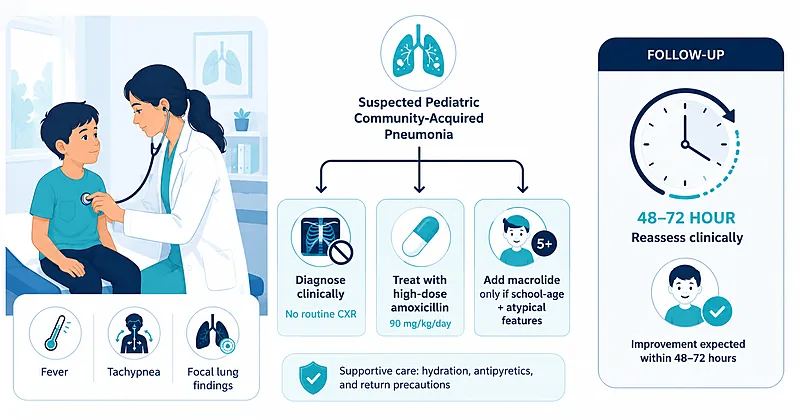
- 1Diagnose pediatric community-acquired pneumonia clinically — fever, tachypnea, increased work of breathing, and focal auscultatory findings, not chest x-ray.
- 2Use age-specific respiratory rate thresholds and pulse oximetry on every child — SpO2 below 92% on room air is a red flag.
- 3Skip routine chest imaging in well-appearing outpatients — reserve x-rays for diagnostic uncertainty, treatment failure, or suspected complications.
- 4Prescribe high-dose amoxicillin (90 mg/kg/day) as first-line empiric therapy for fully immunized children with non-severe disease.
- 5Use a 5-day antibiotic course for most outpatients — recent randomized trials confirm non-inferiority versus 7–10 days.
- 6Add macrolide coverage only for school-age children (roughly 5 years and older) when clinical features point toward atypical infection.
- 7Test for influenza and SARS-CoV-2 during seasonal circulation; start oseltamivir promptly when influenza is confirmed or strongly suspected.
- 8Reassess at 48–72 hours — persistent fever or worsening work of breathing should trigger reevaluation, not a phone refill.
- 9Admit infants under 6 months, any child with hypoxemia, dehydration, inability to tolerate oral therapy, or signs of complication.
Recognizing Pediatric Community-Acquired Pneumonia in Outpatients
The diagnosis of pediatric community-acquired pneumonia is fundamentally clinical. No single sign confirms it and no single sign rules it out, so the bedside synthesis matters more than any single test. Fever, tachypnea, work of breathing, and focal lung findings together carry far more weight than any one finding in isolation.
Tachypnea is the most sensitive bedside sign of lower respiratory tract infection in young children, and counting respirations over a full minute is more reliable than the 15-second estimate often documented in busy clinics. Use age-specific respiratory rate thresholds when deciding whether breathing is genuinely fast for the child in front of you.
Diagnose pediatric community-acquired pneumonia on clinical grounds — fever combined with tachypnea, increased work of breathing, and focal auscultatory findings. Chest imaging is not required to make the diagnosis in a well-appearing outpatient.
Strong Rec Moderate Evidence PIDS/IDSA 2011 BTS 2011Count the respiratory rate over a full minute in any child with suspected pneumonia, and interpret the number against age-specific cut-offs rather than adult ranges. A 9-month-old breathing 55 times per minute is dramatically different from a 7-year-old at the same rate.
Strong Rec Moderate Evidence WHO IMCIMeasure pulse oximetry on every child being evaluated for pediatric community-acquired pneumonia. SpO2 below 92% on room air should change disposition toward observation, supplemental oxygen, or admission.
Strong Rec High Evidence PIDS/IDSA 2011 BTS 2011Distinguish pneumonia from viral bronchiolitis in children under 2 years before reaching for antibiotics. Diffuse wheeze with retractions during the winter respiratory season usually points to bronchiolitis, where antibiotics do not change the course.
Strong Rec High Evidence AAP 2014Age-Specific Vital Sign Cut-offs for Outpatient Triage
| Age Group | Normal RR (breaths/min) | Tachypnea Threshold | Other Outpatient Red Flags |
|---|---|---|---|
| 2–12 months | 25–40 | ≥ 50 | Grunting, nasal flaring, refusal to feed, age < 6 months |
| 1–5 years | 20–30 | ≥ 40 | Suprasternal retractions, abdominal breathing, vomiting all oral intake |
| 5–12 years | 18–25 | ≥ 30 | SpO2 < 92%, chest wall retractions, marked fatigue |
| > 12 years | 12–20 | ≥ 20 with distress | SpO2 < 92%, altered mental status, hemodynamic concern |
Imaging Indications for Pediatric Community-Acquired Pneumonia
Routine chest radiography in well-appearing outpatients with suspected pediatric community-acquired pneumonia has fallen out of favor on both sides of the Atlantic. The diagnostic yield is low, results rarely change empiric therapy, and the radiation exposure adds up across a childhood of respiratory illnesses. Reserve imaging for situations where the answer would actually change what you do next.
Do not order routine chest radiography in well-appearing children with suspected pediatric community-acquired pneumonia who will be managed as outpatients. The result rarely changes empiric antibiotic choice or disposition.
Against High Evidence PIDS/IDSA 2011 BTS 2011Obtain a chest radiograph when the clinical picture is genuinely uncertain, when the child has failed an appropriate antibiotic course at 48–72 hours, or when complications such as parapneumonic effusion or empyema are suspected.
Strong Rec Moderate Evidence PIDS/IDSA 2011Consider lung ultrasound by a trained operator as an alternative to chest radiography where it is available. Pooled data show it performs at least as well as plain films for detecting consolidation in children, and it avoids ionizing radiation.
Conditional Rec Moderate Evidence Meta-analyses 2018–2022Avoid routine follow-up chest radiography after an uncomplicated course in children who recover clinically. Reserve repeat imaging for round pneumonia, recurrent same-lobe infection, persistent symptoms beyond 4–6 weeks, or suspicion of an underlying structural problem.
Against Moderate Evidence PIDS/IDSA 2011Empiric Amoxicillin: First-Line for Outpatient Pediatric Pneumonia
Streptococcus pneumoniae remains the most common bacterial cause of pediatric community-acquired pneumonia even in the conjugate-vaccine era, and high-dose amoxicillin reliably covers it. The drug is cheap, well tolerated, and palatable as a suspension — an underrated trio in outpatient pediatrics.
For children with a credible IgE-mediated amoxicillin allergy, second-generation or third-generation cephalosporins are generally safe alternatives. Most reported “penicillin allergies” in children are not true allergies, and structured de-labeling pathways are increasingly available.
Prescribe high-dose amoxicillin 90 mg/kg/day divided twice or three times daily (maximum 4 g/day) as first-line empiric therapy for fully immunized children with non-severe pediatric community-acquired pneumonia.
Strong Rec High Evidence PIDS/IDSA 2011 BTS 2011Treat uncomplicated outpatient pediatric community-acquired pneumonia for 5 days rather than 7–10 days. Randomized trials in children with clinical improvement by day 3 show non-inferiority and less antibiotic-associated harm.
Strong Rec High Evidence SAFER Trial 2021 SCOUT-CAP 2022For children with non-severe penicillin allergy, prescribe cefdinir, cefuroxime axetil, or cefpodoxime. For severe IgE-mediated allergy or anaphylaxis, use clindamycin (with consideration of local pneumococcal susceptibility) or a respiratory fluoroquinolone if no other option.
Moderate Rec Moderate Evidence PIDS/IDSA 2011Do not use azithromycin as a first-line agent against typical bacterial pneumonia. Pneumococcal resistance to macrolides exceeds 30–50% in many regions, and monotherapy with a macrolide is no longer reliable cover for S. pneumoniae.
Against High Evidence CDC ABCs Surveillance PIDS/IDSA 2011Avoid routine antibiotic prescriptions for clearly viral lower respiratory tract illness in preschool-aged children — wheeze plus low-grade fever in a well-appearing toddler during respiratory virus season usually does not represent bacterial pneumonia.
Against High Evidence EPIC Study 2015Empiric Antibiotics for Outpatient Pediatric CAP: Drug-by-Drug Guide
| Drug | Dose (oral) | Best Suited For | Practical Tips |
|---|---|---|---|
| Amoxicillin | 90 mg/kg/day divided BID or TID (max 4 g/day) × 5 days | First-line for fully immunized child with non-severe CAP | Banana-flavored suspension is well tolerated. Refrigerate after mixing. |
| Amoxicillin-clavulanate | 90 mg/kg/day of amoxicillin component, divided BID | Aspiration risk, suspected H. influenzae, unimmunized child | More GI side effects than amoxicillin alone. Use the 14:1 formulation. |
| Azithromycin | 10 mg/kg on day 1, then 5 mg/kg/day for 4 more days (max 500 mg / 250 mg) | Add-on for school-age child with atypical features; not monotherapy | Check QT-prolonging co-medications. Counsel on rare cardiac risk. |
| Cefdinir | 14 mg/kg/day divided BID (max 600 mg/day) | Non-severe penicillin allergy; once-daily option available | Reddish stool with iron co-administration is benign and reversible. |
| Clindamycin | 30–40 mg/kg/day divided TID | Severe penicillin allergy where local pneumococcal susceptibility supports it | Bitter taste limits adherence. Counsel on Clostridioides difficile risk. |
| Levofloxacin | 10 mg/kg/day (age ≥ 5 y); 16–20 mg/kg/day divided BID (age 6 mo to < 5 y) | Last-line: severe beta-lactam allergy with no other safe option | Reserve for specialty input. Black-box warnings apply. |
When to Add Atypical Coverage in Childhood Pneumonia
Mycoplasma pneumoniae is uncommon under age 5 and progressively more common into adolescence. Routine macrolide cover for every child with cough and fever is one of the more durable habits in outpatient pediatrics, and it should largely stop. Add atypical coverage selectively, when the clinical pattern points there.
Suspect Mycoplasma pneumoniae in older children and adolescents with a prolonged dry cough, headache, sore throat, low-grade fever, and patchy or diffuse findings rather than lobar consolidation. Outbreaks within schools and households can be a useful clue when no single child has dramatic findings.
Add a macrolide to amoxicillin only when the patient is roughly school-aged or older and the clinical pattern points toward atypical infection. Do not add atypical coverage routinely for every child with pediatric community-acquired pneumonia.
Conditional Rec Moderate Evidence PIDS/IDSA 2011 BTS 2011Consider doxycycline as an alternative atypical agent in children aged 8 years or older, particularly during periods of high macrolide resistance. Short courses (5–7 days) do not stain teeth in this age group.
Conditional Rec Moderate Evidence AAP Red Book 2024Do not rely on a single positive Mycoplasma IgM result to drive antibiotic decisions. False positives are common, and serology rarely returns quickly enough to inform initial outpatient management. Treat based on the clinical pattern, not the titer.
Against Moderate Evidence Pediatric Infect Dis J reviewsSorting Typical From Atypical at the Bedside
| Clinical Feature | More Typical (S. pneumoniae) | More Atypical (M. pneumoniae) | Practical Action |
|---|---|---|---|
| Typical age | All ages, especially < 5 years | School-age and adolescents | Age < 5 with CAP: amoxicillin alone is usually enough |
| Onset | Abrupt, high fever | Gradual over 1–2 weeks | Insidious cough with malaise in a teenager → consider atypical |
| Cough character | Productive, often painful | Dry, paroxysmal, long-lasting | Weeks of dry cough plus headache: consider macrolide add-on |
| Auscultation | Focal crackles, dullness | Diffuse crackles ± wheeze | Lobar findings argue against pure atypical illness |
| Extrapulmonary clues | Few | Headache, sore throat, rash, hemolysis | Constellation of features beats any single sign |
| Imaging (if obtained) | Lobar or segmental consolidation | Interstitial, patchy bilateral | Imaging is supportive, not decisive in outpatient triage |
Viral Testing and Antiviral Therapy
Viruses cause the majority of CAP in young children, particularly under age 5. Identifying influenza, SARS-CoV-2, and (less actionably) RSV during seasonal circulation can spare antibiotics, guide isolation, and unlock antiviral therapy for high-risk patients.
Test for influenza and SARS-CoV-2 in any child with suspected pediatric community-acquired pneumonia during periods of local circulation. A positive result may avoid an antibiotic prescription and may open the door to antiviral therapy.
Moderate Rec Moderate Evidence CDC Influenza GuidanceStart oseltamivir promptly — ideally within 48 hours of symptom onset — for children with confirmed or strongly suspected influenza, particularly those with pneumonia, underlying chronic conditions, or age below 2 years.
Strong Rec Moderate Evidence IDSA Influenza 2018 CDCConsider concurrent bacterial pneumonia in any child with influenza who deteriorates after initial improvement — the “second hump” of fever and worsening respiratory distress should prompt antibiotic therapy and reassessment of disposition.
Moderate Rec Moderate Evidence PIDS/IDSA 2011Outpatient versus Inpatient: Who Can Stay Home
The disposition question is rarely about whether the diagnosis is pneumonia — it is about whether the child can be fed, oxygenated, observed, and brought back in if things change. The factors below help frame that decision more reliably than gestalt alone.
- Age younger than 3–6 months (lower threshold)
- SpO2 below 92% on room air
- Moderate to severe work of breathing — grunting, deep retractions, nasal flaring
- Inability to tolerate oral intake or signs of dehydration
- Apnea, cyanosis, or altered level of consciousness
- Suspected complication: empyema, lung abscess, septic shock
- Failure of appropriate outpatient antibiotics at 48–72 hours
- Significant comorbidity (sickle cell disease, congenital heart disease, immunocompromise, neuromuscular weakness)
- Caregiver unable to monitor, return promptly, or access care
Admit any infant under 3–6 months with suspected bacterial pneumonia for parenteral therapy and observation, regardless of how well they appear at the index visit.
Strong Rec Moderate Evidence PIDS/IDSA 2011Refer for inpatient care when home circumstances threaten safe outpatient management — caregivers unable to recognize deterioration, no reliable transportation, or no telephone for follow-up. Social factors weigh heavily in pediatric disposition.
Strong Rec Low Evidence Expert ConsensusClinical Decision Pathway
A practical, question-based pathway for the child who walks into your office with a cough and fever. Work through the questions in order — each one shapes the next.
Monitoring and Follow-Up
A structured 48-to-72-hour reassessment is the single most important piece of outpatient pediatric pneumonia care. Most children improve markedly within this window; those who do not need a closer look rather than a second telephone refill.
Document return precautions in plain language the caregiver can read at home. Verbal counseling at discharge is forgotten within hours; a printed list (or message in a parent app) is far more durable.
| Parameter | When to Check | Expected Trajectory | Common Pitfalls |
|---|---|---|---|
| Fever | 48–72 h after starting antibiotics | Defervescence by 48–72 h in most | Switching antibiotic at 24 h for persistent fever is usually premature |
| Work of breathing | 48–72 h, then as needed | Steady improvement; no new retractions or grunting | Worsening work of breathing trumps a normal SpO2 — reassess in person |
| Oral intake / hydration | Daily by caregiver | Returning toward baseline; wet diapers as usual | Poor feeding is often the first sign of deterioration in young children |
| Cough | Through completion of antibiotics | May linger 2–3 weeks even with full recovery | Cough alone after defervescence is not treatment failure |
| Follow-up CXR | Only if clinically indicated | Not routine after uncomplicated outpatient course | Order only for round pneumonia, recurrent disease, or persistent symptoms |
Evidence in Context
What the data show, where the major pediatric guidelines agree, and where they part ways.
Where PIDS/IDSA and BTS Agree
Where the Two Frameworks Differ
Short-Course Antibiotic Evidence: SAFER and SCOUT-CAP
What the EPIC Study Tells Us About Etiology
Lung Ultrasound in Pediatric Pneumonia: Where the Evidence Stands
References
- 1.Bradley JS, Byington CL, Shah SS, et al. The management of community-acquired pneumonia in infants and children older than 3 months of age: clinical practice guidelines by the Pediatric Infectious Diseases Society and the Infectious Diseases Society of America. Clin Infect Dis. 2011;53(7):e25–e76. doi:10.1093/cid/cir531
- 2.Harris M, Clark J, Coote N, et al. British Thoracic Society guidelines for the management of community-acquired pneumonia in children: update 2011. Thorax. 2011;66 Suppl 2:ii1–ii23. doi:10.1136/thoraxjnl-2011-200598
- 3.Pernica JM, Harman S, Kam AJ, et al. Short-course antimicrobial therapy for pediatric community-acquired pneumonia: the SAFER randomized clinical trial. JAMA Pediatr. 2021;175(5):475–482. doi:10.1001/jamapediatrics.2020.6735
- 4.Williams DJ, Creech CB, Walter EB, et al. Short- vs standard-course outpatient antibiotic therapy for community-acquired pneumonia in children: the SCOUT-CAP randomized clinical trial. JAMA Pediatr. 2022;176(3):253–261. doi:10.1001/jamapediatrics.2021.5547
- 5.Jain S, Williams DJ, Arnold SR, et al. Community-acquired pneumonia requiring hospitalization among U.S. children. N Engl J Med. 2015;372(9):835–845. doi:10.1056/NEJMoa1405870
- 6.Uyeki TM, Bernstein HH, Bradley JS, et al. Clinical practice guidelines by the Infectious Diseases Society of America: 2018 update on diagnosis, treatment, chemoprophylaxis, and institutional outbreak management of seasonal influenza. Clin Infect Dis. 2019;68(6):e1–e47. doi:10.1093/cid/ciy866
How to Read the Evidence Tags
Each recommendation carries two tags — recommendation strength and evidence quality — using Medaptly’s own simplified system.
Recommendation Strength
| Tag | What It Means |
|---|---|
| Strong Rec | High-quality evidence broadly supports this action. |
| Moderate Rec | The weight of evidence favors this action. |
| Conditional Rec | Benefit is less certain — individualize. |
| Against | Evidence shows no benefit or potential harm. |
Evidence Quality
| Tag | What It Means |
|---|---|
| High Evidence | Multiple well-designed RCTs or high-quality meta-analyses. |
| Moderate Evidence | Single RCT or large observational studies. |
| Low Evidence | Expert consensus or small studies. |