
Perianal Crohn Fistula: Coordinated Surgical and Medical Care
Clinical Practice Update — MRI Classification, Seton Strategy, and Biologic Combination Therapy
This is an original clinical education article informed by current guidelines and evidence. See References below for source documents.
- Clinical Focus
- Coordinated surgical and medical management of perianal fistulizing Crohn disease in adults
- Target Audience
- Colorectal surgeons, gastroenterologists, IBD specialists, general surgeons, residents
- Setting
- Multidisciplinary IBD clinics, colorectal surgery, gastroenterology outpatient and inpatient
- Source Evidence
- •ECCO Guidelines on Crohn’s Disease — Medical Therapy (2020, updated 2024)
- •AGA Clinical Practice Guideline on Perianal Fistulizing Crohn’s Disease (2024)
- •ACG Clinical Guideline: Management of Crohn’s Disease in Adults (2018)
- •ACCENT II Trial — Infliximab Maintenance for Fistulas (NEJM, 2004)
- •ADMIRE-CD Trial — Darvadstrocel for Complex Fistulas (Lancet, 2016; long-term follow-up 2018)
Key Clinical Takeaways
Effective perianal Crohn fistula management is never a surgical problem alone, nor a medical problem alone. The best outcomes come from a deliberate sequence: image the anatomy with MRI, control sepsis with a draining seton, induce healing with anti-TNF therapy, and only consider definitive surgical closure when deep remission has been confirmed. The points below distill the current evidence into practical decisions for the clinic and operating room.
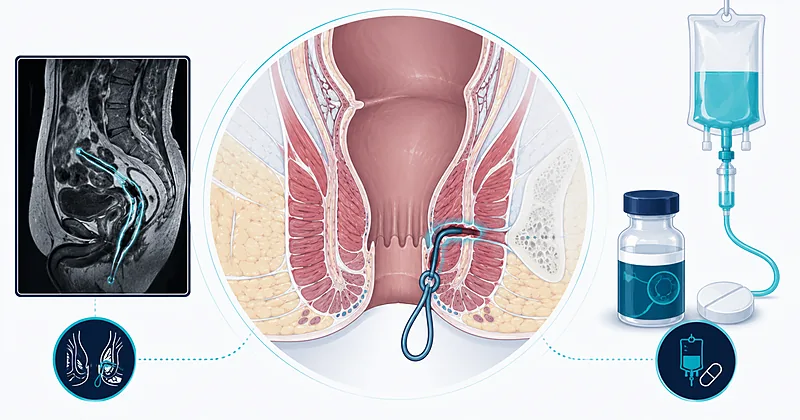
- 1Obtain pelvic MRI in every patient with suspected complex perianal Crohn fistula before any operative intervention.
- 2Classify each tract as simple or complex — complex anatomy mandates biologic therapy and changes the surgical strategy entirely.
- 3Drain every abscess and place a loose, non-cutting seton before initiating or escalating biologic therapy.
- 4Start infliximab as first-line anti-TNF therapy for symptomatic perianal Crohn fistula and combine with a thiopurine when feasible.
- 5Use therapeutic drug monitoring to target higher trough levels in fistulizing disease than in luminal disease.
- 6Leave the seton in place until clinical response is established — usually 6 weeks to several months — not on a fixed schedule.
- 7Treat associated proctitis aggressively — closure cannot be achieved while rectal inflammation persists.
- 8Consider mesenchymal stem cell therapy (darvadstrocel) for complex perianal Crohn fistula refractory to conventional therapy.
- 9Do not pursue definitive closure procedures (LIFT, advancement flap) until both clinical and MRI-confirmed deep remission are documented.
- 10Reserve faecal diversion for severe refractory disease or as a bridge to organ-preserving therapy in a multidisciplinary setting.
MRI Classification in Perianal Crohn Fistula
High-resolution pelvic MRI is the cornerstone of assessment in perianal Crohn fistula. It defines tract anatomy, identifies occult sepsis, and establishes a baseline that drives every subsequent surgical and medical decision. Clinical examination alone — even by an experienced surgeon — understages roughly one in four patients, missing secondary tracts and undrained collections that will sabotage any treatment plan.
Imaging Recommendations
Perform pelvic MRI before any operative intervention in suspected complex perianal Crohn fistula. Use a dedicated protocol with T2-weighted and post-contrast T1 sequences in axial, coronal, and sagittal planes.
Strong Rec High Evidence ECCO 2024 AGA 2024Document the tract relative to the sphincter complex using the Parks anatomical scheme and apply Van Assche grading or the simpler St James scale on MRI reports to support clinical communication.
Strong Rec Moderate Evidence ECCO 2024Distinguish simple from complex perianal Crohn fistula on MRI. Simple disease is low (superficial, low intersphincteric, or low transsphincteric), with a single external opening and no secondary tracts, abscess, proctitis, or stricture.
Strong Rec High Evidence AGA 2024Evaluate for proctitis and anorectal stricture on the same MRI study, since both upgrade an apparently simple fistula to complex disease and alter the medical regimen and surgical timing.
Strong Rec Moderate Evidence ECCO 2024Repeat pelvic MRI at 6 to 12 months after initiating combined therapy to assess radiologic healing. Clinical closure of the external opening alone is an unreliable marker of true tract resolution.
Moderate Rec Moderate Evidence AGA 2024Consider endoanal ultrasound as an adjunct when MRI is contraindicated, equivocal, or unavailable, particularly when intraoperative mapping is needed in a hands-on setting.
Conditional Rec Low Evidence Expert ConsensusReading the MRI: From Finding to Action
| MRI Finding | What It Means | Surgical Implication | Medical Implication | Common Pitfall |
|---|---|---|---|---|
| Low intersphincteric tract, single | Simple disease | Fistulotomy may be safe if no proctitis | Optimise medical therapy first | Underestimating extent — always confirm with EUA |
| High transsphincteric tract | Complex disease | Loose seton mandatory; avoid fistulotomy | Start anti-TNF promptly | Cutting seton — risk of incontinence |
| Secondary tract or horseshoe | Multi-tract complex disease | Drain each tract individually | Higher trough anti-TNF target | Missing the secondary tract on EUA |
| Discrete abscess collection | Active sepsis | Urgent drainage before anything else | Defer biologic until drained | Starting biologic into undrained sepsis |
| Rectal wall thickening or proctitis | Active luminal disease | No definitive closure attempts | Treat luminal disease aggressively | Advancement flap onto inflamed mucosa — will fail |
| Rectovaginal extension | Severe complex disease | Specialist referral; staged approach | Combination biologic strategy | Pursuing repair without multidisciplinary input |
Examination Under Anaesthesia and Seton Strategy
Once MRI has mapped the anatomy, examination under anaesthesia (EUA) confirms what is treatable and what is unsafe to cut. The goal of every initial operation is the same: drain sepsis, place a loose seton through any complex tract, and protect the sphincter. Definitive closure procedures belong to a later phase of care — not the index operation.
Perform EUA with a colorectal surgeon experienced in inflammatory bowel disease whenever the MRI reveals complex anatomy, an abscess, or proctitis.
Strong Rec Moderate Evidence ECCO 2024 AGA 2024Drain every collection identified on imaging or palpation at the index operation. Untreated sepsis is the single most common reason that subsequent biologic therapy appears to fail.
Strong Rec High Evidence ECCO 2024Place a loose, non-cutting seton (vessel loop or silastic) through every complex tract. The seton maintains drainage, prevents recurrent abscess, and allows biologic therapy to work without trapping pus.
Strong Rec High Evidence ECCO 2024 ACG 2018Do not use cutting setons in perianal Crohn fistula. The risk of permanent faecal incontinence outweighs any potential closure benefit in an inflammatory disease that already threatens the sphincter.
Against Moderate Evidence ECCO 2024Avoid primary fistulotomy in high transsphincteric, suprasphincteric, or anterior tracts in women. Reserve fistulotomy for selected low, simple tracts with no proctitis after multidisciplinary discussion.
Against Moderate Evidence AGA 2024Leave the seton in place until clinical response is established — defined as cessation of drainage on examination and a closed, non-tender external opening, not by a fixed calendar.
Strong Rec Moderate Evidence ECCO 2024Time seton removal to coincide with biologic induction. Removing the seton around the second or third induction dose, when local inflammation is settling, balances closure against the risk of premature occlusion and re-collection.
Moderate Rec Moderate Evidence Observational CohortsConsider definitive closure procedures (ligation of intersphincteric fistula tract or endorectal advancement flap) only after at least 6 months of biologic therapy, with documented absence of proctitis and radiologic healing.
Conditional Rec Low Evidence AGA 2024Biologic Therapy in Perianal Crohn Fistula
Biologic therapy — not antibiotics, not immunomodulators alone — is the medical backbone of perianal Crohn fistula management. Infliximab remains the agent with the strongest evidence in fistulizing disease and is the default first-line choice. The therapeutic strategy increasingly leans toward combination therapy and proactive drug-level optimisation rather than a fixed dosing schedule.
Start infliximab 5 mg/kg IV at weeks 0, 2, and 6, then every 8 weeks for maintenance, in symptomatic perianal Crohn fistula once sepsis is drained. Infliximab has the largest randomised evidence base of any biologic in fistulizing disease.
Strong Rec High Evidence ACCENT II ECCO 2024Consider intensified induction (10 mg/kg, or shortened intervals) in patients with extensive complex disease, low serum albumin, or high body weight — all predictors of accelerated drug clearance.
Moderate Rec Moderate Evidence AGA 2024Combine infliximab with an immunomodulator (azathioprine 2–2.5 mg/kg or 6-mercaptopurine) where feasible. Combination therapy improves trough levels, reduces immunogenicity, and improves fistula response over monotherapy.
Strong Rec High Evidence SONIC AGA 2024Check thiopurine methyltransferase activity or genotype before starting azathioprine or 6-mercaptopurine to identify patients at risk of severe myelosuppression.
Strong Rec High Evidence ACG 2018Use therapeutic drug monitoring to target higher infliximab trough levels in perianal Crohn fistula than in luminal disease — typically above 10–15 mcg/mL during induction and at least 7–10 mcg/mL during maintenance, based on observational evidence.
Strong Rec Moderate Evidence AGA 2024 Observational CohortsUse adalimumab as an alternative anti-TNF (160 mg week 0, 80 mg week 2, then 40 mg every 2 weeks) when infliximab is unsuitable. Efficacy in fistulizing disease is supported by post-hoc analyses of CHARM and subsequent cohorts.
Moderate Rec Moderate Evidence AGA 2024Consider ustekinumab or vedolizumab in patients who have lost response to or are intolerant of anti-TNF therapy, recognising that evidence specifically for fistula closure is less robust than for luminal disease.
Conditional Rec Low Evidence AGA 2024Consider local injection of allogeneic adipose-derived mesenchymal stem cells (darvadstrocel) in complex perianal Crohn fistula refractory to conventional therapy with adequately drained, single or multi-tract disease.
Moderate Rec High Evidence ADMIRE-CD ECCO 2024Prescribe ciprofloxacin or metronidazole as adjunctive antibiotic therapy during the induction phase to reduce drainage and discomfort, recognising that antibiotics alone do not heal the fistula.
Moderate Rec Moderate Evidence ECCO 2024Choosing the Biologic by Clinical Scenario
| Clinical Scenario | Preferred Agent | Combination Partner | Monitoring Tip |
|---|---|---|---|
| Biologic-naive, complex fistula, no proctitis | Infliximab 5 mg/kg | Azathioprine 2–2.5 mg/kg | Trough at week 14; target >10 mcg/mL |
| Biologic-naive, complex fistula plus proctitis | Infliximab 10 mg/kg or intensified interval | Azathioprine or methotrexate | Early trough; aim higher target levels |
| Loss of response on infliximab, anti-drug antibodies | Switch to adalimumab | Add immunomodulator if absent | Recheck trough after 12 weeks |
| Anti-TNF failure, complex tract, adequate drainage | Ustekinumab or vedolizumab | Consider darvadstrocel as adjunct | Clinical and MRI reassessment at 6 months |
| Refractory complex fistula, multiple class failures | Darvadstrocel local injection | Continue best available systemic therapy | MRI at 6 and 12 months |
| Pregnant patient with active fistula | Continue infliximab or adalimumab | Avoid methotrexate; thiopurines case-by-case | Coordinate with obstetrics on third-trimester dosing |
Coordinating Surgery and Biologic Therapy
Most outcomes in this disease are determined by the sequencing of surgical and medical interventions, not by either in isolation. The single most important coordination decision is the timing of seton removal relative to biologic induction.
Manage every patient with complex perianal Crohn fistula in a multidisciplinary clinic that includes a colorectal surgeon and an IBD gastroenterologist. Coordinated decision-making improves response rates and reduces unnecessary operations.
Strong Rec Moderate Evidence ECCO 2024Treat coexisting proctitis aggressively with biologic and immunomodulator therapy. Closure of perianal Crohn fistula will not be achieved while the rectal mucosa remains inflamed.
Strong Rec High Evidence ECCO 2024Continue maintenance biologic therapy indefinitely in patients with healed perianal Crohn fistula. Stopping is associated with high relapse rates and the relapsed disease is often more aggressive than at presentation.
Moderate Rec Moderate Evidence ECCO 2024Reserve faecal diversion (loop ileostomy) for severe refractory disease, life-threatening sepsis, or as a bridge to organ-preserving therapy in a multidisciplinary setting. Diversion alone rarely cures perianal Crohn fistula.
Conditional Rec Low Evidence AGA 2024 ECCO 2024Counsel patients that proctectomy with permanent stoma may be necessary in destroyed sphincter anatomy, intractable disease, or anorectal cancer, and frame it as a definitive treatment when reconstruction has failed.
Moderate Rec Low Evidence Expert ConsensusSeton Timeline and Medical Therapy Coordination
| Time Point | Seton Status | Medical Therapy Action | Imaging | Pitfall to Avoid |
|---|---|---|---|---|
| Index EUA (week 0) | Place loose seton, drain sepsis | Hold biologic if undrained pus; start antibiotics | MRI already obtained pre-op | Operating without pre-op MRI |
| Weeks 0–6 (induction) | Seton in situ | Infliximab weeks 0, 2, 6 + thiopurine | Clinical exam only | Removing seton at any drainage symptom |
| Weeks 8–14 | Seton in situ; assess drainage | Check infliximab trough; optimise dose | Clinical exam | Switching biologic before checking trough |
| 3–6 months | Remove seton if drainage ceased | Continue maintenance infliximab | Repeat MRI to assess radiologic healing | Removing seton in persistent drainage |
| 6–12 months | Removed; monitor for recurrence | Continue indefinite maintenance | MRI for sustained deep remission | Stopping biologic on clinical closure alone |
| Beyond 12 months | Consider definitive procedure if remission | Maintain biologic through and after surgery | MRI before any definitive surgery | Closure surgery on persistent proctitis |
Clinical Decision Pathway
A practical, question-based approach to working through a new presentation of perianal Crohn fistula. Answer the questions in order — each one changes what comes next.
Monitoring Response and Long-Term Follow-Up
Response in perianal Crohn fistula is measured on three planes: symptoms, clinical examination, and imaging. Each can lag the others, so a single endpoint is not enough.
Reassess clinically at 8 and 14 weeks after starting biologic therapy. Use the Fistula Drainage Assessment — cessation of drainage on gentle compression at two consecutive visits defines clinical response.
Moderate Rec Moderate Evidence ECCO 2024Obtain a follow-up pelvic MRI between 6 and 12 months after biologic initiation to assess radiologic healing, even when the patient is asymptomatic and the external opening appears closed.
Moderate Rec Moderate Evidence AGA 2024Aim for deep remission — clinical, biochemical, and radiologic healing — before contemplating any definitive closure procedure or de-escalation of medical therapy.
Strong Rec Moderate Evidence ECCO 2024Counsel patients about the long-term risk of anorectal cancer in chronic perianal Crohn fistula. Examine any non-healing or atypical tract with biopsy, particularly when behaviour changes after years of stable disease.
Strong Rec Moderate Evidence ECCO 2024Document the goals of care explicitly with every patient. For most, the realistic goal is durable symptomatic control and sphincter preservation, not anatomical cure.
Strong Rec Low Evidence Expert ConsensusEvidence in Context
Where the major guidelines agree, where they differ, and how the pivotal trials shape current practice.
Where ECCO, AGA, and ACG Agree
All three frameworks converge on the central role of pelvic MRI in assessment, the requirement to drain sepsis before immunosuppression, the use of a loose seton in complex tracts, and the role of anti-TNF therapy as the medical backbone. They also agree that fistulotomy should be reserved for selected simple tracts and that proctitis must be treated for closure to be possible.
Where Guidelines Differ: Combination Therapy Threshold
The 2024 AGA guideline endorses combination biologic-plus-immunomodulator therapy more strongly than older ACG guidance, reflecting accumulated post-SONIC evidence in fistulizing disease specifically. ECCO sits between the two and emphasises individual risk assessment for malignancy and infection, particularly in younger men where the lymphoma risk with thiopurines is most discussed.
ACCENT II: Anti-TNF Maintenance for Fistula Closure
In the ACCENT II trial, maintenance infliximab every 8 weeks was superior to placebo for sustained reduction in draining fistulas at 54 weeks. The trial established the principle that fistula closure requires continued exposure to anti-TNF therapy and that intermittent dosing leads to recurrence. Its findings remain the foundation of modern medical management.
SONIC: Combination Therapy in Crohn’s Disease
SONIC demonstrated that infliximab plus azathioprine was superior to either agent alone for inducing steroid-free clinical remission in biologic-naive Crohn’s disease. Although the trial focused on luminal disease, its subgroup and registry data support a combination strategy in fistulizing disease as well, where higher trough levels are particularly valuable.
ADMIRE-CD: Mesenchymal Stem Cells for Refractory Disease
The ADMIRE-CD trial showed that a single local injection of allogeneic adipose-derived mesenchymal stem cells (darvadstrocel) produced higher rates of combined clinical and radiologic remission at 24 weeks than placebo in complex perianal Crohn fistula refractory to conventional therapy. Long-term follow-up demonstrated maintained benefit at 52 and 104 weeks. The therapy expanded the toolbox for biologic-experienced patients.
References
- 1.Sands BE, Anderson FH, Bernstein CN, et al. Infliximab maintenance therapy for fistulizing Crohn’s disease. N Engl J Med. 2004;350(9):876–885. doi:10.1056/NEJMoa030815
- 2.Colombel JF, Sandborn WJ, Reinisch W, et al. Infliximab, azathioprine, or combination therapy for Crohn’s disease (SONIC). N Engl J Med. 2010;362(15):1383–1395. doi:10.1056/NEJMoa0904492
- 3.Panes J, Garcia-Olmo D, Van Assche G, et al. Expanded allogeneic adipose-derived mesenchymal stem cells (Cx601) for complex perianal fistulas in Crohn’s disease: a phase 3 randomised, double-blind controlled trial. Lancet. 2016;388(10051):1281–1290. doi:10.1016/S0140-6736(16)31203-X
- 4.Lichtenstein GR, Loftus EV, Isaacs KL, Regueiro MD, Gerson LB, Sands BE. ACG Clinical Guideline: Management of Crohn’s Disease in Adults. Am J Gastroenterol. 2018;113(4):481–517. doi:10.1038/ajg.2018.27
- 5.Torres J, Bonovas S, Doherty G, et al. ECCO Guidelines on Therapeutics in Crohn’s Disease: Medical Treatment. J Crohns Colitis. 2020;14(1):4–22. doi:10.1093/ecco-jcc/jjz180
- 6.Adamina M, Bonovas S, Raine T, et al. ECCO Guidelines on Therapeutics in Crohn’s Disease: Surgical Treatment. J Crohns Colitis. 2020;14(2):155–168. doi:10.1093/ecco-jcc/jjz187
- 7.Panes J, Garcia-Olmo D, Van Assche G, et al. Long-term efficacy and safety of stem cell therapy (Cx601) for complex perianal fistulas in patients with Crohn’s disease. Gastroenterology. 2018;154(5):1334–1342.e4. doi:10.1053/j.gastro.2017.12.020
How to Read the Evidence Tags
Each recommendation in this article is labelled with a recommendation strength, an evidence quality tag, and one or more source tags. These are Medaptly’s simplified interpretations and do not reproduce any single guideline body’s classification system.
Recommendation Strength
| Tag | What It Means |
|---|---|
| Strong Rec | High-quality evidence broadly supports this action. |
| Moderate Rec | The weight of evidence favours this action. |
| Conditional Rec | Benefit is less certain — individualise the decision. |
| Against | Evidence shows no benefit or potential harm. |
Evidence Quality
| Tag | What It Means |
|---|---|
| High Evidence | Multiple well-designed RCTs or high-quality meta-analyses. |
| Moderate Evidence | Single RCT or large observational studies. |
| Low Evidence | Expert consensus or small studies. |