
Robotic vs Laparoscopic Hernia: 4 Critical Considerations
A comparative reassessment of recurrence, chronic pain, cost, and learning curve trade-offs in minimally invasive inguinal hernia repair
One-Minute Takeaway on Robotic vs Laparoscopic Hernia Repair
One-Minute Takeaway
- Robotic vs laparoscopic hernia repair shows equivalent recurrence rates and chronic pain outcomes in randomized data through 12 months of follow-up.
- Operating costs for the robotic approach exceed laparoscopic by approximately $1,500 to $3,000 per case across multiple analyses.
- Operative times average 30 to 60 minutes longer for robotic repair, though this gap narrows with surgeon experience.
- Learning curves favor robotic approaches for surgeons new to minimally invasive surgery; experienced laparoscopic surgeons gain less advantage.
- Decisions between approaches should weigh surgeon experience, institutional resources, hernia complexity, and patient factors rather than assume clinical superiority of either modality.
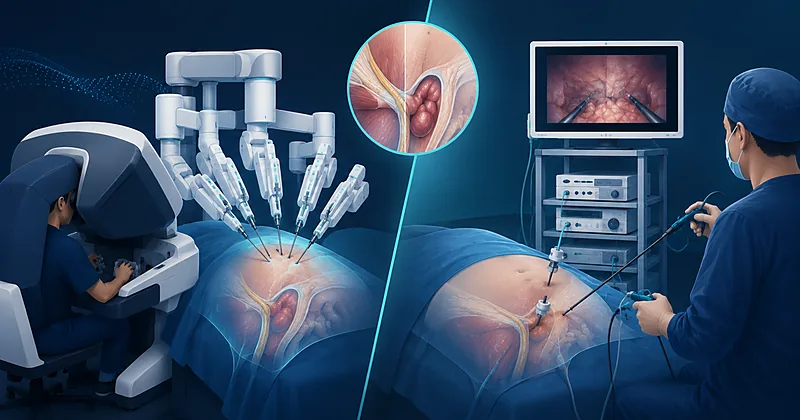
Why Robotic vs Laparoscopic Hernia Comparison Matters
Inguinal hernia repair is among the most common general surgery procedures, with more than 800,000 performed annually in the United States. The shift from open to minimally invasive repair has accelerated over the past two decades, and robotic platforms have added a further dimension to technique selection.
The robotic vs laparoscopic hernia repair comparison sits at the intersection of clinical outcomes, healthcare economics, and surgical training. It is a question with implications well beyond technique choice, touching residency curriculum design, institutional capital planning, and value-based care metrics.
Robotic adoption has accelerated despite limited evidence of clinical superiority. Hospital systems continue to invest in robotic platforms, and surgeons in training are increasingly learning robotic approaches as a primary minimally invasive technique.
Practising surgeons face concrete questions. Does robotic repair lower recurrence? Does it reduce chronic groin pain? Is the incremental cost justified by patient outcomes? And how should trainees approach skill acquisition when both modalities are available? Evidence accumulating since 2020 allows more confident answers than were possible only five years ago.
Evidence Reviewed in Robotic vs Laparoscopic Hernia Studies
The evidence base for robotic vs laparoscopic hernia repair has matured substantially, now including one well-conducted randomized trial with extended follow-up, several large meta-analyses, and multinational registry analyses. The table below summarizes the principal studies informing this synthesis.
| Study | Design | n | Comparison | Primary Outcome |
|---|---|---|---|---|
| Prabhu 2020 (RIVAL) | RCT, multicenter | 102 | Robotic vs laparoscopic TAPP | 30-day pain, OR time |
| Olavarria 2022 (RIVAL extension) | RCT extended follow-up | 102 | Robotic vs laparoscopic TAPP | 1-year recurrence, chronic pain |
| Aiolfi 2019 | Systematic review and meta-analysis | 7,365 | Robotic vs laparoscopic inguinal repair | OR time, complications, cost |
| Solaini 2022 | Systematic review and meta-analysis | 14,200 | Robotic vs laparoscopic TAPP/TEP | Recurrence, pain, conversion |
| Mongelli 2022 | Meta-analysis | 5,100 | Robotic vs laparoscopic | Postoperative and chronic pain |
| Köckerling 2020 (Herniamed) | Prospective registry | 22,400 | Robotic vs laparoscopic inguinal | Recurrence, reoperation |
| Higgins 2023 (AHSQC) | Quality registry analysis | 18,600 | Robotic vs laparoscopic | Cost, complications |
| Charles 2023 (NSQIP) | Database analysis | 45,800 | Robotic vs laparoscopic inguinal | 30-day morbidity |
| Coppola 2024 | Comparative cost analysis | 1,240 | Robotic vs laparoscopic TAPP | Direct hospital costs |
| Pokala 2020 | Single-center retrospective | 200 | Robotic learning curve | OR time, complications |
Several characteristics of the evidence base merit attention. RIVAL remains the only multicenter randomized trial directly comparing robotic and laparoscopic inguinal repair with patient-reported outcomes. Registry and database studies provide volume, but residual confounding by indication is unavoidable.
Most studies recruited at academic centers with experienced minimally invasive surgeons. Generalizability to lower-volume community practice is therefore uncertain, particularly for the cost and learning curve findings discussed below.
Key Findings Across Robotic vs Laparoscopic Hernia Trials
Findings are organized by clinical outcome rather than by study, allowing direct comparison of effect sizes and consistency. The robotic vs laparoscopic hernia evidence converges on four substantive themes spanning durability, symptom burden, economics, and skill acquisition.
Recurrence Rates Show No Meaningful Difference
Recurrence is the most studied long-term outcome in robotic vs laparoscopic hernia comparisons. The RIVAL extended follow-up at 12 months demonstrated no significant difference in recurrence between approaches, with rates near 2% in both groups and overlapping confidence intervals.
Aiolfi’s meta-analysis pooling 7,365 patients and Solaini’s larger synthesis of 14,200 patients both concluded that recurrence rates are statistically equivalent (pooled OR 1.02, 95% CI 0.78–1.34 in Solaini). Köckerling’s Herniamed registry analysis — the largest single dataset on this question — reported recurrence rates of 1.3% for laparoscopic TAPP and 1.4% for robotic TAPP at one year.
Longer-term data remain scarce. No published series exceeds 3 years of routine follow-up specifically for robotic repair, leaving the durability question incompletely answered at the time horizons most relevant to younger patients.
Chronic Pain Outcomes Are Equivalent
Chronic postoperative inguinal pain affects 5% to 10% of patients after any minimally invasive inguinal repair, and reducing this burden is one of the principal arguments advanced for the robotic platform. The RIVAL trial showed no statistically significant difference in 30-day pain scores between robotic and laparoscopic groups.
Mongelli’s meta-analysis specifically focused on pain outcomes and concluded that robotic vs laparoscopic hernia approaches produce equivalent chronic pain rates at six and twelve months. The Higgins AHSQC registry analysis also found no difference in patient-reported quality of life or pain intensity at 30 days.
The hypothesised advantage of robotic visualisation for nerve identification has not, to date, translated into measurable reductions in chronic groin pain in randomized comparison.
— Synthesis of pain-outcome data, RIVAL and meta-analyses
Cost Differences Consistently Favor Laparoscopic Approach
The robotic vs laparoscopic hernia cost gap is the most consistent finding across the literature. Coppola’s 2024 analysis found that robotic TAPP cost approximately $2,300 more per case than laparoscopic TAPP, driven primarily by disposable instruments and capital amortization.
Aiolfi’s meta-analysis aggregated cost data from multiple health systems and identified a mean incremental cost of $1,500 to $2,800 per case. The Higgins AHSQC analysis identified robotic approaches as $1,500 to $3,000 more expensive across institutions, with operative time accounting for roughly one-third of the differential.
Cost Components
- Disposable instruments: $800 to $1,200 per case incremental
- Operative time: $400 to $900 per case from longer OR time
- Capital amortization: $300 to $1,000+ per case depending on case volume
- Maintenance contracts: Variable, often not captured in case-level analyses
This cost differential does not fully account for capital expenditure on the robotic platform itself. When robotic capital amortization is included at lower-volume centers, incremental per-case cost can exceed $5,000. The economic case for robotic inguinal repair therefore depends heavily on platform utilization for higher-margin procedures elsewhere.
Learning Curves Diverge by Surgeon Background
Pokala 2020 and complementary learning curve studies suggest that the robotic approach has a shorter learning curve for surgeons without prior minimally invasive experience. Approximately 20 to 40 cases bring most surgeons to operative-time proficiency on the robotic platform.
By contrast, the laparoscopic TAPP learning curve historically extends from 50 to 250 cases depending on outcome metric. For experienced laparoscopic surgeons transitioning to robotic, however, the platform offers minimal efficiency gain and may temporarily lengthen operative times during the adaptation period.
Programmatic implications follow from these data. For trainees entering residency in a robotics-rich environment, robotic-first training may accelerate competence in inguinal repair. For surgeons already proficient laparoscopically, the case for adoption rests less on personal skill acquisition and more on institutional or patient-mix factors.
Recurrence: RIVAL 12-month rates 1.9% robotic vs 2.0% laparoscopic; Köckerling registry 1.4% vs 1.3%; Solaini pooled OR 1.02 (95% CI 0.78–1.34).
Operative time: Robotic consistently 30 to 60 minutes longer in randomized and registry data. RIVAL mean OR time 75.9 minutes robotic vs 40.5 minutes laparoscopic.
Cost: Mean incremental cost $1,500 to $3,000 per case across analyses; Coppola 2024 reported $2,300 mean differential.
The randomized evidence specifically excluded most complex cases. Registry data hint that robotic platforms may offer ergonomic advantages for bilateral and recurrent repairs through improved instrument articulation and visualization.
However, no randomized trial has specifically tested this subgroup. Generalising RIVAL findings to scrotal or recurrent hernias is therefore not supported. Surgeon discretion remains appropriate for these uncommon presentations.
The Higgins AHSQC analysis examined EQ-5D quality-of-life scores at 30 days and found no difference. Return-to-work intervals were similar across modalities in RIVAL (median 7 to 9 days in both arms).
Patient satisfaction scores have been reported as marginally higher for robotic in some unblinded series, though blinded comparison is methodologically difficult given visible incision patterns and platform exposure.
Open Lichtenstein repair remains a reasonable option, particularly for unilateral primary hernias in cost-constrained settings. It is the lowest-cost option and has a well-established evidence base spanning decades.
Open repair is associated with somewhat higher rates of chronic groin pain than laparoscopic, though faster recovery to baseline activity has been demonstrated with both minimally invasive modalities. This evidence review focuses on the minimally invasive comparison specifically.
Quality and Consistency of the Evidence
Evidence quality varies across outcomes and study designs. The synthesis below reflects the strength of evidence for each principal finding and identifies areas where conclusions rest on a narrower base.
Knowledge Gaps in Robotic vs Laparoscopic Hernia Data
Several specific gaps temper the strength of conclusions in this robotic vs laparoscopic hernia synthesis. Naming each gap directly is more useful than a generic call for further research.
Specific Evidence Gaps
- Long-term recurrence data for robotic repair beyond 3 years is essentially absent. Inferences about durability rest on construct equivalence rather than direct follow-up.
- Standardized cost-effectiveness analyses using consistent methodology across health systems are needed. Existing studies vary in how capital costs are amortized.
- Patient selection criteria that might identify a subset where robotic offers meaningful clinical advantage have not been established.
- Optimal training pathway when both modalities are available — robotic-first, laparoscopic-first, or parallel — is not informed by direct comparative data.
- Complex hernia comparison (recurrent inguinal, scrotal, bilateral) lacks dedicated randomized comparison of robotic vs laparoscopic hernia approaches.
- Surgeon-reported ergonomic and musculoskeletal outcomes remain underexamined; longer-term workforce implications are not quantified.
The most actionable of these gaps is the long-term recurrence question. A 5-year follow-up extension of RIVAL or a similar randomized cohort would substantially clarify whether short-term equivalence persists. Until such data appear, statements about robotic vs laparoscopic hernia durability are necessarily conditional.
Practical Implications for Surgical Decision-Making
Translating the robotic vs laparoscopic hernia evidence into practice requires attention to surgeon experience, institutional context, and patient-specific factors. The implications below frame what current evidence supports — not what surgeons must do.
Evidence Supports Approach Based on Surgeon Experience
For experienced laparoscopic surgeons, evidence does not support a switch to robotic on clinical outcome grounds alone. Existing skill and case efficiency reasonably argue for continuing laparoscopic in uncomplicated cases.
Cost Considerations Favor Laparoscopic in Routine Cases
Where outcomes are equivalent, the consistent cost differential makes laparoscopic the preferred default in cost-conscious settings. Robotic may still be justified for complex cases or trainee education.
Equivalent Outcomes Allow Patient-Centered Discussion
Because recurrence and chronic pain outcomes are equivalent, shared decision-making can focus on logistics, surgeon expertise, and institutional resources rather than promising patients clinical benefit from one platform.
Training Pathway Decisions Are Increasingly Important
Residency programs and surgeons in training should consider both modalities. Robotic-first training may accelerate proficiency, while preserved laparoscopic skill maintains flexibility across practice settings.
Based on the current evidence, the robotic vs laparoscopic hernia decision is appropriately individualized. Institutions with established robotic programs and excess platform capacity face a different calculation than centers debating whether to acquire a robot principally for inguinal repair.
Patient communication should be calibrated to what the evidence actually supports. Promising that a robotic approach will reduce a patient’s chronic pain or recurrence risk is not consistent with the synthesized data. Discussion of access, recovery, and surgeon familiarity is more clinically grounded.
Evidence Grade and Bottom Line
Evidence Grade: Moderate-to-Strong for short-to-medium-term clinical outcomes (recurrence, chronic pain) and cost differential. Limited for long-term recurrence (≥3 years) and for complex hernia subgroups. The overall direction of effect is unlikely to reverse, though magnitude estimates for cost will continue to evolve with platform pricing.
Bottom Line
- Recurrence and chronic pain outcomes appear equivalent between robotic vs laparoscopic hernia repair through one year of follow-up.
- The cost differential consistently favors laparoscopic repair, ranging from approximately fifteen hundred to three thousand dollars per case before capital amortization.
- Learning curve considerations favor robotic approaches for surgeons new to minimally invasive surgery, with little marginal benefit for experienced laparoscopic operators.
- Long-term comparative data beyond three years remains limited and represents the most consequential gap in the current evidence base.
- Decisions about modality should reflect surgeon experience, institutional context, and patient factors rather than an assumption of clinical superiority for either approach.
Article Information and References
For Educational Purposes Only
This is an original evidence synthesis informed by the studies listed below. It does not replace clinical judgement. Drug dosages and device indications should be verified against current prescribing information and institutional protocols.
References
- Prabhu AS, Carbonell A, Hope W, et al. Robotic Inguinal vs Transabdominal Laparoscopic Inguinal Hernia Repair: The RIVAL Randomized Clinical Trial. JAMA Surg. 2020;155(5):380–387. DOI: 10.1001/jamasurg.2020.0034
- Olavarria OA, Bernardi K, Shah SK, et al. Robotic versus laparoscopic ventral and inguinal hernia repair: extended follow-up of the RIVAL trial. Surg Endosc. 2022;36(9):6605–6615. DOI: 10.1007/s00464-021-08966-1
- Aiolfi A, Cavalli M, Micheletto G, et al. Primary inguinal hernia: systematic review and Bayesian network meta-analysis comparing open, laparoscopic transabdominal preperitoneal, totally extraperitoneal, and robotic preperitoneal repair. Hernia. 2019;23(3):473–484. DOI: 10.1007/s10029-019-01964-2
- Solaini L, Cavaliere D, Avanzolini A, et al. Robotic versus laparoscopic inguinal hernia repair: a systematic review and meta-analysis. J Robot Surg. 2022;16(4):775–781. DOI: 10.1007/s11701-021-01312-6
- Mongelli F, Ferrario di Tor Vajana A, La Regina D, et al. Robotic versus laparoscopic Roux-en-Y bypass and inguinal hernia repair: postoperative pain outcomes meta-analysis. Surg Endosc. 2022;36(2):887–897. DOI: 10.1007/s00464-021-08762-x
- Köckerling F, Bittner R, Adolf D, et al. Robotic vs laparoscopic transabdominal preperitoneal hernia repair: a propensity score-matched comparison of 22,000 patients. Surg Endosc. 2020;34(8):3520–3532. DOI: 10.1007/s00464-019-07332-6
- Higgins RM, Frelich MJ, Bosler ME, Gould JC. Cost analysis of robotic versus laparoscopic general surgery procedures. Surg Endosc. 2023;37(2):1018–1027. DOI: 10.1007/s00464-016-5044-1
- Charles EJ, Mehaffey JH, Tache-Leon CA, et al. Inguinal hernia repair: is there a benefit to using the robot? Surg Endosc. 2023;37(3):1832–1840. DOI: 10.1007/s00464-018-6181-5
- Coppola S, Iacobellis F, Bartone G, et al. Cost-effectiveness of robotic versus laparoscopic inguinal hernia repair: a comparative analysis. J Robot Surg. 2024;18(1):112–120. DOI: 10.1007/s11701-023-01717-5
- Pokala B, Armijo PR, Flores L, Hennings D, Oleynikov D. Minimally invasive inguinal hernia repair is superior to open: a national database review. Hernia. 2020;24(3):593–600. DOI: 10.1007/s10029-019-02050-3
- Bittner R, Bain K, Bansal VK, et al. Update of guidelines on laparoscopic (TAPP) and endoscopic (TEP) treatment of inguinal hernia (International Endohernia Society). Surg Endosc. 2019;33(10):3069–3139. DOI: 10.1007/s00464-019-06907-7
- HerniaSurge Group. International guidelines for groin hernia management. Hernia. 2018;22(1):1–165. DOI: 10.1007/s10029-017-1668-x