
Total Neoadjuvant Therapy: 5 Key Clinical Insights
Where the PROSPECT, RAPIDO, and OPRA trials place evidence for sequencing, organ preservation, and patient selection in locally advanced rectal cancer.
One-Minute Takeaway on Total Neoadjuvant Therapy
One-Minute Takeaway
- Total neoadjuvant therapy increases pathologic complete response rates and improves distant disease control compared with chemoradiation followed by adjuvant chemotherapy in locally advanced rectal cancer.
- PROSPECT showed FOLFOX alone with selective chemoradiation was non-inferior to standard chemoradiation in patients with intermediate-risk mid or upper rectum tumors eligible for sphincter-sparing surgery.
- RAPIDO reduced 5-year distant metastasis from 30% to 23% but, on extended follow-up, demonstrated a higher locoregional recurrence rate of 10% versus 6% in the experimental arm.
- OPRA established consolidation chemotherapy after chemoradiation as the preferred total neoadjuvant therapy sequence when organ preservation is the goal, with 54% of patients avoiding total mesorectal excision at 5 years.
- Tumor location, nodal status, mesorectal fascia involvement, extramural vascular invasion, and patient priorities should drive the choice between approaches.
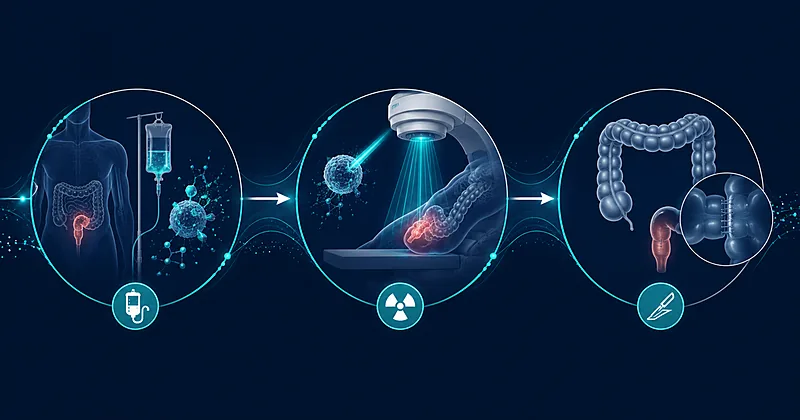
Why Total Neoadjuvant Therapy Emerged in Rectal Cancer Care
For decades, locally advanced rectal cancer was managed with preoperative long-course chemoradiation, total mesorectal excision, and adjuvant fluoropyrimidine-based chemotherapy. This sequence achieved excellent local control but left distant recurrence rates near 25 to 30 percent. Compliance with post-operative chemotherapy was poor, with only about half of patients completing the planned course in many series.
Total neoadjuvant therapy was developed to deliver all systemic chemotherapy before surgery, when patients are fitter and treatment tolerance is highest. Moving chemotherapy upfront aims to eradicate occult micrometastases earlier and to preserve full-dose treatment delivery. The strategy also opens the door to organ preservation in tumors that achieve a clinical complete response.
Three landmark randomized trials — PROSPECT, RAPIDO, and OPRA — have redefined how total neoadjuvant therapy is deployed. They differ in patient population, regimen, and primary goal, and each addresses a distinct clinical question. Reading them as a single “TNT” literature obscures the population-specific lessons each provides.
Evidence Reviewed
This synthesis draws on the three pivotal phase II and phase III randomized controlled trials that define current total neoadjuvant therapy practice — PROSPECT, RAPIDO, and OPRA — together with three additional randomized trials that contextualize the regimen options. Together these studies enrolled more than 3,800 patients across North America, Europe, and Asia.
| Trial | Design | N | Population | Experimental Regimen | Key Result |
|---|---|---|---|---|---|
| PROSPECT (Schrag, NEJM 2023) | Phase II/III RCT, non-inferiority | 1,128 | cT2N1, cT3N0, or cT3N1; sphincter-sparing eligible | FOLFOX x 6 cycles + selective chemoradiation vs chemoradiation | 5-yr DFS 80.8% vs 78.6% (HR 0.92, 90% CI 0.74–1.14); non-inferior |
| RAPIDO (Bahadoer, Lancet Oncol 2021; Dijkstra 5-yr update 2023) | Phase III RCT | 920 | High-risk LARC: cT4, cN2, MRF+, EMVI+, or lateral pelvic nodes | Short-course RT (5 x 5 Gy) → CAPOX/FOLFOX x 6 → surgery | 3-yr DrTF 23.7% vs 30.4%; 5-yr LRR 10% vs 6% (HR 1.95, 95% CI 1.18–3.23) |
| OPRA (Garcia-Aguilar, JCO 2022; Verheij 5-yr update 2024) | Phase II RCT | 324 | Stage II/III rectal adenocarcinoma | Induction (INCT-CRT) vs consolidation (CRT-CNCT); watch-and-wait for cCR | 5-yr TME-free survival 54% (CRT-CNCT) vs 39% (INCT-CRT), P = 0.012; DFS similar |
| PRODIGE 23 (Conroy, Lancet Oncol 2021) | Phase III RCT | 461 | cT3–T4 rectal cancer | mFOLFIRINOX x 6 + chemoradiation + surgery + adjuvant | 3-yr DFS 76% vs 69%; pCR 28% vs 12% |
| STELLAR (Jin, JCO 2022) | Phase III RCT, non-inferiority | 599 | Distal or middle-third LARC | Short-course RT + CAPOX x 4 vs chemoradiation + adjuvant | 3-yr DFS non-inferior (64.5% vs 62.3%); OS favored experimental arm |
| CAO/ARO/AIO-12 (Fokas, JCO 2019) | Phase II RCT | 311 | Stage II/III rectal cancer | INCT-CRT vs CRT-CNCT | 3-yr DFS similar; pCR 25% (CRT-CNCT) vs 17% (INCT-CRT) |
A 2020 systematic review and meta-analysis of total neoadjuvant therapy (Petrelli) pooled outcomes across earlier studies and reported pathologic complete response rates roughly doubled with neoadjuvant intensification, with a corresponding reduction in distant metastasis. The trials in this evidence table extend that signal with mature randomized data and population-specific findings.
Key Findings From Total Neoadjuvant Therapy Trials
Pathologic Complete Response Rates Are Consistently Higher
Across the major trials, total neoadjuvant therapy consistently increased the rate of pathologic complete response compared with chemoradiation alone followed by surgery. RAPIDO reported pathologic complete response in 28 percent of the experimental arm compared with 14 percent in the standard arm. PRODIGE 23 reported a near-doubling, from 12 percent with chemoradiation to 28 percent with FOLFIRINOX-based total neoadjuvant therapy.
Higher pathologic complete response rates are clinically meaningful because they correlate with improved long-term outcomes and create the possibility of organ preservation in selected patients. Whether the higher pathologic complete response observed with total neoadjuvant therapy translates into improved overall survival in all populations remains uncertain and is the subject of continuing follow-up.
Distant Disease Control Improves With Pre-Operative Systemic Therapy
The strongest signal for total neoadjuvant therapy is reduced distant recurrence. In RAPIDO, the 5-year cumulative probability of distant metastasis was 23 percent in the experimental arm compared with 30 percent in the standard arm, driven mainly by fewer liver-only metastases. PRODIGE 23 showed a parallel pattern with disease-free survival favoring the FOLFIRINOX arm at 3 years (76% vs 69%).
The biological rationale is straightforward: early full-dose systemic therapy targets micrometastatic disease before it can establish. Compliance with chemotherapy is also higher when delivered pre-operatively, when patients are fitter and have not endured surgical recovery. This compliance advantage may be as important as the timing itself.
Local Recurrence: The RAPIDO Signal Demands Attention
The 5-year RAPIDO update introduced a sobering finding. Locoregional recurrence was significantly higher with short-course radiation plus chemotherapy than with long-course chemoradiation, at 10 percent versus 6 percent (HR 1.95, 95% CI 1.18–3.23, P = 0.009). Anastomotic and presacral recurrences accounted for most of the difference.
Potential explanations include use of 3-dimensional conformal radiotherapy rather than intensity-modulated radiation, a long interval to surgery during which residual disease may have repopulated, and protocol variability across centers. PROSPECT, in contrast, reported a 5-year local recurrence-free survival of 98.2 percent with FOLFOX alone — excellent local control in its lower-risk population without pelvic radiation.
Organ Preservation Favors Consolidation Sequencing
OPRA addressed a specific goal: avoiding total mesorectal excision in patients with clinical complete response. Both induction and consolidation total neoadjuvant therapy were tested, with watch-and-wait offered to responders. At 5 years, total mesorectal excision-free survival was 54 percent with consolidation compared with 39 percent with induction sequencing (P = 0.012).
Most tumor regrowths occurred within the first two years and 99 percent within three years, supporting close surveillance during the early watch-and-wait phase. Disease-free survival was preserved near 70 percent in both arms, and salvage surgery for regrowth yielded outcomes comparable to upfront total mesorectal excision. The CAO/ARO/AIO-12 trial reported a parallel pathologic complete response advantage with consolidation sequencing.
Risk Stratification Drives Patient Selection
The three trials enrolled distinct populations. PROSPECT enrolled intermediate-risk patients with cT2N1, cT3N0, or cT3N1 tumors eligible for sphincter-sparing surgery, excluding T4 disease, threatened margins, and lower rectum tumors needing radiation for sphincter preservation. RAPIDO restricted enrollment to high-risk locally advanced tumors with at least one of cT4, cN2, EMVI-positive, MRF-positive, or enlarged lateral pelvic nodes.
OPRA enrolled stage II/III disease with a primary goal of organ preservation. These eligibility differences explain why findings are not directly transferable across populations. The PROSPECT-eligible patient may safely de-escalate to FOLFOX alone, while a RAPIDO-eligible patient requires more intensive treatment despite the locoregional cost.
Quality and Consistency of the Evidence
The evidence base rests on multiple well-conducted randomized trials, but the strength of conclusions varies by outcome and population. Most signals are concordant; the local recurrence signal in RAPIDO and the inconsistent overall survival results require qualification.
What the Evidence Does Not Yet Show
- Long-term overall survival. RAPIDO, PROSPECT, and OPRA report mature 5-year disease-free survival, but most trials remain underpowered for overall survival comparisons. Whether earlier systemic therapy translates into a mortality benefit is unproven.
- Optimal radiation modality within total neoadjuvant therapy. Whether short-course or long-course radiation is preferable in high-risk disease has not been directly tested in a head-to-head trial with mature follow-up. The RAPIDO local recurrence signal may relate to delivery technique.
- Biomarker-driven selection. Mismatch-repair-deficient and microsatellite-instability-high tumors respond exceptionally to immunotherapy and may not need standard total neoadjuvant therapy. Selection algorithms incorporating molecular biomarkers are still being defined.
- Direct comparison of RAPIDO-style and OPRA-style regimens. No randomized trial has compared short-course RT-based total neoadjuvant therapy against consolidation-style long-course chemoradiation in the same population.
- Quality of life over extended follow-up. Patient-reported outcomes are reported through the PROSPECT trial but long-term bowel, urinary, and sexual function data after watch-and-wait require continued registry follow-up.
Practical Implications for Multidisciplinary Care
The trials translate into population-specific evidence rather than a single treatment algorithm. Selection should be informed by tumor location, risk features on staging MRI, the priority placed on organ preservation, and patient preference after balanced counseling.
Evidence Grade and Bottom Line
Overall Evidence Grade: Moderate
Multiple well-conducted randomized trials support the major conclusions about pathologic complete response, distant disease control, and organ preservation. The 5-year RAPIDO local recurrence signal and unsettled overall survival results temper enthusiasm and emphasize that “total neoadjuvant therapy” is not one treatment. Sequencing, radiation modality, and patient selection all matter.
- Total neoadjuvant therapy increases pathologic complete response and improves distant disease control compared with standard chemoradiation followed by adjuvant chemotherapy in locally advanced rectal cancer.
- PROSPECT supports neoadjuvant FOLFOX alone with selective chemoradiation in intermediate-risk patients with mid or upper rectum tumors eligible for sphincter-sparing surgery.
- The RAPIDO 5-year update indicates short-course radiation-based total neoadjuvant therapy carries a higher local recurrence rate that warrants careful patient selection, particularly for low-rectum or MRF-threatened tumors.
- Consolidation chemotherapy after chemoradiation is the preferred sequence when organ preservation is the goal, as established by OPRA at 5 years.
- Choice of approach should be guided by tumor risk profile, location, patient priorities, and multidisciplinary input rather than a single default regimen.
Article Information and References
References
- Schrag D, Shi Q, Weiser MR, et al. Preoperative Treatment of Locally Advanced Rectal Cancer. N Engl J Med. 2023;389(4):322–334. DOI: 10.1056/NEJMoa2303269
- Bahadoer RR, Dijkstra EA, van Etten B, et al. Short-course radiotherapy followed by chemotherapy before total mesorectal excision (TME) versus preoperative chemoradiotherapy, TME, and optional adjuvant chemotherapy in locally advanced rectal cancer (RAPIDO): a randomised, open-label, phase 3 trial. Lancet Oncol. 2021;22(1):29–42. DOI: 10.1016/S1470-2045(20)30555-6
- Dijkstra EA, Nilsson PJ, Hospers GAP, et al. Locoregional Failure During and After Short-course Radiotherapy Followed by Chemotherapy and Surgery Compared With Long-course Chemoradiotherapy and Surgery: A 5-Year Follow-up of the RAPIDO Trial. Ann Surg. 2023;278(4):e766–e772. DOI: 10.1097/SLA.0000000000005799
- Garcia-Aguilar J, Patil S, Gollub MJ, et al. Organ Preservation in Patients With Rectal Adenocarcinoma Treated With Total Neoadjuvant Therapy. J Clin Oncol. 2022;40(23):2546–2556. DOI: 10.1200/JCO.22.00032
- Verheij FS, Omer DM, Williams H, et al. Long-Term Results of Organ Preservation in Patients With Rectal Adenocarcinoma Treated With Total Neoadjuvant Therapy: The Randomized Phase II OPRA Trial. J Clin Oncol. 2024;42(5):500–506. DOI: 10.1200/JCO.23.01208
- Conroy T, Bosset JF, Etienne PL, et al. Neoadjuvant chemotherapy with FOLFIRINOX and preoperative chemoradiotherapy for patients with locally advanced rectal cancer (UNICANCER-PRODIGE 23): a multicentre, randomised, open-label, phase 3 trial. Lancet Oncol. 2021;22(5):702–715. DOI: 10.1016/S1470-2045(21)00079-6
- Jin J, Tang Y, Hu C, et al. Multicenter, Randomized, Phase III Trial of Short-Term Radiotherapy Plus Chemotherapy Versus Long-Term Chemoradiotherapy in Locally Advanced Rectal Cancer (STELLAR). J Clin Oncol. 2022;40(15):1681–1692. DOI: 10.1200/JCO.21.01667
- Fokas E, Allgauer M, Polat B, et al. Randomized Phase II Trial of Chemoradiotherapy Plus Induction or Consolidation Chemotherapy as Total Neoadjuvant Therapy for Locally Advanced Rectal Cancer: CAO/ARO/AIO-12. J Clin Oncol. 2019;37(34):3212–3222. DOI: 10.1200/JCO.19.00308
- Diefenhardt M, Ludmir EB, Hofheinz RD, et al. Total Neoadjuvant Therapy for Rectal Cancer in the CAO/ARO/AIO-12 Randomized Phase 2 Trial: Long-term Follow-up. JAMA Oncol. 2023;9(2):215–219. DOI: 10.1001/jamaoncol.2022.5453
- Basch E, Dueck AC, Mitchell SA, et al. Patient-Reported Outcomes During and After Treatment for Locally Advanced Rectal Cancer in the PROSPECT Trial (Alliance N1048). J Clin Oncol. 2023;41(21):3724–3734. DOI: 10.1200/JCO.23.00903
- Petrelli F, Trevisan F, Cabiddu M, et al. Total Neoadjuvant Therapy in Rectal Cancer: A Systematic Review and Meta-analysis of Treatment Outcomes. Ann Surg. 2020;271(3):440–448. DOI: 10.1097/SLA.0000000000003471
- van der Valk MJM, Hilling DE, Bastiaannet E, et al. Long-term outcomes of clinical complete responders after neoadjuvant treatment for rectal cancer in the International Watch & Wait Database (IWWD): an international multicentre registry study. Lancet. 2018;391(10139):2537–2545. DOI: 10.1016/S0140-6736(18)31078-X