
Medication Overuse Headache: Withdrawal Strategies and Bridge Therapy
Clinical Practice Update — Identifying Overuse, Choosing Abrupt vs Taper, and Reinitiating Prevention
This is an original clinical education article informed by current guidelines and evidence. See References below for source documents.
- Clinical Focus
- Evidence-based approach to medication overuse headache in adults with chronic migraine or tension-type headache
- Target Audience
- Neurologists, primary care physicians, headache specialists, pharmacists, nurse practitioners
- Setting
- Outpatient neurology, primary care, headache clinic, and selected inpatient withdrawal
- Source Evidence
- •International Classification of Headache Disorders, 3rd edition (ICHD-3, 2018)
- •American Headache Society 2021 Consensus Statement on Integrating Migraine Treatments
- •European Headache Federation Guideline on Medication Overuse Headache (2020)
- •MOTS Trial: Medication Overuse Treatment Strategy (Neurology, 2020)
Key Clinical Takeaways
Medication overuse headache turns a treatable episodic headache disorder into a chronic daily one, and the cure is almost always to withdraw the offending agent. The points below distill what every clinician needs to recognise it, plan withdrawal, and restart prevention without delay.
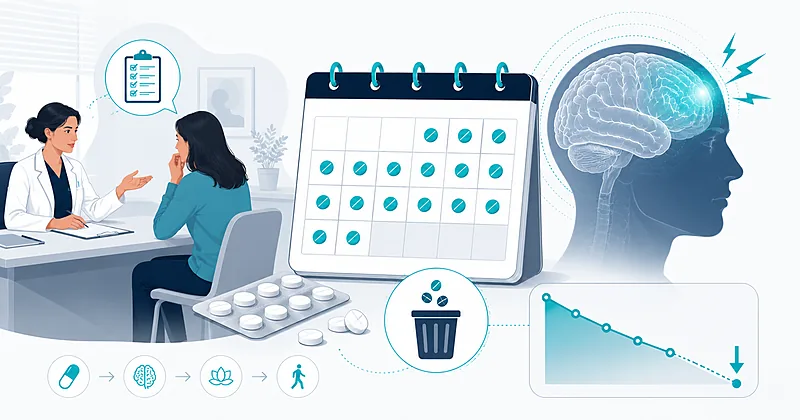
- 1Ask about acute medication days per month at every chronic migraine and tension-type headache visit — this is how medication overuse headache is found.
- 2The diagnostic threshold is 15 days/month for simple analgesics and 10 days/month for triptans, opioids, ergots, or combination analgesics, sustained for over three months.
- 3For NSAIDs, triptans, ergots, and simple analgesics, abrupt withdrawal is safe and the preferred approach in motivated outpatients.
- 4For opioids, barbiturates such as butalbital, and benzodiazepines, gradual taper is essential to prevent withdrawal seizures and autonomic syndromes.
- 5Bridge therapy with naproxen, a short prednisone course, or a greater occipital nerve block reduces the severity and duration of withdrawal headache.
- 6Start migraine prevention at the same time as withdrawal, not after — this is the single most important predictor of long-term success.
- 7CGRP monoclonal antibodies and onabotulinumtoxin A have shown efficacy in medication overuse headache even when started before complete withdrawal.
- 8Counsel patients that headaches predictably worsen for 2–10 days during withdrawal before improving — setting this expectation prevents premature relapse.
- 9Treat coexisting depression and anxiety from the outset — these predict relapse more strongly than any other clinical factor.
- 10Use a headache diary throughout withdrawal and the first six months of prevention — it improves adherence and detects relapse early.
Identifying Medication Overuse Headache
Medication overuse headache is a secondary headache that develops in a patient with a pre-existing primary headache disorder — most often migraine, less often tension-type headache — who has been using acute symptomatic treatment too frequently. The diagnosis rests on a careful history rather than any test.
Who Should Be Screened
Ask every patient presenting with headache on 15 or more days per month how many days per month they take any acute headache medication. This single question identifies most cases of medication overuse headache.
Strong Rec High Evidence ICHD-3 2018 EHF 2020Document the exact agent, dose, and frequency for every acute medication taken. Patients commonly underestimate over-the-counter use, so ask separately about paracetamol, ibuprofen, aspirin, and combination products.
Strong Rec Moderate Evidence EHF 2020Apply the ICHD-3 thresholds to confirm medication overuse headache: simple analgesics on 15 or more days per month, or triptans, opioids, ergots, or combination analgesics on 10 or more days per month, each sustained for more than three months.
Strong Rec High Evidence ICHD-3 2018Confirm the patient has an underlying primary headache disorder — usually migraine or tension-type headache. Medication overuse headache does not occur in someone using analgesics for non-headache pain such as arthritis.
Strong Rec High Evidence ICHD-3 2018Screen for depression, anxiety, and substance use disorders at the time of diagnosis. These coexisting conditions are present in roughly half of patients with medication overuse headache and strongly predict relapse if untreated.
Strong Rec Moderate Evidence EHF 2020 AHS 2021Red Flags Mimicking Medication Overuse Headache
New onset chronic daily headache without prior episodic headache, focal neurological signs, papilloedema, headache worsened by Valsalva, age over 50 at first presentation, or systemic symptoms should prompt imaging and reassessment before attributing symptoms to medication overuse alone.
Abrupt Withdrawal vs Gradual Taper: Choosing the Right Approach
The withdrawal strategy depends entirely on the drug class. Abrupt cessation is safe and faster for most agents, but is dangerous for opioids, barbiturates, and benzodiazepines because of physical dependence. The choice is therefore a pharmacological one, not a matter of patient preference.
When Abrupt Withdrawal Is Appropriate
Stop simple analgesics (paracetamol, ibuprofen, aspirin, naproxen) abruptly on a planned day, with bridge therapy and prevention started the same day.
Strong Rec Moderate Evidence EHF 2020Discontinue triptan use abruptly. Triptans do not cause physical dependence, and rebound is shorter (typically 2–4 days) than with analgesics or ergots.
Strong Rec Moderate Evidence EHF 2020Discontinue ergot derivatives (ergotamine, dihydroergotamine taken orally) abruptly. Ergots have a long half-life and rebound peaks at 3–5 days.
Strong Rec Low Evidence EHF 2020Discontinue combination analgesics (e.g. paracetamol-caffeine-codeine) abruptly only if the codeine content is low and the patient is not opioid-dependent. Otherwise, taper as for opioids.
Moderate Rec Low Evidence EHF 2020When Gradual Taper Is Required
Taper opioids by 10–25 percent of the daily dose per week using structured opioid tapering. Abrupt cessation risks autonomic withdrawal syndrome and is rarely justified in this setting.
Strong Rec Moderate Evidence AHS 2021 EHF 2020Taper butalbital-containing combinations (still widely prescribed in the United States) over 2–4 weeks, with phenobarbital substitution if daily intake exceeds the equivalent of 200 mg butalbital, due to risk of withdrawal seizures.
Strong Rec Low Evidence AHS 2021Taper benzodiazepines (often co-used in this population) by 10–25 percent of the daily dose per week, switching to a longer-acting agent such as diazepam where practical.
Strong Rec Moderate Evidence AHS 2021Outpatient vs Inpatient Withdrawal
Manage most patients with medication overuse headache as outpatients. Outpatient withdrawal is effective for the great majority and avoids the costs and dislocation of admission.
Strong Rec Moderate Evidence EHF 2020Consider inpatient withdrawal for daily opioid or butalbital use, severe coexisting psychiatric illness, repeated failed outpatient attempts, or limited home support. Day-hospital protocols using IV dihydroergotamine are an alternative.
Conditional Rec Low Evidence EHF 2020 AHS 2021Bridge Therapy During Withdrawal
Withdrawal headaches predictably worsen for 2–10 days before improving. Bridge therapy — short, time-limited treatment intended to take the edge off this rebound — reduces suffering and dramatically improves the chance the patient will see withdrawal through. The principle is short courses, not new chronic medications.
Prescribe naproxen 500 mg twice daily for 5–7 days as first-line bridge therapy in patients whose overused agent was not an NSAID. The fixed course is therapeutic, not as-needed, to break the conditioning of taking medication for headache.
Strong Rec Moderate Evidence AHS 2021 EHF 2020Consider a short oral prednisone course (60 mg daily for 2 days, then taper by 10 mg every 2 days over 8–10 days) when withdrawal headache is severe or NSAIDs are contraindicated.
Moderate Rec Low Evidence AHS 2021Use metoclopramide 10 mg or prochlorperazine 10 mg orally for nausea and as an adjunct for headache during the first week. These dopamine antagonists also have intrinsic anti-migraine activity.
Moderate Rec Moderate Evidence AHS 2021Offer a bilateral greater occipital nerve block with lidocaine 1–2 percent (with or without methylprednisolone) at the start of withdrawal. The procedure provides rapid relief in many patients and can be repeated.
Moderate Rec Moderate Evidence AHS 2021Consider an inpatient or day-hospital course of intravenous dihydroergotamine (typically 0.5–1 mg every 8 hours with an antiemetic) for patients with severe, refractory medication overuse headache — do not use within 24 hours of triptan dosing.
Conditional Rec Moderate Evidence AHS 2021Do not use the same drug class as bridge therapy that the patient was overusing. Bridging triptan overuse with another triptan, or opioid overuse with another opioid, simply continues the cycle.
Against Moderate Evidence EHF 2020 AHS 2021Reinitiating Prevention in Medication Overuse Headache
For most of the past two decades, conventional wisdom held that preventive therapy should wait until withdrawal was complete. Newer trials — including head-to-head data on CGRP monoclonal antibodies and the MOTS trial — have rewritten this rule. Starting prevention concurrently with withdrawal is now the preferred approach in medication overuse headache, and is the single intervention most strongly associated with sustained remission.
Timing of Prevention
Initiate or reinitiate preventive therapy on the same day withdrawal begins. Waiting until after withdrawal delays benefit and raises relapse risk substantially.
Strong Rec High Evidence AHS 2021If the patient previously failed an oral preventive at adequate dose and duration, do not restart it — choose a different mechanism. A new prevention failure during withdrawal is especially demoralising.
Strong Rec Low Evidence AHS 2021Choice of Preventive Agent
Start topiramate at 25 mg nightly, titrated by 25 mg weekly to 100 mg daily, as the best-supported oral preventive in medication overuse headache. Counsel about paraesthesiae, cognitive slowing, and contraception (topiramate is teratogenic).
Strong Rec High Evidence AHS 2021 EHF 2020Offer a CGRP monoclonal antibody (erenumab, fremanezumab, galcanezumab, or eptinezumab) to patients who have failed two or more oral preventives. These agents work even when started before complete withdrawal in medication overuse headache.
Strong Rec High Evidence AHS 2021For patients meeting chronic migraine criteria, consider onabotulinumtoxin A 155–195 units every 12 weeks using the PREEMPT injection paradigm. Evidence supports benefit in chronic migraine with comorbid medication overuse headache.
Strong Rec High Evidence AHS 2021Use amitriptyline 10–50 mg at bedtime when sleep disturbance, low mood, or anxiety coexist with medication overuse headache. Start at 10 mg to limit anticholinergic effects.
Moderate Rec Moderate Evidence EHF 2020Consider propranolol 40–240 mg daily in divided doses, or another beta-blocker, particularly in patients with comorbid hypertension or anxiety. Avoid in asthma or marked bradycardia.
Moderate Rec Moderate Evidence AHS 2021Offer cognitive behavioural therapy or a structured behavioural programme alongside drug prevention. Behavioural treatment reduces relapse and addresses the conditioned aspect of medication overuse headache.
Strong Rec Moderate Evidence AHS 2021 EHF 2020Clinical Decision Pathway
A practical, question-based sequence to use at the bedside or in clinic. Work through the questions in order on the first visit.
Practical Drug Guides
Withdrawal Approach by Drug Class
| Drug Class | Withdrawal Method | Typical Rebound Duration | Specific Risks | Practical Tips |
|---|---|---|---|---|
| Simple analgesics (paracetamol, ibuprofen, aspirin, naproxen) | Abrupt | 5–7 days | GI bleeding if NSAID bridge added without PPI | Bridge with naproxen + PPI if NSAID was not the overused agent |
| Triptans | Abrupt | 2–4 days | None significant; expect rapid improvement | Best prognosis group; reassure patient outcome is usually excellent |
| Ergots (ergotamine, oral DHE) | Abrupt | 3–5 days | Avoid IV DHE within 24 h of last triptan dose | IV DHE protocol useful as bridge in inpatient setting |
| Combination analgesics (paracetamol/caffeine/codeine) | Abrupt if low codeine; taper if dependent | 7–14 days | Caffeine withdrawal headache may add to picture | Reduce caffeine intake from all sources concurrently |
| Opioids | Taper 10–25%/week | Weeks; longest of all classes | Autonomic withdrawal syndrome; relapse risk highest | Consider clonidine for autonomic symptoms; inpatient if daily use |
| Butalbital combinations / benzodiazepines | Slow taper; consider phenobarbital substitution | Weeks | Withdrawal seizures if cut abruptly | Inpatient withdrawal advised if daily dose is high |
Preventive Options: When to Choose Which
| Preventive | Starting/Target Dose | Best Suited For | Time to Effect | Avoid In |
|---|---|---|---|---|
| Topiramate | 25 mg nightly → 100 mg daily | First-line oral; weight loss desirable | 8–12 weeks | Pregnancy planning; nephrolithiasis history |
| Amitriptyline | 10 mg nightly → 25–50 mg | Insomnia, low mood, tension-type comorbid | 4–8 weeks | Cardiac conduction abnormalities; older adults at fall risk |
| Propranolol | 40 mg BID → 80–240 mg daily | Coexisting hypertension or anxiety | 4–8 weeks | Asthma; severe peripheral vascular disease |
| Onabotulinumtoxin A | 155–195 units every 12 weeks | Chronic migraine with medication overuse headache | After 2nd cycle (24 weeks) | Episodic migraine; neuromuscular disease |
| CGRP monoclonal antibody (erenumab/fremanezumab/galcanezumab/eptinezumab) | Monthly or quarterly s.c./IV per agent | ≥2 oral preventive failures; refractory cases | Often within 4–8 weeks | Pregnancy planning; severe constipation (erenumab) |
Monitoring and Follow-Up
Follow-up density matters more than the specific schedule. Patients who are seen in the first 2–4 weeks of withdrawal relapse less often than those left to wait three months. A simple headache diary — counting both headache days and acute medication days — is the single most useful monitoring tool.
Ask every patient to keep a daily headache diary recording headache severity, acute medication name and dose, and any rescue treatment, from the day withdrawal starts and for at least 6 months.
Strong Rec Moderate Evidence EHF 2020Review the patient at 2 weeks, 6 weeks, 3 months, and 6 months after withdrawal begins. Early review is the strongest predictor of staying off overused medication.
Strong Rec Moderate Evidence AHS 2021Set the safe-use limit for any future acute medication at fewer than 10 days per month total, regardless of class. Patients who learn this rule are much less likely to relapse into medication overuse headache.
Strong Rec Moderate Evidence EHF 2020Continue successful prevention for at least 6–12 months of stable, low headache-day frequency before tapering. Premature withdrawal of prevention is a common cause of relapse.
Strong Rec Low Evidence AHS 2021What to Watch For at Each Visit
| Visit | Targets to Check | Action If Off Track | Common Pitfalls |
|---|---|---|---|
| Week 2 | Bridge complete; acute medication days falling | Repeat occipital nerve block; add antiemetic | Patient stops bridge but resumes overused agent |
| Week 6 | Prevention titrated to target; medication days <10/month | Reinforce day-limit rule; address adherence barriers | Prevention dose too low; side effect drives discontinuation |
| Month 3 | Headache days reduced ≥50%; mood and sleep stable | Switch prevention class or escalate to CGRP mAb / Botox | Considering prevention a failure before adequate trial |
| Month 6 | Sustained reduction in headache days and medication days | Plan ongoing prevention; defer taper until stable | Tapering prevention too early; loss to follow-up |
Evidence in Context
Where the major sources agree, where they differ, and what the recent trials have added.
Where ICHD-3, EHF, and AHS Agree
All three documents converge on the diagnostic thresholds (15 days/month for simple analgesics, 10 days/month for triptans/opioids/ergots/combinations, sustained for more than three months) and on the central role of withdrawing the overused medication. They also agree on the importance of treating coexisting depression and anxiety, on patient education about safe medication-day limits, and on long-term follow-up given the high relapse rate.
Where EHF and AHS Differ
Timing of prevention: The 2020 EHF guidance still permits delaying prevention until after withdrawal, while the 2021 AHS Consensus Statement favours starting prevention concurrently. The MOTS trial and CGRP mAb post-hoc analyses support the AHS position.
Role of inpatient withdrawal: EHF is more permissive of inpatient withdrawal as a default, particularly in European centres with established protocols. AHS reserves inpatient management for selected high-risk cases.
The MOTS Trial: Withdrawal vs Switch
The Medication Overuse Treatment Strategy trial (Schwedt and colleagues, 2020) randomised patients with chronic migraine and medication overuse to either formal withdrawal plus prevention, or a switch to a different limited-frequency acute medication plus prevention. The two arms produced comparable reductions in headache days at six months, supporting a more flexible approach for patients who cannot tolerate full withdrawal.
CGRP Monoclonal Antibodies in Medication Overuse Headache
Subgroup analyses of the pivotal CGRP mAb trials in chronic migraine showed efficacy in patients with concurrent medication overuse, even before withdrawal was complete. This represents a meaningful change from older preventives, which were classically thought to be blunted by ongoing overuse. The implication is that CGRP mAbs can be started while withdrawal is in progress rather than deferred.
The Role of Behavioural Therapy
Several randomised trials have shown that cognitive behavioural therapy added to standard medical care reduces both headache days and acute medication use over 12 months. The benefit appears largest in patients with significant anxiety, depression, or catastrophising. Behavioural intervention should not be reserved for treatment failures but offered alongside drug treatment from the outset.
References
- 1.Headache Classification Committee of the International Headache Society. The International Classification of Headache Disorders, 3rd edition. Cephalalgia. 2018;38(1):1–211. doi:10.1177/0333102417738202
- 2.Ailani J, Burch RC, Robbins MS, on behalf of the Board of Directors of the American Headache Society. The American Headache Society Consensus Statement: Update on integrating new migraine treatments into clinical practice. Headache. 2021;61(7):1021–1039. doi:10.1111/head.14153
- 3.Diener HC, Antonaci F, Braschinsky M, et al. European Academy of Neurology guideline on the management of medication-overuse headache. European Journal of Neurology. 2020;27(7):1102–1116. doi:10.1111/ene.14268
- 4.Schwedt TJ, Hentz JG, Sahai-Srivastava S, et al. Patient-centered treatment of chronic migraine with medication overuse: A prospective, randomized, pragmatic clinical trial. Neurology. 2022;98(14):e1409–e1421. doi:10.1212/WNL.0000000000200117
- 5.Tepper SJ, Diener HC, Ashina M, et al. Erenumab in chronic migraine with medication overuse: Subgroup analysis of a randomized trial. Neurology. 2019;92(20):e2309–e2320. doi:10.1212/WNL.0000000000007497
How to Read the Evidence Tags
Every recommendation carries simplified tags for strength and evidence quality — Medaptly’s own interpretation, not a reproduction of any single guideline’s grading.
Recommendation Strength
| Tag | What It Means |
|---|---|
| Strong Rec | High-quality evidence broadly supports this action. |
| Moderate Rec | The weight of evidence favours this action. |
| Conditional Rec | The benefit is less certain — individualise. |
| Against | Evidence shows no benefit or potential harm. |
Evidence Quality
| Tag | What It Means |
|---|---|
| High Evidence | Multiple well-designed RCTs or high-quality meta-analyses. |
| Moderate Evidence | Single RCT or large observational studies. |
| Low Evidence | Expert consensus or small studies. |