
Gout Flare Treatment and Long-Term Control in Primary Care
Clinical Practice Update — Acute Flare Management and Urate-Lowering Therapy in Adults
This is an original clinical education article informed by current guidelines and evidence. See References below for source documents.
- Clinical Focus
- Evidence-based gout flare treatment and urate-lowering therapy in adults
- Target Audience
- Family physicians, general practitioners, nurse practitioners, pharmacists
- Setting
- Primary care, urgent care, community pharmacy
- Source Evidence
- •ACR Guideline for the Management of Gout (Arthritis Care Res, 2020)
- •EULAR Recommendations for Management of Gout (Ann Rheum Dis, 2017)
- •ACP Clinical Practice Guideline on Acute and Recurrent Gout (Ann Intern Med, 2017)
- •AGREE Trial — Low-Dose vs High-Dose Colchicine (Arthritis Rheum, 2010)
Key Clinical Takeaways
Effective gout flare treatment rests on two distinct goals that are easy to confuse: settling the acute attack quickly with anti-inflammatory medication, and lowering serum urate over the long term to prevent the next one. The points below distill the evidence into actionable rules you can apply in a single primary care visit.
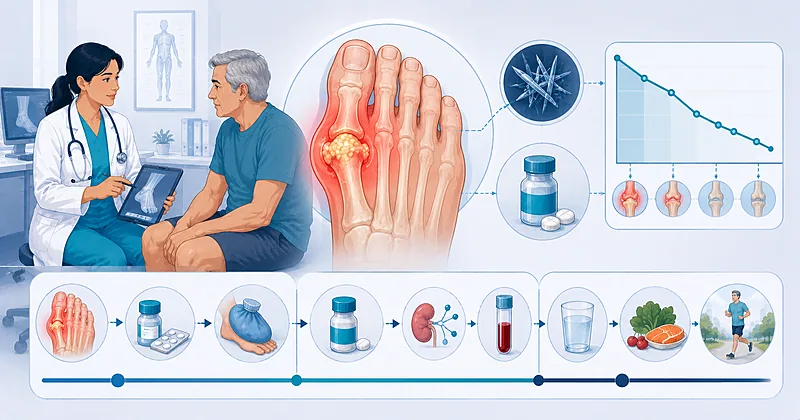
- 1Treat any flare early — the sooner anti-inflammatory therapy starts, the faster and more completely the attack resolves → Treating the Flare
- 2Choose one agent — colchicine, an NSAID, or a glucocorticoid — based on the patient’s comorbidities, not on a fixed hierarchy → Choosing Therapy
- 3Use low-dose colchicine for the flare — it works as well as the old high-dose regimen with far less diarrhoea → Choosing Therapy
- 4Never start or stop urate-lowering therapy because of the flare itself — if the patient is already on it, keep it going → Starting ULT
- 5Offer urate-lowering therapy to anyone with two or more flares a year, tophi, or joint damage on imaging → Who Needs ULT
- 6Start allopurinol low and titrate slowly, framing the plan around shared decision-making and lifelong adherence → Starting ULT
- 7Treat to a serum urate target below 6 mg/dL (360 micromol/L), checking levels and adjusting the dose until you get there → Serum Urate Target
- 8Cover the first 3 to 6 months of urate-lowering therapy with anti-inflammatory prophylaxis to prevent mobilisation flares → Prophylaxis
Why Gout Belongs in Primary Care
Gout is the most common inflammatory arthritis in adults, and the great majority of cases can be managed entirely in primary care. The science is settled and the drugs are cheap, yet the condition remains undertreated: many patients cycle through repeated painful flares for years without ever being offered the one therapy that prevents them.
The conceptual key is to keep two timelines separate. Flares are an acute, self-limiting inflammatory event driven by urate crystals already deposited in the joint. Long-term control is a chemistry problem: dissolve those crystals by holding serum urate below its saturation point. Anti-inflammatory drugs win the battle; urate-lowering therapy wins the war.
Gout Flare Treatment: First Steps at Presentation
The single biggest determinant of how a flare resolves is how quickly treatment begins. Speed matters more than which agent you pick, so the practical priority is getting an effective anti-inflammatory into the patient within hours of symptom onset rather than agonising over the perfect choice.
Start anti-inflammatory therapy as early as possible in the flare, ideally within the first 24 hours of symptom onset. Give patients who flare repeatedly a supply to keep at home with a clear self-start plan.
Strong Rec Moderate Evidence EULAR 2017Apply ice to the affected joint and rest it as an adjunct to drug therapy. Simple measures reduce pain and carry no downside.
Conditional Rec Low Evidence ACR 2020Do not measure serum urate as a way to confirm or exclude the diagnosis during the attack. Diagnose clinically in the acute setting and defer the urate check until the flare has resolved.
Moderate Rec Low Evidence EULAR 2017Choosing Anti-Inflammatory Therapy for Gout Flare Treatment
All three first-line drug classes work. The major guideline bodies agree that the choice between colchicine, an NSAID, and a glucocorticoid should be driven by the patient sitting in front of you — their kidney function, cardiovascular history, gastrointestinal risk, and what they can tolerate — rather than a one-size-fits-all ranking.
Prescribe low-dose colchicine when colchicine is the chosen agent: 1.2 mg at the first sign of the flare, then 0.6 mg one hour later. This regimen matches high-dose efficacy with markedly fewer adverse effects.
Strong Rec High Evidence ACR 2020 AGREE Trial 2010Avoid colchicine and NSAIDs in patients with advanced chronic kidney disease. Reach for an oral or intra-articular glucocorticoid instead, which is safer when renal function is poor.
Conditional Rec Moderate Evidence ACR 2020Prescribe a full-dose oral NSAID, such as naproxen 500 mg twice daily, for a patient with good renal function and no significant gastrointestinal or cardiovascular contraindication. Add gastroprotection where ulcer risk is present.
Strong Rec High Evidence ACR 2020 ACP 2017Prescribe oral prednisolone roughly 30 to 40 mg daily for about 5 days as an equally effective alternative, particularly useful when both colchicine and NSAIDs are contraindicated. A taper is not required for a short course.
Strong Rec High Evidence ACR 2020 ACP 2017Consider an intra-articular corticosteroid injection when only one or two large joints are involved. It delivers fast local relief and avoids systemic exposure.
Conditional Rec Low Evidence EULAR 2017Do not use the obsolete high-dose colchicine regimen of hourly dosing until diarrhoea develops. It causes substantial toxicity without improving the outcome of the flare.
Against High Evidence AGREE Trial 2010Consider combining two agents (for example a glucocorticoid plus colchicine) for a severe or polyarticular flare that does not settle with one drug. Reserve this for inadequate single-agent response.
Conditional Rec Low Evidence EULAR 2017Matching the Drug to the Patient
| Patient Profile | Preferred Agent & Dose | Avoid or Use Caution | Practical Tips |
|---|---|---|---|
| Healthy, good renal function | Naproxen 500 mg BID, or low-dose colchicine | — | Any of the three classes is reasonable; patient preference counts. |
| Advanced CKD (eGFR <30) | Prednisolone 30–40 mg daily × 5 days, or intra-articular steroid | NSAIDs; full-dose colchicine | Glucocorticoids are the safest systemic option here. |
| Anticoagulated or GI bleed history | Low-dose colchicine or glucocorticoid | NSAIDs | NSAIDs raise bleeding risk; avoid them. |
| Poorly controlled diabetes | Low-dose colchicine or NSAID | Systemic glucocorticoids | Steroids spike glucose; warn the patient and monitor. |
| On a strong CYP3A4/P-gp inhibitor | NSAID or glucocorticoid | Colchicine | Clarithromycin and similar drugs make colchicine dangerous. |
Clinical Decision Pathway
A practical, question-based approach to the patient presenting with a flare. Work through the questions in order.
Who Needs Urate-Lowering Therapy
Flare treatment alone leaves the underlying crystal burden untouched. Urate-lowering therapy is what changes the disease course, and identifying who should be offered it is a core primary care decision.
Initiate urate-lowering therapy for any patient with one or more subcutaneous tophi, radiographic damage attributable to gout, or two or more flares per year.
Strong Rec High Evidence ACR 2020Evaluate for urate-lowering therapy through shared decision-making in patients with infrequent flares who also have moderate-to-severe chronic kidney disease, a serum urate above 9 mg/dL, or a history of kidney stones.
Conditional Rec Moderate Evidence ACR 2020Do not start urate-lowering therapy for asymptomatic hyperuricemia alone, even when chronic kidney disease, hypertension, or cardiovascular disease coexists. Raised urate without flares or tophi is not by itself an indication to treat.
Against Moderate Evidence ACR 2020Starting Urate-Lowering Therapy Safely
Allopurinol is the first-line urate-lowering agent for nearly everyone, including patients with kidney disease. The art lies in starting low, titrating patiently, and protecting against the paradoxical early flares that a falling urate level can trigger.
Start allopurinol at a low dose of 100 mg daily or less, and 50 mg daily in chronic kidney disease, then titrate upward gradually. Offer HLA-B*5801 testing first in patients of Han Chinese, Korean, Thai, or African American background.
Strong Rec High Evidence ACR 2020Prescribe allopurinol in preference to febuxostat as the first choice for most patients, including those with kidney disease, on grounds of cost and cardiovascular safety signals with febuxostat.
Strong Rec Moderate Evidence ACR 2020Consider switching to febuxostat or adding a uricosuric such as probenecid when allopurinol is not tolerated or the urate target is not reached at an adequate dose.
Moderate Rec Moderate Evidence EULAR 2017Counsel patients that allopurinol is a lifelong therapy and that stopping it usually brings the flares back. Set the expectation of permanence at the very first conversation.
Conditional Rec Low Evidence ACR 2020Beginning allopurinol at a high dose is the classic mistake. A low starting dose with gradual titration reduces both the risk of the rare but serious allopurinol hypersensitivity syndrome and the frequency of early mobilisation flares. There is no maximum effective dose dictated by the starting point — the dose is whatever it takes to reach target, which can exceed 300 mg daily and sometimes approaches 800 mg.
Setting and Reaching the Serum Urate Target
A treat-to-target approach is the strategy that actually dissolves crystals and stops flares. Pick a target, titrate the dose to hit it, and keep checking — “start and forget” prescribing is why so much gout stays uncontrolled.
Adopt a treat-to-target strategy, titrating the urate-lowering dose to a serum urate below 6 mg/dL (360 micromol/L) rather than fixing a single dose and leaving it.
Strong Rec Moderate Evidence ACR 2020Aim for a urate below 5 mg/dL (300 micromol/L) in patients with a heavy crystal load such as visible tophi, to dissolve deposits faster.
Moderate Rec Low Evidence EULAR 2017Provide anti-inflammatory prophylaxis — low-dose colchicine 0.6 mg once or twice daily, a low-dose NSAID, or low-dose prednisolone — for at least 3 to 6 months when starting urate-lowering therapy.
Strong Rec High Evidence ACR 2020Continue urate-lowering therapy indefinitely once the target is reached, maintaining the dose that holds urate below 6 mg/dL rather than stopping after symptoms settle.
Conditional Rec Low Evidence ACR 2020Monitoring and Follow-Up
Long-term success depends on a simple monitoring rhythm: check the urate, adjust the dose, repeat until target, then settle into maintenance surveillance.
| Parameter | When to Check | Action Threshold | Common Pitfalls |
|---|---|---|---|
| Serum urate | Every 2–5 weeks during titration; then every 6–12 months | Above 6 mg/dL → increase the dose | Stopping titration before target is reached is the commonest failure. |
| Renal function | Before starting and periodically thereafter | Declining eGFR → reconsider NSAID and colchicine dosing | Allopurinol dose is still titrated to target despite CKD. |
| Skin and FBC | First few weeks of allopurinol | Any rash → stop allopurinol immediately | An early rash can herald hypersensitivity; do not dismiss it. |
| Flare frequency | At each review | Ongoing flares at target → extend prophylaxis | Watch for drug interactions before blaming treatment failure. |
| Tophi | At each review if present | Not shrinking → aim for a lower urate target | Resolution is slow; reassure but keep urate low. |
Lifestyle and Long-Term Control
Diet alone rarely brings urate to target, but it supports drug therapy and addresses the cardiovascular and metabolic conditions that travel with gout.
Advise dietary modification as a supporting measure: limiting alcohol, sugar-sweetened drinks, and purine-rich foods, alongside weight loss where relevant. Frame it as an adjunct to urate-lowering therapy, not a substitute.
Conditional Rec Low Evidence ACR 2020Reassess any contributing medications, such as switching a thiazide diuretic to an alternative where clinically appropriate, since some drugs raise serum urate.
Conditional Rec Low Evidence EULAR 2017Evidence in Context
What the evidence shows, where the major guideline bodies agree, and where they part company.
Where ACR and EULAR Agree
Both frameworks converge on the core message: any of the three anti-inflammatory classes is acceptable for a flare, allopurinol is the preferred long-term agent, a urate below 6 mg/dL is the central target, and prophylaxis should cover the early months of urate lowering.
Treat-to-Target vs Treat-to-Symptom
The treat-to-target philosophy, titrating to a urate threshold, is the dominant strategy supported by the major bodies. A smaller body of opinion has questioned whether a symptom-led approach might suffice for some patients, but the weight of trial evidence favours hitting a defined urate level.
Low-Dose Colchicine: What the Trial Showed
A landmark randomised comparison found that a low-dose colchicine regimen achieved pain relief comparable to the old high-dose schedule while dramatically cutting gastrointestinal side effects. This single finding rewrote how colchicine is dosed for flares.
Allopurinol vs Febuxostat Safety
Cardiovascular safety signals associated with febuxostat, combined with its higher cost, underpin the strong preference for allopurinol as first-line even in kidney disease. Febuxostat keeps a clear role for patients who cannot use allopurinol.
References
- 1.FitzGerald JD, Dalbeth N, Mikuls T, et al. 2020 American College of Rheumatology Guideline for the Management of Gout. Arthritis Care Res. 2020;72(6):744–760. doi:10.1002/acr.24180
- 2.Richette P, Doherty M, Pascual E, et al. 2016 updated EULAR evidence-based recommendations for the management of gout. Ann Rheum Dis. 2017;76(1):29–42. doi:10.1136/annrheumdis-2016-209707
- 3.Qaseem A, Harris RP, Forciea MA, et al. Management of Acute and Recurrent Gout: A Clinical Practice Guideline From the American College of Physicians. Ann Intern Med. 2017;166(1):58–68. doi:10.7326/M16-0570
- 4.Terkeltaub RA, Furst DE, Bennett K, et al. High versus low dosing of oral colchicine for early acute gout flare. Arthritis Rheum. 2010;62(4):1060–1068. doi:10.1002/art.27327
How to Read the Evidence Tags
Every recommendation carries two tags for recommendation strength and evidence quality — Medaptly’s own simplified interpretations of the underlying guideline grading.
Recommendation Strength
| Tag | What It Means |
|---|---|
| Strong Rec | High-quality evidence broadly supports this action. |
| Moderate Rec | The weight of evidence favours this action. |
| Conditional Rec | The benefit is less certain — individualise. |
| Against | Evidence shows no benefit or potential harm. |
Evidence Quality
| Tag | What It Means |
|---|---|
| High Evidence | Multiple well-designed RCTs or high-quality meta-analyses. |
| Moderate Evidence | Single RCT or large observational studies. |
| Low Evidence | Expert consensus or small studies. |