
Diabetic Ketoacidosis: Protocol-Driven Inpatient Management
Clinical Practice Update — Fluid, Insulin, and Electrolyte Protocols on the Ward
This is an original clinical education article informed by current guidelines and evidence. See References below for source documents.
- Clinical Focus
- Protocol-driven diabetic ketoacidosis management in adults, from resuscitation to resolution
- Target Audience
- Internal medicine physicians, hospitalists, ED physicians, residents, ward pharmacists
- Setting
- Emergency department, acute medical unit, hospital inpatient wards
- Source Evidence
- •ADA Standards of Care — Hyperglycemic Crises in Adults (2024 consensus report)
- •JBDS-IP — Management of DKA in Adults (UK, 2023 revision)
- •Self et al. — Balanced Crystalloids vs Saline in DKA (pooled analysis, 2020)
- •Subcutaneous insulin in mild-to-moderate DKA — systematic review (2021)
Key Clinical Takeaways
Safe diabetic ketoacidosis management rests on three parallel tracks running from the first hour: restore circulating volume, switch off ketogenesis with fixed-rate insulin, and protect potassium before it falls. The points below condense the evidence into a protocol you can run at the bedside without waiting for specialist input.
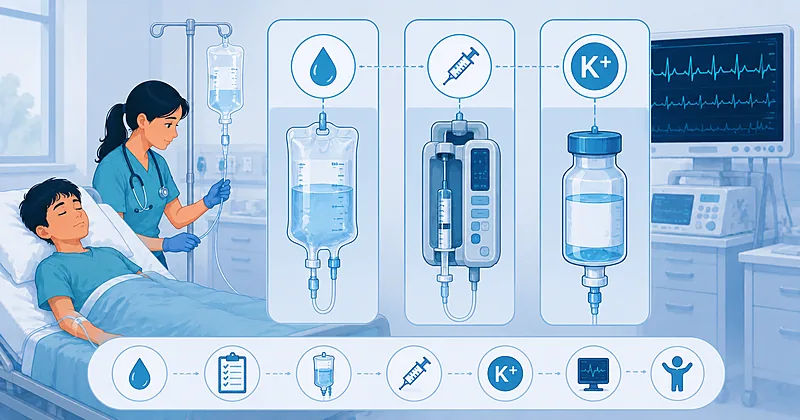
- 1Confirm all three diagnostic criteria before committing to the protocol: ketonemia, acidosis, and hyperglycemia (or known diabetes) → Confirming the Diagnosis
- 2Start a fixed-rate insulin infusion at 0.1 units/kg/hour — do not wait for fluids to finish first → Starting Insulin
- 3Give an initial fluid bolus for the shocked patient, then a structured replacement schedule over the following hours → Fluid Resuscitation
- 4Add potassium to replacement fluid once serum potassium is below 5.5 mmol/L and the patient is passing urine → Potassium Replacement
- 5Introduce 10% glucose alongside saline once blood glucose falls below 14 mmol/L, while continuing insulin → Adding Glucose
- 6Continue any long-acting basal insulin throughout; stopping it is a common and avoidable error → Continuing Basal Insulin
- 7Track resolution with ketones and bicarbonate, not glucose — glucose normalizes long before the acidosis clears → Defining Resolution
- 8Only convert to subcutaneous insulin once ketosis has resolved and the patient is eating; overlap the doses → Transition to Subcutaneous
Confirming the Diagnosis Before Starting Treatment
Protocol-driven diabetic ketoacidosis management depends on a confident diagnosis, because the same protocol applied to an alternative cause of acidosis can cause harm. All three biochemical features should be present, or the picture should be re-examined.
Ketones present: capillary blood ketones at or above 3.0 mmol/L, or significant ketonuria on dipstick.
Acidosis: venous pH below 7.3 or bicarbonate below 15 mmol/L.
Hyperglycemia or known diabetes: glucose typically above 11 mmol/L — but normoglycemic presentations occur, especially with SGLT2 inhibitors or in pregnancy.
Measure capillary blood ketones at the bedside in any unwell patient with diabetes or unexplained metabolic acidosis. Blood beta-hydroxybutyrate is more reliable than urine dipstick for both diagnosis and tracking response.
Strong Rec High Evidence JBDS-IP 2023Evaluate for the precipitating cause in parallel with treatment. Infection, missed insulin, new-onset diabetes, myocardial infarction, and SGLT2 inhibitor use are the most common triggers and each changes downstream management.
Moderate Rec Moderate Evidence ADA 2024Do not exclude DKA on the basis of glucose alone. In a patient on an SGLT2 inhibitor, withhold the drug and treat the ketoacidosis even when glucose sits in the normal range.
Strong Rec Moderate Evidence ADA 2024Fluid Resuscitation in Diabetic Ketoacidosis Management
Fluid is the first intervention in diabetic ketoacidosis management, and most adults present with a profound deficit of several litres. The aim of the first hours is to restore circulating volume and renal perfusion, which in itself lowers glucose and improves acidosis before insulin has fully acted.
Start with a 500 mL bolus of isotonic crystalloid over 10–15 minutes for any patient with systolic blood pressure below 90 mmHg, and repeat as needed to restore perfusion before moving to scheduled replacement.
Strong Rec Moderate Evidence JBDS-IP 2023Consider balanced crystalloids in preference to 0.9% sodium chloride where available. Pooled trial data suggest faster resolution of acidosis and less hyperchloremia, although either fluid is acceptable and saline remains a reasonable default.
Moderate Rec Moderate Evidence Self et al. 2020Slow the rate of fluid replacement in young adults, the elderly, pregnancy, and anyone with heart or kidney failure. Rapid correction in these groups is the setting in which cerebral edema and fluid overload occur.
Conditional Rec Low Evidence JBDS-IP 2023Insulin and Glucose in Diabetic Ketoacidosis Management
Insulin is what switches off ketone production, so it sits at the heart of diabetic ketoacidosis management. The modern approach uses a weight-based fixed rate rather than a sliding scale, because a steady infusion clears ketones more predictably than chasing glucose figures.
Start a fixed-rate intravenous insulin infusion of soluble insulin at 0.1 units per kg per hour. Begin it as soon as the diagnosis is confirmed rather than delaying until a fluid bag is complete.
Strong Rec High Evidence JBDS-IP 2023 ADA 2024Introduce 10% glucose at 125 mL/hour alongside the saline once capillary glucose falls below 14 mmol/L. This lets the insulin infusion continue at full rate to clear ketones without driving the patient hypoglycemic.
Strong Rec High Evidence JBDS-IP 2023Continue the patient’s usual long-acting basal insulin at its normal dose and timing throughout the admission. Maintaining background insulin smooths the eventual transition off the infusion and prevents rebound ketosis.
Strong Rec Moderate Evidence JBDS-IP 2023Increase the fixed insulin rate if ketones are not falling by at least 0.5 mmol/L per hour. A failure to clear ketones usually signals an inadequate rate, line failure, or an unresolved precipitant rather than insulin resistance.
Moderate Rec Low Evidence JBDS-IP 2023Potassium and Electrolyte Replacement
Total-body potassium is depleted in every patient, even when the initial serum value looks normal or high, because acidosis shifts potassium out of cells. Once insulin starts, potassium moves back inside, and the level can fall sharply within the first few hours.
Do not add potassium to the first resuscitation fluid until the serum level is known and the patient is passing urine. Replacing potassium blindly into an anuric or hyperkalemic patient risks dangerous accumulation.
Strong Rec High Evidence ADA 2024Add potassium to replacement fluid at the standard concentration once serum potassium falls below 5.5 mmol/L. Re-check the level within two hours of starting insulin, then at least every four hours during the active phase.
Strong Rec High Evidence JBDS-IP 2023Hold insulin temporarily if serum potassium is below 3.3 mmol/L, and replace potassium first. Starting insulin into a hypokalemic patient can precipitate a fatal arrhythmia by driving potassium even lower.
Strong Rec Moderate Evidence ADA 2024Avoid routine bicarbonate in adults, even with severe acidosis. The acidosis corrects as ketogenesis stops, and bicarbonate offers no outcome benefit while adding risks of paradoxical CNS acidosis and worsened hypokalemia.
Against Moderate Evidence ADA 2024Clinical Decision Pathway
A practical, question-based route through the first day of treatment. Work through the questions in order at each review.
Protocol at a Glance: The Three Pillars
The first table organises the protocol by clinical task rather than by time, so each member of the team can see their own responsibility at a glance.
Pillar-by-Pillar Action Map
| Pillar | First Action | Trigger to Adjust | Common Pitfall |
|---|---|---|---|
| Fluid | Isotonic crystalloid; 500 mL bolus if shocked | Slow rate in young, elderly, cardiac, renal, pregnant | Over-rapid correction risking cerebral edema |
| Insulin | Fixed rate 0.1 units/kg/h, continue basal | Ketones not falling ≥0.5 mmol/L/h | Stopping basal insulin; chasing glucose with a sliding scale |
| Potassium | None in first bag until level known and urine output confirmed | Add once below 5.5 mmol/L; hold insulin if below 3.3 | Missing the early post-insulin fall |
| Glucose | Add 10% glucose when below 14 mmol/L | Recurrent hypoglycemia despite glucose running | Reducing insulin instead of adding glucose |
Monitoring by Parameter
| Parameter | How Often | Target Direction | What It Tells You |
|---|---|---|---|
| Capillary ketones | Hourly | Fall ≥0.5 mmol/L/h | The true measure of whether treatment is working |
| Capillary glucose | Hourly | Toward 14 mmol/L, then steady | When to add glucose, not when to stop insulin |
| Potassium | 2 h after insulin, then 4-hourly | Stay 4.0–5.0 mmol/L | The parameter most likely to kill if ignored |
| Venous bicarbonate | 2–4 hourly | Rise above 15 mmol/L | Confirms resolution alongside ketones |
| Fluid balance | Continuous | Positive but controlled | Early warning of overload, especially in cardiac patients |
Defining Resolution and Transition to Subcutaneous Insulin
Resolution is a biochemical endpoint, not a glucose reading. Calling DKA resolved too early — on the basis of a normal sugar — leads to premature withdrawal of the infusion and a relapse into ketosis overnight.
Define resolution as ketones below 0.6 mmol/L with venous bicarbonate above 15 mmol/L and a venous pH above 7.3. All three should be met before the infusion is considered for stopping.
Strong Rec Moderate Evidence JBDS-IP 2023Convert to a subcutaneous insulin regimen only once ketosis has resolved and the patient is able to eat. Give the first short-acting subcutaneous dose with a meal and overlap it with the infusion to prevent a gap in coverage.
Strong Rec Moderate Evidence JBDS-IP 2023 ADA 2024Refer every patient to the specialist diabetes team before discharge. Admission is an opportunity to address the precipitant, review the home regimen, and provide sick-day rules that reduce the risk of readmission.
Moderate Rec Low Evidence JBDS-IP 2023Evidence in Context
Where the major frameworks agree, where they part company, and what the trial evidence adds.
Where ADA and JBDS-IP Agree
Both frameworks converge on the essentials: prompt isotonic fluid resuscitation, a weight-based intravenous insulin infusion, cautious and proactive potassium replacement, and the use of ketones and bicarbonate — not glucose — to judge resolution. Both also discourage routine bicarbonate.
Where the Two Frameworks Differ
Insulin bolus: some protocols permit an initial intravenous bolus before the infusion, whereas the UK approach favours a fixed-rate infusion from the outset without a bolus. Ketone monitoring: the UK pathway is built explicitly around hourly capillary ketones, a metric that some other protocols use less centrally.
Balanced Crystalloids: What the Trials Show
Pooled analyses of balanced crystalloid trials in patients presenting with DKA point to quicker resolution of acidosis and a shorter time to discontinuation of insulin compared with saline, alongside less hyperchloremic acidosis. The effect is modest, and either fluid is clinically acceptable.
Subcutaneous Insulin in Mild-to-Moderate DKA
Systematic reviews suggest that subcutaneous rapid-acting insulin protocols can manage selected mild-to-moderate cases outside critical care, with comparable safety to intravenous infusion. This remains a setting-dependent option and does not replace the infusion-based pathway for severe presentations.
References
- 1.Umpierrez GE, Davis GM, ElSayed NA, et al. Hyperglycaemic crises in adults with diabetes: a consensus report. Diabetologia. 2024;67(8):1455–1479. doi:10.1007/s00125-024-06183-8
- 2.Kitabchi AE, Umpierrez GE, Miles JM, Fisher JN. Hyperglycemic crises in adult patients with diabetes. Diabetes Care. 2009;32(7):1335–1343. doi:10.2337/dc09-9032
- 3.Self WH, Evans CS, Jenkins CA, et al. Clinical effects of balanced crystalloids vs saline in adults with diabetic ketoacidosis. JAMA Netw Open. 2020;3(11):e2024596. doi:10.1001/jamanetworkopen.2020.24596
- 4.Andrade-Castellanos CA, Colunga-Lozano LE, Delgado-Figueroa N, Gonzalez-Padilla DA. Subcutaneous rapid-acting insulin analogues for diabetic ketoacidosis. Cochrane Database Syst Rev. 2016;(1):CD011281. doi:10.1002/14651858.CD011281.pub2
- 5.Dhatariya KK; Joint British Diabetes Societies for Inpatient Care. The management of diabetic ketoacidosis in adults. Diabet Med. 2022;39(6):e14788. doi:10.1111/dme.14788
How to Read the Evidence Tags
Every recommendation carries two tags — one for recommendation strength and one for evidence quality. These are Medaptly’s own simplified interpretations, designed for quick reading at the bedside.
Recommendation Strength
| Tag | What It Means |
|---|---|
| Strong Rec | High-quality evidence broadly supports this action. |
| Moderate Rec | The weight of evidence favours this action. |
| Conditional Rec | The benefit is less certain — individualise. |
| Against | Evidence shows no benefit or potential harm. |
Evidence Quality
| Tag | What It Means |
|---|---|
| High Evidence | Multiple well-designed RCTs or high-quality meta-analyses. |
| Moderate Evidence | Single RCT or large observational studies. |
| Low Evidence | Expert consensus or small studies. |