
Thyroid Storm Treatment: Recognition and Sequenced Pharmacologic Therapy
Clinical Practice Update — Emergency Recognition, Drug Sequencing, and Stabilisation in Adults
This is an original clinical education article informed by current guidelines and evidence. See References below for source documents.
- Clinical Focus
- Emergency recognition and sequenced pharmacologic thyroid storm treatment in adults
- Target Audience
- Emergency physicians, hospitalists, intensivists, endocrinologists, residents
- Setting
- Emergency department, intensive care unit, acute medical unit
- Source Evidence
- •American Thyroid Association Guidelines for Hyperthyroidism and Thyrotoxicosis (2016)
- •Japan Thyroid Association / Japan Endocrine Society Thyroid Storm Guidelines (2016)
- •Burch & Wartofsky Diagnostic Criteria for Thyroid Storm (Endocrinol Metab Clin, 1993)
- •Akamizu et al. Nationwide Survey of Thyroid Storm (Thyroid, 2012)
Key Clinical Takeaways
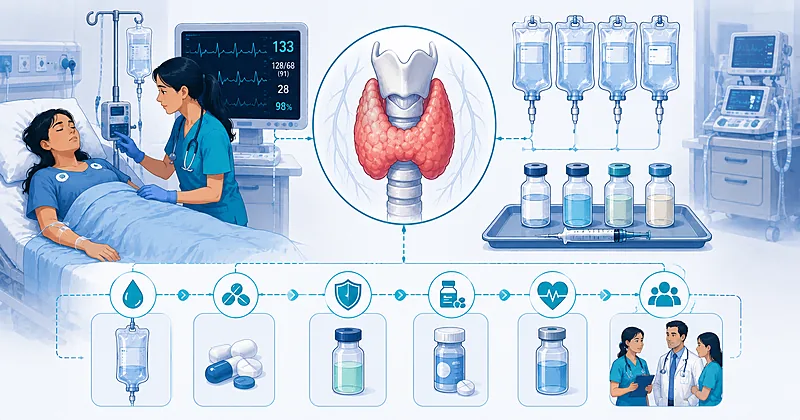
Effective thyroid storm treatment is a race against a self-amplifying cascade, and the order in which you give drugs matters as much as which drugs you choose. The points below distil the evidence into an actionable bedside sequence for a condition that still carries a mortality of roughly one in ten even when recognised early. Successful thyroid storm treatment depends on starting empirically the moment the clinical picture fits, because every hour of delay allows the thyrotoxic feedback loop to tighten further.
- 1Diagnose thyroid storm clinically — do not wait for thyroid function tests, which look identical to uncomplicated thyrotoxicosis. Use the Burch-Wartofsky score as a prompt, not a gatekeeper → Recognising Storm
- 2Give a beta-blocker first to control the adrenergic surge driving fever, tachycardia, and agitation → Step 1 Beta-Blockade
- 3Start a thionamide to block new hormone synthesis — propylthiouracil is preferred in true storm because it also blocks peripheral conversion → Step 2 Thionamides
- 4Wait at least one hour, then give iodine — never before the thionamide, or you risk fuelling the fire → Step 3 Iodine Timing
- 5Add stress-dose hydrocortisone to treat relative adrenal insufficiency and further block conversion → Step 4 Corticosteroids
- 6Cool aggressively with paracetamol and external measures — avoid aspirin, which displaces hormone from binding proteins → Supportive Care
- 7Hunt for and treat the precipitant — infection, surgery, or iodine load — because storm rarely resolves until the trigger is addressed → Finding the Trigger
- 8Escalate to ICU early and consider plasmapheresis when standard therapy fails within 24 to 48 hours → When to Escalate
Recognising When Thyroid Storm Treatment Is Needed
The first and hardest decision in thyroid storm treatment is recognising that the patient needs thyroid storm treatment at all, because the biochemistry does not distinguish a life-threatening storm from stable thyrotoxicosis. The diagnosis rests on the combination of severe thyrotoxic features with evidence of systemic decompensation — high fever, marked tachycardia or atrial fibrillation, altered mental status, and gastrointestinal or hepatic dysfunction.
Two scoring frameworks help structure the assessment. The Burch-Wartofsky point scale assigns weighted points across thermoregulatory, cardiovascular, neurological, and gastrointestinal systems, while the Japanese criteria require a raised free thyroid hormone plus defined combinations of organ involvement. Neither replaces clinical judgement at the bedside.
Why Early Empiric Treatment Wins
Because confirmatory tests add nothing to the acute decision, the threshold to begin thyroid storm treatment should be low. A patient who turns out to have decompensated thyrotoxicosis short of full storm loses little from a few doses of a beta-blocker and a thionamide, whereas a patient in genuine storm can deteriorate to multi-organ failure within hours if therapy is withheld pending laboratory results. This asymmetry of risk is the central argument for treating first and confirming later.
The Sequenced Pharmacologic Approach to Thyroid Storm Treatment
Thyroid storm treatment attacks the disease at four points simultaneously: the adrenergic response, new hormone synthesis, hormone release, and peripheral conversion. The crucial safety principle in thyroid storm treatment is sequence — the thionamide must precede iodine, because iodine given to an unblocked gland can transiently increase hormone production. Keeping these four mechanisms in mind makes the sequence intuitive rather than something to memorise.
Step 1: Adrenergic Control with Beta-Blockade
Initiate propranolol 60–80 mg orally every 4–6 hours, or 0.5–1 mg by slow intravenous injection with cardiac monitoring, as the first pharmacologic step. Propranolol is favoured because at high doses it also blunts peripheral conversion of T4 to T3, supporting rate control in atrial fibrillation as well as the broader thyrotoxic state.
Strong Rec Moderate Evidence ATA 2016 JTA/JES 2016Consider an intravenous esmolol infusion (loading dose 250–500 mcg/kg, then 50–100 mcg/kg/min) when titratable control is needed or when heart failure makes longer-acting agents risky. Its short half-life allows rapid withdrawal if cardiac output falls.
Moderate Rec Low Evidence ATA 2016Step 2: Block Synthesis with a Thionamide
Prescribe propylthiouracil with a 500–1000 mg loading dose followed by 250 mg every 4 hours in confirmed storm. Beyond blocking synthesis, propylthiouracil inhibits the peripheral conversion of T4 to active T3, giving it a theoretical edge over methimazole in the acute phase despite the recognised risk of antithyroid drug hepatotoxicity.
Strong Rec Moderate Evidence ATA 2016 JTA/JES 2016Use methimazole 20–25 mg every 4–6 hours as an alternative when propylthiouracil is unavailable or contraindicated, accepting that it does not block peripheral conversion. Methimazole carries a lower hepatotoxicity risk and is the preferred long-term agent once the patient stabilises.
Moderate Rec Moderate Evidence ATA 2016Step 3: Block Release with Iodine — After the Thionamide
Administer potassium iodide (saturated solution, typically 5 drops every 6 hours) or Lugol’s solution beginning at least 60 minutes after the first thionamide dose. The delay ensures the gland is already blocked, so the iodine suppresses release through the Wolff-Chaikoff effect rather than supplying fresh substrate for synthesis.
Strong Rec Moderate Evidence ATA 2016 JTA/JES 2016Do not give iodine as monotherapy or before the synthesis block is established. In a patient with iodine-induced thyrotoxicosis or recent contrast load, weigh the benefit carefully and consider lithium or an alternative release blocker in discussion with endocrinology.
Against Low Evidence ATA 2016Step 4: Block Conversion with Corticosteroids
Give hydrocortisone 100 mg intravenously every 8 hours (or an equivalent dexamethasone regimen) to cover the relative adrenal insufficiency seen in severe thyrotoxicosis and to reduce peripheral T4-to-T3 conversion. Steroids have been associated with improved survival in observational storm cohorts.
Strong Rec Moderate Evidence ATA 2016 JTA/JES 2016Supportive Care and Finding the Trigger
Drug therapy buys time, but supportive care and treating the precipitant determine whether the patient recovers. Hyperthermia, volume depletion, and the underlying trigger each demand parallel attention from the moment storm is suspected, and supportive measures should never be deferred while waiting for the pharmacologic limbs of thyroid storm treatment to take effect.
Treat hyperthermia with paracetamol and active external cooling. Avoid salicylates, which displace thyroid hormone from binding proteins and can raise free hormone levels, worsening the storm.
Strong Rec Low Evidence ATA 2016Resuscitate with intravenous fluids and correct electrolytes, anticipating large insensible losses from fever and sweating. Patients with cardiac decompensation need careful, monitored fluid balance rather than aggressive boluses.
Strong Rec Low Evidence ATA 2016Finding and Treating the Trigger
Storm is almost always provoked. The commonest precipitants are infection, recent thyroid or non-thyroid surgery, abrupt withdrawal of antithyroid medication, trauma, diabetic ketoacidosis, and iodinated contrast or amiodarone exposure. A focused search for sepsis, with a low threshold for empiric antibiotics, runs alongside the endocrine therapy.
Clinical Decision Pathway
A practical, question-based approach to thyroid storm treatment for the first hour. Work through the questions in order while the team prepares medications.
Drug Reference for Thyroid Storm Treatment
Each agent used in thyroid storm treatment is mapped to the mechanism it targets, so the team can see at a glance why the sequence is built the way it is. Doses are typical adult starting regimens and must always be verified against local formulary.
| Agent | Mechanism Targeted | Typical Adult Dose | Sequence Position | Practical Cautions |
|---|---|---|---|---|
| Propranolol | Adrenergic surge + conversion | 60–80 mg PO q4–6h or 0.5–1 mg IV slow | First | Caution in overt heart failure; monitor closely |
| Esmolol | Adrenergic surge (titratable) | 250–500 mcg/kg load, 50–100 mcg/kg/min | First (alternative) | Preferred when rapid reversibility matters |
| Propylthiouracil | Synthesis + peripheral conversion | 500–1000 mg load, then 250 mg q4h | Second | Hepatotoxicity risk; switch to methimazole later |
| Methimazole | Synthesis | 20–25 mg q4–6h | Second (alternative) | No conversion block; preferred long-term |
| Potassium iodide | Hormone release | ~5 drops SSKI q6h | Third — ≥1h after thionamide | Never before synthesis block |
| Hydrocortisone | Conversion + adrenal support | 100 mg IV q8h | Fourth | Send cortisol first if adrenal axis unclear |
- Iodine suppresses release through the Wolff-Chaikoff effect only once the gland is already blocked by a thionamide.
- All doses are typical starting regimens for adults and must be confirmed against local protocols and patient-specific factors.
Monitoring and When to Escalate
Response to thyroid storm treatment is judged clinically — temperature, heart rate, and mental status — rather than by repeat thyroid hormone levels, which lag behind recovery by days. Track the parameters below and define escalation triggers explicitly at handover so the next team knows exactly when to call for help.
| Parameter | How Often | Goal of Therapy | Escalation Trigger |
|---|---|---|---|
| Temperature | Continuous / hourly | Trending toward normal | Persistent fever above 39°C despite cooling |
| Heart rate & rhythm | Continuous telemetry | Rate falling with beta-blockade | Refractory tachyarrhythmia or hypotension |
| Mental status | Every 1–2 hours | Improving alertness | New seizure or declining consciousness |
| Liver function | Daily | Stable on propylthiouracil | Rising transaminases — review thionamide choice |
| Overall trajectory | At 24 and 48 hours | Clear clinical improvement | No improvement → consider plasma exchange |
Refer early for intensive care and consider therapeutic plasma exchange when the patient deteriorates or fails to respond to maximal pharmacologic therapy within 24 to 48 hours. Plasma exchange rapidly removes circulating hormone and bridges to definitive treatment.
Conditional Rec Low Evidence ATA 2016 JTA/JES 2016Evidence in Context
Where the major frameworks agree on thyroid storm treatment, where they differ, and why much of the regimen rests on physiology and observational data rather than randomised trials.
Where ATA and Japanese Guidelines Agree
Both frameworks endorse the same multi-pronged strategy — beta-blockade, a thionamide, iodine after the synthesis block, corticosteroids, and aggressive supportive care — and both stress that the diagnosis is clinical rather than biochemical.
Where the Diagnostic Criteria Differ
The Burch-Wartofsky scale produces a probability gradient from a weighted point total, whereas the Japanese criteria use a categorical combination of a raised free hormone plus defined organ involvement. The Japanese approach tends to be more specific, the point scale more sensitive.
Why the Evidence Base Is Mostly Observational
Storm is rare and rapidly life-threatening, so randomised trials of its treatment are neither practical nor ethical. Much of the regimen is grounded in thyroid physiology and supported by case series and nationwide surveys, which is why most recommendations sit at moderate or low evidence quality.
The Place of Plasma Exchange
Therapeutic plasma exchange is a rescue option in refractory storm, removing protein-bound hormone that drugs cannot rapidly clear. Evidence is limited to case reports and small series, so it is reserved for patients failing maximal medical therapy or unable to take thionamides.
References
- 1.Ross DS, Burch HB, Cooper DS, et al. 2016 American Thyroid Association Guidelines for Diagnosis and Management of Hyperthyroidism and Other Causes of Thyrotoxicosis. Thyroid. 2016;26(10):1343–1421. doi:10.1089/thy.2016.0229
- 2.Satoh T, Isozaki O, Suzuki A, et al. 2016 Guidelines for the management of thyroid storm from the Japan Thyroid Association and Japan Endocrine Society. Endocr J. 2016;63(12):1025–1064. doi:10.1507/endocrj.EJ16-0336
- 3.Burch HB, Wartofsky L. Life-threatening thyrotoxicosis. Thyroid storm. Endocrinol Metab Clin North Am. 1993;22(2):263–277. pubmed.ncbi.nlm.nih.gov/8325286
- 4.Akamizu T, Satoh T, Isozaki O, et al. Diagnostic criteria, clinical features, and incidence of thyroid storm based on nationwide surveys. Thyroid. 2012;22(7):661–679. doi:10.1089/thy.2011.0334
How to Read the Evidence Tags
Every recommendation carries tags for recommendation strength and evidence quality — Medaptly’s own simplified interpretation, not a reproduction of any guideline body’s classification system.
Recommendation Strength
| Tag | What It Means |
|---|---|
| Strong Rec | High-quality evidence or strong physiologic rationale broadly supports this action. |
| Moderate Rec | The weight of evidence favours this action. |
| Conditional Rec | The benefit is less certain — individualise to the patient. |
| Against | Evidence or physiology indicates no benefit or potential harm. |
Evidence Quality
| Tag | What It Means |
|---|---|
| High Evidence | Multiple well-designed RCTs or high-quality meta-analyses. |
| Moderate Evidence | Single RCT, large observational data, or strong physiologic basis. |
| Low Evidence | Expert consensus, case series, or small studies. |