
VTE Treatment: Selecting a DOAC and Setting Duration of Therapy
Clinical Practice Update — Anticoagulant Choice, Dosing, and How Long to Treat in Adults
This is an original clinical education article informed by current guidelines and evidence. See References below for source documents.
- Clinical Focus
- Anticoagulant selection and duration of therapy in adults with a first venous thromboembolism
- Target Audience
- Internists, primary care physicians, hospitalists, ED physicians, pharmacists, residents
- Setting
- Outpatient clinics, emergency departments, hospital inpatient, anticoagulation services
- Source Evidence
- •CHEST Antithrombotic Therapy for VTE Disease — Second Update (2021)
- •ASH Guidelines for Management of VTE: Treatment of DVT and PE (2020)
- •ASH Guidelines for VTE in Patients With Cancer (2021)
- •AMPLIFY-EXT (NEJM, 2013) and EINSTEIN-CHOICE (NEJM, 2017) extension trials
Key Clinical Takeaways
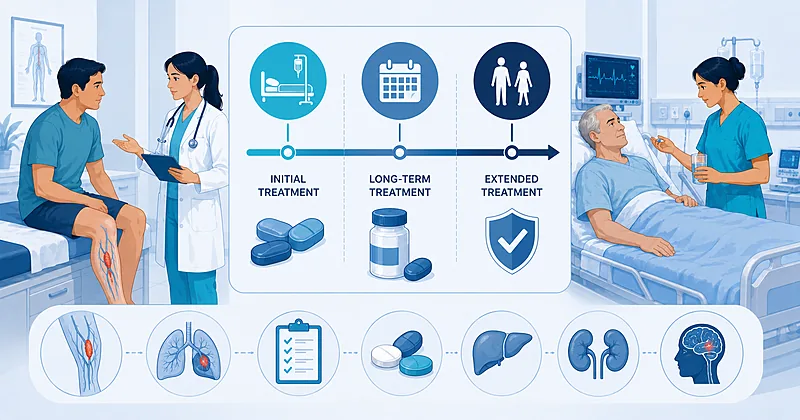
Modern VTE treatment turns on two decisions that a clinician must make early and revisit often: which anticoagulant to start, and how long to continue it. For most adults without cancer, a direct oral anticoagulant has replaced the heparin-to-warfarin bridge, and the duration question now hinges far more on why the clot happened than on where it sat. The rules below distill the evidence into actions you can apply at the bedside.
- 1Choose a DOAC over warfarin for most adults with non-cancer VTE — comparable efficacy with consistently less major bleeding.
- 2Use the correct loading strategy: apixaban and rivaroxaban start oral from day one; dabigatran and edoxaban need 5 to 10 days of parenteral heparin first.
- 3Treat every patient for a minimum of three months — this is the primary treatment phase regardless of cause.
- 4Stop at three months when VTE was provoked by a major transient factor that has now resolved, such as surgery.
- 5Consider indefinite anticoagulation after an unprovoked event or a persistent provoking factor, balanced against bleeding risk.
- 6Step down to a reduced-dose DOAC for extended therapy beyond six months when the decision is to continue.
- 7Favour apixaban or a DOAC for most cancer-associated VTE, reserving low-molecular-weight heparin for luminal GI or genitourinary tumours.
- 8Reassess bleeding risk and the treat-versus-stop balance at every visit — the extended decision is never permanent.
- 9Avoid DOACs in antiphospholipid syndrome, severe renal impairment, and pregnancy — these remain warfarin or heparin territory.
Choosing an Anticoagulant for VTE Treatment
The first decision in VTE treatment is which agent to start. Across the major guidelines, a direct oral anticoagulant is now the default for adults without cancer, because four large trials showed these agents match warfarin for preventing recurrence while roughly halving major bleeding. Warfarin and low-molecular-weight heparin retain specific niches, but they are no longer the routine starting point.
Start a direct oral anticoagulant as first-line therapy for adults with acute DVT or PE who do not have cancer, antiphospholipid syndrome, or severe renal impairment.
Strong Rec High Evidence CHEST 2021 ASH 2020Evaluate renal function before prescribing. Document a creatinine clearance, since each DOAC has a renal threshold below which it should be dose-reduced or avoided.
Strong Rec Moderate Evidence CHEST 2021Do not use DOACs in patients with confirmed antiphospholipid syndrome, particularly triple-positive disease, where they performed worse than warfarin for arterial and recurrent events.
Against Moderate Evidence CHEST 2021Loading: Which Agents Need Heparin First
A frequent prescribing error is treating all four DOACs as interchangeable at initiation. Two were studied as single-drug regimens from day one; two were studied only after a lead-in of parenteral heparin. Getting this wrong either underdoses the patient early or exposes them to unnecessary injections.
Prescribe apixaban or rivaroxaban as a single-agent oral regimen with an intensified loading dose for the first one to three weeks — no parenteral lead-in is required.
Strong Rec High Evidence CHEST 2021Initiate at least 5 days of low-molecular-weight heparin before switching to dabigatran or edoxaban, both of which were only studied after a heparin lead-in.
Strong Rec High Evidence CHEST 2021Duration of Therapy: The Core VTE Treatment Question
How long to anticoagulate is where VTE treatment becomes individualised. The guidelines converge on a three-phase model: an initial phase of a few days, a primary treatment phase of three to six months, and an optional extended phase that may run indefinitely. The pivotal driver of the extended decision is not the size or location of the clot but the nature of the provoking factor.
Discontinue anticoagulation at three months for a first VTE provoked by a major transient risk factor, such as recent surgery or trauma, that has fully resolved.
Strong Rec Moderate Evidence ASH 2020 CHEST 2021Consider extended anticoagulation of indefinite duration after an unprovoked first VTE, where the yearly recurrence risk after stopping is substantial.
Moderate Rec Moderate Evidence ASH 2020 CHEST 2021Reassess the decision against bleeding risk at least annually for any patient on extended therapy. The choice to continue is provisional and should be revisited as the patient ages and comorbidities accrue.
Strong Rec Low Evidence CHEST 2021Step the dose down to reduced-intensity apixaban or rivaroxaban when extended therapy continues past six months in a patient at standard recurrence risk.
Moderate Rec High Evidence AMPLIFY-EXT 2013 EINSTEIN-CHOICE 2017Clinical Decision Pathway
A practical, question-based approach to anticoagulant selection and duration. Work through the questions in order for any adult with a confirmed first VTE.
DOAC Options: A Drug-by-Drug Guide
The four agents differ in their loading approach, maintenance dose, reduced extended-phase dose, and renal floor. The table below is organised by drug name so you can move directly from “I want to use apixaban” to the regimen, rather than working backwards from severity.
| Drug | Loading Approach | Maintenance Dose | Reduced Extended Dose | Renal Floor & Tips |
|---|---|---|---|---|
| Apixaban | Oral from day 1, no heparin lead-in | 10 mg BID × 7 days, then 5 mg BID | 2.5 mg BID after 6 months | Most flexible in low CrCl; twice-daily aids adherence checks |
| Rivaroxaban | Oral from day 1, no heparin lead-in | 15 mg BID × 21 days, then 20 mg daily | 10 mg daily after 6 months | Take 15/20 mg doses with food for absorption |
| Edoxaban | Requires 5–10 days of heparin first | 60 mg daily (30 mg if low weight or reduced CrCl) | Continue 60 mg or 30 mg daily | Dose-reduce for weight ≤60 kg or P-gp inhibitors |
| Dabigatran | Requires 5–10 days of heparin first | 150 mg BID | Continue 150 mg BID | Idarucizumab reversal available; dyspepsia common |
Always verify the current dose against the product label and screen for drug interactions before prescribing; reduced doses depend on age, weight, renal function, and agent-specific criteria.
Monitoring and Follow-Up
DOACs need no routine coagulation monitoring, but they are not “fit and forget”. A short schedule of renal checks, adherence review, and the duration reassessment keeps patients safe across the treatment course.
| Parameter | When to Check | What to Look For | Common Pitfalls |
|---|---|---|---|
| Renal function | Baseline, then at least annually | Falling CrCl that crosses a dose-adjustment threshold | Forgetting to recheck after an acute illness or AKI |
| Adherence | Every visit | Missed doses, especially with twice-daily agents | Assuming “no monitoring” means no follow-up at all |
| Duration decision | At 3 months, then annually | Whether the provoking factor has resolved; bleeding risk | Letting extended therapy continue by inertia without review |
| Bleeding signs | Every visit and on patient report | Anaemia, melaena, new bruising, or haematuria | Missing a GI lesion behind “DOAC bleeding” |
Evidence in Context
What the trials show, where CHEST and ASH agree, and where their emphasis differs.
Where CHEST and ASH Agree
Both bodies endorse DOACs over warfarin as the default for non-cancer VTE, a minimum primary treatment phase of three months, and stopping at three months when a major transient provoker has resolved. They also agree that the provoked-versus-unprovoked distinction, rather than clot location, should anchor the extended-phase decision.
Where Their Emphasis Differs
CHEST leans toward extended anticoagulation for unprovoked events in patients at low-to-moderate bleeding risk, while ASH frames the same decision more explicitly around shared decision-making and patient values. On cancer-associated thrombosis, both now accept oral factor Xa inhibitors, but ASH is more cautious about luminal GI tumours where bleeding risk is higher.
Reduced-Dose Extended Therapy: What the Trials Show
In the apixaban extension trial, both the treatment dose and a lower 2.5 mg twice-daily dose markedly cut recurrent VTE versus placebo, with bleeding rates close to placebo at the lower dose. A separate rivaroxaban extension trial found that 10 mg daily out-performed aspirin for preventing recurrence without a meaningful rise in major bleeding. Together these support stepping down rather than stopping when extended therapy is chosen.
Why D-dimer and Ultrasound Are Not Routine
ASH advises against routinely using prognostic scores, D-dimer, or residual-thrombosis ultrasound to set duration after unprovoked VTE, because the available evidence suggests these add bleeding without a worthwhile reduction in recurrence. The clinical history of the index event remains the more reliable guide.
References
- 1.Stevens SM, Woller SC, Kreuziger LB, et al. Antithrombotic Therapy for VTE Disease: Second Update of the CHEST Guideline and Expert Panel Report. Chest. 2021;160(6):e545–e608. doi:10.1016/j.chest.2021.07.056
- 2.Ortel TL, Neumann I, Ageno W, et al. American Society of Hematology 2020 guidelines for management of venous thromboembolism: treatment of deep vein thrombosis and pulmonary embolism. Blood Adv. 2020;4(19):4693–4738. doi:10.1182/bloodadvances.2020001830
- 3.Lyman GH, Carrier M, Ay C, et al. American Society of Hematology 2021 guidelines for management of venous thromboembolism: prevention and treatment in patients with cancer. Blood Adv. 2021;5(4):927–974. doi:10.1182/bloodadvances.2020003442
- 4.Agnelli G, Buller HR, Cohen A, et al. Apixaban for extended treatment of venous thromboembolism. N Engl J Med. 2013;368(8):699–708. doi:10.1056/NEJMoa1207541
- 5.Weitz JI, Lensing AWA, Prins MH, et al. Rivaroxaban or aspirin for extended treatment of venous thromboembolism. N Engl J Med. 2017;376(13):1211–1222. doi:10.1056/NEJMoa1700518
How to Read the Evidence Tags
Every recommendation carries two tags — one for recommendation strength and one for evidence quality. These are Medaptly’s own simplified interpretations, not a reproduction of any guideline body’s grading system.
Recommendation Strength
| Tag | What It Means |
|---|---|
| Strong Rec | High-quality evidence broadly supports this action. |
| Moderate Rec | The weight of evidence favours this action. |
| Conditional Rec | The benefit is less certain — individualise. |
| Against | Evidence shows no benefit or potential harm. |
Evidence Quality
| Tag | What It Means |
|---|---|
| High Evidence | Multiple well-designed RCTs or high-quality meta-analyses. |
| Moderate Evidence | Single RCT or large observational studies. |
| Low Evidence | Expert consensus or small studies. |