
Primary Ovarian Insufficiency: Diagnosis and Management
Clinical Practice Update — Recognising, Confirming, and Treating Early Loss of Ovarian Function in Women Under 40
This is an original clinical education article informed by current guidelines and evidence. See References below for source documents.
- Clinical Focus
- Diagnosis and hormone therapy for primary ovarian insufficiency in women under 40
- Target Audience
- Gynaecologists, primary care physicians, endocrinologists, residents
- Setting
- Primary care, gynaecology clinics, reproductive endocrinology
- Source Evidence
- •ESHRE Guideline on Premature Ovarian Insufficiency (2024)
- •ACOG Committee Opinion on Hormone Therapy in POI (2017, reaffirmed)
- •NICE Guideline NG23 — Menopause: Diagnosis and Management (2024)
- •Endocrine Society Clinical Practice Guideline on Hormone Therapy
Key Clinical Takeaways
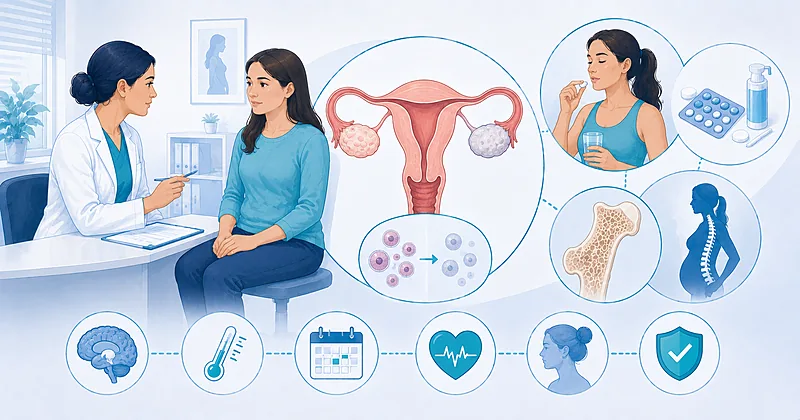
Primary ovarian insufficiency is the loss of normal ovarian function before age 40, and it is frequently missed or mislabelled as early menopause. Reaching the diagnosis quickly matters because untreated oestrogen deficiency at a young age carries real consequences for bone, cardiovascular, and cognitive health. The points below distill current evidence into actionable rules you can apply in clinic.
- 1Confirm the diagnosis with two separate FSH measurements in the menopausal range, taken at least four weeks apart, alongside four or more months of irregular or absent periods
- 2Do not rely on anti-Mullerian hormone alone to make the diagnosis — it supports the picture but does not replace FSH testing
- 3Search for a cause: karyotype, fragile X premutation testing, and adrenal antibodies are the highest-yield investigations
- 4Start systemic hormone therapy at diagnosis unless contraindicated — replacement, not optional symptom relief, is the goal
- 5Use a higher oestrogen dose than standard menopausal regimens — younger ovaries normally produce more
- 6Always add a progestogen for any woman with an intact uterus to protect the endometrium
- 7Continue hormone therapy at least until the average age of natural menopause, around 50—51 years
- 8Address fertility, bone density, and emotional wellbeing as core parts of management, not afterthoughts
How to Confirm Primary Ovarian Insufficiency
The diagnosis of primary ovarian insufficiency rests on a combination of menstrual disturbance and biochemical evidence of ovarian failure. The most common pitfall is acting on a single elevated FSH value, since gonadotropin levels can fluctuate substantially in early ovarian decline.
Evaluate for primary ovarian insufficiency in any woman under 40 with four or more months of oligomenorrhoea or secondary amenorrhoea. Menstrual change is the entry point to the entire workup.
Strong Rec High Evidence ESHRE 2024Perform two FSH measurements in the menopausal range, separated by at least four weeks, before confirming the diagnosis. A single raised value is insufficient because gonadotropins vary cycle to cycle in early ovarian decline.
Strong Rec High Evidence ESHRE 2024 NICE NG23Do not use anti-Mullerian hormone as a standalone diagnostic test. A low value reinforces the clinical impression but cannot replace paired FSH testing for a definitive diagnosis.
Against Moderate Evidence ESHRE 2024Measure oestradiol alongside FSH to document the degree of oestrogen deficiency. A low oestradiol supports the diagnosis and establishes the baseline before starting replacement.
Moderate Rec Moderate Evidence ESHRE 2024Investigating the Underlying Cause
Most cases are idiopathic, but a targeted search identifies a cause in a meaningful minority and changes management. Genetic and autoimmune testing carries implications for the patient, for relatives, and for screening of associated conditions.
Perform karyotype analysis in every woman with confirmed primary ovarian insufficiency. Chromosomal abnormalities, including Turner syndrome variants, carry cardiovascular and other surveillance implications.
Strong Rec Moderate Evidence ESHRE 2024Test for the fragile X premutation (FMR1 CGG repeat expansion), which is the most common identifiable genetic cause and has direct implications for family members of reproductive age.
Strong Rec Moderate Evidence ESHRE 2024 ACOG 2017Screen for adrenal autoimmunity with 21-hydroxylase antibodies. A positive result flags the risk of autoimmune adrenal insufficiency, a potentially life-threatening association that warrants ongoing vigilance.
Moderate Rec Moderate Evidence ESHRE 2024Check thyroid function and thyroid peroxidase antibodies, since autoimmune thyroid disease is the most frequent autoimmune condition clustering with primary ovarian insufficiency.
Moderate Rec Moderate Evidence ESHRE 2024Diagnostic Workup at a Glance
| Investigation | What It Tells You | When to Order | Practical Tips |
|---|---|---|---|
| FSH (paired) | Confirms ovarian failure | At presentation, repeat in 4 weeks | Stop hormonal contraception first to avoid suppression |
| Karyotype | Detects Turner variants, X abnormalities | After diagnosis confirmed | Positive result triggers cardiac and renal review |
| FMR1 (fragile X) | Most common genetic cause | After diagnosis confirmed | Offer genetic counselling before testing |
| 21-hydroxylase Ab | Adrenal autoimmunity risk | At diagnosis | Counsel on adrenal crisis warning signs if positive |
| TSH + TPO Ab | Autoimmune thyroid disease | At diagnosis, then periodically | Most common autoimmune association |
Hormone Therapy for Primary Ovarian Insufficiency
Hormone therapy in primary ovarian insufficiency is physiological replacement, not the risk-benefit calculation applied to older postmenopausal women. The aim is to restore the oestrogen a healthy ovary would otherwise be producing, protecting bone and cardiovascular health for the decades before natural menopause would have occurred.
Initiate systemic oestrogen replacement at the time of diagnosis for all women with primary ovarian insufficiency unless a clear contraindication exists. Early replacement protects bone density and reduces long-term cardiovascular risk.
Strong Rec High Evidence ESHRE 2024 ACOG 2017Prescribe a higher oestrogen dose than typical menopausal regimens — for example, transdermal oestradiol 100 mcg or oral oestradiol 2 mg daily — to mirror the output of a functioning premenopausal ovary.
Strong Rec Moderate Evidence ESHRE 2024Add a progestogen for every woman with an intact uterus to prevent endometrial hyperplasia from unopposed oestrogen. Either sequential or continuous regimens are acceptable depending on whether withdrawal bleeds are desired.
Strong Rec High Evidence ESHRE 2024 NICE NG23Consider transdermal oestradiol as the preferred route in women with risk factors for venous thromboembolism, since it avoids first-pass hepatic metabolism and carries a lower thrombotic risk than oral preparations.
Moderate Rec Moderate Evidence NICE NG23May be appropriate to offer a combined oral contraceptive pill as an alternative for women who also want contraception or prefer it, recognising it provides somewhat less consistent bone protection than dedicated replacement.
Conditional Rec Moderate Evidence ESHRE 2024Continue replacement until at least the average age of natural menopause, around 50 to 51 years, before reassessing. Stopping early reintroduces the risks of premature oestrogen deficiency.
Strong Rec High Evidence ESHRE 2024 ACOG 2017Counsel patients that the cardiovascular and breast safety profile of replacement in this young population differs from data in older postmenopausal women, and that withholding therapy is itself a risk.
Strong Rec Moderate Evidence ESHRE 2024Replacement Options Compared
| Regimen | Typical Oestrogen Dose | Best Suited For | Contraceptive Cover | Practical Tips |
|---|---|---|---|---|
| Transdermal HRT | Oestradiol patch ~100 mcg | VTE risk factors; preference for non-oral | No | Rotate sites; add separate contraception if pregnancy not desired |
| Oral HRT | Oestradiol 2 mg daily | Patient preference for tablets | No | Higher VTE risk than transdermal; pair with progestogen |
| Combined oral pill | Ethinyloestradiol-based | Wants contraception alongside replacement | Yes | Take continuously or with short breaks; slightly less bone benefit |
| Oestrogen + LNG-IUS | Transdermal or oral oestrogen | Wants endometrial protection plus contraception | Yes | IUS delivers the progestogen locally and covers contraception |
Clinical Decision Pathway
A practical, question-based approach to the woman presenting with possible early ovarian failure. Work through the questions in order.
Monitoring and Follow-Up
Follow-up centres on confirming adequate replacement, protecting bone, and watching for the autoimmune conditions that cluster with this diagnosis.
| Parameter | When to Check | What to Look For | Common Pitfalls |
|---|---|---|---|
| Symptom review | 3 months after starting, then annually | Resolution of vasomotor and genitourinary symptoms | Persistent symptoms often mean the dose is too low, not that therapy has failed |
| DXA scan | At diagnosis; repeat per risk | Low bone mineral density needing intervention | Skipping the baseline scan means later loss goes undetected |
| Thyroid function | At diagnosis, then periodically | Emerging autoimmune thyroid disease | Easy to forget once replacement is settled |
| Wellbeing check | Every review | Low mood, grief around fertility loss | Psychological impact is frequently overlooked in busy clinics |
Fertility and Emotional Wellbeing
A diagnosis of primary ovarian insufficiency lands as both a health concern and a fertility loss, often in women who had not finished family planning. Acknowledging this directly is part of good care.
Counsel patients that spontaneous pregnancy remains possible in a small proportion of cases, while being honest that the chance is low and unpredictable. For those wanting children, discuss egg donation as the option with the highest success.
Moderate Rec Moderate Evidence ESHRE 2024Refer to a reproductive specialist early when fertility is a priority, since options such as donor conception benefit from timely planning rather than delayed referral.
Moderate Rec Low Evidence ESHRE 2024Ensure psychological support is offered, since the diagnosis is associated with measurable rates of anxiety and low mood. Signpost to peer support groups and counselling where available.
Strong Rec Moderate Evidence ESHRE 2024Evidence in Context
Where the major guidelines align, where they diverge, and what the underlying evidence supports.
Where the Guidelines Agree
ESHRE, ACOG, and NICE all converge on the core message: oestrogen replacement should be offered to every woman with this diagnosis and continued to the typical age of menopause, because the long-term harms of untreated deficiency at a young age outweigh the concerns that shape prescribing in older women.
Why This Is Not the Same as Menopausal HRT
The cautious risk-benefit framing around hormone therapy stems largely from the WHI findings in older postmenopausal women. Applying those concerns to a 30-year-old replacing physiological oestrogen is a category error; the populations, doses, and baseline risks are fundamentally different.
HRT Versus the Combined Pill for Bone
Comparative studies suggest dedicated hormone replacement may offer marginally better bone mineral density outcomes than the combined oral contraceptive pill, though both are acceptable. The pill remains a reasonable choice when contraception is also wanted.
The Role of Androgen Replacement
Evidence for routine testosterone replacement in this population is limited. It is not recommended as standard, though it may be considered case by case for persistent low sexual desire after oestrogen replacement is optimised.
References
- 1.European Society of Human Reproduction and Embryology (ESHRE) Guideline Group on POI. Management of women with premature ovarian insufficiency. Hum Reprod. 2016;31(5):926–937. doi:10.1093/humrep/dew027
- 2.Committee on Gynecologic Practice. Hormone Therapy in Primary Ovarian Insufficiency. ACOG Committee Opinion No. 698. Obstet Gynecol. 2017;129(5):e134–e141. doi:10.1097/AOG.0000000000002044
- 3.Nelson LM. Primary Ovarian Insufficiency. N Engl J Med. 2009;360(6):606–614. doi:10.1056/NEJMcp0808697
- 4.National Institute for Health and Care Excellence. Menopause: diagnosis and management. NICE Guideline NG23. nice.org.uk/guidance/ng23
How to Read the Evidence Tags
Every recommendation carries two tags for recommendation strength and evidence quality — Medaptly’s own simplified interpretations, mapped from the source grading systems.
Recommendation Strength
| Tag | What It Means |
|---|---|
| Strong Rec | High-quality evidence broadly supports this action. |
| Moderate Rec | The weight of evidence favours this action. |
| Conditional Rec | The benefit is less certain — individualise. |
| Against | Evidence shows no benefit or potential harm. |
Evidence Quality
| Tag | What It Means |
|---|---|
| High Evidence | Multiple well-designed RCTs or high-quality meta-analyses. |
| Moderate Evidence | Single RCT or large observational studies. |
| Low Evidence | Expert consensus or small studies. |