
Pelvic Organ Prolapse: Evaluation and Treatment Options
Clinical Practice Update — Symptom Assessment, POP-Q Staging, and Choosing Between Conservative and Surgical Care
This is an original clinical education article informed by current guidelines and evidence. See References below for source documents.
- Clinical Focus
- Evaluation and pelvic organ prolapse treatment in adult women
- Target Audience
- Gynecologists, primary care physicians, urogynecology referrers, residents, nurse practitioners
- Setting
- Outpatient gynecology, primary care, urogynecology referral
- Source Evidence
- •ACOG/AUGS Practice Bulletin on Pelvic Organ Prolapse (2024)
- •NICE Guideline NG123 — Urinary Incontinence and Pelvic Organ Prolapse (2019, updated 2024)
- •Cochrane Review — Surgery for Women with Apical Vaginal Prolapse (2023)
- •POPPY Trial — Pelvic Floor Muscle Training for Prolapse (Lancet, 2014)
Key Clinical Takeaways
Effective pelvic organ prolapse treatment begins with one principle: treat the symptoms, not the anatomy. Many women with descent on examination feel nothing and need only reassurance. The points below distill current evidence into actionable rules for evaluation and management.
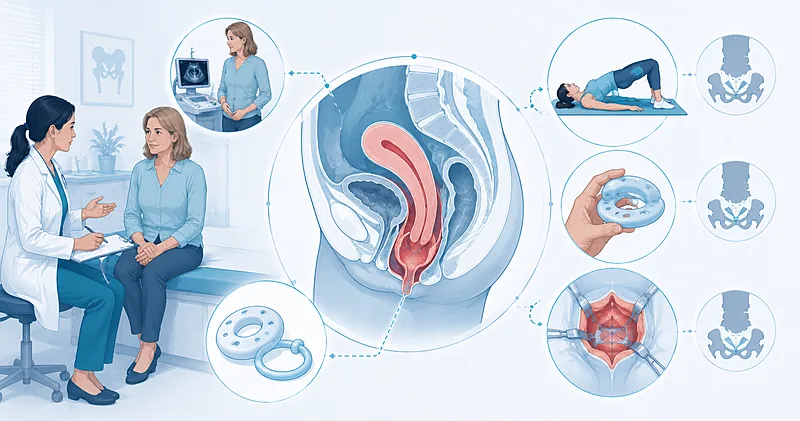
- 1Stage every prolapse with POP-Q staging, but base management on bother, not on the stage number alone → Evaluation
- 2Offer watchful waiting to any woman with mild or asymptomatic descent → Conservative Care
- 3Recommend supervised pelvic floor muscle training first-line for stage 1–2 symptomatic prolapse → Conservative Care
- 4Offer a vaginal pessary as an effective alternative to surgery at any prolapse stage → Pessary Management
- 5Prescribe vaginal estrogen alongside a pessary in postmenopausal women to reduce erosion → Pessary Management
- 6Match the surgical approach to the compartment that has prolapsed, not to a single default operation → Surgical Options
- 7Counsel patients that transvaginal mesh is no longer used for routine primary repair → Surgical Options
- 8Discuss colpocleisis as a durable, low-morbidity option for older women not seeking to preserve coital function → Surgical Options
- 9Investigate occult stress incontinence before prolapse surgery, since repair can unmask it → Pre-Operative Workup
Evaluating a Woman Before Pelvic Organ Prolapse Treatment
A structured evaluation does two things: it confirms which compartments have descended and it establishes how much the descent bothers the woman. Both pieces drive every subsequent pelvic organ prolapse treatment decision, because a stage 3 cystocele in an asymptomatic woman and a stage 1 prolapse in a distressed one call for opposite approaches.
Document symptom burden with a validated symptom questionnaire before deciding on any intervention. The degree of bother, not the anatomical stage, determines whether treatment is warranted.
Strong Rec Moderate Evidence ACOG/AUGS 2024Perform a POP-Q examination to record the leading edge of each compartment relative to the hymen. Reproducible staging allows consistent communication and meaningful follow-up over time.
Strong Rec High Evidence ACOG/AUGS 2024Examine the woman in a position that reproduces her maximal descent, standing if needed, since supine examination frequently understates the prolapse she experiences during daily activity.
Moderate Rec Low Evidence NICE NG123Evaluate for coexisting bladder and bowel dysfunction, including urinary urgency, incomplete emptying, and obstructed defecation, which influence both the choice and the sequencing of treatment.
Strong Rec Moderate Evidence ACOG/AUGS 2024Routine imaging is not required to diagnose prolapse, which remains a clinical diagnosis. Reserve dynamic MRI or translabial ultrasound for complex multicompartment cases, suspected enterocele, or planning a redo repair. Consider urodynamic assessment when stress incontinence symptoms coexist or when prolapse reduction unmasks leakage.
Conservative Pelvic Organ Prolapse Treatment
For most women with early-stage symptomatic descent, conservative pelvic organ prolapse treatment is the appropriate first step. It carries minimal risk, can be started immediately, and does not foreclose surgery later. The two pillars are pelvic floor muscle training and lifestyle modification.
Refer for supervised pelvic floor muscle training as first-line therapy in women with stage 1 or stage 2 symptomatic prolapse. A structured programme of at least 16 weeks improves symptoms and prolapse severity more than lifestyle advice alone.
Strong Rec High Evidence POPPY Trial 2014 NICE NG123Counsel patients on weight reduction, management of chronic cough, and avoidance of repeated heavy lifting. Reducing intra-abdominal pressure addresses a modifiable driver of progression.
Moderate Rec Low Evidence ACOG/AUGS 2024Treat associated constipation actively with fibre, fluids, and stool softeners. Straining at defecation worsens both prolapse symptoms and the chance of post-operative recurrence.
Moderate Rec Low Evidence NICE NG123Vaginal Pessaries: A Non-Surgical Mainstay
A vaginal pessary is an effective option for women at any prolapse stage who wish to avoid or delay surgery, who are awaiting an operation, or who are unfit for one. Roughly two-thirds of women fitted with a pessary continue using it successfully at one year, making it a genuine long-term alternative rather than a stopgap.
Offer a pessary trial to every woman considering surgery, since many achieve durable symptom control without an operation. Start with a ring pessary for most anterior and apical prolapse and reserve space-filling types such as the Gellhorn for advanced descent.
Strong Rec Moderate Evidence ACOG/AUGS 2024Prescribe topical vaginal estrogen in postmenopausal pessary users unless contraindicated. Local estrogen improves tissue integrity and reduces the risk of erosion, bleeding, and discharge.
Moderate Rec Moderate Evidence ACOG/AUGS 2024Arrange a follow-up review within a few weeks of the initial fitting, then at regular intervals, to check comfort, retention, and the vaginal mucosa. Teach self-management of removal and reinsertion where the woman is able and willing.
Moderate Rec Low Evidence NICE NG123Surgical Options by Compartment
Surgery is offered when symptoms persist despite conservative measures, when a pessary is unsuitable or declined, or when the woman prefers a definitive repair. The operation is chosen to match the affected compartment and the woman’s goals, including whether she wishes to preserve the uterus and coital function.
Perform an apical suspension procedure whenever the apex has descended, since unaddressed apical support is a leading cause of recurrence after isolated anterior or posterior repair. Sacrocolpopexy and sacrospinous fixation are both well-supported, with the choice guided by route, age, and surgical expertise.
Strong Rec High Evidence Cochrane 2023Repair anterior and posterior compartment defects with native-tissue colporrhaphy as the standard primary approach. Native-tissue repair avoids the complications that led to the withdrawal of transvaginal mesh for routine use.
Strong Rec Moderate Evidence NICE NG123Do not use transvaginal synthetic mesh for primary prolapse repair outside specialist research settings. Regulatory bodies have restricted its use after reports of mesh exposure, chronic pain, and dyspareunia.
Against Moderate Evidence NICE NG123 FDA 2019Consider colpocleisis for older women with advanced prolapse who do not wish to retain the option of penetrative intercourse. This obliterative procedure offers high anatomical success with short operating time and low complication rates.
Conditional Rec Moderate Evidence ACOG/AUGS 2024Discuss uterine preservation as an option in women who wish to keep their uterus and have no other indication for hysterectomy. Hysteropexy achieves comparable short-term outcomes to hysterectomy-based repair in suitable candidates.
Moderate Rec Moderate Evidence Cochrane 2023Surgical Approaches: Matching Procedure to Patient
| Procedure | Compartment Addressed | Best Suited For | Counselling Points |
|---|---|---|---|
| Anterior colporrhaphy | Anterior (cystocele) | Symptomatic bladder bulge with good apical support | Recurrence rises if apical descent is left unrepaired |
| Posterior colporrhaphy | Posterior (rectocele) | Symptomatic rectocele, obstructed defecation | Avoid over-narrowing to prevent dyspareunia |
| Sacrospinous fixation | Apical (vaginal route) | Apical prolapse, woman preferring vaginal surgery | Faster recovery; small risk of buttock pain |
| Sacrocolpopexy | Apical (abdominal route) | Vault prolapse, younger active women, redo repair | Durable but longer recovery; uses abdominal mesh graft |
| Colpocleisis | All compartments (obliterative) | Frail, older women not seeking coital function | Irreversible loss of penetrative intercourse; counsel clearly |
Pre-Operative Workup and Counselling
Thorough preparation reduces surprises after surgery. The two issues most often overlooked are occult stress incontinence and unrealistic expectations about what repair can deliver.
Evaluate for occult stress urinary incontinence with prolapse reduction before surgery. Repairing the prolapse can unmask leakage that was previously hidden by kinking of the urethra.
Moderate Rec Moderate Evidence ACOG/AUGS 2024Counsel patients on realistic recurrence rates and the possibility of needing a further procedure. Shared decision-making about acceptable trade-offs improves satisfaction regardless of the operation chosen.
Strong Rec Moderate Evidence NICE NG123Refer complex, recurrent, or mesh-complication cases to a specialist multidisciplinary urogynecology service. Concentrating difficult cases in experienced centres improves outcomes and access to the full range of options.
Strong Rec Low Evidence NICE NG123Clinical Decision Pathway
A practical, question-based approach to selecting a management strategy. Follow the questions in order.
Monitoring and Follow-Up
| Management Choice | When to Review | What to Assess | Common Pitfalls |
|---|---|---|---|
| Watchful waiting | When symptoms change | New or worsening bulge, bladder or bowel symptoms | Discharging without a clear route back into care |
| Pelvic floor training | During and at end of programme | Symptom bother, technique, adherence | Expecting anatomical reversal rather than symptom relief |
| Vaginal pessary | Few weeks after fitting, then regularly | Comfort, retention, vaginal mucosa for erosion | Losing the patient to follow-up and risking erosion |
| After surgery | Early post-op, then medium-term | Wound healing, recurrence, new incontinence, sexual function | Attributing all new symptoms to the prolapse rather than the repair |
Evidence in Context
What the evidence shows, where the major frameworks agree, and where genuine uncertainty remains.
Where ACOG/AUGS and NICE Agree
Both frameworks agree that management should be driven by symptom bother rather than anatomical stage, that conservative options should be offered before surgery, and that apical support must be addressed when the apex has descended. Both also endorse the retreat from transvaginal mesh for routine primary repair.
Pelvic Floor Training: What the Trials Show
The POPPY trial demonstrated that a supervised, individualised programme of pelvic floor muscle training reduced prolapse symptoms compared with a simple lifestyle leaflet. The effect is most reliable in earlier-stage prolapse, and benefit depends heavily on supervision and adherence rather than on home exercises alone.
Apical Repair: Abdominal Versus Vaginal Route
The Cochrane review of apical prolapse surgery found that abdominal sacrocolpopexy tends to offer lower recurrence than vaginal procedures, at the cost of longer recovery and operating time. Sacrospinous fixation remains a sound vaginal alternative, and the best choice depends on the woman’s age, activity level, and surgical priorities.
The Mesh Story and Where It Leaves Us
Reports of mesh exposure, chronic pelvic pain, and dyspareunia led multiple regulators to restrict or withdraw transvaginal mesh kits for prolapse. Abdominally placed mesh in sacrocolpopexy is a distinct procedure with a different safety profile and remains an accepted option. The lesson has reshaped how new devices are introduced and how thoroughly women are now counselled.
References
- 1.Hagen S, Stark D, Glazener C, et al. Individualised pelvic floor muscle training in women with pelvic organ prolapse (POPPY): a multicentre randomised controlled trial. Lancet. 2014;383(9919):796–806. doi:10.1016/S0140-6736(13)61977-7
- 2.Maher C, Feiner B, Baessler K, et al. Surgery for women with apical vaginal prolapse. Cochrane Database Syst Rev. 2023;7:CD012376. doi:10.1002/14651858.CD012376.pub2
- 3.American College of Obstetricians and Gynecologists and American Urogynecologic Society. Pelvic Organ Prolapse. Obstet Gynecol. 2024;143(1):e1–e30. pubmed.ncbi.nlm.nih.gov/37486661
- 4.National Institute for Health and Care Excellence. Urinary incontinence and pelvic organ prolapse in women: management. NICE Guideline [NG123]. 2019. nice.org.uk/guidance/ng123
How to Read the Evidence Tags
Every recommendation carries two tags for recommendation strength and evidence quality — Medaptly’s own simplified interpretations, plus a source tag.
Recommendation Strength
| Tag | What It Means |
|---|---|
| Strong Rec | High-quality evidence broadly supports this action. |
| Moderate Rec | The weight of evidence favours this action. |
| Conditional Rec | The benefit is less certain — individualise. |
| Against | Evidence shows no benefit or potential harm. |
Evidence Quality
| Tag | What It Means |
|---|---|
| High Evidence | Multiple well-designed RCTs or high-quality meta-analyses. |
| Moderate Evidence | Single RCT or large observational studies. |
| Low Evidence | Expert consensus or small studies. |