
Pediatric Asthma Management: Age-Based Stepwise Care
Clinical Practice Update — Stepwise Control by Age Group and Acute Exacerbation Care
This is an original clinical education article informed by current guidelines and evidence. See References below for source documents.
- Clinical Focus
- Evidence-based pediatric asthma management across the 0–5, 6–11, and 12+ age bands
- Target Audience
- Pediatricians, family physicians, emergency clinicians, residents, nurse practitioners
- Setting
- Primary care, pediatric clinics, emergency departments
- Source Evidence
- •GINA Global Strategy for Asthma Management and Prevention (2024)
- •NAEPP / EPR-4 Focused Updates on Asthma Management (2020)
- •NICE/BTS/SIGN Joint Guideline on Asthma (2024)
- •START / SYGMA Trials — ICS-Formoterol as Reliever (NEJM, 2018–2019)
Key Clinical Takeaways
Effective pediatric asthma management depends on getting three things right: matching the controller step to the child’s age band, choosing the correct reliever strategy, and acting fast during exacerbations. Age changes almost everything in pediatric asthma management — the device, the drug, the dose, and the threshold to escalate. The points below distill current evidence into rules you can apply in clinic and at the bedside.
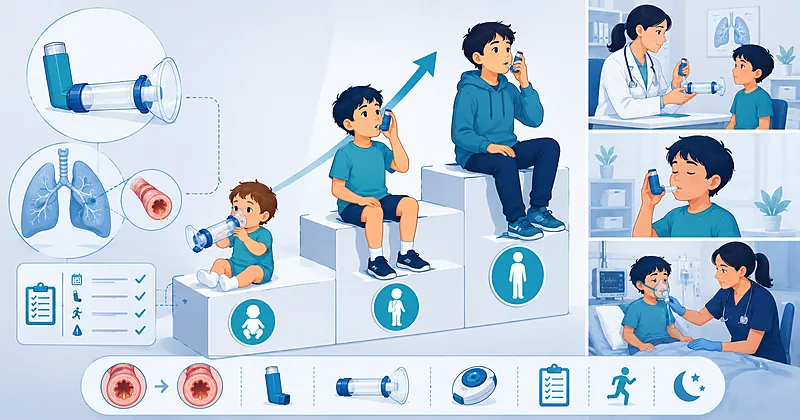
- 1Treat the three age bands as separate problems: 0–5 years, 6–11 years, and 12 years and older each have their own stepwise ladder.
- 2Deliver every inhaled drug through a valved holding chamber in young children; a pressurised inhaler with correct spacer technique outperforms a nebuliser for most exacerbations.
- 3For children 6 and older, low-dose ICS-formoterol used as both controller and reliever simplifies the regimen and cuts severe exacerbations.
- 4Never leave a child on a short-acting reliever alone; even mild intermittent symptoms warrant inhaled corticosteroid cover.
- 5Check inhaler technique and adherence before stepping up — most apparent treatment failure is actually a device or compliance problem.
- 6Give systemic corticosteroids early in moderate-to-severe exacerbations, ideally within the first hour of presentation.
- 7Reassess control every 1–3 months after any change, and consider stepping down once symptoms have been stable for around three months.
- 8Give every family a written action plan that names the medicines, the doses, and the exact signs that mean “seek help now”.
Confirming the Diagnosis Before Starting Treatment
Pediatric asthma management begins with a secure diagnosis, which is harder in young children because spirometry is unreliable before about age 5. In this group the diagnosis rests on a recurring pattern of wheeze, cough, and breathlessness that responds to a controller trial, rather than on a single lung-function number.
In school-age children and adolescents, objective testing carries more weight, and good pediatric asthma management means using that testing to confirm the label rather than starting controllers on symptoms alone. Demonstrating reversible airflow limitation supports the diagnosis and helps avoid committing a child to years of unnecessary inhalers.
Evaluate for a recurring symptom pattern — more than one episode of wheeze, worse at night or with exercise, viral triggers, or a personal or family history of atopy — before labelling a preschooler as asthmatic.
Moderate Rec Moderate Evidence GINA 2024Perform spirometry with bronchodilator reversibility in children able to do it reliably (usually from age 5–6), looking for an improvement in FEV1 that confirms variable airflow limitation.
Strong Rec Moderate Evidence NICE/BTS/SIGN 2024Consider a fractional exhaled nitric oxide measurement or a monitored controller trial when the diagnosis remains uncertain after history and spirometry.
Conditional Rec Low Evidence NICE/BTS/SIGN 2024Stepwise Pediatric Asthma Management by Age Group
The core of stepwise pediatric asthma management is matching the controller intensity to current symptom burden, then moving up or down as control changes. The single biggest shift in pediatric asthma management in recent years is the move away from short-acting reliever monotherapy toward regimens that always pair symptom relief with anti-inflammatory cover.
Children Aged 0–5 Years
In the youngest children, the ladder is simpler and the reliever-plus-controller combinations available in older children are not licensed. Treatment leans on regular low-dose inhaled corticosteroid as the foundation, with a reliever for breakthrough symptoms.
Start regular daily low-dose inhaled corticosteroid for a preschooler with a clear pattern of asthma symptoms or frequent viral-induced wheeze that disrupts sleep or activity.
Strong Rec High Evidence GINA 2024Prescribe an inhaled short-acting beta-agonist delivered by pressurised inhaler and valved holding chamber as the reliever for this age group; reserve a leukotriene receptor antagonist as an add-on rather than a first-line controller.
Moderate Rec Moderate Evidence GINA 2024Children Aged 6–11 Years
School-age children gain access to combination inhalers, and the evidence increasingly favours an anti-inflammatory reliever approach. The choice between a daily-controller-plus-reliever track and a combined maintenance-and-reliever track depends on adherence, symptom frequency, and family preference.
Initiate low-dose inhaled corticosteroid as the preferred starting controller for a 6–11 year old with troublesome symptoms more than twice a month, adjusting upward only after confirming technique and adherence.
Strong Rec High Evidence GINA 2024 NAEPP 2020Consider a combined low-dose inhaled-corticosteroid-formoterol maintenance-and-reliever regimen in this age group, since it reduces severe flares compared with the same controller dose plus a separate short-acting reliever.
Moderate Rec High Evidence GINA 2024Refer to a pediatric respiratory specialist when a child remains poorly controlled on medium-dose combination therapy despite confirmed good technique and adherence.
Strong Rec Low Evidence NICE/BTS/SIGN 2024Adolescents Aged 12 Years and Older
Once a child reaches adolescence, the adult tracks apply. The preferred approach across mild and moderate disease is anti-inflammatory reliever therapy, which addresses the long-standing problem of teenagers over-relying on a blue inhaler while skipping their controller.
Prescribe as-needed low-dose inhaled-corticosteroid-formoterol as the preferred reliever-only strategy for an adolescent with mild asthma, rather than a short-acting beta-agonist alone.
Strong Rec High Evidence GINA 2024 SYGMA 2018Do not rely on short-acting beta-agonist monotherapy in adolescents; reliever-only use without inhaled corticosteroid leaves airway inflammation untreated and raises the risk of severe attacks.
Against High Evidence GINA 2024Pediatric Asthma Management During Acute Exacerbations
An acute attack is where pediatric asthma management is most time-critical. The priorities are rapid bronchodilation, early systemic corticosteroid, and a structured reassessment that decides who can go home and who needs escalation. The same age-based thinking that guides controller selection also shapes pediatric asthma management in the emergency setting, from device choice to escalation thresholds.
Give repeated doses of inhaled short-acting beta-agonist via a pressurised inhaler and spacer as first-line bronchodilation for mild-to-moderate exacerbations, reserving the nebuliser for severe attacks or children unable to use a spacer.
Strong Rec High Evidence GINA 2024Start a short course of oral corticosteroid early in moderate-to-severe exacerbations, and titrate supplemental oxygen to keep oxygen saturation within the target range rather than driving it to 100%.
Strong Rec High Evidence GINA 2024 NAEPP 2020Add inhaled ipratropium to beta-agonist therapy in severe exacerbations, as the combination improves bronchodilation and reduces hospital admission compared with beta-agonist alone.
Moderate Rec High Evidence GINA 2024Reassess response within one hour and arrange admission for any child with persistent hypoxia, exhaustion, a silent chest, or a poor response to initial bronchodilator therapy.
Strong Rec Moderate Evidence NICE/BTS/SIGN 2024Before discharge after any exacerbation, review or adjust the controller step, confirm inhaler technique, and update the written action plan so that ongoing pediatric asthma management is tightened rather than left unchanged.
Strong Rec Moderate Evidence GINA 2024Clinical Decision Pathway
A practical, question-based route through a clinic visit for an established asthmatic child. Work through the questions in order at each review.
Controller Choices Mapped to Age and Scenario
This table is organised by the clinical scenario a clinician actually faces, then maps the preferred controller, the reliever to pair with it, and a practical caution for each age band.
| Age & Scenario | Preferred Controller | Reliever to Pair | Practical Caution |
|---|---|---|---|
| 0–5, recurrent wheeze with symptom burden | Regular low-dose ICS | SABA via pMDI + spacer with mask | Always use an age-appropriate mask; rinse the mouth area after dosing. |
| 0–5, ICS alone insufficient | Double the low ICS dose or add LTRA | SABA via pMDI + spacer with mask | Reassess diagnosis if still uncontrolled; specialist input is reasonable. |
| 6–11, mild persistent symptoms | Low-dose ICS daily | SABA, or ICS-formoterol if on MART | Confirm the child can coordinate a mouthpiece before dropping the mask. |
| 6–11, frequent flares despite daily ICS | Low-dose ICS-formoterol (MART) | Same ICS-formoterol inhaler as reliever | Educate the family that one inhaler now does both jobs. |
| 12+, mild asthma | As-needed low-dose ICS-formoterol | Same inhaler (anti-inflammatory reliever) | Make clear a SABA-only inhaler is no longer the default. |
| 12+, moderate asthma | Daily low-dose ICS-formoterol (MART) | Same ICS-formoterol inhaler as reliever | Cap total daily inhalations per the product limit. |
- pMDI = pressurised metered-dose inhaler; MART = maintenance-and-reliever therapy; LTRA = leukotriene receptor antagonist.
- Verify all doses against your local formulary and the specific product licence before prescribing, and keep growth monitoring in mind for any child on regular inhaled corticosteroid.
Reading Exacerbation Severity at the Bedside
This assessment grid groups the bedside signs by what they tell you about the work of breathing, then pairs each severity band with an immediate action and a common trap.
| Severity Band | Bedside Signs | Immediate Action | Common Trap |
|---|---|---|---|
| Mild | Talks in sentences, mild work of breathing, saturations in target range | Spacer-delivered SABA, observe response | Discharging without a clear follow-up and action plan |
| Moderate | Talks in phrases, visible accessory muscle use, mild hypoxia | Repeated SABA plus early oral corticosteroid | Delaying steroid while waiting to see if SABA alone works |
| Severe | Talks in words only, marked recession, agitation, clear hypoxia | Add ipratropium, oxygen to target, prepare for escalation | Underestimating a quiet child who is simply too tired to wheeze |
| Life-threatening | Silent chest, exhaustion, drowsiness, poor respiratory effort | Senior and critical-care help now; consider IV therapy | Reading a falling respiratory rate as recovery rather than fatigue |
- This grid is a clinical aid only and does not replace a validated pediatric severity score or local escalation protocol.
- SABA = short-acting beta-agonist. Always interpret signs in the context of the child’s baseline and age.
Monitoring and Follow-Up
Good follow-up is what turns a prescription into durable control, and it is the part of pediatric asthma management most often shortchanged once symptoms settle. The schedule below focuses on the few checks that change management most often.
| What to Review | When | What Good Looks Like | Common Pitfall |
|---|---|---|---|
| Symptom control | 1–3 months after any change | Few daytime symptoms, no night waking, full activity | Relying on the child’s report alone without asking about activity |
| Inhaler technique | Every visit | Correct actuation, spacer use, and breath-hold | Assuming technique learned once stays correct over time |
| Reliever use | Every visit and on refill | Low and infrequent reliever demand | Missing the warning sign of multiple canisters per year |
| Growth | At routine reviews | Height tracking along the expected centile | Not plotting height in children on long-term ICS |
A usable plan names the daily controller and its dose, the reliever and when to use it, the specific signs that mean symptoms are worsening, the rescue steps to take at home, and the exact thresholds that should trigger an urgent review or emergency call.
Evidence in Context
What the trials show, where the major frameworks agree, and where they diverge on managing asthma in children.
Why the Field Moved Away From SABA-Only Treatment
For decades the mildest asthma was treated with a reliever inhaler alone, on the assumption that occasional symptoms needed only occasional rescue. Accumulating trial data showed this left underlying inflammation untreated and exposed even mild patients to severe attacks. The anti-inflammatory reliever concept — combining a fast-acting bronchodilator with a corticosteroid in a single inhaler — emerged to close that gap, ensuring that every puff for symptoms also delivers anti-inflammatory cover.
Where the Major Frameworks Agree
Across the global and national guidance, there is broad agreement that inhaled corticosteroid is the cornerstone of long-term control, that short-acting reliever monotherapy should be abandoned, that device and adherence checks must precede any step-up, and that families need a written action plan. The disagreements are about sequencing and emphasis, not these fundamentals.
Where They Differ on Younger Children
The frameworks diverge most in the 6–11 group and below. Some place earlier emphasis on maintenance-and-reliever regimens once a child is old enough for the relevant inhaler, while others retain a more traditional daily-controller-plus-separate-reliever structure as the default. Local licensing of specific combination inhalers in children often drives which track is practical in a given setting.
The Reliever-Only Trials in Mild Disease
Landmark trials of as-needed ICS-formoterol in mild asthma demonstrated that this single-inhaler approach reduced severe exacerbations compared with reliever monotherapy, while keeping overall corticosteroid exposure low. These findings underpin the shift to anti-inflammatory reliever therapy as the preferred entry point for adolescents and adults with mild disease.
References
- 1.Reddel HK, Bacharier LB, Bateman ED, et al. Global Initiative for Asthma Strategy 2021: Executive Summary and Rationale for Key Changes. Am J Respir Crit Care Med. 2022;205(1):17–35. doi:10.1164/rccm.202109-2205PP
- 2.Cloutier MM, Baptist AP, Blake KV, et al. 2020 Focused Updates to the Asthma Management Guidelines (NAEPP). J Allergy Clin Immunol. 2020;146(6):1217–1270. doi:10.1016/j.jaci.2020.10.003
- 3.O’Byrne PM, FitzGerald JM, Bateman ED, et al. Inhaled Combined Budesonide–Formoterol as Needed in Mild Asthma (SYGMA 1). N Engl J Med. 2018;378(20):1865–1876. doi:10.1056/NEJMoa1715274
- 4.National Institute for Health and Care Excellence. Asthma: diagnosis, monitoring and chronic asthma management (BTS, NICE, SIGN). NG245. 2024. nice.org.uk/guidance/ng245
- 5.Bisgaard H, Le Roux P, Bjåmer D, et al. Budesonide/formoterol maintenance plus reliever therapy in young children. Pediatrics. 2010;125(6):e1513–e1518. doi:10.1542/peds.2009-2992
How to Read the Evidence Tags
Each recommendation carries two tags — one for recommendation strength and one for evidence quality — using Medaptly’s own simplified interpretations rather than any single body’s grading system.
Recommendation Strength
| Tag | What It Means |
|---|---|
| Strong Rec | High-quality evidence broadly supports this action. |
| Moderate Rec | The weight of evidence favours this action. |
| Conditional Rec | The benefit is less certain — individualise. |
| Against | Evidence shows no benefit or potential harm. |
Evidence Quality
| Tag | What It Means |
|---|---|
| High Evidence | Multiple well-designed RCTs or high-quality meta-analyses. |
| Moderate Evidence | Single RCT or large observational studies. |
| Low Evidence | Expert consensus or small studies. |