
Neurologic Follow-Up After Pediatric Bacterial Meningitis
Clinical Practice Update — Sequelae Surveillance, Hearing Assessment, and Neurodevelopmental Monitoring in Children
This is an original clinical education article informed by current guidelines and evidence. See References below for source documents.
- Clinical Focus
- Structured pediatric bacterial meningitis follow-up and detection of neurologic sequelae
- Target Audience
- Pediatricians, pediatric neurologists, primary care physicians, audiologists, residents
- Setting
- Post-discharge clinic, primary care, neurodevelopmental follow-up services
- Source Evidence
- •NICE NG240 — Meningitis (Bacterial) and Meningococcal Disease (2024)
- •AAP Red Book — Pneumococcal and Meningococcal Infections (2024)
- •Edmond K et al. — Global Sequelae After Childhood Meningitis (Lancet Infect Dis, 2010)
- •Cochrane Review — Corticosteroids for Acute Bacterial Meningitis (2015)
Key Clinical Takeaways
Effective pediatric bacterial meningitis follow-up rests on a simple premise: the acute infection ends at discharge, but the risk of disability does not. Roughly one in five survivors carries a lasting neurologic deficit, and many of these are silent at the point of recovery. The takeaways below distill the evidence into a surveillance plan you can run from the first post-discharge visit.
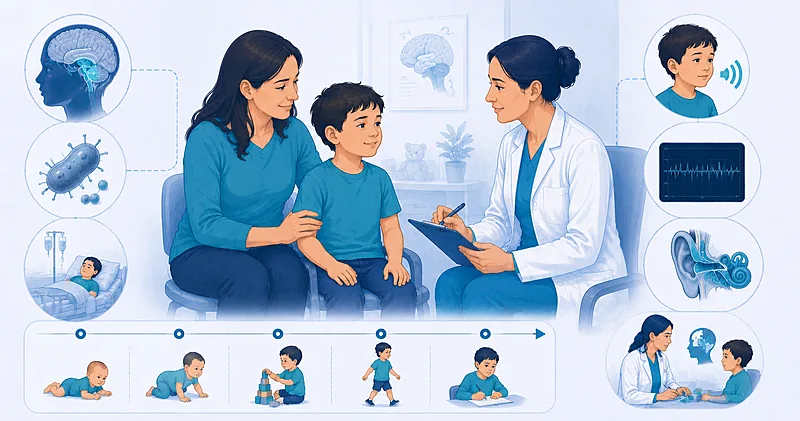
- 1Arrange formal audiology before discharge or within 4 weeks — sensorineural hearing loss is the most common sequela and the most time-critical to detect.
- 2Treat profound post-meningitic deafness as a cochlear implant emergency — labyrinthitis ossificans can close the implant window within weeks.
- 3Schedule a structured neurodevelopmental review at 4 to 6 weeks and again at one year, even when the child looks well at discharge.
- 4Counsel every family that post-meningitic epilepsy can emerge months after recovery, and give clear seizure safety-netting advice.
- 5Monitor head circumference in infants — a crossing of centiles may signal post-infectious hydrocephalus or subdural collection.
- 6Reserve repeat neuroimaging for children with focal deficits, seizures, an enlarging head, or failure to recover as expected.
- 7Recognise that behaviour, attention, and learning problems may only surface at school age — keep the door open for late referral.
- 8Hand the family a written follow-up plan listing each appointment, the deficits to watch for, and when to seek urgent review.
Who Needs Structured Pediatric Bacterial Meningitis Follow-Up
Every child who survives proven or probable bacterial meningitis warrants structured pediatric bacterial meningitis follow-up. The intensity of that surveillance, however, should be tiered to risk. Causative organism, age at infection, and the in-hospital course together predict who is most likely to develop disability.
Pneumococcal disease carries the highest burden of severe sequelae, while neonatal Gram-negative meningitis is associated with hydrocephalus and motor injury. A complicated acute illness — prolonged seizures, depressed consciousness, or a documented complication on imaging — raises the prior probability of a lasting deficit and justifies closer review.
Ensure every survivor of confirmed or clinically diagnosed bacterial meningitis enters a defined follow-up pathway before they leave the ward, with the first appointment booked at discharge.
Strong Rec Moderate Evidence NICE NG240 2024Evaluate for higher-intensity surveillance when the infection was pneumococcal, occurred in the neonatal period, or was complicated by seizures, prolonged coma, or imaging abnormalities.
Moderate Rec Moderate Evidence Edmond 2010Hearing Surveillance: The First Priority
Hearing loss is the signature complication of childhood meningitis and the one part of follow-up where timing genuinely changes outcomes. Damage to the cochlea begins during the acute illness, and in profound cases the inner ear can begin to ossify within weeks — permanently closing the window for cochlear implantation.
For this reason, audiology is the one investigation that should not wait for a routine clinic slot. The aim is a definitive, age-appropriate hearing assessment as soon after recovery as the child can cooperate with testing.
Perform a formal audiological assessment before discharge where feasible, and in all cases within 4 weeks of the child being fit to test. Use age-appropriate methods: otoacoustic emissions and auditory brainstem response in infants, behavioural audiometry in older children.
Strong Rec High Evidence NICE NG240 2024 AAP Red Book 2024Refer any child with confirmed profound sensorineural deafness for urgent cochlear implant assessment without waiting for the standard surveillance interval, because delayed referral risks an inoperable ossified cochlea.
Strong Rec Moderate Evidence NICE NG240 2024Reassess hearing even after an initial normal result, since a minority of children develop delayed or fluctuating loss. Repeat testing if parents or teachers later raise concern about hearing or speech.
Moderate Rec Low Evidence AAP Red Book 2024Neurodevelopmental Monitoring in Pediatric Bacterial Meningitis Follow-Up
Beyond hearing, the broad work of pediatric bacterial meningitis follow-up is to track the developing brain over time. Cognitive, motor, language, and behavioural domains can each be affected, and a single early review will miss problems that only emerge as developmental demands increase.
The practical model is serial surveillance against expected milestones rather than a one-off discharge check. Compare each visit to the child’s own trajectory and to age norms, and lower your threshold to refer when progress stalls.
Conduct a structured developmental review at 4 to 6 weeks post-discharge and again at around 12 months, covering gross and fine motor skills, language, social development, and vision.
Strong Rec Moderate Evidence NICE NG240 2024Monitor head circumference at each infant visit and plot it on a growth chart. Investigate a head that crosses upward through centiles or a bulging fontanelle for hydrocephalus or a subdural collection.
Strong Rec Moderate Evidence AAP Red Book 2024Refer promptly to physiotherapy, occupational therapy, or speech and language therapy when any motor, feeding, or communication delay is identified, rather than adopting a watch-and-wait stance.
Strong Rec Low Evidence NICE NG240 2024Advise families that cognitive, attentional, and behavioural difficulties may not appear until school entry. Keep a pathway open for re-referral and ensure school-age concerns trigger reassessment.
Moderate Rec Moderate Evidence Edmond 2010Epilepsy, Motor, and Visual Sequelae
A subset of children develop focal neurologic injury — spasticity, hemiparesis, ataxia, or cortical visual impairment — and a smaller group develop epilepsy. Acute symptomatic seizures during the illness raise the later risk of an unprovoked seizure disorder, though most children who seize acutely do not go on to develop epilepsy.
Examine for focal deficits at each visit, specifically asymmetry of tone or power, abnormal gait, and visual behaviour. Refer to pediatric neurology when a persisting focal sign is found.
Strong Rec Moderate Evidence NICE NG240 2024Counsel parents on the symptoms of post-meningitic epilepsy and give written advice on what a seizure looks like, basic first aid, and when to call emergency services, since onset may be delayed by months.
Strong Rec Low Evidence NICE NG240 2024Do not start prophylactic antiseizure medication to prevent epilepsy in a child who has recovered without ongoing seizures, as there is no evidence of benefit from this practice.
Against Low Evidence Expert ConsensusEnsure a formal vision assessment for any child with cortical signs, an abnormal ocular exam, or parental concern, because cortical visual impairment is easily missed in infancy.
Moderate Rec Low Evidence AAP Red Book 2024Clinical Decision Pathway
A question-based route through the first year of surveillance. Work through the questions at each scheduled visit.
Practical Surveillance Schedule
This schedule organises follow-up by timepoint rather than by organ system, so a single clinician can see what is due at each visit. Adjust intensity upward for high-risk children.
| Timepoint | What to Assess | Key Action | Easy-to-Miss Pitfall |
|---|---|---|---|
| Before discharge | Baseline neuro exam, hearing pathway, written plan | Book audiology and first clinic visit | Discharging without a booked hearing test |
| Within 4 weeks | Formal audiology | Urgent implant referral if profound loss | Delay allowing cochlear ossification |
| 4–6 weeks | Developmental milestones, focal signs, head size | Refer on any delay or focal deficit | Reassuring a parent who reports regression |
| Around 12 months | Repeat development, language, behaviour, hearing if concern | Formalise therapy and education input | Discharging too early as “recovered” |
| School entry | Cognition, attention, learning, hearing in noise | Re-refer if school raises concern | Assuming early normality rules out late deficits |
Recognising Sequelae by Clinical Profile
This table groups the major sequelae by how they present and when, so the right surveillance is matched to the right risk window. It is framed around what the clinician observes, not around any single grading system.
| Sequela | Typical Timing | How It Presents | Surveillance Anchor |
|---|---|---|---|
| Sensorineural hearing loss | Acute to early weeks | Reduced response to sound, speech delay | Audiology within 4 weeks |
| Hydrocephalus / subdural collection | Weeks | Enlarging head, irritability, vomiting | Head circumference at each infant visit |
| Motor deficit / cerebral palsy | Weeks to months | Asymmetric movement, abnormal tone, gait delay | Serial developmental exam |
| Epilepsy | Months | Unprovoked seizures after recovery | Parental seizure education and safety-netting |
| Cognitive / behavioural difficulty | Months to school age | Learning, attention, and social problems | Open re-referral pathway at school entry |
| Visual impairment | Weeks to months | Poor fixation, inconsistent visual response | Vision assessment if cortical signs |
Coordinating Monitoring and Family Support
Surveillance only works if someone owns it. Fragmented care — audiology in one place, development in another, neurology somewhere else — is how children fall between services. A named coordinating clinician and a shared written plan close that gap.
Document a single coordinating clinician — usually the general pediatrician or primary care physician — responsible for tracking that each appointment is attended and acted upon.
Moderate Rec Low Evidence NICE NG240 2024Provide the family with written information that lists each scheduled appointment, the specific deficits to watch for at home, and clear instructions on when to seek urgent review.
Strong Rec Low Evidence NICE NG240 2024Reassess immunisation status and, where indicated, evaluate for an underlying predisposition such as complement deficiency or an anatomical defect after recurrent or unusual infection.
Moderate Rec Moderate Evidence AAP Red Book 2024Evidence in Context
What the data show about sequelae, and where the guidance and trials converge or diverge.
How Common Are Lasting Sequelae?
Pooled global sequelae data suggest that around a fifth of children who survive bacterial meningitis are left with at least one major or minor deficit. Hearing loss is the single most frequent, followed by cognitive and motor impairment. The risk is highest after pneumococcal disease.
Where NICE and the AAP Align on Follow-Up
Both bodies make early formal hearing assessment a firm priority and both endorse structured developmental review of survivors. The emphasis on urgent action for profound deafness, driven by the implantation window, is shared across guidance.
Does Dexamethasone Change the Follow-Up Picture?
A Cochrane synthesis found that adjunctive corticosteroids reduce hearing loss in some settings, most clearly in high-income populations and with certain organisms. This shifts prevention earlier but does not remove the need for the same post-discharge hearing surveillance in every survivor.
Why Late Cognitive Effects Are Under-Recognised
Subtle deficits in attention, processing speed, and academic attainment may not be measurable until a child faces structured schooling. Follow-up that closes at one year will systematically miss these effects, which is why an open re-referral route into school age matters.
References
- 1.National Institute for Health and Care Excellence. Meningitis (bacterial) and meningococcal disease: recognition, diagnosis and management. NICE Guideline NG240. 2024. nice.org.uk/guidance/ng240
- 2.Edmond K, Clark A, Korczak VS, et al. Global and regional risk of disabling sequelae from bacterial meningitis: a systematic review and meta-analysis. Lancet Infect Dis. 2010;10(5):317–328. doi:10.1016/S1473-3099(10)70048-7
- 3.Brouwer MC, McIntyre P, Prasad K, van de Beek D. Corticosteroids for acute bacterial meningitis. Cochrane Database Syst Rev. 2015;(9):CD004405. doi:10.1002/14651858.CD004405.pub5
- 4.Lucas MJ, Brouwer MC, van de Beek D. Neurological sequelae of bacterial meningitis. J Infect. 2016;73(1):18–27. doi:10.1016/j.jinf.2016.04.009
- 5.Kohli-Lynch M, Russell NJ, Seale AC, et al. Neurodevelopmental impairment in children after group B streptococcal disease worldwide. Clin Infect Dis. 2017;65(suppl_2):S190–S199. doi:10.1093/cid/cix663
How to Read the Evidence Tags
Each recommendation carries a strength tag and an evidence-quality tag — Medaptly’s own simplified interpretation, not a reproduction of any guideline body’s grading system.
Recommendation Strength
| Tag | What It Means |
|---|---|
| Strong Rec | High-quality evidence broadly supports this action. |
| Moderate Rec | The weight of evidence favours this action. |
| Conditional Rec | The benefit is less certain — individualise. |
| Against | Evidence shows no benefit or potential harm. |
Evidence Quality
| Tag | What It Means |
|---|---|
| High Evidence | Multiple well-designed studies or high-quality systematic reviews. |
| Moderate Evidence | Single robust study or consistent observational data. |
| Low Evidence | Expert consensus or small studies. |