
Anorectal Abscess Drainage: A Drainage-Focused Management Guide
Clinical Practice Update — Incision Technique, Antibiotic Indications, and Fistula Prevention in Adults
This is an original clinical education article informed by current guidelines and evidence. See References below for source documents.
- Clinical Focus
- Evidence-based anorectal abscess drainage technique and antibiotic decision-making in adults
- Target Audience
- General surgeons, colorectal surgeons, emergency physicians, surgical residents
- Setting
- Emergency department, operating theatre, ambulatory surgery
- Source Evidence
- •ASCRS Clinical Practice Guidelines for Anorectal Abscess and Fistula (2022)
- •Association of Coloproctology of Great Britain and Ireland (ACPGBI) Position Statement (2017)
- •Sözener U, et al. Antibiotics for Prevention of Fistula After Abscess Drainage RCT (Dis Colon Rectum, 2011)
- •Mocanu V, et al. Meta-analysis of Antibiotics and Fistula Formation (Am J Surg, 2019)
Key Clinical Takeaways
Prompt anorectal abscess drainage is the definitive treatment for perianal sepsis, and delay is the single most common driver of avoidable harm. The points below distil the evidence into rules you can apply from the moment a fluctuant, tender perianal swelling presents.
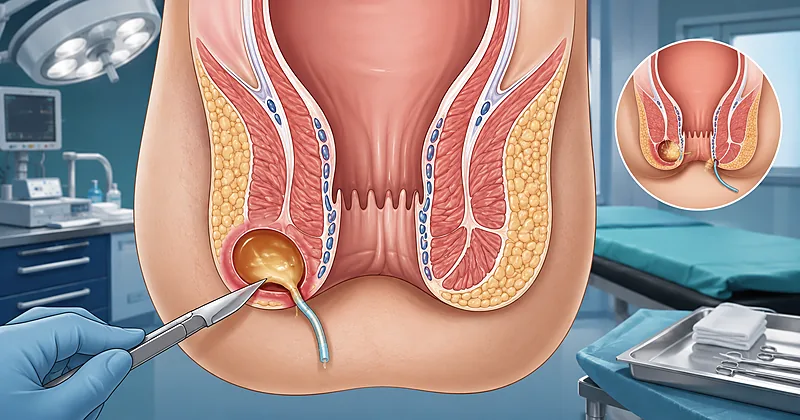
- 1Treat a fluctuant perianal abscess as a surgical emergency — drain it promptly rather than waiting for systemic signs.
- 2Antibiotics are not a substitute for drainage — pus must be released surgically, not treated medically.
- 3Place the incision as close to the anal verge as the cavity allows to keep any future fistula tract short.
- 4Avoid probing for an internal opening at the index drainage — it risks creating an iatrogenic fistula.
- 5Reserve antibiotics for systemic sepsis, spreading cellulitis, immunosuppression, diabetes, or valvular heart disease.
- 6Take a deep, supralevator, or horseshoe abscess to theatre under anaesthesia rather than attempting bedside drainage.
- 7Routine packing offers no benefit over a generous deroofing wound and adds pain — reconsider it as a default.
- 8Counsel every patient that roughly one in three will develop an anal fistula and may need a second procedure.
Recognising the Abscess Before Drainage
Most anorectal abscesses arise from an obstructed anal gland in the intersphincteric plane, then track along paths of least resistance. Recognising which space is involved tells you whether bedside drainage is safe or whether the patient belongs in theatre.
Evaluate every patient with perianal pain and a tender swelling for an abscess, even when external signs are subtle — deep abscesses may show only severe pain, a fever, or a sense of perianal sepsis without an obvious lump.
Strong Rec Moderate Evidence ASCRS 2022Consider cross-sectional imaging (MRI or CT) when a deep, supralevator, or recurrent collection is suspected, or when examination is limited by pain — imaging maps the cavity that physical examination cannot reach.
Moderate Rec Moderate Evidence ASCRS 2022Do not delay drainage to obtain imaging in a patient with an obvious superficial perianal abscess and clinical sepsis — release of pus takes priority over a perfect anatomical map.
Strong Rec Low Evidence ACPGBI 2017Anorectal Abscess Drainage Technique Step by Step
The principles of anorectal abscess drainage are simple but unforgiving: a generous opening, complete evacuation, and an incision sited to minimise future fistula length. The recommendations below cover the index procedure for a straightforward perianal or ischiorectal collection.
Perform incision and drainage as the definitive first-line treatment for any acute anorectal abscess. There is no role for antibiotics alone in an immunocompetent patient with a drainable collection.
Strong Rec High Evidence ASCRS 2022 ACPGBI 2017Site the skin incision over the point of maximal fluctuance but as near the anal verge as the cavity permits. A tract that later becomes a fistula will then be short and easier to manage definitively.
Strong Rec Moderate Evidence ASCRS 2022Make a cruciate or elliptical incision and deroof the cavity so the skin edges cannot reseal. A simple stab that closes over within days is the classic cause of early recurrence.
Strong Rec Low Evidence ACPGBI 2017Do not probe the cavity searching for an internal opening during emergency drainage. Aggressive probing can create a false passage and convert a simple abscess into a complex iatrogenic fistula.
Against Moderate Evidence ASCRS 2022Avoid routine wound packing after straightforward drainage. Evidence shows packing increases pain without lowering recurrence; a clean deroofed cavity left open to heal by secondary intention is sufficient for most patients.
Conditional Rec Moderate Evidence ACPGBI 2017Send a pus swab for culture when the patient is immunosuppressed, has recurrent disease, or fails to respond, so that any subsequent antibiotic choice is targeted rather than empirical.
Moderate Rec Low Evidence ASCRS 2022Choosing the Setting: Bedside or Theatre
Not every abscess can be drained safely under local anaesthetic in the emergency department. The depth, the patient’s ability to tolerate the procedure, and the suspicion of a complex space all push the decision toward formal theatre management.
Drain a small, superficial, clearly fluctuant perianal abscess under local anaesthetic when the patient is comfortable and the anatomy is obvious.
Moderate Rec Low Evidence ACPGBI 2017Refer for examination under anaesthesia and theatre drainage when the abscess is deep, ischiorectal, supralevator, horseshoe, or when local anaesthetic cannot provide adequate access and analgesia.
Strong Rec Moderate Evidence ASCRS 2022Drain a horseshoe abscess through the deep postanal space (a modified Hanley approach) with counter-incisions over each ischiorectal extension, rather than a single inadequate opening.
Moderate Rec Low Evidence ASCRS 2022Drain a supralevator abscess according to its origin: through the rectum if it arises from upward intersphincteric extension, or through the ischiorectal fossa if it descends from a pelvic source. Choosing the wrong route can create a high, complex fistula.
Moderate Rec Low Evidence ASCRS 2022When Antibiotics Are Indicated After Drainage
The default position is that an uncomplicated abscess in a healthy adult needs drainage and nothing more. Antibiotics earn their place only in defined high-risk situations, and a separate question — whether they reduce later fistula formation — has its own emerging evidence.
Do not prescribe antibiotics routinely after uncomplicated drainage in an otherwise healthy adult. They neither speed healing nor prevent recurrence once the pus is released.
Against High Evidence ASCRS 2022Prescribe a course of antibiotics covering enteric and anaerobic organisms when there is spreading cellulitis, systemic sepsis, immunosuppression, poorly controlled diabetes (as for many diabetic patients), or significant surrounding tissue involvement.
Strong Rec Moderate Evidence ASCRS 2022Give antibiotic prophylaxis around the time of drainage in patients with prosthetic heart valves or other high-risk cardiac conditions, in line with endocarditis-prevention practice.
Moderate Rec Low Evidence ASCRS 2022Consider a short post-drainage antibiotic course to reduce the chance of subsequent fistula formation, while counselling the patient that this benefit is modest and the supporting trial evidence is mixed.
Conditional Rec Moderate Evidence Mocanu 2019Reassess and escalate antibiotic therapy urgently if pain, swelling, or systemic features worsen despite drainage, since this pattern can herald necrotising perianal infection in a vulnerable patient.
Strong Rec Low Evidence ACPGBI 2017Clinical Decision Pathway
A practical, question-based approach to anorectal abscess drainage. Work through the questions in order from first presentation.
Matching Drainage to the Anatomical Space
This table organises the common abscess types by anatomical space and pairs each with its safe drainage route and the practical traps to avoid — a clinical lens rather than a textbook classification.
| Abscess Type | Where It Sits | Preferred Drainage Route | Setting | Practical Trap to Avoid |
|---|---|---|---|---|
| Perianal | Just under perianal skin | Skin incision near anal verge | Local anaesthetic, ED | Incision too far from verge lengthens any fistula |
| Ischiorectal | Ischiorectal fossa, lateral to sphincter | Generous skin incision over the swelling | Theatre preferred | Under-draining a large fossa cavity |
| Intersphincteric | Between internal and external sphincters | Internal drainage into anal canal | Theatre | Missing it entirely — little to see externally |
| Supralevator | Above levator ani | Route depends on origin (rectal vs fossa) | Theatre, often imaged first | Wrong route creates a high complex fistula |
| Horseshoe | Deep postanal space, both fossae | Postanal drainage with counter-incisions | Theatre | Single opening leaves untreated tracks |
After the Drainage: Monitoring and Follow-Up
Follow-up after anorectal abscess drainage centres on wound healing, early recognition of recurrence, and identifying the third of patients who will declare a fistula. This monitoring table is organised by what you are watching and the action each finding triggers.
| What to Watch | When | Reassuring Finding | Action if Abnormal |
|---|---|---|---|
| Wound bed | First 1–2 weeks | Cavity contracting, healthy granulation | Persistent cavity → reassess for residual collection |
| Discharge | 2–6 weeks | Settling, then ceasing | Persistent discharge suggests a fistula → refer |
| Pain and swelling | First 72 hours | Steady improvement | Worsening → exclude residual or deep collection |
| Recurrence | Weeks to months | No new swelling | New abscess at same site → investigate for fistula |
| Underlying disease | At follow-up | No red-flag features | Recurrent or atypical → screen for Crohn’s or immunodeficiency |
Counsel every patient before discharge that a recurrent abscess or persistent discharge from the wound signals a likely fistula and warrants prompt surgical review rather than repeated courses of antibiotics.
Strong Rec Moderate Evidence ASCRS 2022Advise simple analgesia, regular bathing of the area, and a normal fibre-rich diet to keep stools soft while the open wound heals by secondary intention.
Moderate Rec Low Evidence ACPGBI 2017Evidence in Context
What the evidence shows, where the major guideline bodies agree, and where genuine uncertainty remains around antibiotics and wound care.
Where ASCRS and ACPGBI Agree
Both bodies place prompt incision and drainage at the centre of management, agree that antibiotics alone cannot treat a drainable collection, and endorse withholding antibiotics in healthy patients after uncomplicated drainage. They also converge on reserving theatre for deep or complex spaces.
Antibiotics and the Question of Later Fistula
A randomised trial of antibiotics after abscess drainage did not show a clear reduction in fistula formation, whereas a later pooled analysis suggested a modest protective signal. The result is a conditional recommendation rather than a firm one — reasonable to discuss, not mandatory to prescribe.
Packing the Wound: What the Trials Show
Randomised data comparing packed and non-packed perianal abscess wounds found no advantage in healing time or recurrence, but consistently more pain and more dressing changes with packing. The practical conclusion is to abandon routine packing of straightforward cavities.
Primary Fistulotomy at the Time of Drainage
Concurrent fistulotomy when a low, obvious tract is found can lower recurrence, but carries a continence risk and demands an experienced operator. It is best confined to selected patients in specialist hands, not the emergency setting.
References
- 1.Gaertner WB, Burgess PL, Davids JS, et al. The American Society of Colon and Rectal Surgeons Clinical Practice Guidelines for the Management of Anorectal Abscess, Fistula-in-Ano, and Rectovaginal Fistula. Dis Colon Rectum. 2022;65(8):964–985. doi:10.1097/DCR.0000000000002473
- 2.Sözener U, Gedik E, Kessaf Aslar A, et al. Does adjuvant antibiotic treatment after drainage of anorectal abscess prevent development of anal fistulas? A randomized, placebo-controlled, double-blind, multicenter study. Dis Colon Rectum. 2011;54(8):923–929. doi:10.1097/DCR.0b013e31821cc1f9
- 3.Mocanu V, Dang JT, Switzer N, et al. The role of antibiotics in the management of anorectal abscess: a systematic review and meta-analysis. Am J Surg. 2019;217(5):910–917. doi:10.1016/j.amjsurg.2019.01.015
- 4.Newton K, Dumville J, Briggs M, et al. Postoperative Packing of Perianal Abscess Cavities (PPAC2): randomized clinical trial. Br J Surg. 2022;109(10):951–957. doi:10.1093/bjs/znac225
How to Read the Evidence Tags
Every recommendation carries two tags for recommendation strength and evidence quality — Medaptly’s own simplified interpretations, with the source noted alongside.
Recommendation Strength
| Tag | What It Means |
|---|---|
| Strong Rec | High-quality evidence broadly supports this action. |
| Moderate Rec | The weight of evidence favours this action. |
| Conditional Rec | The benefit is less certain — individualise. |
| Against | Evidence shows no benefit or potential harm. |
Evidence Quality
| Tag | What It Means |
|---|---|
| High Evidence | Multiple well-designed RCTs or high-quality meta-analyses. |
| Moderate Evidence | Single RCT or large observational studies. |
| Low Evidence | Expert consensus or small studies. |