
Hiatal Hernia & Anti-Reflux Surgery: An Indications-to-Technique Guide
Clinical Practice Update — Patient Selection, Preoperative Workup, and Fundoplication in GERD
This is an original clinical education article informed by current guidelines and evidence. See References below for source documents.
- Clinical Focus
- Patient selection and fundoplication technique in anti-reflux surgery for adults
- Target Audience
- General and foregut surgeons, gastroenterologists, surgical residents, advanced practice providers
- Setting
- Surgical outpatient clinic, foregut multidisciplinary team, operating room
- Source Evidence
- •SAGES Guidelines for the Surgical Treatment of GERD (2021)
- •ICARUS International Delphi Consensus on Anti-Reflux Surgery (2020)
- •LOTUS Trial — Surgery vs Esomeprazole, 5-Year Outcomes (JAMA, 2011)
- •ACG Clinical Guideline for the Diagnosis and Management of GERD (2022)
Key Clinical Takeaways
A successful anti-reflux surgery outcome is decided in the clinic, not the operating room. The single biggest predictor of a happy patient is correct selection: objective proof of acid reflux, a clear symptom-to-reflux correlation, and realistic expectations. The points below distill patient selection, preoperative workup, and fundoplication choice into rules you can apply directly.
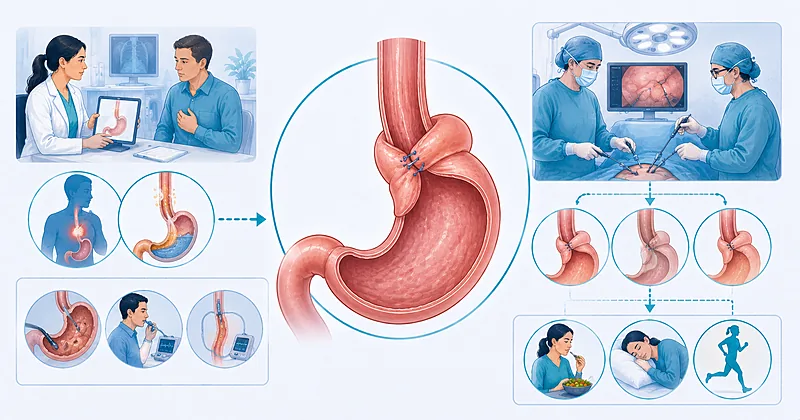
- 1Confirm pathological reflux with objective reflux testing before offering anti-reflux surgery to any patient without a large hernia or erosive disease.
- 2Obtain manometry in every case to exclude achalasia and major motility disorders that would make a wrap dangerous.
- 3Counsel that a PPV response to acid suppression predicts a good surgical result; refractory typical symptoms with normal testing predict a poor one.
- 4Choose a partial fundoplication when manometry shows weak peristalsis to lower the risk of long-term dysphagia.
- 5Close the crura and aim for at least 2–3 cm of tension-free intra-abdominal esophagus in every repair.
- 6Reserve magnetic sphincter augmentation for selected patients with preserved motility and smaller hernias as an alternative to fundoplication.
- 7Evaluate for obesity, and consider a bariatric procedure rather than a wrap when BMI is high and reflux coexists.
- 8Set expectations that some patients resume acid-suppression therapy over time even after a technically sound operation.
Who Is a Candidate for Anti-Reflux Surgery
Patient selection is where anti-reflux surgery succeeds or fails. The strongest candidates fall into a few recognisable groups: those who respond to acid suppression but want freedom from lifelong medication, those with volume regurgitation that drugs cannot fix, those with a large or symptomatic hiatal hernia, and those with erosive disease or complications despite therapy.
Refer for surgical evaluation when a patient has well-documented GERD and either a partial or complete response to proton pump inhibitors but wishes to stop long-term medication, or has a large hiatal hernia driving symptoms.
Strong Rec High Evidence SAGES 2021Prescribe surgery as the preferred option for troublesome regurgitation that persists despite optimised medical therapy, since acid suppression does little for the volume reflux that drives it.
Strong Rec Moderate Evidence SAGES 2021 ICARUS 2020Consider surgery in patients with extra-esophageal symptoms such as chronic cough or laryngitis only when objective testing proves reflux and other causes have been excluded, and counsel that response is less predictable.
Conditional Rec Low Evidence ACG 2022The Preoperative Workup Before Anti-Reflux Surgery
A complete workup protects the patient from an operation they do not need and protects the surgeon from a wrap placed over an undiagnosed motility disorder. Four investigations form the backbone: endoscopy, objective reflux monitoring, manometry, and a contrast study or anatomic assessment of the hernia.
Perform upper endoscopy in every candidate to document esophagitis grade, assess for Barrett’s metaplasia, measure the hernia, and rule out malignancy before committing to an operation.
Strong Rec High Evidence SAGES 2021Obtain ambulatory reflux monitoring off therapy when there is no large hernia and no severe erosive esophagitis, because a normal study should usually halt the plan for surgery.
Strong Rec High Evidence ACG 2022 ICARUS 2020Perform high-resolution manometry in all patients before anti-reflux surgery to exclude achalasia and major motility disorders and to characterise peristaltic strength, which directly informs the choice of wrap.
Strong Rec Moderate Evidence SAGES 2021 ICARUS 2020Evaluate hernia anatomy with a barium esophagram or cross-sectional imaging when a paraesophageal or large hernia is suspected, to plan dissection and anticipate the need for esophageal lengthening.
Moderate Rec Low Evidence SAGES 2021Choosing the Fundoplication in Anti-Reflux Surgery
The central technical decision in anti-reflux surgery is how far to wrap the fundus around the esophagus. A complete 360-degree Nissen offers the most durable reflux control; partial wraps trade a little reflux control for fewer swallowing problems. Motility, patient priorities, and surgeon experience guide the choice.
Perform a laparoscopic approach as the standard of care for primary anti-reflux surgery, since it delivers equivalent reflux control to the open operation with less pain and faster recovery.
Strong Rec High Evidence SAGES 2021Prescribe a partial fundoplication (anterior or posterior) over a complete wrap when manometry demonstrates significantly weak or ineffective peristalsis, to reduce the risk of persistent postoperative dysphagia.
Moderate Rec Moderate Evidence SAGES 2021Construct a short, floppy wrap of roughly 2 cm over a bougie when performing a complete fundoplication, dividing the short gastric vessels as needed so the wrap sits without tension.
Strong Rec Moderate Evidence SAGES 2021 ICARUS 2020Consider magnetic sphincter augmentation as an alternative to fundoplication in patients with preserved esophageal motility and a hernia smaller than 3 cm who wish to avoid the gas-bloat profile of a wrap.
Conditional Rec Moderate Evidence SAGES 2021Do not select a complete Nissen wrap in a patient with confirmed absent peristalsis, because the obstruction added by a full wrap will not be cleared by a non-propulsive esophagus.
Against Moderate Evidence ICARUS 2020Fundoplication Options: A Wrap-by-Wrap Guide
| Wrap Type | Wrap Geometry | Best Suited For | Trade-Off to Counsel |
|---|---|---|---|
| Nissen | 360° complete | Normal motility, reflux control the priority | Most gas-bloat and early dysphagia; usually settles by 3 months |
| Toupet | 270° posterior partial | Weak or ineffective peristalsis | Slightly higher long-term reflux recurrence than Nissen |
| Dor | 180–200° anterior partial | Adjunct after myotomy; very poor motility | Weakest reflux barrier of the wraps |
| Magnetic augmentation | Bead ring at the GEJ | Preserved motility, hernia under 3 cm | Early dysphagia; device-related reoperation in a minority |
Technical Principles of a Durable Repair
Whatever wrap is chosen, the same handful of technical steps separate a durable repair from one that recurs. These are the steps the major guidelines and consensus statements return to again and again.
Perform complete mediastinal dissection of the hernia sac and mobilise the esophagus to secure at least 2–3 cm of tension-free intra-abdominal length before constructing the wrap.
Strong Rec Moderate Evidence SAGES 2021 ICARUS 2020Consider a Collis gastroplasty to lengthen the esophagus when adequate mobilisation still leaves the gastroesophageal junction under tension above the hiatus, particularly in long-standing large hernias.
Conditional Rec Low Evidence SAGES 2021Close the crura primarily with non-absorbable sutures, and reserve mesh reinforcement for selected large hiatal defects where the surgeon judges primary closure to be under excessive tension.
Moderate Rec Low Evidence SAGES 2021 ICARUS 2020Refer patients to a high-volume foregut surgeon or centre for reoperative anti-reflux surgery, where the dissection is harder and the complication profile is materially higher.
Strong Rec Moderate Evidence ICARUS 2020Clinical Decision Pathway
A practical, question-based route from the GERD clinic to a chosen operation. Work through the questions in order before committing to a wrap.
Outcomes and What to Tell the Patient
Honest counselling about likely results is part of good selection. The table below frames the conversation around the questions patients actually ask, drawing on long-term trial and registry data rather than any single source’s figures.
| Patient Question | What the Evidence Suggests | Honest Caveat |
|---|---|---|
| Will my heartburn go away? | Most well-selected patients have good symptom control in the early years | Control can erode over a decade; some symptoms return |
| Can I stop my medication? | Many patients come off PPIs after surgery | A meaningful minority resume acid suppression over time |
| Will I have trouble swallowing? | Early dysphagia is common and usually transient | A small group needs dilation or, rarely, revision |
| Will I be bloated or unable to burp? | Gas-bloat and reduced belching are recognised after complete wraps | Partial wraps and device options reduce but do not eliminate this |
| Could it come back? | Most repairs remain durable for years | Recurrent hernia is the leading reason for reoperation |
Monitoring and Follow-Up
| Parameter | When to Assess | What to Look For | Common Pitfalls |
|---|---|---|---|
| Diet progression | First 2–6 weeks | Tolerance of soft then solid diet | Advancing diet too fast and alarming the patient with early dysphagia |
| Dysphagia | 6–12 weeks | Should be resolving; persistent dysphagia needs evaluation | Intervening too early — most early dysphagia settles without action |
| Recurrent reflux | Any time symptoms return | Re-investigate with endoscopy and pH/imaging before reoperating | Assuming wrap failure without objective re-testing |
| Barrett’s surveillance | Per pre-existing schedule | Continue surveillance — surgery does not remove the metaplasia | Stopping surveillance because the patient feels cured |
Evidence in Context
What the major trials and consensus statements show, where they align, and where they leave room for judgement.
Surgery Versus Long-Term Medication
The LOTUS trial randomised patients with chronic GERD to a laparoscopic wrap or maintenance esomeprazole. At five years, both strategies kept most patients in remission, with comparable overall control. Surgery excelled at regurgitation; medication avoided the wrap-specific side effects of dysphagia, bloating, and impaired belching. The take-home is that the choice is preference-sensitive, not a clear win for either.
Complete Versus Partial Fundoplication
Randomised comparisons of Nissen against Toupet consistently show similar reflux control with less dysphagia and gas-bloat after the partial wrap. SAGES frames partial wraps as the safer default when peristalsis is impaired, while accepting that a complete wrap may give marginally more durable reflux control in patients with normal motility.
Where SAGES and the ICARUS Consensus Align
Both stress objective confirmation of reflux before surgery, mandatory manometry, complete hiatal dissection with adequate intra-abdominal esophageal length, and tailoring the wrap to motility. ICARUS adds a strong emphasis on multidisciplinary assessment and on referral to experienced centres for complex and reoperative cases.
Magnetic Augmentation Versus Fundoplication
Comparative studies suggest magnetic sphincter augmentation gives reflux control broadly comparable to fundoplication in suitable anatomy, while preserving the ability to belch and vomit. The trade-off is a recognised rate of early dysphagia and a small but real risk of device-related reintervention. It remains an option for selected patients, not a wholesale replacement for the wrap.
References
- 1.Slater BJ, Dirks RC, McKinley SK, et al. SAGES guidelines for the surgical treatment of gastroesophageal reflux (GERD). Surg Endosc. 2021;35(9):4903–4917. doi:10.1007/s00464-021-08625-5
- 2.Pauwels A, Boecxstaens V, Andrews CN, et al. How to select patients for antireflux surgery? The ICARUS guidelines (international consensus regarding preoperative examinations and clinical characteristics assessment to select adult patients for antireflux surgery). Gut. 2019;68(11):1928–1941. doi:10.1136/gutjnl-2019-318260
- 3.Galmiche JP, Hatlebakk J, Attwood S, et al. Laparoscopic antireflux surgery vs esomeprazole treatment for chronic GERD: the LOTUS randomized clinical trial. JAMA. 2011;305(19):1969–1977. doi:10.1001/jama.2011.626
- 4.Katz PO, Dunbar KB, Schnoll-Sussman FH, et al. ACG Clinical Guideline for the Diagnosis and Management of Gastroesophageal Reflux Disease. Am J Gastroenterol. 2022;117(1):27–56. doi:10.14309/ajg.0000000000001538
How to Read the Evidence Tags
Every recommendation carries two tags — one for recommendation strength and one for evidence quality. These are Medaptly’s own simplified interpretations, not a reproduction of any guideline body’s grading system.
Recommendation Strength
| Tag | What It Means |
|---|---|
| Strong Rec | High-quality evidence broadly supports this action. |
| Moderate Rec | The weight of evidence favours this action. |
| Conditional Rec | The benefit is less certain — individualise. |
| Against | Evidence shows no benefit or potential harm. |
Evidence Quality
| Tag | What It Means |
|---|---|
| High Evidence | Multiple well-designed RCTs or high-quality meta-analyses. |
| Moderate Evidence | Single RCT or large observational studies. |
| Low Evidence | Expert consensus or small studies. |