
Esophageal Cancer Surgery: A Staging-to-Resection Guide
Clinical Practice Update — Clinical Staging, Multimodal Sequencing, and Operative Decision-Making
This is an original clinical education article informed by current guidelines and evidence. See References below for source documents.
- Clinical Focus
- Clinical staging and surgical management of resectable esophageal cancer in adults
- Target Audience
- Surgical oncologists, general surgeons, gastroenterologists, oncology trainees
- Setting
- Tertiary surgical centers, multidisciplinary tumor boards, upper GI units
- Source Evidence
- •NCCN Guidelines for Esophageal and Esophagogastric Junction Cancers (2024)
- •ESMO Clinical Practice Guidelines for Oesophageal Cancer (2022)
- •CROSS Trial — Neoadjuvant Chemoradiotherapy (NEJM, 2012; long-term follow-up Lancet Oncol, 2015)
- •FLOT4 Trial — Perioperative Chemotherapy in Adenocarcinoma (Lancet, 2019)
- •CheckMate 577 — Adjuvant Nivolumab (NEJM, 2021)
Key Clinical Takeaways
Successful esophageal cancer surgery begins long before the operating room: the quality of clinical staging dictates whether a patient is offered resection, neoadjuvant therapy, or definitive non-surgical treatment. The points below distill how accurate staging flows into operative decisions, drawn from current evidence and landmark trials.
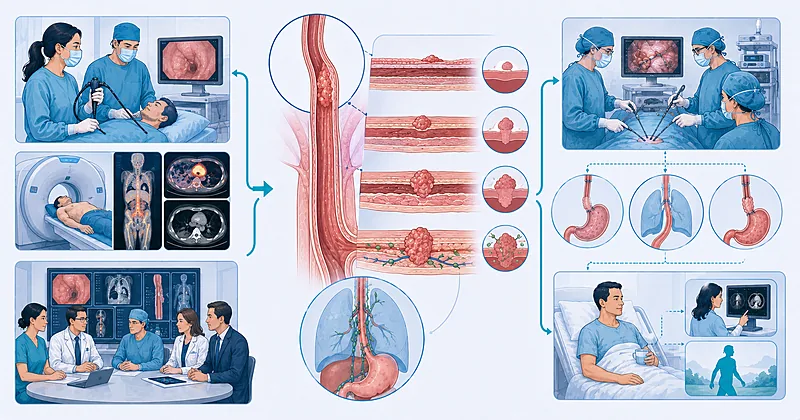
- 1Combine endoscopic ultrasound, PET-CT, and CT to establish clinical T and N category before any treatment decision in esophageal cancer surgery.
- 2Reserve upfront resection for early-stage disease (cT1a managed endoscopically; selected cT1b–cT2N0) where node involvement is unlikely.
- 3Offer neoadjuvant therapy for locally advanced resectable tumors (cT3, or node-positive) to improve R0 rates and survival.
- 4Match the operative approach to tumor location: transthoracic esophagectomy for mid/distal tumors needing a wide nodal harvest.
- 5Aim for a minimum of 15 examined lymph nodes to ensure adequate pathological staging and regional control.
- 6Refer every operative candidate to a high-volume center — mortality falls substantially with surgical volume.
- 7Consider adjuvant immunotherapy after neoadjuvant chemoradiotherapy plus resection when residual disease remains.
- 8Reassess fitness, nutrition, and response before proceeding to esophagectomy after neoadjuvant treatment.
Why Accurate Staging Drives Esophageal Cancer Surgery
Every downstream decision in esophageal cancer surgery rests on the precision of the initial workup. Understaging exposes a patient to a non-curative operation; overstaging denies a curable patient their best chance. The goal of staging is a confident assignment of depth of invasion, nodal burden, and the presence of distant spread.
Perform endoscopic ultrasound to define depth of tumor invasion and assess regional nodes whenever the tumor is not an obvious early mucosal lesion. EUS remains the most accurate tool for the T category.
Strong Rec Moderate Evidence NCCN 2024 ESMO 2022Obtain a PET-CT in all candidates for curative treatment to detect occult distant metastases that would change management. Up to one in six patients are upstaged by functional imaging.
Strong Rec Moderate Evidence NCCN 2024Perform diagnostic laparoscopy for distal esophageal and junctional adenocarcinomas to exclude peritoneal disease before committing to esophagectomy.
Moderate Rec Low Evidence ESMO 2022Document histology, location, and HER2 and PD-L1 status at diagnosis, since these biomarkers steer both neoadjuvant and adjuvant systemic therapy choices.
Strong Rec Moderate Evidence NCCN 2024Matching Stage to Treatment Intent
Once staging is complete, the tumor falls into one of four broad management buckets. The table below frames each by the clinical question a surgeon faces rather than by a staging body’s own categories.
| Clinical Scenario | Typical Depth & Nodes | Preferred Strategy | Surgical Decision Point |
|---|---|---|---|
| Superficial mucosal | cT1a, node-negative | Endoscopic resection (EMR/ESD) | Esophagectomy only if deep submucosal invasion or positive margins on specimen |
| Early invasive | cT1b–cT2, node-negative | Upfront surgery in fit patients | Proceed directly to esophagectomy with formal lymphadenectomy |
| Locally advanced | cT3 or any node-positive | Neoadjuvant therapy, then resection | Restage and reassess fitness before surgery 4–10 weeks after treatment |
| Borderline / T4 | cT4a (resectable) vs cT4b | Induction therapy; surgery only if downstaged | cT4b invasion of aorta, airway, or spine is a contraindication to resection |
Treat cT1a tumors confined to the mucosa with endoscopic resection rather than esophagectomy when the lesion is well differentiated and lymphovascular invasion is absent. Surgical morbidity is avoided with equivalent oncologic outcomes.
Strong Rec Moderate Evidence NCCN 2024 ESMO 2022Do not offer resection when imaging shows invasion of the aorta, tracheobronchial tree, or vertebral body. These unresectable T4b features mandate definitive chemoradiotherapy instead.
Against Moderate Evidence NCCN 2024Sequencing Therapy Around Esophageal Cancer Surgery
For locally advanced disease, the central question is no longer whether to give systemic therapy but which regimen and in what order relative to esophageal cancer surgery. Histology is the pivot: squamous and adenocarcinoma respond differently.
Initiate neoadjuvant chemoradiotherapy for resectable locally advanced esophageal cancer, particularly squamous cell carcinoma, to raise the rate of complete (R0) resection and improve overall survival.
Strong Rec High Evidence CROSS 2012 ESMO 2022Prescribe perioperative combination chemotherapy as a strong alternative for esophageal and junctional adenocarcinoma, given before and after resection. This approach has shown superior survival over older regimens in adenocarcinoma.
Strong Rec High Evidence FLOT4 2019Consider adjuvant immunotherapy for one year in patients with residual pathologic disease after neoadjuvant chemoradiotherapy and R0 resection. Disease-free survival is meaningfully prolonged in this group.
Moderate Rec High Evidence CheckMate 577Schedule resection roughly 4 to 10 weeks after completing neoadjuvant chemoradiotherapy. Operating too early limits tumor regression; waiting too long risks fibrosis that complicates dissection.
Conditional Rec Low Evidence ESMO 2022Choosing the Right Operation
The operative approach is selected from tumor location, the need for nodal clearance, and patient physiology. The table contrasts the principal techniques by the trade-offs that actually drive the choice in theater.
| Technique | Best Suited Tumor Site | Nodal Access | Practical Trade-Off |
|---|---|---|---|
| Ivor Lewis (transthoracic) | Mid and distal third | Excellent abdominal and thoracic harvest | Intrathoracic anastomosis; leak is high-stakes but contained |
| McKeown (three-field) | Upper and mid third | Widest, includes cervical nodes | Cervical anastomosis; higher recurrent nerve injury risk |
| Transhiatal | Distal and junctional | Limited mediastinal access | Avoids thoracotomy; less complete nodal dissection |
| Minimally invasive / robotic | Most sites in expert hands | Comparable to open in skilled centers | Lower pulmonary morbidity; steep learning curve |
Perform a formal two-field lymphadenectomy and examine at least 15 nodes for accurate pathological staging and improved regional control. Higher node counts correlate with better staging accuracy.
Strong Rec Moderate Evidence NCCN 2024 ESMO 2022Refer patients to a high-volume esophagectomy center. Operative mortality and failure-to-rescue rates are consistently lower where annual case volume is high.
Strong Rec High Evidence NCCN 2024Consider a minimally invasive or robotic approach in experienced centers to reduce pulmonary complications and shorten recovery without compromising oncologic completeness.
Moderate Rec Moderate Evidence ESMO 2022Evaluate cardiopulmonary reserve and nutritional status before scheduling esophagectomy. Optimize anemia, sarcopenia, and smoking status during the neoadjuvant window.
Strong Rec Low Evidence ESMO 2022Clinical Decision Pathway
A practical, question-based route from a new diagnosis to a defined operative plan. Work through each question in order.
Monitoring and Follow-Up
Surveillance after resection balances early detection of recurrence against the burden of testing. The schedule below is framed around what each check is actually looking for.
| Parameter | When to Check | What to Look For | Common Pitfall |
|---|---|---|---|
| Anastomotic integrity | First 7–10 days post-op | Signs of anastomotic leak: tachycardia, sepsis, new arrhythmia | Attributing early tachycardia to pain alone |
| Nutrition & weight | Every visit, first 2 years | Ongoing weight loss, dumping, reflux | Discharging without dietitian follow-up |
| Clinical review | Every 3–6 months for 2 years | New dysphagia, pain, or weight change suggesting recurrence | Relying on imaging alone over symptom review |
| Cross-sectional imaging | Symptom-directed or per protocol | Locoregional or distant recurrence | Over-scanning asymptomatic, low-risk patients |
Evidence in Context
What the major trials established, where the guidelines align, and where genuine uncertainty remains.
Neoadjuvant Chemoradiotherapy: What CROSS Established
The CROSS trial demonstrated that adding chemoradiotherapy before surgery improved survival compared with surgery alone, with a particularly strong benefit in squamous cell carcinoma and high rates of complete resection. It cemented preoperative chemoradiotherapy as a standard for locally advanced disease.
Perioperative Chemotherapy in Adenocarcinoma
The FLOT4 trial showed that a modern perioperative chemotherapy regimen improved survival over an older standard in resectable gastric and junctional adenocarcinoma, reshaping how adenocarcinoma is sequenced around surgery.
Adjuvant Immunotherapy After Resection
CheckMate 577 found that adjuvant immune checkpoint inhibition roughly doubled disease-free survival in patients with residual pathologic disease after neoadjuvant chemoradiotherapy and R0 resection, introducing a postoperative role for immunotherapy.
Where Real Uncertainty Remains
The optimal neoadjuvant regimen for adenocarcinoma (chemoradiotherapy versus chemotherapy) and the safety of active surveillance after a clinical complete response are both areas of ongoing trials. These decisions are best individualized through a multidisciplinary team.
References
- 1.van Hagen P, Hulshof MCCM, van Lanschot JJB, et al. Preoperative chemoradiotherapy for esophageal or junctional cancer. N Engl J Med. 2012;366(22):2074–2084. doi:10.1056/NEJMoa1112088
- 2.Al-Batran SE, Homann N, Pauligk C, et al. Perioperative chemotherapy with fluorouracil plus leucovorin, oxaliplatin, and docetaxel versus fluorouracil or capecitabine plus cisplatin and epirubicin (FLOT4). Lancet. 2019;393(10184):1948–1957. doi:10.1016/S0140-6736(18)32557-1
- 3.Kelly RJ, Ajani JA, Kuzdzal J, et al. Adjuvant Nivolumab in Resected Esophageal or Gastroesophageal Junction Cancer. N Engl J Med. 2021;384(13):1191–1203. doi:10.1056/NEJMoa2032125
- 4.Obermannová R, Alsina M, Cervantes A, et al. Oesophageal cancer: ESMO Clinical Practice Guideline for diagnosis, treatment and follow-up. Ann Oncol. 2022;33(10):992–1004. doi:10.1016/j.annonc.2022.07.003
- 5.Shapiro J, van Lanschot JJB, Hulshof MCCM, et al. Neoadjuvant chemoradiotherapy plus surgery versus surgery alone for oesophageal or junctional cancer (CROSS): long-term results. Lancet Oncol. 2015;16(9):1090–1098. doi:10.1016/S1470-2045(15)00040-6
How to Read the Evidence Tags
Every recommendation carries a strength tag and an evidence-quality tag — Medaptly’s own simplified interpretation, not any guideline body’s classification system.
Recommendation Strength
| Tag | What It Means |
|---|---|
| Strong Rec | High-quality evidence broadly supports this action. |
| Moderate Rec | The weight of evidence favors this action. |
| Conditional Rec | The benefit is less certain — individualize. |
| Against | Evidence shows no benefit or potential harm. |
Evidence Quality
| Tag | What It Means |
|---|---|
| High Evidence | Multiple well-designed RCTs or high-quality meta-analyses. |
| Moderate Evidence | Single RCT or large observational studies. |
| Low Evidence | Expert consensus or small studies. |