
Statin Intolerance: Nocebo, Rechallenge, and Non-Statin Options
Separating drug-related symptoms from the expectation of harm — and what the evidence supports offering when intolerance is real.
One-Minute Takeaway
- Statin intolerance is reported by around 9% of patients (95% CI 8–10%), yet the strongest available evidence — meta-analyses of double-blind randomised trials — shows most attributed symptoms are not caused by the drug.
- In blinded n-of-1 trials (SAMSON, StatinWISE), muscle-symptom scores on a statin and on placebo were nearly identical, pointing to a large nocebo effect.
- Across 123,940 trial participants, only about 1 in 15 first-year muscle-symptom reports were actually due to the statin, with no excess after year one.
- A blinded rechallenge confirms reproducible intolerance in roughly 40% of previously intolerant patients (GAUSS-3), while about half restart a statin after an n-of-1 trial (SAMSON).
- For confirmed intolerance, bempedoic acid reduced major cardiovascular events (HR 0.87), and ezetimibe and PCSK9 inhibitors add evidence-based options.
The Clinical Problem in Statin Intolerance
Statins reduce atherosclerotic cardiovascular disease and are among the most extensively studied medicines in clinical practice. Despite this, a substantial proportion of patients discontinue them, most often citing muscle pain or weakness. The gap between proven benefit and real-world discontinuation defines the problem of statin intolerance.
How common is it? A 2022 meta-analysis of more than 4.1 million patients estimated an overall reported prevalence of 9.1% (95% CI 8.0–10.0%). Under recognised diagnostic definitions the figure was lower — around 7.0% (NLA), 6.7% (ILEP), and 5.9% (EAS).
The most revealing number in that analysis was the setting-based split. Prevalence in randomised controlled trials was 4.9% (95% CI 4.0–6.0%), against 17% (95% CI 14–19%) in observational cohort studies. That threefold gap is itself a clue to what is happening.
Blinded trials strip out expectation and reporting bias; observational reports do not. The discrepancy is explained largely by the nocebo effect — genuine symptoms driven by the anticipation of harm rather than the molecule. Serious statin myopathy, defined by creatine kinase above ten times the upper limit of normal, remains rare, at roughly 1 per 1,000 to 1 per 10,000 patients per year.
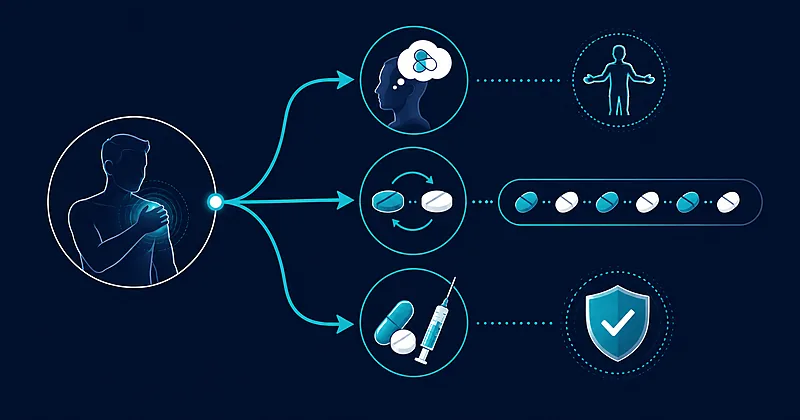
The stakes are high. Abandoning a statin forfeits durable cardiovascular protection in patients who often need it most. The clinical task, therefore, is twofold: distinguish true pharmacological intolerance from a nocebo response, and protect high-risk patients either way. Three approaches address this task.
Available Approaches to Statin Intolerance
The evidence base supports three complementary approaches: recognising and countering the nocebo effect, confirming true intolerance through a blinded n-of-1 rechallenge, and using non-statin lipid-lowering therapy for the minority with confirmed intolerance. The comparative evidence for each is summarised below, then examined in turn.
| Study / Source | Design | N | Population & focus | Key result |
|---|---|---|---|---|
| CTT Collaboration, 2022 | IPD meta-analysis of double-blind RCTs | 123,940 | Statin vs placebo; muscle symptoms | Year-1 muscle pain/weakness rate ratio 1.07 (95% CI 1.04–1.10); absolute excess 11 per 1,000 person-years (95% CI 6–16); no excess after year 1 (RR 0.99, 0.96–1.02) |
| Bytyçi et al., 2022 | Systematic review & meta-analysis | 4,143,517 | Prevalence of statin intolerance | Overall prevalence 9.1% (95% CI 8.0–10.0%); RCTs 4.9% (4.0–6.0%) vs cohorts 17% (14–19%) |
| SAMSON, 2021 | Blinded n-of-1 crossover (statin / placebo / no tablet) | 60 | Prior statin discontinuers; nocebo | Symptom score 16.3 (95% CI 13.0–19.6) statin vs 15.4 (12.1–18.7) placebo vs 8.0 (4.7–11.3) no tablet; no statin–placebo difference (P=0.39); nocebo ratio 0.90 |
| StatinWISE, 2021 | Series of blinded n-of-1 RCTs (atorvastatin 20 mg vs placebo) | 151 | Prior muscle symptoms on statins | Muscle-symptom score mean difference −0.11 (95% CI −0.36 to 0.14; P=0.40); two-thirds intended to restart a statin |
| GAUSS-3 (Phase A), 2016 | Blinded atorvastatin vs placebo rechallenge | 491 | History of intolerance to ≥2 statins | Symptoms on atorvastatin but not placebo in 42.6% (209/491), confirming reproducible intolerance in a substantial minority |
| GAUSS-3 (Phase B), 2016 | RCT, evolocumab vs ezetimibe | 218 | Confirmed statin intolerance; LDL lowering | LDL-C change −54.5% (95% CI −57.2 to −51.8) with evolocumab vs −16.7% (−20.5 to −12.9) with ezetimibe |
| CLEAR Outcomes, 2023 | Double-blind RCT (bempedoic acid 180 mg vs placebo) | 13,970 | Statin-intolerant patients; CV outcomes | 4-component MACE HR 0.87 (95% CI 0.79–0.96; P=0.004); myocardial infarction HR 0.77 (0.66–0.91); LDL-C lowered ~21% |
| IMPROVE-IT, 2015 | Double-blind RCT (ezetimibe + simvastatin vs simvastatin) | 18,144 | Post-acute coronary syndrome; CV outcomes | Primary composite at 7 years 32.7% vs 34.7%; HR 0.936 (95% CI 0.89–0.99; P=0.016) |
Approach 1 — Recognising the Nocebo Effect
The nocebo effect is the strongest single explanation for the trial-versus-observation gap. Two blinded n-of-1 trials tested it directly by having each patient alternate between a statin and placebo under blinding.
In SAMSON, 60 patients who had stopped statins because of side effects cycled through statin, placebo, and no-tablet months. Mean symptom score was 8.0 during no-tablet months (95% CI 4.7–11.3), 15.4 during placebo months (12.1–18.7), and 16.3 during statin months (13.0–19.6). Symptom burden on the statin and on placebo did not differ (P=0.39).
The pooled nocebo ratio was 0.90, meaning about 90% of the symptom burden experienced on a statin was reproduced by an identical placebo. StatinWISE, a series of n-of-1 trials in 151 participants, reached the same conclusion: the mean muscle-symptom difference between atorvastatin and placebo was −0.11 (95% CI −0.36 to 0.14; P=0.40).
Clinical pearl. These symptoms are real, but the evidence indicates they are largely not pharmacological. Framing the nocebo effect for patients is therapeutic in itself — in SAMSON, half of participants restarted a statin after seeing that placebo produced the same symptoms.
Approach 2 — The Blinded N-of-1 Rechallenge
Population-level trials cannot tell an individual whether their symptoms track the drug. The n-of-1 design can: the patient serves as their own control, blinded, across alternating statin and placebo periods. This mirrors ordinary clinical rechallenge but removes expectation as a confounder.
GAUSS-3 formalised this. In its blinded rechallenge phase, 491 patients with a history of intolerance to two or more statins received atorvastatin and placebo in random order. Muscle symptoms occurred on atorvastatin but not placebo in 42.6% (209/491) — reproducible, drug-linked intolerance in a substantial minority.
The same phase showed how much perception contributes: a further group reported symptoms on placebo but not the statin, and a smaller group on both. A structured rechallenge therefore sorts patients efficiently. Many resume a statin; the confirmed minority proceed to alternatives with a documented basis.
Approach 3 — Non-Statin Lipid-Lowering Therapy
For patients with confirmed intolerance, several non-statin therapies lower LDL cholesterol, and some carry cardiovascular outcome evidence.
Ezetimibe blocks intestinal cholesterol absorption. In IMPROVE-IT, adding ezetimibe to simvastatin after acute coronary syndrome reduced the primary composite endpoint over seven years (32.7% vs 34.7%; HR 0.936, 95% CI 0.89–0.99). LDL lowering was modest, the outcome benefit was real, and prespecified muscle events were similar to control.
Bempedoic acid inhibits ATP-citrate lyase and is activated in the liver rather than skeletal muscle. CLEAR Outcomes randomised 13,970 statin-intolerant patients to bempedoic acid or placebo. It lowered LDL-C by about 21% and reduced four-component MACE (HR 0.87, 95% CI 0.79–0.96), driven by fewer myocardial infarctions (HR 0.77, 0.66–0.91).
This is the only cardiovascular outcome trial conducted specifically in statin-intolerant patients. Bempedoic acid did not reduce cardiovascular or all-cause mortality, and gout, cholelithiasis, and elevated hepatic enzymes were more frequent than with placebo.
PCSK9 inhibitors lower LDL cholesterol potently. In the GAUSS-3 comparison, evolocumab reduced LDL-C by 54.5% versus 16.7% with ezetimibe in patients with confirmed intolerance. These monoclonal antibodies are injectable and are reserved for higher LDL burdens or higher risk. Inclisiran, a small-interfering RNA given twice yearly, is a newer LDL-lowering option, though dedicated cardiovascular outcome data are still maturing.
Comparative Analysis
The three approaches are best read as a sequence rather than as competing alternatives. Recognising the nocebo effect comes first because it applies to most patients labelled intolerant. Rechallenge resolves the persistent cases. Non-statin therapy is reserved for the confirmed minority.
Before abandoning statins entirely, several within-class strategies allow many patients to tolerate some therapy: a lower dose, a different statin, or intermittent dosing. The prevalence data support this — complete, reproducible intolerance is far less common than the label suggests.
Among non-statin options, the evidence differs in both strength and relevance. Ezetimibe is oral, inexpensive, and outcome-proven, but only as an adjunct to a statin rather than in an intolerant population. Bempedoic acid is oral and, uniquely, was tested for hard outcomes in statin-intolerant patients — though without a mortality signal.
PCSK9 inhibitors achieve the largest LDL reductions and have strong outcome evidence in statin-treated populations, but were not tested for hard endpoints specifically in intolerant patients. The practical implication is that outcome certainty is highest where the trial enrolled the relevant population and where LDL lowering was greatest.
Quality and Consistency of the Evidence
Evidence quality varies by claim. The colour-coded assessment below rates the strength and consistency of the data supporting each approach.
- High — the nocebo contribution. SAMSON, StatinWISE, and the CTT meta-analysis converge: symptom scores on statin and placebo are close, and most reports are not drug-caused. Strong evidence supports a large nocebo component.
- High — bempedoic acid outcomes in intolerant patients. A single large, double-blind outcome trial (CLEAR Outcomes) showed a MACE reduction consistent with the LDL hypothesis. The main caveat is reliance on one trial.
- Moderate — rechallenge identifies true intolerance. GAUSS-3 Phase A demonstrates reproducible intolerance in about 40%, consistent with the n-of-1 data, though from a selected referral population.
- Moderate — ezetimibe outcome benefit. IMPROVE-IT is robust but tested ezetimibe as an add-on to a statin, not in intolerant patients.
- Indirect — PCSK9 inhibitor hard outcomes in intolerance. Outcome benefit is extrapolated from trials in statin-treated patients; in intolerant patients the direct evidence is for LDL lowering only.
What the Evidence Does Not Show
- It does not show that statins never cause symptoms. A real minority have reproducible, drug-linked intolerance (about 40% on blinded rechallenge in GAUSS-3), and the CTT analysis found a genuine, if small, first-year excess.
- It does not show that PCSK9 inhibitors reduce hard cardiovascular outcomes specifically in statin-intolerant patients; those outcome trials enrolled statin-treated patients.
- It does not establish long-term outcome benefit for every non-statin agent beyond an LDL surrogate — dedicated outcome data for inclisiran remain pending.
- It does not confirm that muscle cramps or spasms, as distinct from pain or weakness, are statin-related; the CTT analysis found no clear cramp signal.
- It does not yet define how best to embed blinded n-of-1 rechallenge in routine primary care; the trials show it works at the group and individual level, but implementation evidence is limited.
Practical Implications
The evidence supports treating a report of statin intolerance as the starting point for evaluation, not a final verdict. Most patients so labelled can tolerate some statin therapy once the nocebo effect is addressed.
Where symptoms persist, dose reduction, switching statin, or intermittent dosing are supported by the low rate of complete intolerance in blinded settings. Explaining that placebo reproduces most symptoms is a legitimate, evidence-based part of the conversation.
A blinded or otherwise structured rechallenge can distinguish reproducible intolerance from a nocebo response and gives any subsequent decision a documented basis. For confirmed intolerance, bempedoic acid has outcome evidence in exactly this population, while ezetimibe and PCSK9 inhibitors extend the options by LDL need and risk.
Because the cardiovascular stakes are high, shared decision-making and clear documentation matter throughout. The consistent message across the evidence is that the drug is safer, and intolerance less absolute, than reputation suggests.
Evidence Grade and Bottom Line
Overall grade: Moderate to High. The evidence for a large nocebo component and for bempedoic acid’s cardiovascular benefit in intolerant patients is strong. The evidence for rechallenge and for some non-statin outcome claims is moderate or indirect.
- Reported statin intolerance is common (~9%), but blinded trials show most attributed muscle symptoms are not caused by the drug.
- Only about 1 in 15 first-year muscle-symptom reports are genuinely statin-related, and no excess persists beyond the first year.
- A blinded n-of-1 rechallenge confirms reproducible intolerance in roughly 40% of previously intolerant patients and helps about half restart a statin.
- For confirmed intolerance, bempedoic acid reduced major cardiovascular events; ezetimibe and PCSK9 inhibitors provide additional evidence-based LDL lowering.
Article Information and References
- Cholesterol Treatment Trialists’ Collaboration. Effect of statin therapy on muscle symptoms: an individual participant data meta-analysis of large-scale, randomised, double-blind trials. Lancet. 2022;400(10355):832–845. DOI: https://doi.org/10.1016/S0140-6736(22)01545-8
- Bytyçi I, Penson PE, Mikhailidis DP, et al. Prevalence of statin intolerance: a meta-analysis. Eur Heart J. 2022;43(34):3213–3223. DOI: https://doi.org/10.1093/eurheartj/ehac015
- Stroes ES, Thompson PD, Corsini A, et al; European Atherosclerosis Society Consensus Panel. Statin-associated muscle symptoms: impact on statin therapy—European Atherosclerosis Society Consensus Panel Statement on Assessment, Aetiology and Management. Eur Heart J. 2015;36(17):1012–1022. DOI: https://doi.org/10.1093/eurheartj/ehv043
- Howard JP, Wood FA, Finegold JA, et al. Side effect patterns in a crossover trial of statin, placebo, and no treatment (SAMSON). J Am Coll Cardiol. 2021;78(12):1210–1222. DOI: https://doi.org/10.1016/j.jacc.2021.07.022
- Herrett E, Williamson E, Brack K, et al; StatinWISE Trial Group. Statin treatment and muscle symptoms: series of randomised, placebo controlled n-of-1 trials. BMJ. 2021;372:n135. DOI: https://doi.org/10.1136/bmj.n135
- Nissen SE, Stroes E, Dent-Acosta RE, et al; GAUSS-3 Investigators. Efficacy and tolerability of evolocumab vs ezetimibe in patients with muscle-related statin intolerance: the GAUSS-3 randomized clinical trial. JAMA. 2016;315(15):1580–1590. DOI: https://doi.org/10.1001/jama.2016.3608
- Nissen SE, Lincoff AM, Brennan D, et al; CLEAR Outcomes Investigators. Bempedoic acid and cardiovascular outcomes in statin-intolerant patients. N Engl J Med. 2023;388(15):1353–1364. DOI: https://doi.org/10.1056/NEJMoa2215024
- Cannon CP, Blazing MA, Giugliano RP, et al; IMPROVE-IT Investigators. Ezetimibe added to statin therapy after acute coronary syndromes. N Engl J Med. 2015;372(25):2387–2397. DOI: https://doi.org/10.1056/NEJMoa1410489