
Subclinical Hypothyroidism: 6 Key Practice Considerations
The TRUST trial reshaped who should start thyroid hormone — and the honest answer is far fewer patients than a raised TSH alone would suggest.
One-Minute Takeaway
- For most adults with subclinical hypothyroidism, high-quality randomized trials show that levothyroxine does not improve symptoms, tiredness, or quality of life.
- The TRUST trial, in adults 65 and older, found levothyroxine no better than placebo for hypothyroid symptoms or tiredness at one year.
- A meta-analysis of 21 trials in 2,192 adults confirmed the same absence of benefit for quality of life and thyroid-related symptoms.
- Even adults 80 and older, and the most symptomatic patients, showed no measurable improvement once treated.
- Levothyroxine still deserves consideration mainly at a TSH of 10 or above, in pregnancy or preconception, or when TSH exceeds 20.
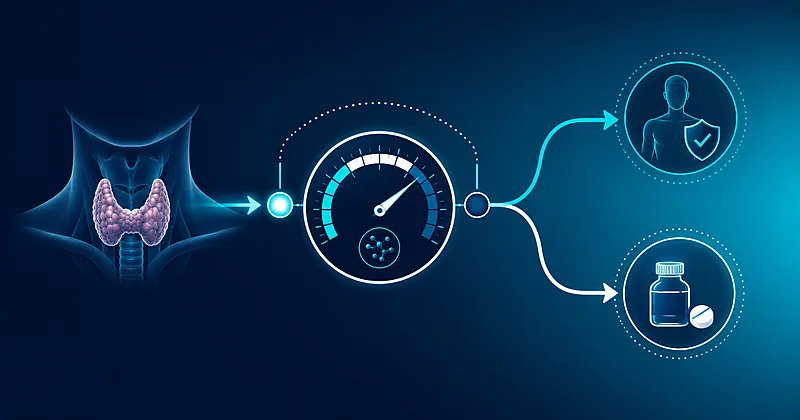
Why Subclinical Hypothyroidism Matters
Subclinical hypothyroidism is a biochemical diagnosis: a serum thyrotropin (TSH) level above the reference range while free thyroxine stays normal. It is common, affecting up to roughly 10% of adults, and it grows more frequent with age. Most people who carry the label have only a mildly elevated TSH, between 4 and 10 mIU/L.
Age itself complicates the picture. Serum TSH drifts upward in healthy older people, so a value that looks abnormal on one test may simply reflect normal ageing. This likely inflates the apparent prevalence of subclinical hypothyroidism in adults older than 70. A meaningful share of cases also return to normal on repeat testing, without any treatment.
The clinical pull toward treatment comes from two places. Patients often report nonspecific complaints — fatigue, low mood, weight gain — that seem to fit an underactive thyroid. And large cohort studies have linked higher TSH values to cardiovascular risk, which raises the worry that leaving the number uncorrected causes harm.
That cardiovascular signal is concentrated at the top of the range. In pooled cohort data, subclinical hypothyroidism was associated with more coronary heart disease events once TSH reached 10 mIU/L or higher, with no clear excess at the milder elevations that make up most cases. Association, though, is not the same as a treatment benefit.
This sets up the question this review addresses: does correcting the number with levothyroxine actually help patients feel better or live longer, and if so, which patients? An elevated lab value predicting future risk does not guarantee that treatment removes that risk. Answering the question needs randomized trials — and since 2017, those trials have finally arrived.
What the Guideline Recommends for Subclinical Hypothyroidism
In 2019, an international guideline panel published a BMJ Rapid Recommendation that broke with decades of threshold-based practice. For adults with subclinical hypothyroidism, it issued a strong recommendation against routinely starting thyroid hormones. The advice holds whether or not patients report mild-to-moderate symptoms.
The recommendation covers adults whose TSH is elevated but below 20 mIU/L, with a normal free thyroxine level confirmed on at least two measurements. That range captures the large majority of people who receive this diagnosis in everyday practice.
The panel was explicit about who falls outside the advice. It does not apply to women who are pregnant or trying to conceive, nor to patients with a TSH above 20 mIU/L, a level that points toward overt disease. It may also not apply to people with severe symptoms, or to very young adults, such as those aged 30 or younger.
This was a marked shift. Earlier European Thyroid Association guidance recommended levothyroxine even for symptom-free younger patients once TSH exceeded 10 mIU/L, plus a treatment trial for symptomatic younger patients below that level. The newer recommendation reflects what happened when those long-standing assumptions were finally tested in large trials.
An elevated TSH on its own — especially a mild one — is not a reason to prescribe. Confirm that it persists, look for a genuine cause, and reserve treatment for the defined situations where a rationale still holds.
Evidence Reviewed
The recommendation rests on a consistent body of randomized evidence assembled over more than a decade, alongside cohort data that clarifies who is actually at risk. The table below summarises the trials and analyses that anchor current practice. Every figure was drawn from the primary report.
| Study / Source | Design | N | Population | Key result | Grade |
|---|---|---|---|---|---|
| Feller 2018 | Systematic review & meta-analysis (21 RCTs) | 2,192 | Nonpregnant adults with SCH (ages 32–74) | No quality-of-life benefit (SMD −0.11; 95% CI −0.25 to 0.03); no symptom benefit (SMD 0.01; 95% CI −0.12 to 0.14) | [V] |
| TRUST — Stott 2017 | Double-blind RCT | 737 | Adults ≥65; TSH 4.6–19.99 | No change in hypothyroid symptoms (difference 0.0; 95% CI −2.0 to 2.1) or tiredness (0.4; 95% CI −2.1 to 2.9) at 1 year (MCID 9 points) | [V] |
| IEMO / TRUST ≥80 — Mooijaart 2019 | Prospectively pooled RCT data | 251 | Adults ≥80 (mean age 85) with SCH | No symptom improvement (1.3; 95% CI −2.7 to 5.2) or tiredness change (−0.1; 95% CI −4.5 to 4.3) | [V] |
| TRUST symptomatic subgroup — de Montmollin 2020 | RCT secondary analysis | 638 (high-symptom n=132) | Older adults with high baseline symptom burden | No benefit even in the most symptomatic (hypothyroid symptoms −2.0; 95% CI −5.5 to 1.5) | [V] |
| Birmingham Elderly Thyroid — Parle 2010 | Double-blind RCT | 94 | Community-dwelling adults ≥65 | No cognitive benefit; MMSE 28.3 vs 28.3 at 12 months (no significant between-group difference) | [V] |
| Thyroid Studies Collaboration — Rodondi 2010 | Individual-participant data, 9 prospective cohorts (prognostic) | 55,287 (3,450 with SCH) | General adult populations | Risk marker, not a treatment effect: coronary events HR 1.89 (95% CI 1.28 to 2.80) at TSH 10–19.9 vs normal | [V] |
All values are between-group differences unless labelled SMD; each score’s sign follows its own direction (higher = more symptoms). DOIs for every row appear under References and were confirmed to resolve. Rows 2–4 share overlapping TRUST participants, so they corroborate rather than independently replicate one another; row 6 is prognostic cohort data, included to show who carries elevated risk rather than who benefits from treatment.
Key Changes and Their Basis
From treating the number to treating the patient
For years, management keyed off the TSH value: cross a threshold, start levothyroxine. TRUST tested that logic head-on. In 737 adults aged 65 and older, one year of levothyroxine, titrated to lower TSH, produced no improvement in the two primary outcomes over placebo.
The effects were not merely small — they sat essentially at zero and well short of the predefined clinically important difference of 9 points. The 2018 meta-analysis then pooled 21 trials and reached the same conclusion across quality of life, thyroid-related symptoms, mood, and body mass index. The guidance followed the data.
Age does not rescue the case for treatment
A reasonable hope was that the oldest patients, or those with the most comorbidity, might respond differently. The pooled IEMO and TRUST analysis focused specifically on adults aged 80 and over. Across 251 participants with a mean age of 85, levothyroxine again produced no improvement in hypothyroid symptoms or tiredness.
Adverse events were balanced between groups, offering no reassuring signal that the oldest patients gained something the wider trial missed. If anything, the case for withholding treatment is strongest here, where the burden of lifelong medication and interactions weighs most heavily.
Symptoms do not identify responders
Perhaps the trials diluted a real effect by enrolling many people without symptoms. A secondary analysis tested exactly that, isolating older adults with the highest baseline symptom burden. Even in this group, levothyroxine did not outperform placebo, and baseline symptom severity did not modify the treatment effect.
Cognition told the same story. In the Birmingham Elderly Thyroid trial, thyroxine produced no gain on the Mini-Mental State Examination or other cognitive measures at 12 months. Taken together, the common clinical instinct — give a symptomatic older patient a trial of therapy — is not supported for this population.
Where treatment still has a rationale
The trials that drive the “do not treat” message enrolled mostly people with a mildly raised TSH, and by design excluded pregnant women. So the null result is strongest precisely where the trials looked, and thinner where they did not. Four situations still carry a defensible rationale for treatment.
A TSH of 10 mIU/L or higher is the clearest. Cohort data associate this range with elevated cardiovascular risk, and randomized trials barely enrolled it, so many clinicians still treat here — particularly younger patients — while acknowledging that trial evidence of symptom benefit at this level is limited.
Pregnancy and preconception sit outside the recommendation entirely, because fertility and obstetric outcomes are governed by separate evidence and specialist guidance. A TSH above 20 mIU/L points toward overt disease rather than the subclinical state. And a very young, clearly symptomatic adult warrants individual assessment rather than a blanket rule.
“No benefit” is best evidenced in the exact group the trials studied: older adults with a mild TSH elevation and vague symptoms. It is weakest where trials were sparse — TSH of 10 or above, pregnancy, and the very young — which is why those remain the places to still consider levothyroxine.
Quality and Consistency of the Evidence
The signal is unusually consistent for a contested topic. Independent randomized trials, a meta-analysis judged moderate-to-high quality, and prespecified secondary analyses all point the same way for the populations studied. The main limits are short follow-up, few hard outcomes, and the overlap of TRUST participants across several of the analyses.
- Symptoms and quality of life, older adults with mild elevation — High. Consistent null across trials and a moderate-to-high GRADE meta-analysis.
- Symptoms in the oldest and most symptomatic — Moderate to high. Smaller samples, but the pooled and subgroup analyses concur with the main result.
- Cognition and fatigue — Moderate. Consistent null, but individual trials such as Parle 2010 (n=94) were modest in size.
- Cardiovascular events and mortality with treatment — Low. Few events and short follow-up; possible harms, including a mortality signal, could not be excluded.
- Benefit at TSH ≥10, in pregnancy, or in the very young — Insufficient. These groups were barely enrolled or excluded, so conclusions are indirect.
Two housekeeping points support confidence in the trials. Funding came from public bodies rather than industry, although study drug was supplied at no charge, and no preprints were relied upon. The consistency across separately conducted studies is what gives the recommendation its weight.
What the Evidence Does Not Show
The trials answer the common case well but leave real gaps.
They do not show whether treating a TSH of 10 mIU/L or higher reduces cardiovascular events. That is the range where risk appears to rise, yet it was barely represented in the randomized data, so the benefit is inferred rather than demonstrated.
They do not show whether levothyroxine helps women who are pregnant or planning pregnancy, because these women were excluded and are addressed by separate obstetric evidence. Nor do they show whether clearly symptomatic adults aged 30 or younger benefit, since this group was under-represented.
Finally, they do not show whether longer treatment, beyond the one to three years studied, changes outcomes, and they identify no symptom pattern or biomarker that reliably picks out a responsive minority. Where those gaps exist, current advice reflects an absence of evidence rather than evidence of absence.
Practical Implications
The evidence supports a more selective, confirmation-first approach. The considerations below frame what the data reasonably supports; they inform clinical judgement and patient preference rather than replace them.
- Confirm before you commit. Repeat TSH and free thyroxine after two to three months before settling on the diagnosis; a single result overcalls it, and a meaningful share normalizes on retesting.
- In older adults, do not start levothyroxine for tiredness or borderline numbers. The randomized evidence shows no benefit for symptoms, quality of life, or cognition in this group.
- When TSH is mildly elevated with nonspecific symptoms, look elsewhere for the cause. A levothyroxine trial rarely changes how these patients feel, and it commits them to lifelong therapy and monitoring.
- Treatment remains reasonable at a TSH of 10 or above, especially in younger patients. The rationale is cardiovascular risk, tempered by honesty that trial evidence of symptom benefit at this level is limited.
- Handle pregnancy, preconception, and TSH above 20 separately. These sit outside the “do not treat” advice and belong to obstetric and overt-hypothyroidism pathways.
- Revisit existing prescriptions. For patients already taking levothyroxine for mild subclinical hypothyroidism without clear benefit, a monitored trial of dose reduction or withdrawal is a reasonable option.
Evidence Grade and Bottom Line
For the typical patient with mild subclinical hypothyroidism, the evidence of no symptom or quality-of-life benefit is strong, graded moderate to high. For treatment benefit at a TSH of 10 or above, in pregnancy, or in the very young, the evidence is insufficient and largely indirect.
- For the common presentation — an older adult with a mildly raised TSH and vague symptoms — levothyroxine is unlikely to help, and current guidance recommends against starting it.
- The strongest remaining case for treatment is a narrow one: a TSH of 10 or above (particularly in younger patients), pregnancy or preconception, a TSH above 20, or clear progression toward overt disease.
- Confirming that the abnormality persists, and reconsidering prescriptions that are not helping, can spare many patients unnecessary lifelong medication.
Article Information and References
- Feller M, Snel M, Moutzouri E, et al. Association of thyroid hormone therapy with quality of life and thyroid-related symptoms in patients with subclinical hypothyroidism: a systematic review and meta-analysis. JAMA. 2018;320(13):1349–1359. DOI: https://doi.org/10.1001/jama.2018.13770
- Stott DJ, Rodondi N, Kearney PM, et al. Thyroid hormone therapy for older adults with subclinical hypothyroidism. N Engl J Med. 2017;376(26):2534–2544. DOI: https://doi.org/10.1056/NEJMoa1603825
- Mooijaart SP, Du Puy RS, Stott DJ, et al. Association between levothyroxine treatment and thyroid-related symptoms among adults aged 80 years and older with subclinical hypothyroidism. JAMA. 2019;322(20):1977–1986. DOI: https://doi.org/10.1001/jama.2019.17274
- de Montmollin M, Feller M, Beglinger S, et al. L-thyroxine therapy for older adults with subclinical hypothyroidism and hypothyroid symptoms: secondary analysis of a randomized trial. Ann Intern Med. 2020;172(11):709–716. DOI: https://doi.org/10.7326/M19-3193
- Parle J, Roberts L, Wilson S, et al. A randomized controlled trial of the effect of thyroxine replacement on cognitive function in community-living elderly subjects with subclinical hypothyroidism: the Birmingham Elderly Thyroid study. J Clin Endocrinol Metab. 2010;95(8):3623–3632. DOI: https://doi.org/10.1210/jc.2009-2571
- Rodondi N, den Elzen WPJ, Bauer DC, et al; Thyroid Studies Collaboration. Subclinical hypothyroidism and the risk of coronary heart disease and mortality. JAMA. 2010;304(12):1365–1374. DOI: https://doi.org/10.1001/jama.2010.1361
- Bekkering GE, Agoritsas T, Lytvyn L, et al. Thyroid hormones treatment for subclinical hypothyroidism: a clinical practice guideline. BMJ. 2019;365:l2006. DOI: https://doi.org/10.1136/bmj.l2006
- Pearce SH, Brabant G, Duntas LH, et al. 2013 ETA guideline: management of subclinical hypothyroidism. Eur Thyroid J. 2013;2(4):215–228. DOI: https://doi.org/10.1159/000356507
- Biondi B, Cappola AR, Cooper DS. Subclinical hypothyroidism: a review. JAMA. 2019;322(2):153–160. DOI: https://doi.org/10.1001/jama.2019.9052
- Peeters RP. Subclinical hypothyroidism. N Engl J Med. 2017;376(26):2556–2565. DOI: https://doi.org/10.1056/NEJMcp1611144
- Floriani C, Gencer B, Collet TH, Rodondi N. Subclinical thyroid dysfunction and cardiovascular diseases: 2016 update. Eur Heart J. 2018;39(7):503–507. DOI: https://doi.org/10.1093/eurheartj/ehx050
Specialty: Internal Medicine · Content type: Evidence Review · Format: Original evidence synthesis (literature review).