
Triple Agonists: Major Effects on 5 Outcomes
Retatrutide has cleared its first phase 3 hurdles, yet the numbers driving the headlines remain unpublished — and nothing in this class can be prescribed.
One-Minute Takeaway
- Triple agonists engage the GIP, GLP-1 and glucagon receptors in one molecule. The best evidence is randomised and placebo-controlled: retatrutide 12 mg cut weight by 24.2% at 48 weeks in phase 2, against 2.1% on placebo.
- In the first published phase 3 trial of any triple agonist, HbA1c fell 1.94 percentage points at 40 weeks in early type 2 diabetes, against 0.81 on placebo.
- Liver fat fell 82.4% at 24 weeks in a phase 2a substudy of 98 adults with steatotic liver disease.
- The larger obesity figures now circulating come from a congress presentation and sponsor releases, not peer-reviewed papers.
- No triple agonists are approved anywhere. The ACP’s 2026 living guideline still places semaglutide and tirzepatide first-line.
Why Triple Agonists Matter
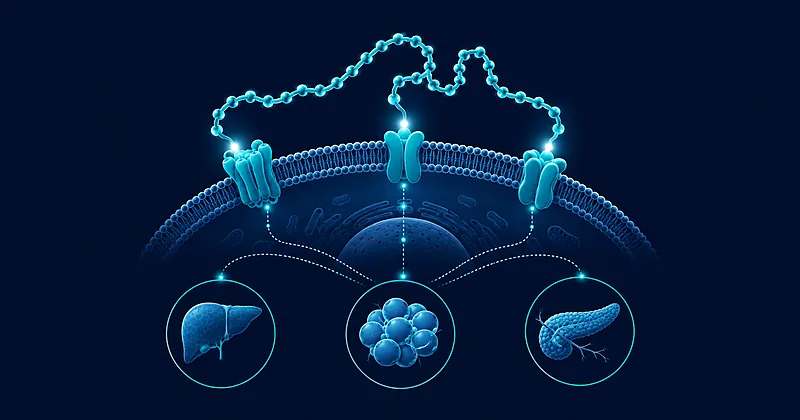
Obesity pharmacotherapy has advanced by adding receptors. Semaglutide engages GLP-1 alone, and tirzepatide adds GIP. Triple agonists add a third target, the glucagon receptor, inside a single once-weekly peptide.
The rationale is mechanistic rather than incremental. Incretin agonism suppresses appetite and slows gastric emptying. Glucagon receptor agonism is thought to raise energy expenditure and mobilise hepatic lipid, as Goldney and colleagues set out in their review of the class.
The counter-intuitive part is that glucagon raises glucose. Pairing it with two incretin agonists is what allows triple agonists to lower HbA1c while adding a thermogenic arm. That balance is the design premise, which is why glycaemic safety and tolerability deserve scrutiny rather than assumption.
Moiz and colleagues reviewed 26 randomised trials of GLP-1 receptor agonists and co-agonists in adults with overweight or obesity and without diabetes. Across 15,491 participants, retatrutide produced the largest placebo-adjusted weight reduction of the twelve agents assessed.
-
Placebo-adjusted weight loss reported by the Annals review
- Retatrutide 12 mg, 48 weeks22.1% (95% CI 19.3–24.9)
- Tirzepatide 15 mg, 72 weeks17.8% (95% CI 16.3–19.3)
- Semaglutide 2.4 mg, 68 weeks13.9% (95% CI 11.0–16.7)
- Liraglutide 3.0 mg, 26 weeks5.8% (95% CI 3.6–8.0)
That review carries a caveat that matters for how triple agonists are discussed. No head-to-head trials existed, so the ranking rests on placebo-anchored comparisons drawn from different trials and populations. Cross-trial ranking is a hypothesis, not a result.
For internal medicine the practical context is set by the American College of Physicians. Its April 2026 living guideline conditionally recommends semaglutide and tirzepatide first-line for adults with obesity, on moderate-certainty evidence. Triple agonists appear nowhere in it, because none is approved.
That gap between public expectation and prescribable reality is the reason this review is organised around what remains unknown. Interest in triple agonists is running well ahead of the published evidence.
Evidence Reviewed
The table below is restricted to peer-reviewed sources with a resolving DOI and a verified sample size. Every figure in it was checked against the source publication.
Three widely reported datasets on triple agonists are deliberately absent: the TRIUMPH-1 obesity trial, the TRIUMPH-4 knee osteoarthritis trial, and the UBT251 phase 2 trial. All three exist only as sponsor toplines or congress slides, so they are discussed below and graded accordingly.
| Study / Source | Design | N | Population | Comparison | Key result |
|---|---|---|---|---|---|
| Moiz 2025 Ann Intern Med | Systematic review, 26 RCTs | 15,491 | Overweight or obesity, without diabetes | 12 GLP-1 receptor agonists and co-agonists vs placebo | Largest weight reduction of any agent reviewed: retatrutide 12 mg, up to 22.1% vs placebo (95% CI 19.3% to 24.9%) at 48 weeks. No head-to-head trials were available to rank agents directly. |
| Pasqualotto 2024 Metabol Open | Meta-analysis, 3 RCTs | 640 (510 on drug) | Overweight, obesity and/or type 2 diabetes | Retatrutide vs placebo | Weight WMD −10.66 kg (95% CI −17.63 to −3.69). Loss of ≥15%: RR 18.40 (95% CI 6.00 to 56.42). |
| Bajaj 2026 TRANSCEND-T2D-1 Lancet | Phase 3 RCT, 40 weeks | 537 | Type 2 diabetes on diet and exercise alone; HbA1c 7.0–9.5%; BMI ≥23 | Retatrutide 4, 9 or 12 mg vs placebo | HbA1c at 12 mg: treatment difference −1.12% (95% CI −1.39 to −0.85). Weight: −12.7% (95% CI −14.4 to −11.0). |
| Jastreboff 2023 N Engl J Med | Phase 2 RCT, 48 weeks | 338 | BMI ≥30, or ≥27 with a weight-related condition; no diabetes | Retatrutide 1–12 mg vs placebo | LS mean weight change at 48 weeks: −24.2% (12 mg) vs −2.1% (placebo). Loss ≥15% in 83% vs 2%. |
| Rosenstock 2023 Lancet | Phase 2 RCT, 36 weeks | 281 | Type 2 diabetes; HbA1c 7.0–10.5%; BMI 25–50 | Retatrutide 0.5–12 mg vs placebo and dulaglutide 1.5 mg | HbA1c at 24 weeks: −2.02% (SE 0.11) at 12 mg vs −0.01% (placebo) and −1.41% (dulaglutide); p=0.0002 vs dulaglutide. |
| Sanyal 2024 Nat Med | Phase 2a RCT substudy, 48 weeks | 98 | Steatotic liver disease with liver fat ≥10% on MRI-PDFF | Retatrutide 1–12 mg vs placebo | Liver fat at 24 weeks: −82.4% (12 mg) vs +0.3% (placebo), p<0.001. Normal liver fat reached by 86% vs 0%. |
| Urva 2022 Lancet | Phase 1b RCT, multiple ascending dose, 12 weeks | 72 | Type 2 diabetes | Retatrutide vs placebo (dulaglutide 1.5 mg reference arm) | Acceptable safety profile with reductions in glucose and bodyweight; pharmacokinetics supported once-weekly dosing. |
Seven sources spanning phase 1b to phase 3. Participant counts overlap and should not be summed: the Sanyal substudy sits inside the Jastreboff trial, and both the Moiz review and the Pasqualotto meta-analysis include the Jastreboff and Rosenstock trials. Every trial of triple agonists listed here was manufacturer-funded (LS = least-squares; WMD = weighted mean difference).
Key Findings on Triple Agonists
Five outcome domains now carry data: body weight, glycaemic control, hepatic steatosis, knee osteoarthritis pain and obstructive sleep apnoea. The certainty attached to each differs sharply, and the difference tracks publication status more closely than trial quality.
Body weight: the signal that made the class
In the phase 2 obesity trial, 338 adults were randomised across five retatrutide arms and placebo for 48 weeks. Weight loss tracked dose closely, and the top two doses separated only modestly from each other.
-
Phase 2, weight change at 48 weeks (LS mean)
- Retatrutide 1 mg−8.7%
- Retatrutide 4 mg−17.1%
- Retatrutide 8 mg−22.8%
- Retatrutide 12 mg−24.2%
- Placebo−2.1%
Categorical results matter more to a clinician than means. At 48 weeks, 83% of the 12 mg group lost at least 15% of body weight, against 2% on placebo. Pasqualotto’s meta-analysis of three randomised trials of triple agonists put the pooled risk ratio for that threshold at 18.40 (95% CI 6.00 to 56.42).
The phase 3 obesity data are the reason the field is excited, and the reason this review is cautious. TRIUMPH-1 randomised 2,339 adults with obesity or overweight and a weight-related comorbidity to retatrutide or placebo for 80 weeks.
-
TRIUMPH-1, weight change at 80 weeks — congress data, not peer-reviewed
- Retatrutide 4 mg−19.0%
- Retatrutide 9 mg−25.9%
- Retatrutide 12 mg−28.3%
- Reached BMI <30 on 12 mg65.3%
Those figures were presented at the 2026 ADA Scientific Sessions. They have not been published or peer-reviewed, and no confidence intervals are in the public domain.
Clinical Pearl
When a patient quotes “28%” from a news story, that number rests on a sponsor press release and a conference slide. The largest published randomised weight-loss figure for triple agonists remains 24.2% over 48 weeks — striking, but from a 338-patient dose-finding trial rather than a registrational one.
Glycaemic control: the first published phase 3 evidence
TRANSCEND-T2D-1 is the first phase 3 trial of a triple agonist to reach a peer-reviewed journal. Bajaj and colleagues randomised 537 adults with type 2 diabetes inadequately controlled on diet and exercise to retatrutide or placebo for 40 weeks.
-
TRANSCEND-T2D-1, HbA1c change at 40 weeks (baseline 7.9%)
- Retatrutide 4 mg−1.69%
- Retatrutide 9 mg−1.86%
- Retatrutide 12 mg−1.94%
- Placebo−0.81%
The estimated treatment difference at 12 mg was −1.12% (95% CI −1.39 to −0.85). Weight fell 15.3% at the top dose, a treatment difference of −12.7% (95% CI −14.4 to −11.0). Weight loss had not plateaued when the trial stopped.
Two details deserve attention. Between 82% and 89% of treated participants reached an HbA1c below 7.0%. No severe hypoglycaemia was reported, despite the glucagon component of triple agonists.
This population was not typical of a general medicine clinic. Mean diabetes duration was 2.5 years and most participants were treatment-naive. The effect size should not be transposed onto long-standing, insulin-treated disease.
Hepatic steatosis: large effects, small trial
Ninety-eight participants in the phase 2 obesity trial had liver fat of at least 10% on MRI-PDFF and formed a prespecified substudy. Sanyal and colleagues measured relative liver fat change at 24 weeks.
-
Phase 2a substudy, relative liver fat change at 24 weeks
- Retatrutide 1 mg−42.9%
- Retatrutide 4 mg−57.0%
- Retatrutide 8 mg−81.4%
- Retatrutide 12 mg−82.4%
- Placebo+0.3%
Normal liver fat, below 5%, was reached by 86% of the 12 mg group and by none of the placebo group. The dose-response was steep to 8 mg and then flattened, suggesting a near-maximal effect at higher doses.
This is a surrogate endpoint in fewer than one hundred people. It is a strong mechanistic signal for the glucagon-driven hepatic lipid mobilisation that distinguishes triple agonists. It is not evidence of histological or clinical benefit.
Osteoarthritis pain and sleep apnoea: promising, unpublished
TRIUMPH-4 randomised 445 adults with obesity and radiographically confirmed knee osteoarthritis to retatrutide 9 mg, 12 mg or placebo for 68 weeks. Weight fell 28.7% at the top dose, against 2.1% on placebo. WOMAC pain subscale scores improved by 3.7 points, against 2.1 with placebo.
A nested substudy within TRIUMPH-1 reported an apnoea-hypopnoea index reduction of up to 60.6% in participants with moderate-to-severe obstructive sleep apnoea. Both datasets remain sponsor toplines and congress reports.
Tolerability: what the third receptor costs
Gastrointestinal adverse events dominate. They are dose-related, cluster during escalation, and are largely mild to moderate. In the phase 2 trial they were partially mitigated by starting at 2 mg rather than 4 mg, and heart rate rose in a dose-dependent fashion, peaked at 24 weeks, then declined.
One tolerability signal is specific to triple agonists at the top dose. In TRIUMPH-4, dysesthesia was reported in 20.9% of the 12 mg group, against 0.7% on placebo. The events were described as mild and rarely caused stopping.
Discontinuation for adverse events in that trial reached 18.2% at 12 mg, against 4.0% on placebo. In the published diabetes trial the equivalent rates were 2% to 5%, against 0% on placebo. Population and dose, not the molecule alone, appear to drive tolerability.
What Remains Uncertain
The uncertainty here is not whether triple agonists reduce weight. It is almost everything else a physician needs before using them.
Empirical gaps
No cardiovascular or kidney outcome data exist for any agent in this class. The dedicated outcomes trial for retatrutide is event-driven and registered to run for about five years. Until it reports, the cardiovascular benefit shown for semaglutide cannot be assumed to carry across to triple agonists.
Durability beyond two years is unknown. An extension in participants with a BMI of at least 35 reported 30.3% mean loss at 104 weeks, but that too is unpublished. No trial has yet characterised what happens on withdrawal.
Methodological gaps
Every efficacy comparison against tirzepatide or semaglutide currently rests on cross-trial inference, and Moiz and colleagues said so explicitly. Head-to-head trials are registered against both semaglutide and tirzepatide, but none has reported.
Sponsor toplines and peer-reviewed publications can also disagree. The company release for TRANSCEND-T2D-1 quoted 16.8% weight loss; the published paper reports 15.3%. Both are correct under different estimands, and only one has been through review.
The estimand problem
Efficacy estimands model what would happen if everyone stayed on drug. Treatment-regimen estimands count everyone as randomised, including those who stopped. Press releases tend to quote the first, while guidelines and formularies use the second.
Expect the widely quoted figures for triple agonists to shrink slightly once each trial is published.
Contextual gaps
The class is narrower than the plural suggests, because retatrutide holds essentially all of the mature evidence. UBT251, a GLP-1, GIP and glucagon agonist licensed by Novo Nordisk, reported 19.7% mean weight loss at 24 weeks in a Chinese phase 2 trial of 205 participants. That result was a press release, with no publication and no phase 3 data.
Nothing is known about cost, coverage or supply for triple agonists. Access to approved incretin therapies is already constrained, so a more potent and probably more expensive agent raises equity questions the trials do not address.
Research Priorities
The retatrutide programme is unusually broad. It spans obesity, type 2 diabetes, knee osteoarthritis, obstructive sleep apnoea, chronic low back pain, steatotic liver disease, and cardiovascular and kidney outcomes. Giblin and colleagues published its design rationale in 2025, and several readouts are expected across 2026.
Four questions will determine whether triple agonists change internal medicine practice or merely the weight-loss market.
Where the answers must come from
- Cardiovascular and kidney outcomes. An event-driven trial in adults with established cardiovascular disease is the only thing that can support outcome-based prescribing.
- Direct comparison. Head-to-head trials against semaglutide and tirzepatide are registered; their readouts would replace cross-trial inference with an actual answer.
- Maintenance dosing. A 4 mg maintenance arm is under evaluation. If weight can be held at a lower dose, the dysesthesia and discontinuation burden seen at 12 mg matters far less.
- Full publication. The phase 3 obesity and osteoarthritis datasets need peer review before their figures belong in a clinical conversation.
The class also needs a second agent with published randomised data. Until one arrives, statements about triple agonists are really statements about a single molecule.
Quality and Consistency of the Evidence
Consistency is the strongest feature of this evidence base. Direction and dose-response for weight and glucose have held from the 72-patient phase 1b trial through to phase 3, across four populations and three continents.
Quality is more mixed. Every trial of triple agonists to date was manufacturer-funded and manufacturer-analysed, which is normal at this stage but relevant. The Annals review spanned treatment durations of 16 to 104 weeks, with a median of 43, so the longer-term picture rests on very few trials.
- Moderate — Weight reduction versus placebo in adults with obesity. Consistent from phase 1b to phase 3; the largest trial is unpublished.
- Moderate — HbA1c reduction in early, treatment-naive type 2 diabetes. One published phase 3 trial, concordant with phase 2 and phase 1b.
- Low — Hepatic steatosis. Large effect, single substudy of 98 participants, imaging surrogate only.
- Low — Knee osteoarthritis pain and apnoea-hypopnoea index. Single trials, topline reporting, no publication.
- Low — Tolerability at 12 mg. Rates differ widely between the osteoarthritis and diabetes populations.
- Insufficient — Cardiovascular and kidney outcomes. No trial has reported.
- Insufficient — Comparative efficacy against tirzepatide or semaglutide. No head-to-head data.
- Insufficient — Triple agonists other than retatrutide. No published randomised trial of any other agent.
What the Evidence Does Not Show
Four claims about triple agonists are circulating that the published evidence does not support.
Not supported by the published data
- “Triple agonists beat tirzepatide.” No head-to-head trial has reported. A retatrutide versus tirzepatide trial is registered with an estimated completion of December 2026; until it reads out, the apparent gap comes from separate placebo-controlled trials in different populations.
- “Equivalent to bariatric surgery.” Weight-loss magnitude overlaps with surgical series. Nothing has compared the two, and surgery carries decades of outcome data.
- “Reverses fatty liver disease.” Liver fat on MRI fell substantially in 98 people. Histology, fibrosis and hepatic outcomes were not the endpoint.
- “Cardiovascular protection follows from weight loss.” Plausible, and unverified. The event-driven trial designed to answer this is registered to run for about five years.
Two further blanks are worth naming. No published trial of triple agonists has enrolled adolescents, pregnant women or people with advanced kidney disease. And no data describe weight regain after stopping, which is the question patients ask most often.
Practical Implications
Nothing here changes prescribing, because nothing in this class can be prescribed. What the evidence on triple agonists supports is a set of conversations.
For the patient who arrives having read about retatrutide, the honest framing has three parts. The drug is investigational, and its published randomised evidence for weight and glucose is real and strong. The figures they have seen are mostly not yet peer-reviewed.
For the patient already on semaglutide or tirzepatide, there is no switching pathway. The ACP guideline continues to place those two agents first-line on moderate-certainty evidence. Waiting is not a compromise; it is the only option.
For the patient with obesity plus steatotic liver disease, knee osteoarthritis or sleep apnoea: these are the phenotypes where triple agonists are being positioned, and where a clinical trial may be a reasonable referral.
For anticipating what an approved product might look like, expect prominent gastrointestinal effects during escalation, a heart-rate rise that peaks then settles, dysesthesia at the top dose, and discontinuation that climbs with dose. Escalation pace looks modifiable.
Evidence Grade and Bottom Line
Overall evidence grade
ModerateModerate-certainty randomised evidence supports substantial weight and HbA1c reduction over 40 to 48 weeks. Certainty is low for hepatic, articular and respiratory endpoints, and insufficient for any clinical outcome.
- Strong evidence supports weight reduction with triple agonists that exceeds anything previously reported in placebo-controlled obesity trials.
- Evidence from one published phase 3 trial suggests meaningful HbA1c reduction without severe hypoglycaemia in early type 2 diabetes.
- The most impressive figures in circulation are not yet peer-reviewed, and sponsor and published values already differ for the one trial where both exist.
- Insufficient evidence exists to determine cardiovascular benefit, comparative efficacy against approved agents, or durability beyond two years.
- Triple agonists currently amount to one molecule with mature data, so generalisations about the class should be treated accordingly.
Article Information and References
- Moiz A, Filion KB, Toutounchi H, et al. Efficacy and safety of glucagon-like peptide-1 receptor agonists for weight loss among adults without diabetes: a systematic review of randomized controlled trials. Ann Intern Med. 2025;178(2):199-217. DOI: https://doi.org/10.7326/ANNALS-24-01590
- Damen JAA, Idema DL, Vernooij RWM, et al. Benefits and harms of pharmacologic treatments in adults with overweight or obesity: a living systematic review and network meta-analysis for the American College of Physicians. Ann Intern Med. Published online June 16, 2026. DOI: https://doi.org/10.7326/ANNALS-24-03764
- Pasqualotto E, Ferreira ROM, Chavez MP, et al. Effects of once-weekly subcutaneous retatrutide on weight and metabolic markers: a systematic review and meta-analysis of randomized controlled trials. Metabol Open. 2024;24:100321. DOI: https://doi.org/10.1016/j.metop.2024.100321
- Qaseem A, Cross JT Jr, Harrod CS, et al. Pharmacologic treatments with lifestyle modifications in nonpregnant adults with overweight or obesity in outpatient settings: a living clinical guideline from the American College of Physicians (April 2026). Ann Intern Med. Published online June 16, 2026. DOI: https://doi.org/10.7326/ANNALS-25-02714
- Bajaj HS, Welch M, Shah P, et al. Efficacy and safety of retatrutide, a GIP, GLP-1, and glucagon receptor agonist, in people with type 2 diabetes and inadequate glycaemic control with diet and exercise (TRANSCEND-T2D-1): a double-blind, randomised, phase 3 trial. Lancet. Published online June 6, 2026. DOI: https://doi.org/10.1016/S0140-6736(26)00967-0
- Jastreboff AM, Kaplan LM, Frías JP, et al. Triple-hormone-receptor agonist retatrutide for obesity — a phase 2 trial. N Engl J Med. 2023;389(6):514-526. DOI: https://doi.org/10.1056/NEJMoa2301972
- Rosenstock J, Frias J, Jastreboff AM, et al. Retatrutide, a GIP, GLP-1 and glucagon receptor agonist, for people with type 2 diabetes: a randomised, double-blind, placebo and active-controlled, parallel-group, phase 2 trial conducted in the USA. Lancet. 2023;402(10401):529-544. DOI: https://doi.org/10.1016/S0140-6736(23)01053-X
- Sanyal AJ, Kaplan LM, Frias JP, et al. Triple hormone receptor agonist retatrutide for metabolic dysfunction-associated steatotic liver disease: a randomized phase 2a trial. Nat Med. 2024;30(7):2037-2048. DOI: https://doi.org/10.1038/s41591-024-03018-2
- Urva S, Coskun T, Loh MT, et al. LY3437943, a novel triple GIP, GLP-1, and glucagon receptor agonist in people with type 2 diabetes: a phase 1b, multicentre, double-blind, placebo-controlled, randomised, multiple-ascending dose trial. Lancet. 2022;400(10366):1869-1881. DOI: https://doi.org/10.1016/S0140-6736(22)02033-5
- Goldney J, Hamza M, Surti F, Davies MJ, Papamargaritis D. Triple agonism based therapies for obesity. Curr Cardiovasc Risk Rep. 2025;19(1):18. DOI: https://doi.org/10.1007/s12170-025-00770-z
- Giblin K, Kaplan LM, Somers VK, et al. Retatrutide for the treatment of obesity, obstructive sleep apnea and knee osteoarthritis: rationale and design of the TRIUMPH registrational clinical trials. Diabetes Obes Metab. Published online October 15, 2025. DOI: https://doi.org/10.1111/dom.70209