
Pediatric Stroke: 3 Critical Approaches Compared
Why a near day-long diagnostic delay defines the reperfusion window in children — and what the evidence supports for thrombolysis, thrombectomy and medical management.
One-Minute Takeaway
- Pediatric stroke is under-recognised, and the strongest available evidence is observational: verified cohort data place the median time from symptom onset to diagnosis near 22.7 hours, frequently beyond the reperfusion window.
- No completed randomised trial supports acute reperfusion in children. The dose-finding TIPS thrombolysis trial closed in 2013 after enrolling 1 of 93 screened patients.
- For large-vessel occlusion, multicentre registries (Save ChildS and Save ChildS Pro) reported favourable outcomes with low complication rates, and thrombectomy was associated with better function than medical management alone.
- The 2026 AHA/ASA guideline provides the first formal pediatric recommendations: thrombectomy for selected large-vessel occlusion (Class 2a) and alteplase within 4.5 hours for disabling deficits (Class 2b — safe, but efficacy uncertain).
- The most actionable lever remains speed: faster recognition and imaging widen the small pool of children eligible for time-critical treatment.
Why Pediatric Stroke Matters
Stroke is widely regarded as a disease of older adults, yet it also strikes children. In a prospective national registry of 1,129 Canadian children, the incidence of arterial ischemic stroke was 1.72 per 100,000 per year, rising to 10.2 per 100,000 live births among neonates. Population estimates for older children cluster near 1 to 2 per 100,000 annually.
The causes also set pediatric stroke apart from the adult disease. Rather than atherosclerosis, the drivers are cerebral arteriopathies, congenital or acquired heart disease, sickle cell disease, infection and prothrombotic states. This distinct profile is one reason pediatric stroke resists the screening tools and thresholds developed for adults.
The consequences are lasting. Across cohorts, roughly half of survivors carry persistent motor, cognitive or behavioural deficits, and epilepsy develops in a substantial minority. In the same Canadian registry, recurrent arterial ischemic stroke or transient ischemic attack occurred in about 12 percent of older children over follow-up.
Because a child faces decades of life after the event, the potential value of restoring blood flow quickly is high. That value, however, collides with a recognition problem that shapes everything downstream.
The Clinical Problem in Pediatric Stroke
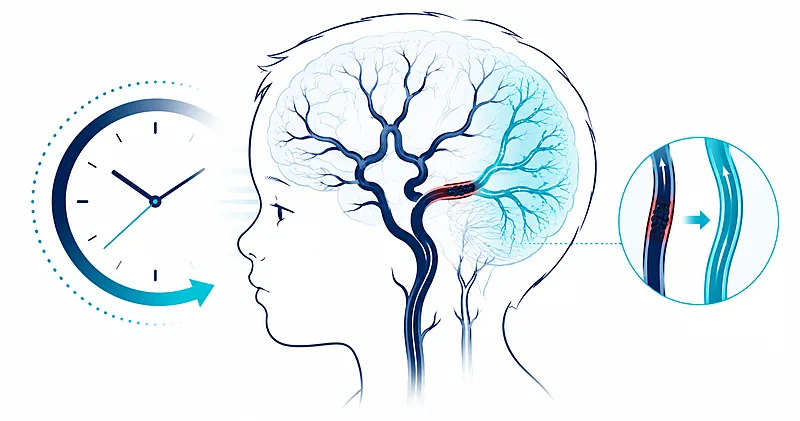
The defining obstacle is time to diagnosis. In a retrospective cohort of 209 children with arterial ischemic stroke, the median interval from symptom onset to diagnosis was 22.7 hours (interquartile range 7.1 to 57.7). Most of that delay was in-hospital rather than pre-hospital.
Recognition at first contact was poor. In that cohort, stroke was suspected on initial assessment in only 38 percent of children, and initial neuroimaging identified the stroke in 47 percent. Delay was longer with gradual onset, altered consciousness, posterior-circulation infarcts and milder deficits.
Several factors drive this. Childhood stroke is rare and often presents atypically, so it sits low on the differential while seizures or reduced consciousness mask focal signs. Common mimics — migraine, seizure, traumatic brain injury and brain tumour — resemble stroke, and adult screening tools do not reliably separate them in children.
The clinical cost is concrete. Intravenous thrombolysis must be given within 4.5 hours, and thrombectomy within a wider but still finite window. A median diagnosis near a full day places many children outside these windows before treatment is even considered.
There is an important exception. In a population study of 161 children that included 39 with large-vessel occlusion, 35 of those 39 reached medical attention within 24 hours of onset. Children with the largest, most disabling occlusions tend to present earlier, which is precisely the group most likely to benefit from reperfusion.
Clinical Pearl. The bottleneck in pediatric stroke is usually recognition and imaging, not transport. Because children with large-vessel occlusion often arrive within the treatment window, a low threshold for urgent MRI (or CT with angiography where MRI is not immediately available) is the single highest-yield step for widening reperfusion eligibility.
Available Approaches
Acute management offers three strategies that can be weighed: best medical management alone, intravenous thrombolysis, and endovascular thrombectomy. No approach rests on a completed pediatric randomised trial; the evidence is observational, and much is extrapolated from adult data. The comparative table below summarises the verified sources that inform each.
| Study / Source | Design | N | Population / focus | Key verified result | Tier |
|---|---|---|---|---|---|
| Rafay 2009 | Retrospective cohort | 209 | Children with AIS, single centre | Median onset-to-diagnosis 22.7 h (IQR 7.1–57.7); stroke suspected at first assessment in 38% | [V] |
| deVeber 2017 | Prospective national registry | 1,129 | Canadian children with AIS | Incidence 1.72/100,000/yr; AIS/TIA recurrence ~12% in older children | [V] |
| Bhatia 2022 | Population cohort | 161 (39 LVO) | Pediatric AIS including large-vessel occlusion | 35 of 39 LVO presented <24 h; poor natural history without reperfusion | [V] |
| Rivkin (TIPS) 2015 | Phase 1 dose-finding (halted) | 1 enrolled / 93 screened | Children 2–17 y, IV tPA <4.5 h | Terminated December 2013 for insufficient accrual | [V] |
| Sporns — Save ChildS 2020 | Retrospective multicentre cohort | 73 | Childhood LVO treated with thrombectomy | PedNIHSS 14.0 → 4.0 by day 7; mRS 1.0 at 24 mo; 1% bleeding complication | [V] |
| Bhatia 2023 | Matched case-control | 52 | Anterior-circulation LVO, ≤18 y | Better 3-month function with thrombectomy vs medical management alone | [V] |
| Sporns — Save ChildS Pro 2024 | Prospective registry | 208 (117 EVT / 91 medical) | Large- or medium-vessel occlusion, 28 d–18 y | Thrombectomy associated with improved function; symptomatic ICH 1%; mortality ~5% in both arms | [V] |
| Bhatia 2019 | Systematic review + IPD meta-analysis | 113 procedures (110 patients) | Pediatric thrombectomy, pooled literature | 87 of 96 with follow-up (90.6%) achieved mRS 0–2 | [V] |
Best medical management
Supportive and medical care is the baseline against which reperfusion is judged. It centres on treating the underlying cause, maintaining physiology, and antithrombotic therapy — antiplatelet or anticoagulation depending on mechanism. For most children with smaller, non-large-vessel strokes, this remains the mainstay.
Its limitation is visible in large-vessel disease. In the population study of childhood large-vessel occlusion, outcomes with conservative treatment were poor, and this natural history is the rationale that has driven interest in adding reperfusion for selected children. Beyond the acute phase, long-term pediatric stroke care extends to secondary prevention, rehabilitation and recurrence-risk management, which the 2019 AHA scientific statement addresses in depth.
Intravenous thrombolysis
Thrombolysis with alteplase is standard for eligible adults, but pediatric evidence is thin. The flagship effort to build it, the Thrombolysis in Pediatric Stroke (TIPS) trial, was a phase 1 dose-finding study in children aged 2 to 17 within 4.5 hours. It was halted by the NIH in December 2013 after enrolling only 1 of 93 screened patients.
That failure reflected how few children reach eligibility in time, not a safety signal against treatment. Observational reports suggest the risk of intracranial haemorrhage after intravenous alteplase is low in children, and the 2026 guideline judges alteplase safe while noting its efficacy remains uncertain.
Tenecteplase has expanded in adult care, but pediatric experience is limited to safety surveillance rather than outcome data. It is best viewed as emerging, not established, in children.
Endovascular thrombectomy
Thrombectomy is where pediatric evidence has grown most. The Save ChildS study pooled 27 centres and 73 children treated for occlusion between 2000 and 2018.
The median Pediatric NIH Stroke Scale score improved from 14.0 at admission to 4.0 by day 7. The median modified Rankin Scale score was 1.0 at 24 months, and one patient (1 percent) had a bleeding complication.
A pooled systematic review with individual-patient-data meta-analysis of 113 procedures in 110 children found that 90.6 percent of those with follow-up reached a good outcome (mRS 0–2). A matched case-control study of 52 children with anterior-circulation occlusion reported better three-month function with thrombectomy than with medical management alone.
The most rigorous pediatric dataset is the prospective Save ChildS Pro registry: 208 children across 45 centres, of whom 117 underwent thrombectomy and 91 received medical treatment. Despite higher baseline severity in the thrombectomy arm, thrombectomy was associated with improved functional outcomes, with a symptomatic haemorrhage rate of about 1 percent and similar mortality (~5 percent) in both arms.
A secondary Save ChildS analysis extended these observations to a 6-to-24-hour window when children were selected by a mismatch between clinical deficit and infarct size. Outcomes were comparable to children treated earlier — mirroring the extended-window results seen in the adult DAWN and DEFUSE 3 trials.
Comparative Analysis
Set side by side, the three approaches differ sharply in the strength of their support. Medical management has the longest track record but leaves large-vessel occlusion outcomes poor. Thrombolysis has a plausible rationale and reassuring safety data, yet no completed trial has shown its efficacy in children. Thrombectomy has the most consistent pediatric outcome data, though all of it is observational.
A recurring pattern across the thrombectomy studies is worth noting. Clinicians tended to select older, more severely affected children for thrombectomy, so the treated groups started sicker. That better outcomes still emerged in the thrombectomy arms strengthens the signal, but it also means the benefit may be concentrated in older children with large occlusions rather than uniform across all ages.
The comparison also reframes the delay problem. Thrombolysis is tightly time-bound at 4.5 hours, so diagnostic delay disqualifies most candidates. Thrombectomy tolerates a wider, tissue-based window, and because large-vessel occlusion often presents earlier, it is the strategy for which faster recognition most plausibly changes who gets treated.
Quality and Consistency of the Evidence
The certainty attached to each claim varies by outcome. The dots below reflect the strength of the underlying evidence.
- Diagnostic delay is substantial and common. Strong, consistent evidence across multiple independent cohorts places the median time to diagnosis near a full day.
- Thrombectomy improves outcomes in large-vessel occlusion. Evidence suggests benefit, supported by concordant registries and a prospective cohort with a comparison group — but no randomised trial.
- Large-vessel occlusion has a poor untreated course. Evidence suggests worse outcomes than non-large-vessel stroke, from population-based follow-up.
- Intravenous thrombolysis efficacy in children. Insufficient evidence to determine efficacy; safety data are reassuring but the only dedicated trial did not complete.
- The lower age limit and optimal device selection for thrombectomy. Preliminary evidence only; small numbers in the youngest children.
Two structural limitations run through the literature. First, selection bias is unavoidable when treated and untreated children are compared without randomisation. Second, sample sizes are small by adult standards, so confidence intervals are wide and rare harms may be under-counted.
What the Evidence Does Not Show
Several questions remain open:
- Whether thrombolysis improves outcomes in children. No completed randomised trial exists, and a future one is widely considered infeasible given low eligibility and ethical constraints on withholding treatment.
- How young a child can safely undergo thrombectomy. Vessel and patient size limit device use, and the youngest children are under-represented in every dataset.
- The best imaging pathway to cut delay. Time-to-imaging metrics are proposed, but the optimal protocol and its effect on outcomes are not yet defined by comparative data.
- Long-term neurodevelopmental outcomes after reperfusion. Most follow-up is measured in months to a few years, not across the developmental span a child will live.
Practical Implications
The evidence supports several practice-shaping points, framed as what the data allow rather than as directives.
Speed of recognition is the lever most within a clinician’s control. Because eligibility is lost to delay far more often than to a lack of treatment options, institutional stroke pathways that shorten time to imaging address the rate-limiting step directly. Many pediatric stroke centres now run dedicated stroke-alert pathways, and time to diagnostic imaging is increasingly used as the key quality metric rather than the door-to-needle time applied in adults.
The 2026 AHA/ASA guideline offers the first pediatric framework. It considers thrombectomy reasonable (Class 2a) for children aged 6 years and older with large-vessel occlusion treated within 6 hours at experienced centres. Alteplase is a weaker recommendation (Class 2b) for children aged 28 days to 18 years within 4.5 hours who have disabling deficits, judged safe though of uncertain efficacy.
For imaging, the guideline prefers urgent MRI with angiography, with CT and CT angiography reasonable when MRI is not available promptly.
Decisions are best made at centres with pediatric neurology, neuro-interventional and neurocritical-care expertise. The observational nature of the evidence places weight on case-by-case judgement, informed consent about uncertainty, and multidisciplinary input — particularly for the youngest children and those at the margins of the treatment windows.
Evidence Grade and Bottom Line
The grade reflects a base of consistent registries, cohorts and one prospective comparison, offset by the absence of randomised data and by small numbers.
- Diagnostic delay, not treatment scarcity, is the central problem; a median diagnosis near 24 hours pushes most children past the reperfusion windows.
- Thrombectomy has the strongest pediatric evidence — observational but concordant — and is a reasonable option for selected older children with large-vessel occlusion.
- Thrombolysis is safe but unproven in children; its use is individualised, and it is time-limited to 4.5 hours.
- The 2026 guideline gives the first formal recommendations, and faster recognition and imaging remain the highest-yield way to widen who can be treated.
Article Information and References
- Bhatia K, Kortman H, Blair C, et al. Mechanical thrombectomy in pediatric stroke: systematic review, individual patient data meta-analysis, and case series. J Neurosurg Pediatr. 2019;24(5):558–571. DOI: https://doi.org/10.3171/2019.5.PEDS19126
- Sporns PB, Bhatia K, Abruzzo T, et al. Endovascular thrombectomy for childhood stroke (Save ChildS Pro): an international, multicentre, prospective registry study. Lancet Child Adolesc Health. 2024;8(12):882–890. DOI: https://doi.org/10.1016/S2352-4642(24)00233-5
- Sporns PB, Sträter R, Minnerup J, et al. Feasibility, safety, and outcome of endovascular recanalization in childhood stroke: the Save ChildS study. JAMA Neurol. 2020;77(1):25–34. DOI: https://doi.org/10.1001/jamaneurol.2019.3403
- Bhatia KD, Chowdhury S, Andrews I, et al. Association between thrombectomy and functional outcomes in pediatric patients with acute ischemic stroke from large vessel occlusion. JAMA Neurol. 2023;80(9):910–918. DOI: https://doi.org/10.1001/jamaneurol.2023.2303
- Bhatia KD, Briest R, Goetti R, et al. Incidence and natural history of pediatric large vessel occlusion stroke: a population study. JAMA Neurol. 2022;79(5):488–497. DOI: https://doi.org/10.1001/jamaneurol.2022.0323
- Sporns PB, Psychogios MN, Straeter R, et al. Clinical diffusion mismatch to select pediatric patients for embolectomy 6 to 24 hours after stroke: an analysis of the Save ChildS study. Neurology. 2021;96(3):e343–e351. DOI: https://doi.org/10.1212/WNL.0000000000011107
- deVeber GA, Kirton A, Booth FA, et al. Epidemiology and outcomes of arterial ischemic stroke in children: the Canadian Pediatric Ischemic Stroke Registry. Pediatr Neurol. 2017;69:58–70. DOI: https://doi.org/10.1016/j.pediatrneurol.2017.01.016
- Rivkin MJ, deVeber G, Ichord RN, et al. Thrombolysis in pediatric stroke study. Stroke. 2015;46(3):880–885. DOI: https://doi.org/10.1161/STROKEAHA.114.008210
- Rafay MF, Pontigon AM, Chiang J, et al. Delay to diagnosis in acute pediatric arterial ischemic stroke. Stroke. 2009;40(1):58–64. DOI: https://doi.org/10.1161/STROKEAHA.108.519066
- Sun LR, Lee S, Lee-Eng J, et al. Tenecteplase for the treatment of pediatric arterial ischemic stroke: a safety surveillance report. Neurology. 2025;104(3):e210310. DOI: https://doi.org/10.1212/WNL.0000000000210310
- Sporns PB, Kemmling A, Hanning U, et al. Thrombectomy in childhood stroke. J Am Heart Assoc. 2019;8(5):e011335. DOI: https://doi.org/10.1161/JAHA.118.011335
- Ferriero DM, Fullerton HJ, Bernard TJ, et al. Management of stroke in neonates and children: a scientific statement from the American Heart Association/American Stroke Association. Stroke. 2019;50(3):e51–e96. DOI: https://doi.org/10.1161/STR.0000000000000183
- Prabhakaran S, Gonzalez NR, Zachrison KS, et al. 2026 guideline for the early management of patients with acute ischemic stroke: a guideline from the American Heart Association/American Stroke Association. Stroke. 2026. DOI: https://doi.org/10.1161/STR.0000000000000513