
Stroke Thrombectomy Selection: 7 Practical Clinical Insights
How late-window mismatch and large-core trials redrew the boundaries of who qualifies for endovascular therapy.
One-Minute Takeaway
- Stroke thrombectomy selection has moved beyond the classic six-hour, small-infarct patient to two once-excluded groups — late-presenting and large-core — now backed by high-certainty randomized evidence.
- In the late window (6–24 h), the DAWN and DEFUSE 3 trials raised functional independence (mRS 0–2) to 49% versus 13% and 45% versus 17%, an NNT near 3.
- In large-core stroke (ASPECTS 3–5), four randomized trials — RESCUE-Japan LIMIT, SELECT2, ANGEL-ASPECT, and TENSION — showed a consistent shift toward less disability; SELECT2 gave a generalized odds ratio of 1.51 (95% CI 1.20–1.89).
- Benefit means less disability, not cure: most large-core survivors remain dependent, and one large-core trial (TESLA) was neutral.
- Selection still hinges on imaging — perfusion or non-contrast CT ASPECTS — and guidelines now rate treatment of selected 6–24 h patients as a Class 1 recommendation.
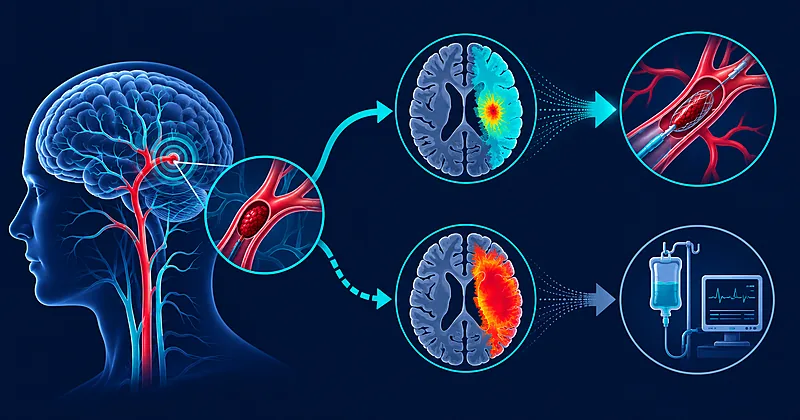
Why Stroke Thrombectomy Selection Matters
Endovascular thrombectomy is one of the most effective treatments in acute medicine for large-vessel-occlusion stroke. Its benefit, however, was first proven only in a narrow group: patients treated within roughly six hours who had a small established infarct. The HERMES pooled analysis of five early trials cemented that standard.
Everyone else was largely turned away. Patients arriving late, or with a large infarct already visible on imaging, were considered too high-risk to treat. For years, stroke thrombectomy selection effectively told these patients that reperfusion carried more danger than reward.
That exclusion mattered enormously. Many strokes are unwitnessed or wake-up events, and a substantial share of patients reach hospital with a large ischemic core. Both groups represent exactly the severe strokes where a good outcome is otherwise unlikely, so the stakes of getting selection right are high.
Two independent lines of randomized evidence changed the calculus. Trials in the extended time window and trials in large-core stroke each asked whether careful imaging-based selection — rather than the clock or infarct size alone — could still identify patients who benefit. Across more than a dozen trials, the answer reshaped guidelines and daily practice.
Available Approaches to Stroke Thrombectomy Selection
The modern approach to stroke thrombectomy selection rests on a single reframing: the enemy is not time or core size in isolation, but irreversible tissue loss. Imaging estimates how much brain is already lost versus still salvageable. From that principle, three selection strategies emerged, summarized in the verified evidence table below.
| Trial (Year) | Design | N | Selection / Population | Key 90-day result | Tier |
|---|---|---|---|---|---|
| DAWN (2018) | RCT, open-label | 206 | 6–24 h; ICA/M1; clinical–core mismatch | Functional independence (mRS 0–2) 49% vs 13%; uw-mRS adjusted difference 2.0 (95% CrI 1.1–3.0) | V |
| DEFUSE 3 (2018) | RCT, open-label | 182 | 6–16 h; ICA/M1; perfusion target mismatch | Disability shift common OR 2.77 (95% CI 1.63–4.70); mRS 0–2 45% vs 17% | V |
| RESCUE-Japan LIMIT (2022) | RCT, open-label | 203 | Large core, ASPECTS 3–5; ≤24 h | mRS 0–3 31.0% vs 12.7% (RR 2.43; 95% CI 1.35–4.37) | V |
| SELECT2 (2023) | RCT, open-label | 352 | ASPECTS 3–5 or core ≥50 mL; ≤24 h | Disability shift gOR 1.51 (95% CI 1.20–1.89); mRS 0–2 20% vs 7% | V |
| ANGEL-ASPECT (2023) | RCT, open-label | 456 | ASPECTS 3–5 or core 70–100 mL; ≤24 h | Disability shift gOR 1.37 (95% CI 1.11–1.69); mRS 0–2 30% vs 11.6% | V |
| TENSION (2023) | RCT, open-label | 253 | ASPECTS 3–5 on non-contrast CT; ≤12 h | Disability shift adjusted OR 2.58 (95% CI 1.60–4.15) | V |
| TESLA (2024) | RCT, Bayesian | 300 | ASPECTS 2–5 on non-contrast CT; ≤24 h | uw-mRS 2.93 vs 2.27 — did not meet the prespecified threshold for superiority (neutral primary) | V |
Clinical–Core Mismatch Selection (Late Window)
DAWN pioneered selection by clinical–core mismatch: a severe neurological deficit that is disproportionate to a small infarct implies salvageable tissue worth saving. Among 206 patients treated 6–24 hours after last known well, thrombectomy raised functional independence to 49% versus 13% with medical care alone.
Disability on the utility-weighted modified Rankin scale also improved, with an adjusted difference of 2.0 points (95% CrI 1.1–3.0). Symptomatic intracranial hemorrhage did not differ significantly between groups (6% vs 3%), and 90-day mortality was similar. The trial stopped early for overwhelming benefit.
Perfusion Target-Mismatch Selection (Late Window)
DEFUSE 3 selected by CT- or MR-perfusion target mismatch — a small core paired with a larger volume of hypoperfused but not-yet-infarcted tissue. In 182 patients treated 6–16 hours after onset, thrombectomy produced a favorable shift in disability (common OR 2.77; 95% CI 1.63–4.70) and raised functional independence to 45% versus 17%.
Mortality was lower with thrombectomy (14% vs 26%), and symptomatic hemorrhage did not differ significantly. Together, DAWN and DEFUSE 3 established that late arrival is not itself disqualifying; the right imaging profile, not the clock, identifies who benefits. Pooled late-window data later showed the benefit was greatest between 12 and 24 hours.
Core-Based and Simplified Selection (Large Core)
The second frontier was infarct size. RESCUE-Japan LIMIT first showed benefit in ASPECTS 3–5 stroke: mRS 0–3 reached 31.0% versus 12.7% (RR 2.43; 95% CI 1.35–4.37), though any intracranial hemorrhage was more common with thrombectomy (58% vs 31%). SELECT2 and ANGEL-ASPECT followed in 2023.
Each demonstrated a shift toward better outcomes — generalized odds ratios of 1.51 and 1.37 — in patients selected by low ASPECTS or large core volume within 24 hours. SELECT2 translated to a number needed to treat of about five for an improved outcome, with functional independence in 20% versus 7%.
TENSION added a practical twist: it selected ASPECTS 3–5 patients using non-contrast CT alone, within 12 hours, and still showed a strong benefit (adjusted OR 2.58; 95% CI 1.60–4.15). The LASTE trial later extended benefit even to the very largest cores (ASPECTS 0–5), reporting an ordinal odds ratio of 1.63 (95% CI 1.29–2.06).
The exception is instructive. TESLA, which also used non-contrast CT and treated to 24 hours, favored thrombectomy numerically but did not cross its prespecified threshold for superiority. The signal in the largest strokes is real but modest, and not every trial reached statistical significance.
Clinical pearl
The unifying question across both frontiers is the same: how much brain is already dead versus salvageable? Late-window mismatch imaging and large-core ASPECTS are two answers to that one question — which is why a patient can qualify for thrombectomy at 20 hours, or with an ASPECTS of 4, when a rigid clock or size cutoff would have excluded them.
Comparative Analysis
Read across both frontiers, several patterns hold, and they matter more than any single trial.
First, the direction of effect is remarkably consistent. Every randomized large-core trial pointed the same way on the ordinal modified Rankin scale, and the late-window trials were unequivocally positive. Consistency across different countries, imaging methods, and time windows is the strongest single argument that the benefit is genuine rather than a chance finding.
Second, magnitude scales with the tissue at risk. Late-window mismatch patients are selected precisely because they retain salvageable brain, so they show large absolute gains, with functional independence near 45–49%. Large-core patients begin from a worse baseline, so absolute independence rates are lower (7–30%), and independent ambulation is often the more meaningful endpoint than full independence.
Third, safety is a real trade-off concentrated in large-core stroke. Any intracranial hemorrhage was more frequent with thrombectomy in several large-core trials, although symptomatic hemorrhage was generally not significantly increased. Procedural vascular complications occurred in roughly one in six thrombectomy patients in SELECT2, a reminder that the intervention is not free of harm.
Fourth, simpler selection can work. TENSION and TESLA relied on non-contrast CT ASPECTS rather than perfusion software, and TENSION in particular confirmed that a pragmatic, widely available pathway can identify large-core patients who benefit — a finding with direct relevance for centers without advanced imaging.
Quality and Consistency of the Evidence
- High — Late-window functional benefit. Two randomized trials (DAWN, DEFUSE 3), consistent, replicated, and already adopted into guidelines.
- High — Large-core functional shift. Four positive randomized trials plus LASTE in the largest cores, all in the same direction, with the neutral TESLA trial trending the same way.
- Moderate — Full independence after large-core stroke. Absolute rates remain modest, and most survivors stay dependent even when treated.
- Moderate — Safety profile. Symptomatic hemorrhage is generally not significantly increased, but any-hemorrhage and procedural complications rise with thrombectomy in large-core stroke.
- Low — Best imaging method for selection. Trials used different tools, and no randomized comparison of perfusion versus non-contrast CT selection exists.
- Insufficient — Routine treatment beyond 24 hours or in the very largest cores. Available data are limited or observational.
What the Evidence Does Not Show
The trials expanded eligibility; they did not promise recovery. Four specific limits deserve emphasis before this evidence is applied to an individual patient.
They do not show that thrombectomy restores function for most large-core patients. Even in positive trials, the majority of survivors remained disabled, and the honest description of the benefit is a shift toward less severe disability rather than a return to normal.
They do not establish benefit beyond 24 hours. Both pivotal late-window trials stopped at 16 to 24 hours, and evidence past that window remains observational and should not be treated as settled.
They do not identify a definitive infarct-size limit beyond which thrombectomy is futile. LASTE suggests benefit even at ASPECTS 0–5, yet the very largest cores carry high mortality and malignant-edema risk, and the neutral TESLA result urges caution at the extreme.
The open question
No head-to-head trial has compared perfusion-based selection against non-contrast CT selection. Both identified patients who benefited, so the field does not yet know whether advanced imaging adds value over a simple ASPECTS read — or merely adds delay. Until that trial exists, the choice of imaging is guided by availability and speed rather than proven superiority.
Practical Implications
For the clinician, stroke thrombectomy selection now turns on two questions answered by imaging rather than by the clock or a size cutoff alone.
In the late window (6–24 hours), select by mismatch: a severe deficit with a small core (DAWN-style clinical–core mismatch) or a favorable perfusion profile (DEFUSE 3-style target mismatch). Current AHA/ASA and European guidelines treat thrombectomy for such carefully selected patients as a Class 1 recommendation, with imaging required to confirm salvageable tissue.
In large-core stroke (ASPECTS 3–5 within 24 hours), thrombectomy is now a reasonable option, and non-contrast CT ASPECTS is adequate for selection. The absence of perfusion software should therefore not automatically exclude a patient, and where an advanced-imaging workup would introduce delay, a pragmatic CT-based pathway is defensible.
Counseling should stay honest. The realistic promise is a meaningful chance of walking independently or regaining daily function — not a cure — and families deserve that framing before consent. At the systems level, the message is to widen access rather than gatekeep: “too late” and “core too big” are no longer automatic exclusions, and imaging, not assumption, should decide.
Evidence Grade and Bottom Line
Overall evidence grade: High for the central claim that thrombectomy benefits carefully selected late-window and large-core patients, and Moderate for the magnitude and safety details that shape individual decisions.
- Late-window thrombectomy (6–24 h) is strongly supported for patients with clinical–core or perfusion mismatch, with a number needed to treat near 3 for functional independence.
- Large-core thrombectomy (ASPECTS 3–5) improves functional outcomes across multiple randomized trials, with lower absolute gains and a real hemorrhage trade-off.
- Non-contrast CT can select large-core patients, simplifying access where perfusion imaging is unavailable or slow.
- The benefit is a shift toward independence, not universal recovery, and the very largest cores warrant individualized judgment.
Article Information and References
For Educational Purposes Only. This is an original evidence synthesis informed by the studies listed below. It does not replace clinical judgement. Drug dosages should be verified against current prescribing information.
- Goyal M, Menon BK, van Zwam WH, et al. Endovascular thrombectomy after large-vessel ischaemic stroke: a meta-analysis of individual patient data from five randomised trials. Lancet. 2016;387(10029):1723–1731. DOI: https://doi.org/10.1016/S0140-6736(16)00163-X
- Nogueira RG, Jadhav AP, Haussen DC, et al. Thrombectomy 6 to 24 hours after stroke with a mismatch between deficit and infarct. N Engl J Med. 2018;378(1):11–21. DOI: https://doi.org/10.1056/NEJMoa1706442
- Albers GW, Marks MP, Kemp S, et al. Thrombectomy for stroke at 6 to 16 hours with selection by perfusion imaging. N Engl J Med. 2018;378(8):708–718. DOI: https://doi.org/10.1056/NEJMoa1713973
- Yoshimura S, Sakai N, Yamagami H, et al. Endovascular therapy for acute stroke with a large ischemic region. N Engl J Med. 2022;386(14):1303–1313. DOI: https://doi.org/10.1056/NEJMoa2118191
- Sarraj A, Hassan AE, Abraham MG, et al. Trial of endovascular thrombectomy for large ischemic strokes. N Engl J Med. 2023;388(14):1259–1271. DOI: https://doi.org/10.1056/NEJMoa2214403
- Huo X, Ma G, Tong X, et al. Trial of endovascular therapy for acute ischemic stroke with large infarct. N Engl J Med. 2023;388(14):1272–1283. DOI: https://doi.org/10.1056/NEJMoa2213379
- Bendszus M, Fiehler J, Subtil F, et al. Endovascular thrombectomy for acute ischaemic stroke with established large infarct: multicentre, open-label, randomised trial. Lancet. 2023;402(10414):1753–1763. DOI: https://doi.org/10.1016/S0140-6736(23)02032-9
- Costalat V, Jovin TG, Albucher JF, et al. Trial of thrombectomy for stroke with a large infarct of unrestricted size. N Engl J Med. 2024;390(18):1677–1689. DOI: https://doi.org/10.1056/NEJMoa2314063
- Yoo AJ, Zaidat OO, Sheth SA, et al. Thrombectomy for stroke with large infarct on noncontrast CT: the TESLA randomized clinical trial. JAMA. 2024;332(16):1355–1366. DOI: https://doi.org/10.1001/jama.2024.13933
- Sarraj A, Abraham MG, Hassan AE, et al. Endovascular thrombectomy plus medical care versus medical care alone for large ischaemic stroke: 1-year outcomes of the SELECT2 trial. Lancet. 2024;403(10428):731–740. DOI: https://doi.org/10.1016/S0140-6736(24)00050-3