
Postpartum Hemorrhage: 3 Core Approaches Compared
Objective blood-loss measurement paired with a bundled first response is reshaping how clinicians catch and control obstetric bleeding.
One-Minute Takeaway
- Postpartum hemorrhage is the leading cause of maternal death worldwide, and most deaths follow bleeding that is recognized late or treated in fragmented steps.
- In the E-MOTIVE cluster-randomized trial, a combined detection-and-treatment bundle reduced the composite of severe bleeding, laparotomy, and death by roughly 60% versus usual care.
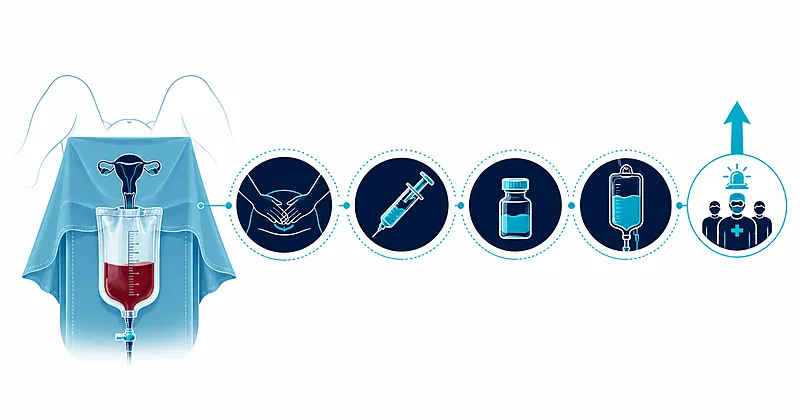
- The bundle pairs objective blood-loss measurement with a first response of uterine massage, uterotonics, tranexamic acid, intravenous fluids, and examination with escalation.
- Recognition of hemorrhage and use of the complete treatment package both rose sharply where the approach was actually implemented.
- The World Health Organization adopted objective measurement and the treatment bundle in 2023, though generalizability and the ideal alert threshold remain open questions.
The Clinical Problem in Postpartum Hemorrhage
Postpartum hemorrhage is the single largest contributor to maternal death, and the burden is heavily concentrated in the places least equipped to respond. Obstetric hemorrhage accounts for roughly a quarter of maternal deaths worldwide.
Of the estimated 287,000 maternal deaths recorded globally in 2020, the great majority occurred in sub-Saharan Africa and South Asia. Most were caused by bleeding after birth, and most of that bleeding was survivable with timely care.
Two recurring failures drive these deaths. The first is late recognition: birth attendants have traditionally judged blood loss by eye, and visual estimation systematically underestimates how much a woman has actually lost.
The second failure is fragmented treatment. Even when hemorrhage is recognized, effective interventions are often applied one at a time, with gaps between each step, so control arrives after the safe therapeutic window has already closed.
Definitions frame the urgency. Hemorrhage after vaginal birth has conventionally been defined as blood loss of 500 mL or more within 24 hours, with severe hemorrhage set at 1,000 mL or more. Uterine atony, a uterus that fails to contract, is the most common cause.
Timing is unforgiving. More than half of all maternal deaths occur within a day of giving birth, and severe postpartum bleeding is the single most important cause among them. Left uncontrolled, it can progress rapidly to hypovolaemic shock and multi-organ dysfunction.
Each year, postpartum hemorrhage is estimated to cause on the order of 70,000 maternal deaths, the majority of them considered preventable with prompt recognition and treatment. The gap is one of delivery and speed, not of missing science.
The clinical problem is therefore not a shortage of effective treatments. It is the reliable, rapid, and complete delivery of treatments that already exist, triggered the moment bleeding crosses a threshold rather than after a patient deteriorates.
Available Approaches
Modern management of postpartum hemorrhage rests on three complementary approaches: objective detection of blood loss, an integrated first-response treatment bundle, and pharmacologic prevention and treatment. The comparative evidence below anchors each approach in trials verified against primary sources.
| Study / Source | Design | N | Population | Comparison | Key result |
|---|---|---|---|---|---|
| E-MOTIVE (Gallos, 2023) | Cluster-randomized trial | 78 hospitals; ~206,000 women | Vaginal birth, 4 African countries | Detection drape + first-response bundle vs usual care | Composite of severe hemorrhage, laparotomy, or death: RR 0.40 (0.32–0.50) |
| Diaz (Cochrane, 2018) | Systematic review | 900 women (drape comparison) | Vaginal birth | Calibrated drape vs gravimetric measurement | Detection of loss >500 mL: RR 1.86 (1.11–3.11), high certainty |
| WOMAN (2017) | Randomized, double-blind, placebo-controlled | 20,060 women | Clinically diagnosed hemorrhage | Tranexamic acid vs placebo, added to usual care | Death due to bleeding: RR 0.81 (0.65–1.00); composite death/hysterectomy unchanged |
| Uterotonics NMA (Gallos, 2018) | Network meta-analysis | 196 trials; 135,559 women | Third stage of labour | Uterotonic agents vs oxytocin (prevention) | Carbetocin RR 0.72 (0.56–0.93); ergometrine+oxytocin RR 0.70 (0.59–0.84) for loss ≥500 mL |
| CHAMPION (Widmer, 2018) | Randomized noninferiority trial | 29,645 women | Vaginal birth, 10 countries | Heat-stable carbetocin vs oxytocin (prevention) | Noninferior for loss ≥500 mL or added uterotonics (14.5% vs 14.4%) |
| CMQCC collaborative (Main, 2017) | Before-and-after quality collaborative | 99 vs 48 comparison hospitals | All births, California | Obstetric hemorrhage safety bundle vs non-participating hospitals | Severe morbidity among hemorrhage patients fell 20.8% vs 1.2% |
1. Objective detection with a calibrated drape
The first approach replaces the eyeball with a measurement. A calibrated blood-collection drape hangs beneath the woman after vaginal birth and shows collected volume against printed markings, giving an objective, time-stamped trigger for action.
High-certainty evidence from a Cochrane review shows that calibrated drapes improve detection of blood loss above 500 mL when compared with weighing collected blood. Objective measurement catches hemorrhage that visual estimation misses.
In practice, the drape is positioned in the late second stage and tied loosely at the waist, allowing the woman to deliver in the position she chooses. After birth and a prophylactic uterotonic, it is unrolled to collect and quantify blood before the cord is cut.
The same review carries an important caveat. Improved detection alone did not translate into clear reductions in transfusion or severe morbidity in the trials examined. Measurement is necessary, but it does not treat anyone by itself.
2. The WHO first-response treatment bundle
The second approach standardizes the response. When hemorrhage is detected, the WHO first-response bundle groups the effective interventions so they are delivered together and immediately rather than in a slow sequence.
The bundle is captured by the letters MOTIVE: uterine Massage, Oxytocic drugs, Tranexamic acid, Intravenous fluids, and genital-tract examination with escalation. Coupled with early detection, this forms the full E-MOTIVE protocol.
The protocol also defines when to act. It triggers the bundle at 500 mL of measured loss, or at 300 mL when an abnormal vital sign or clinical observation accompanies the bleeding. That criterion shifts the response earlier than the traditional threshold used alone.
The governing principle is to treat completely and without delay. Rather than escalating one intervention at a time and reassessing between each, the attendant delivers the elements of the bundle together as soon as the threshold is met.
E-MOTIVE tested the integrated approach across 78 secondary-level hospitals in Kenya, Nigeria, South Africa, and Tanzania. The trial randomized hospitals rather than individual women, and followed roughly 200,000 births through baseline and implementation phases.
The result was a substantially lower risk of the composite primary outcome, which combined severe hemorrhage, laparotomy for bleeding, and death from bleeding. Improvement in that composite was accompanied by higher detection and far more consistent bundle delivery.
A quality-improvement program in California points the same way in a very different setting. Hospitals adopting a national obstetric hemorrhage safety bundle saw severe maternal morbidity among hemorrhage patients fall markedly relative to non-participating hospitals.
Taken together, the trial and the collaborative suggest the bundled approach is not tied to one health system. Its benefit tends to appear wherever detection and response are standardized, whether in a low-resource district hospital or a well-resourced hospital network.
3. Uterotonics for prevention and first-line treatment
The third approach is pharmacologic, and it operates both before and during hemorrhage. Prophylactic uterotonics given in the third stage of labour reduce the chance that atony develops, while therapeutic uterotonics and tranexamic acid help control established bleeding.
Oxytocin remains the standard prophylactic agent. A large Cochrane network meta-analysis found that combination regimens and carbetocin ranked above oxytocin for preventing blood loss of 500 mL or more, though several comparisons carried only moderate certainty.
Heat-stable carbetocin matters for logistics. The CHAMPION trial showed it was noninferior to oxytocin for preventing hemorrhage after vaginal birth, and it does not require the cold storage that oxytocin depends on in many settings.
Where injectable agents are impractical, oral misoprostol offers a heat-stable option for prevention. The network meta-analysis ranks it below oxytocin-based regimens, however, and it is associated with more side effects such as shivering and fever.
For treatment, the WOMAN trial established that tranexamic acid reduces death due to bleeding, with the greatest benefit when given within three hours of birth. Its effect on the combined outcome of death or hysterectomy, however, did not reach significance.
Comparative Analysis of Postpartum Hemorrhage Strategies
Set side by side, the three approaches answer different questions, and the central lesson of recent evidence is that they work best fused rather than chosen between. Detection tells you when to act; the bundle tells you how; uterotonics supply much of what the bundle delivers.
The strongest signal comes from combining detection and treatment. Neither the calibrated drape alone nor any single drug matches the reduction in severe outcomes seen when objective measurement was wired directly to an immediate, standardized bundle in E-MOTIVE.
The contrast with single-agent evidence is instructive. Tranexamic acid reduced deaths from bleeding in the WOMAN trial, yet it did not lower the composite of death or hysterectomy, and it did not reduce hysterectomy on its own. A powerful drug is not a system of care.
Implementation is part of the intervention, not a footnote to it. E-MOTIVE bundled its clinical steps with training, a dedicated hemorrhage trolley, audit and feedback, and local champions, and the sharp rise in bundle use suggests those supports did real work.
The approaches also differ in where they are strongest. Prophylactic uterotonics reduce the incidence of hemorrhage; objective detection compresses the delay to treatment; the bundle governs the quality and completeness of the response once bleeding starts.
Guidance has moved in step with the evidence. In 2012 the World Health Organization found insufficient evidence to recommend measuring blood loss over estimating it. After E-MOTIVE, its 2023 recommendations endorsed routine objective measurement and the treatment bundle, a marked reversal of position.
Objective measurement changes behavior only when it is tied to an immediate, standardized response. The drape earns its value at the moment it triggers the bundle, not simply when it is placed under the patient.
Quality and Consistency of the Evidence
The evidence base spans a large cluster-randomized trial, two Cochrane syntheses, two further multinational randomized trials, and a controlled quality-improvement program. Strength varies by claim, and matching language to that strength matters here.
For postpartum hemorrhage, where overstating a benefit can distort frontline decisions, the certainty behind each claim is as consequential as the claim itself. The grades below reflect that discipline rather than the headline appeal of any single figure.
- High — A combined detection-and-treatment bundle reduced severe composite outcomes after vaginal birth. Strong evidence supports this from a large, internally consistent cluster-randomized trial.
- High — Calibrated drapes improve detection of blood loss above 500 mL compared with weighing, graded high certainty in systematic review.
- Moderate — Tranexamic acid reduces death due to bleeding, especially given early. Evidence suggests benefit, though the overall confidence interval reached the no-effect boundary.
- Moderate — Carbetocin and combination uterotonics may outperform oxytocin for prevention, with several estimates at moderate certainty.
- Low — The optimal alert threshold and the best objective-measurement device remain uncertain; preliminary evidence cannot yet settle either.
Across the strongest studies, direction of effect is consistent: earlier objective recognition and more complete, earlier treatment are associated with fewer severe outcomes. The disagreements sit in magnitude and in questions the trials were not built to answer.
What the Evidence Does Not Show
The current evidence is strong on the bundle’s core benefit but silent or uncertain on several specific points that clinicians and policymakers will reasonably ask about.
Setting. E-MOTIVE was conducted in secondary-level hospitals in four African countries. Whether the same magnitude of benefit transfers to high-income or community birth settings has not been established and is the subject of ongoing research.
Component attribution. The bundle was tested as a whole, so the evidence cannot isolate how much each element — the drape, massage, uterotonics, tranexamic acid, or fluids — contributed to the overall effect.
Detection without treatment. Objective measurement on its own did not clearly improve health outcomes in systematic review. A drape is not a benefit unless it is coupled to a reliable response.
Limits of single agents. Tranexamic acid did not reduce the composite of death or hysterectomy, and prophylactic tranexamic acid in women with anaemia did not reduce clinically diagnosed hemorrhage in the WOMAN-2 trial.
Threshold. The best trigger for action — 500 mL, or 300 mL alongside an abnormal vital sign — and the device used to measure it are not yet resolved by head-to-head evidence.
Practical Implications
The evidence supports treating postpartum hemorrhage as a care-system problem, and several practices follow from what the trials actually showed.
Objective blood-loss measurement after vaginal birth is now recommended in place of visual estimation alone. A calibrated drape is the best-studied tool, though guidance recognizes that other objective methods may serve the same purpose.
When hemorrhage is detected, the evidence favors delivering the whole first-response bundle promptly and together. Sequencing the steps slowly forfeits the advantage that made the bundled approach effective.
Tranexamic acid should be given early, within three hours of birth, once hemorrhage is diagnosed. Delay erodes its benefit, so it belongs in the immediate response rather than as a late rescue measure.
The implementation scaffolding is not optional. Training, a stocked hemorrhage trolley, audit and feedback, and named local champions were part of what made recognition and bundle use rise, and skipping them risks losing the effect.
Cost deserves honest attention. The drape adds expense, and cost-effectiveness analyses alongside E-MOTIVE indicate the approach becomes far more attractive as device cost falls. Programs should plan procurement, not assume it.
The response does not end when bleeding slows. Continued monitoring of blood loss and vital signs, clear documentation of what was given and when, and a low threshold to escalate all help ensure an initial response is not mistaken for a resolved problem.
Framed correctly, adopting this approach is a change to how a unit detects and responds to bleeding, supported by objective measurement and standard supplies, rather than the purchase of any single product.
Evidence Grade and Bottom Line
Overall grade: moderate-to-high for the benefit of a combined detection-and-treatment bundle on severe hemorrhage outcomes, and moderate for the individual pharmacologic components that populate it.
- Objective, early detection of blood loss coupled to an immediate, complete first-response bundle reduces severe postpartum hemorrhage outcomes after vaginal birth.
- The World Health Organization adopted objective measurement and the treatment bundle in 2023, and consolidated global guidance has since followed.
- The size of the real-world benefit depends on implementation quality; detection and treatment must be linked, trained, resourced, and audited.
- No single drug or device substitutes for the system; tranexamic acid, uterotonics, and the drape each contribute within a coordinated response rather than replacing it.
Article Information and References
- Gallos ID, Devall A, Martin J, et al. Randomized Trial of Early Detection and Treatment of Postpartum Hemorrhage. N Engl J Med. 2023;389(1):11–21. DOI: https://doi.org/10.1056/NEJMoa2303966
- Gallos ID, Papadopoulou A, Man R, et al. Uterotonic agents for preventing postpartum haemorrhage: a network meta-analysis. Cochrane Database Syst Rev. 2018;12(12):CD011689. DOI: https://doi.org/10.1002/14651858.CD011689.pub3
- Diaz V, Abalos E, Carroli G. Methods for blood loss estimation after vaginal birth. Cochrane Database Syst Rev. 2018;9(9):CD010980. DOI: https://doi.org/10.1002/14651858.CD010980.pub2
- WOMAN Trial Collaborators. Effect of early tranexamic acid administration on mortality, hysterectomy, and other morbidities in women with post-partum haemorrhage (WOMAN): an international, randomised, double-blind, placebo-controlled trial. Lancet. 2017;389(10084):2105–2116. DOI: https://doi.org/10.1016/S0140-6736(17)30638-4
- WOMAN-2 Trial Collaborators. The effect of tranexamic acid on postpartum bleeding in women with moderate and severe anaemia (WOMAN-2): an international, randomised, double-blind, placebo-controlled trial. Lancet. 2024;404:1645–1656. DOI: https://doi.org/10.1016/S0140-6736(24)01749-5
- Widmer M, Piaggio G, Nguyen TMH, et al. Heat-Stable Carbetocin versus Oxytocin to Prevent Hemorrhage after Vaginal Birth. N Engl J Med. 2018;379(8):743–752. DOI: https://doi.org/10.1056/NEJMoa1805489
- Main EK, Cape V, Abreo A, et al. Reduction of severe maternal morbidity from hemorrhage using a state perinatal quality collaborative. Am J Obstet Gynecol. 2017;216(3):298.e1–298.e11. DOI: https://doi.org/10.1016/j.ajog.2017.01.017
- Begum F, Nieto-Calvache AJ, Schlembach D, et al. FIGO recommendations on objective measurement of blood loss after birth for early detection of postpartum hemorrhage. Int J Gynecol Obstet. 2025;171(3):933–950. DOI: https://doi.org/10.1002/ijgo.70523
- World Health Organization. WHO recommendations on the assessment of postpartum blood loss and use of a treatment bundle for postpartum haemorrhage. Geneva: World Health Organization; 2023. https://www.who.int/publications/i/item/9789240085398