
Preterm Birth Prevention: 3 Clinical Approaches Compared
With hydroxyprogesterone caproate withdrawn from the market, three remaining strategies now carry the evidence — and they do not all point the same way.
One-Minute Takeaway
- Preterm birth prevention now rests on three interventions after the 2023 US withdrawal of 17-OHPC (Makena); the highest-quality evidence most consistently favours vaginal progesterone.
- In singletons with a midtrimester short cervix (≤25 mm), vaginal progesterone reduced birth before 33 weeks (RR 0.62, 95% CI 0.47–0.81; number needed to treat 12) in individual-patient-data meta-analysis.
- Cerclage’s clearest benefit is in singletons with both a prior spontaneous preterm birth and a short cervix (<25 mm): birth before 35 weeks fell from 41% to 28% (RR 0.70, 95% CI 0.55–0.89).
- Cervical pessary trials conflict; the largest US singleton trial (TOPS) showed no benefit and a higher rate of fetal or neonatal death (RR 1.94, 95% CI 1.13–3.32).
- A three-arm randomized trial (SuPPoRT) found cerclage, pessary, and progesterone produced statistically similar preterm birth rates.
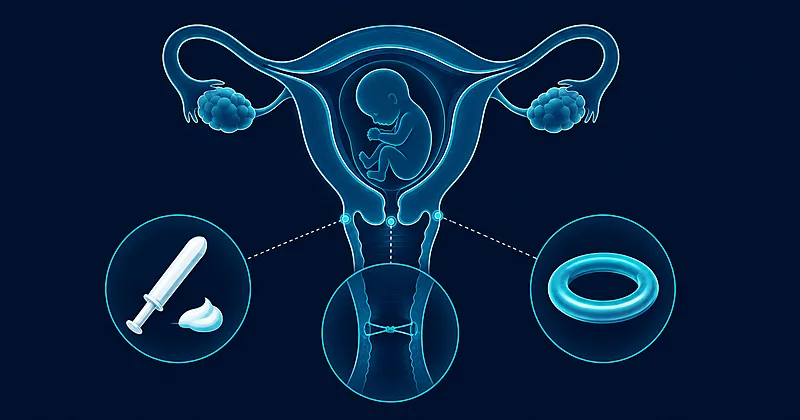
The Clinical Problem in Preterm Birth Prevention
Preterm birth — delivery before 37 completed weeks — remains a leading cause of neonatal death and long-term neurodevelopmental disability. A prior spontaneous preterm birth is among the strongest predictors of recurrence, and a short midtrimester cervix independently raises the risk. These two features define the populations in whom prevention has been most studied.
For more than a decade, intramuscular 17-alpha hydroxyprogesterone caproate (17-OHPC) anchored recurrence prevention. The Meis 2003 trial reported that weekly injections lowered recurrent birth before 37 weeks from 55% to 36% (RR 0.66, 95% CI 0.54–0.81), and this result earned accelerated US approval in 2011.
The required confirmatory trial told a different story. In PROLONG, among 1,708 women with a prior spontaneous preterm birth, 17-OHPC did not reduce birth before 35 weeks (11.0% vs 11.5%; RR 0.95, 95% CI 0.71–1.26). The enrolled population was at markedly lower baseline risk than in Meis, with fewer than 2% having a short cervix.
On April 5–6, 2023, the US Food and Drug Administration withdrew approval of Makena and its generics, effective immediately, citing insufficient evidence of benefit. The American College of Obstetricians and Gynecologists (ACOG) and the Society for Maternal-Fetal Medicine (SMFM) concurred and now discourage 17-OHPC, including compounded formulations. That leaves three evidence-based options to weigh: vaginal progesterone, cervical cerclage, and cervical pessary.
Available Approaches
The three remaining strategies share a goal — keeping the cervix closed or the myometrium quiescent — but they differ in mechanism, in evidence quality, and in the population that benefits. The verified trials and meta-analyses below anchor the comparison; every figure was drawn from a primary source or a systematic review of primary sources.
| Study / Source | Design | N | Population | Comparison | Key result |
|---|---|---|---|---|---|
| Vaginal progesterone | |||||
| EPPPIC 2021 (Stewart) | IPD meta-analysis (31 RCTs) | 3,769 | High-risk singletons (prior sPTB or short cervix) | Vaginal progesterone vs control | PTB <34 wk: RR 0.78 (0.68–0.90) V |
| Romero 2018 | IPD meta-analysis (5 RCTs) | 974 | Singleton, cervical length ≤25 mm | Vaginal progesterone vs placebo | PTB <33 wk: 14% vs 22%, RR 0.62 (0.47–0.81); NNT 12 V |
| OPPTIMUM 2016 (Norman) | RCT | 1,228 | High-risk singletons | Vaginal progesterone vs placebo | Birth/fetal death <34 wk: OR 0.86 (0.61–1.22), NS V |
| Cervical cerclage | |||||
| Berghella 2011 | IPD meta-analysis (5 RCTs) | 504 | Singleton, prior sPTB, CL <25 mm | Cerclage vs no cerclage | PTB <35 wk: 28.4% vs 41.3%, RR 0.70 (0.55–0.89) V |
| Berghella 2017 | IPD meta-analysis (5 RCTs) | 419 | Singleton, no prior sPTB, short cervix | Cerclage vs control | PTB <35 wk: RR 0.88 (0.63–1.23), NS V |
| Cervical pessary | |||||
| PECEP 2012 (Goya) | RCT (open-label) | 385 | Singleton, CL ≤25 mm | Pessary vs expectant management | sPTB <34 wk: 6% vs 27%, OR 0.18 (0.08–0.37) V |
| Nicolaides 2016 | RCT | 932 | Singleton, CL ≤25 mm | Pessary vs expectant management | sPTB <34 wk: 12.0% vs 10.8%, NS V |
| TOPS 2023 (Hoffman) | RCT | 544 | Singleton, CL ≤20 mm, no prior sPTB (99% on vaginal progesterone) | Pessary vs usual care | Birth/fetal death <37 wk: 45.5% vs 45.6%, RR 1.00 (0.83–1.20); fetal/neonatal death 13.3% vs 6.8%, RR 1.94 (1.13–3.32) V |
| Head-to-head comparison | |||||
| SuPPoRT 2024 (Hezelgrave) | RCT (3-arm) | 386 | Singleton, short cervix <25 mm | Cerclage vs pessary vs vaginal progesterone | PTB <37 wk: 30.7% vs 31.1% vs 24.2% (p=0.4), no significant difference V |
| 17-OHPC (withdrawn) — for context | |||||
| Meis 2003 | RCT | 463 | Singleton, prior sPTB | 17-OHPC vs placebo | PTB <37 wk: 36% vs 55%, RR 0.66 (0.54–0.81) V |
| PROLONG 2020 (Blackwell) | RCT | 1,708 | Singleton, prior sPTB | 17-OHPC vs placebo | PTB <35 wk: 11.0% vs 11.5%, RR 0.95 (0.71–1.26), NS V |
Vaginal Progesterone
Vaginal progesterone is a natural progestogen thought to maintain myometrial quiescence and dampen inflammatory changes at the cervix. Its evidence is the most internally consistent of the three, and it is the option ACOG and SMFM most clearly endorse in the short-cervix setting.
In the EPPPIC individual-participant-data meta-analysis of 31 randomized trials, vaginal progesterone reduced birth before 34 weeks in high-risk singletons (RR 0.78, 95% CI 0.68–0.90). The signal is strongest where baseline risk is highest. In Romero’s IPD meta-analysis restricted to singletons with a cervix ≤25 mm, birth before 33 weeks fell from 22% to 14% (RR 0.62, 95% CI 0.47–0.81), with a number needed to treat of 12 and evidence graded high-quality.
The picture is not uniform. OPPTIMUM, the largest single trial, found no significant effect on its obstetric outcome (OR 0.86, 95% CI 0.61–1.22) and no benefit or harm on 2-year childhood neurodevelopment. Its population was broader than short-cervix alone, which helps reconcile the discordance: benefit concentrates in women with a short cervix, where the absolute risk is greatest.
Current ACOG guidance offers vaginal progesterone to women with a prior spontaneous preterm birth, a singleton gestation, and a shortened cervix; in the absence of a short cervix, ACOG states it should not be offered as a substitute for 17-OHPC. SMFM emphasises that the withdrawal of 17-OHPC does not change the indications for vaginal progesterone in a short cervix.
Cervical Cerclage
Cerclage is a transvaginal suture that provides mechanical support to a shortening or incompetent cervix. Its benefit is population-specific, and reading the evidence requires separating women by their prior obstetric history.
In Berghella’s 2011 IPD meta-analysis of singletons with both a prior spontaneous preterm birth and a cervix <25 mm, cerclage reduced birth before 35 weeks from 41.3% to 28.4% (RR 0.70, 95% CI 0.55–0.89) and reduced composite perinatal morbidity and mortality (RR 0.64, 95% CI 0.45–0.91). This remains the clearest indication for an ultrasound-detected short cervix.
The benefit does not extend cleanly to women without that history. In Berghella’s 2017 IPD meta-analysis of short-cervix singletons with no prior spontaneous preterm birth, cerclage did not significantly reduce birth before 35 weeks (RR 0.88, 95% CI 0.63–1.23). A 2025 update of that population found no overall effect at ≤25 mm, though a subgroup with a cervix ≤20.9 mm before 24 weeks showed a reduction in birth before 37 weeks (RR 0.75, 95% CI 0.56–0.99).
History and cervical length together, not either alone, define who benefits from cerclage. A short cervix plus a prior spontaneous preterm birth is the setting with the strongest supporting data; a short cervix in isolation is better served by vaginal progesterone unless the cervix is extremely short.
Cervical Pessary
The cervical pessary is a silicone ring placed around the cervix, proposed to alter the cervico-uterine angle and redistribute pressure away from the internal os. It is non-invasive and removable, which made it attractive — but the randomized evidence is directly contradictory.
The single-centre-network PECEP trial was strongly positive: spontaneous birth before 34 weeks occurred in 6% of the pessary group versus 27% with expectant management (OR 0.18, 95% CI 0.08–0.37). That result was not reproduced. In a larger multicentre trial, Nicolaides and colleagues found no difference in spontaneous birth before 34 weeks (12.0% vs 10.8%).
The most recent and largest US trial, TOPS, enrolled 544 singletons with a cervix ≤20 mm and found no reduction in birth or fetal death before 37 weeks (RR 1.00, 95% CI 0.83–1.20). It also raised a safety concern absent from earlier trials: fetal or neonatal death occurred in 13.3% of the pessary group versus 6.8% with usual care (RR 1.94, 95% CI 1.13–3.32), and the trial was stopped early. On the current evidence, routine pessary use in singletons is not supported.
Comparative Analysis of Preterm Birth Prevention Strategies
Only one randomized trial has compared all three strategies head-to-head. SuPPoRT randomised 386 women who developed a short cervix to cerclage, pessary, or vaginal progesterone. Birth before 37 weeks was statistically similar across arms (30.7% vs 31.1% vs 24.2%; p=0.4), with no significant difference at earlier gestational cut-offs either.
That equivalence should be read alongside the population-specific findings. In women with a prior spontaneous preterm birth and a short cervix, indirect-comparison meta-analysis by Conde-Agudelo and Romero concluded that vaginal progesterone and cerclage are comparably effective — a finding that supports individualising the choice rather than declaring a single winner.
Pessary is the outlier. It matched neither the reproducibility of progesterone nor the niche efficacy of cerclage, and the TOPS mortality signal separates it from the other two on safety grounds. Where the head-to-head and indirect data place progesterone and cerclage on similar footing, they do not extend that parity to the pessary in singleton pregnancies.
The practical consequence is that the decision hinges on two questions: does the woman have a prior spontaneous preterm birth, and how short is the cervix? Those answers, more than any ranking of the interventions in the abstract, determine which strategy the evidence supports.
Quality and Consistency of the Evidence
The three interventions do not sit at the same evidentiary level. Rating each by the strength and consistency of its supporting trials makes the differences explicit.
- High — vaginal progesterone in short-cervix singletons. Multiple double-blind RCTs and independent individual-patient-data meta-analyses with low statistical heterogeneity (I² ≈ 0) point the same direction; benefit is concentrated where the cervix is short.
- Moderate — cerclage in prior sPTB plus short cervix. Consistent IPD meta-analysis of randomized trials, but with a smaller pooled sample and an effect that does not generalise to women without a prior spontaneous preterm birth.
- Low / conflicting — pessary in singletons. Directly contradictory RCTs (strongly positive vs null), and a recent large trial raising a perinatal-mortality safety signal not seen previously. Evidence graded low-quality in systematic reviews.
- Not supported — 17-OHPC. The confirmatory RCT was null, the FDA withdrew approval in 2023, and both ACOG and SMFM recommend against continued use, including compounded formulations.
Two structural cautions apply across the body of evidence. Several head-to-head and pessary trials were stopped early — for lagging enrolment or for safety — which widens confidence intervals and limits conclusions about neonatal outcomes. And most positive findings are anchored to a sonographic short cervix, so extrapolation to women with a normal cervical length is not evidence-based.
What the Evidence Does Not Show
- Whether combining cerclage and vaginal progesterone beats either alone. Practice often combines them in high-risk women, but no adequately powered randomized trial has confirmed added benefit; the supporting data are observational.
- What to offer women with a prior spontaneous preterm birth and a normal cervical length. With 17-OHPC withdrawn and vaginal progesterone unproven in this specific group per ACOG, a genuine evidence gap remains.
- Whether the pessary causes harm in some subgroups. The TOPS mortality signal raised the question but did not resolve it; its mechanism and reproducibility are unknown.
- The optimal cervical-length threshold for each intervention. Trials used different cut-offs (≤20 mm, ≤25 mm), and the point at which cerclage overtakes progesterone in very short cervices is not precisely defined.
- Efficacy in multiple gestations. Progestogens do not reduce preterm birth in unselected twin pregnancies, and the comparative device data in twins are limited and, for pessary versus cerclage, have favoured cerclage on safety.
None of these gaps is filled by restating that “more study is warranted.” Each names a specific decision a clinician faces today for which the randomized evidence is currently silent or underpowered.
Practical Implications
The following reflect what the current evidence supports; they are not prescriptive directives and do not replace individualised assessment.
Screen the high-risk singleton. Women with a prior spontaneous preterm birth are candidates for serial transvaginal cervical-length surveillance in the midtrimester, since the length measurement drives the intervention choice.
Short cervix plus prior spontaneous preterm birth. Cerclage is supported by the strongest randomized data in this group, and vaginal progesterone is a comparably effective alternative; many clinicians use progesterone from early pregnancy and add cerclage if the cervix shortens to ≤25 mm before 24 weeks.
Short cervix without a prior spontaneous preterm birth. Vaginal progesterone is the supported option. Cerclage is not routinely indicated here, though a subgroup with an extremely short cervix may derive benefit.
Cervical pessary. Routine use in singletons is not supported by the current evidence, and the TOPS perinatal-mortality signal argues for caution outside a trial setting.
Prior spontaneous preterm birth with a normal cervix. 17-OHPC is no longer an option, and vaginal progesterone is unproven in this specific scenario; management rests on shared decision-making and cervical-length surveillance.
Evidence Grade and Bottom Line
Overall grade: Moderate- Vaginal progesterone carries the most consistent, highest-quality evidence, and its benefit is concentrated in singletons with a short cervix.
- Cerclage has moderate-quality support in its specific niche — a prior spontaneous preterm birth together with a short cervix — and comparable efficacy to progesterone there.
- Cervical pessary is supported by conflicting trials and is separated from the other two by a perinatal-mortality safety signal in the largest recent study; routine singleton use is not supported.
- 17-OHPC is not recommended; it was withdrawn in 2023 after a null confirmatory trial, and vaginal progesterone is not a proven substitute in the absence of a short cervix.
Article Information and References
- EPPPIC Group; Stewart LA, Simmonds M, et al. Evaluating Progestogens for Preventing Preterm birth International Collaborative (EPPPIC): meta-analysis of individual participant data from randomised controlled trials. Lancet. 2021;397(10280):1183–1194. DOI: https://doi.org/10.1016/S0140-6736(21)00217-8
- Romero R, Conde-Agudelo A, Da Fonseca E, et al. Vaginal progesterone for preventing preterm birth and adverse perinatal outcomes in singleton gestations with a short cervix: a meta-analysis of individual patient data. Am J Obstet Gynecol. 2018;218(2):161–180. DOI: https://doi.org/10.1016/j.ajog.2017.11.576
- Berghella V, Rafael TJ, Szychowski JM, Rust OA, Owen J. Cerclage for short cervix on ultrasonography in women with singleton gestations and previous preterm birth: a meta-analysis. Obstet Gynecol. 2011;117(3):663–671. DOI: https://doi.org/10.1097/AOG.0b013e31820ca847
- Berghella V, Ciardulli A, Rust OA, et al. Cerclage for sonographic short cervix in singleton gestations without prior spontaneous preterm birth: systematic review and meta-analysis of randomized controlled trials using individual patient-level data. Ultrasound Obstet Gynecol. 2017;50(5):569–577. DOI: https://doi.org/10.1002/uog.17457
- Berghella V, Harding S, Nicolaides K, et al. Cerclage for short cervix ≤20 mm before 24 weeks in singleton gestations without prior spontaneous preterm birth decreases preterm birth: a meta-analysis of randomized controlled trials using individual patient-level data. Am J Obstet Gynecol MFM. 2025;7(10):101756. DOI: https://doi.org/10.1016/j.ajogmf.2025.101756
- Hezelgrave NL, Suff N, Seed P, et al. Comparing cervical cerclage, pessary and vaginal progesterone for prevention of preterm birth in women with a short cervix (SuPPoRT): a multicentre randomised controlled trial. PLoS Med. 2024;21(7):e1004427. DOI: https://doi.org/10.1371/journal.pmed.1004427
- Norman JE, Marlow N, Messow CM, et al; OPPTIMUM study group. Vaginal progesterone prophylaxis for preterm birth (the OPPTIMUM study): a multicentre, randomised, double-blind trial. Lancet. 2016;387(10033):2106–2116. DOI: https://doi.org/10.1016/S0140-6736(16)00350-0
- Goya M, Pratcorona L, Merced C, et al; PECEP Trial Group. Cervical pessary in pregnant women with a short cervix (PECEP): an open-label randomised controlled trial. Lancet. 2012;379(9828):1800–1806. DOI: https://doi.org/10.1016/S0140-6736(12)60030-0
- Nicolaides KH, Syngelaki A, Poon LC, et al. A randomized trial of a cervical pessary to prevent preterm singleton birth. N Engl J Med. 2016;374(11):1044–1052. DOI: https://doi.org/10.1056/NEJMoa1511014
- Hoffman MK, Clifton RG, Biggio JR, et al. Cervical pessary for prevention of preterm birth in individuals with a short cervix: the TOPS randomized clinical trial. JAMA. 2023;330(4):340–348. DOI: https://doi.org/10.1001/jama.2023.10812
- Blackwell SC, Gyamfi-Bannerman C, Biggio JR, et al. 17-OHPC to prevent recurrent preterm birth in singleton gestations (PROLONG study): a multicenter, international, randomized double-blind trial. Am J Perinatol. 2020;37(2):127–136. DOI: https://doi.org/10.1055/s-0039-3400227
- Meis PJ, Klebanoff M, Thom E, et al; NICHD Maternal–Fetal Medicine Units Network. Prevention of recurrent preterm delivery by 17 alpha-hydroxyprogesterone caproate. N Engl J Med. 2003;348(24):2379–2385. DOI: https://doi.org/10.1056/NEJMoa035140