
Uterine Fibroid Treatment: 3 Core Approaches Compared
Weighing GnRH antagonists, uterine artery embolization, and surgery against the randomized evidence for symptom relief, durability, and the need for a second procedure.
One-Minute Takeaway
- Uterine fibroid treatment now spans three routes with distinct evidence — oral GnRH antagonists, uterine artery embolization, and surgery — all tested in randomized controlled trials, the strongest tier available here.
- Relugolix combination therapy met its bleeding endpoint in roughly seven of ten women across the LIBERTY trials, compared with fewer than one in five on placebo.
- In the FEMME trial, myomectomy produced a higher two-year fibroid quality-of-life score than embolization, an adjusted difference of 8.0 points (95% CI 1.8–14.1).
- Embolization keeps the uterus for most women, yet roughly one third need a further procedure within five to ten years.
- No trial pits all three approaches against each other, so choice rests on symptoms, fertility goals, and how much durability matters.
The Clinical Problem in Uterine Fibroid Treatment
Uterine fibroids are the most common benign tumor of the reproductive years, and a large share of affected women develop symptoms. Heavy menstrual bleeding, anemia, pelvic pressure, pain, and subfertility are the usual reasons a clinician is asked to intervene.
For decades the answer defaulted to surgery, and hysterectomy remains the most definitive option. The clinical problem now is different: several effective routes exist, and each trades symptom control against invasiveness, uterine preservation, fertility, and how long the benefit lasts.
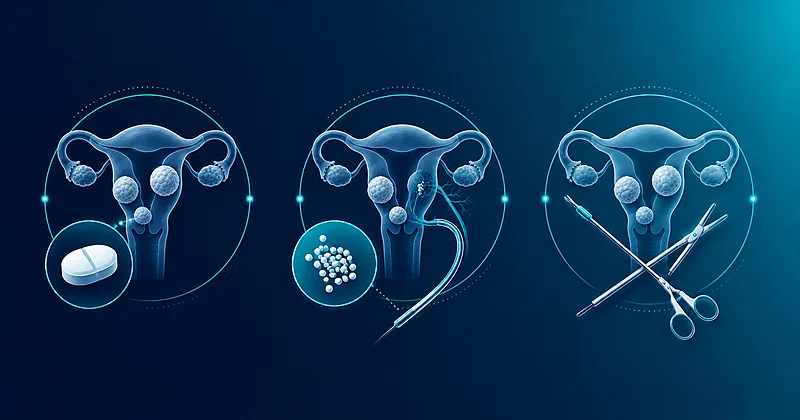
Three broad approaches dominate current practice. Oral GnRH antagonists offer non-invasive medical control of bleeding. Uterine artery embolization shrinks fibroids by blocking their blood supply while sparing the uterus. Surgery covers uterus-preserving myomectomy and definitive hysterectomy.
These routes were tested in different ways, which shapes how their evidence compares. The medical trials are placebo-controlled bleeding studies. The procedural trials are head-to-head comparisons using fibroid-specific quality of life. Reading them together, rather than in isolation, is what this review sets out to do.
The registration trials for GnRH antagonists enrolled women with objectively heavy bleeding, while the embolization-versus-surgery trials enrolled women who wanted to keep their uterus. The populations only partly overlap, so cross-trial numbers describe related but not identical patients.
Available Approaches
The table below summarizes the pivotal randomized evidence behind each route. Every sample size, effect size, and confidence interval was confirmed against a primary source, and each row carries a resolving citation in the reference list.
| Trial / Source | Design | N | Comparison | Key result | Tier |
|---|---|---|---|---|---|
| LIBERTY 1 & 2 (2021) | Two phase 3 RCTs, 24 weeks | 770 | Relugolix combination therapy vs placebo | Bleeding responders 73.4% and 71.2% vs 18.9% and 14.7% on placebo | [V] |
| ELARIS UF-1 & UF-2 (2020) | Two phase 3 RCTs, 6 months | 791 | Elagolix plus add-back vs placebo | Bleeding responders 68.5% and 76.5% vs 8.7% and 10% on placebo | [V] |
| FEMME (2020) | Open-label RCT, 2 years | 254 | Embolization vs myomectomy | Fibroid QoL favored myomectomy; adjusted difference 8.0 points (95% CI 1.8–14.1) | [V] |
| FUME (2012) | RCT, 1–2 years | 163 | Embolization vs myomectomy | Equal QoL at 1 year; hospital stay 2 vs 6 days; 2-year reintervention 14% vs 2.7% | [V] |
| REST (2007 / 2011) | Pragmatic RCT, 5 years | 157 | Embolization vs surgery | Quality of life similar at 5 years; reintervention after embolization about 32% | [V] |
| EMMY (2016) | RCT, 10 years | 177 | Embolization vs hysterectomy | Secondary hysterectomy after embolization 35% at 10 years; quality of life equivalent | [V] |
| Peng meta-analysis (2024) | Systematic review, 13 studies | 13 studies | Embolization vs myomectomy | Higher reintervention OR 1.84 (95% CI 1.62–2.10); higher hysterectomy OR 4.04 (95% CI 3.45–4.72) | [V] |
GnRH Antagonists: Oral Medical Therapy
Oral GnRH antagonists suppress pituitary gonadotropins and lower estrogen, which reduces fibroid-associated bleeding. Both approved agents pair the antagonist with low-dose hormonal add-back to blunt hypoestrogenic effects. Relugolix combines relugolix, estradiol, and norethindrone acetate in one daily tablet; the elagolix regimen uses elagolix with a separate add-back.
In the replicate LIBERTY trials, relugolix combination therapy led to a bleeding response in 73.4% and 71.2% of women, against 18.9% and 14.7% on placebo. The elagolix ELARIS trials showed the same pattern, with responder rates of 68.5% and 76.5% versus single-digit placebo rates. Because these were randomized trials, the bleeding reductions can be read as treatment effects rather than associations.
Durability is the main caveat. Benefit depends on continued use, fibroids tend to regrow after stopping, and treatment is capped at about 24 months because of concern over bone density loss that add-back only partly offsets. GnRH antagonists control symptoms; they do not remove fibroids, and no trial has tested them directly against a procedure.
Uterine Artery Embolization
Uterine artery embolization is an image-guided procedure in which an interventional radiologist blocks the fibroid blood supply with injected particles, causing infarction and shrinkage. It preserves the uterus and avoids a surgical incision, and randomized data now extend to ten years.
Across the FEMME, FUME, REST, and EMMY trials, embolization delivered meaningful and often durable quality-of-life gains with shorter hospital stays than surgery. In FUME, hospital stay was two days versus six for myomectomy. Its recurring limitation is the need for a repeat intervention: in EMMY, 35% of embolization patients had a hysterectomy within ten years, meaning about two thirds avoided one.
Surgery: Myomectomy and Hysterectomy
Surgery remains the reference standard for definitive treatment. Myomectomy removes fibroids while preserving the uterus and is the usual choice when fertility matters. Hysterectomy removes the uterus and eliminates the possibility of recurrence, at the cost of future childbearing.
The FEMME trial gave myomectomy a modest edge over embolization in fibroid-specific quality of life at two years, an adjusted difference of 8.0 points (95% CI 1.8 to 14.1). Myomectomy also carried a lower reintervention rate than embolization across trials and a 2024 meta-analysis. The trade-off is a more invasive procedure with a longer recovery and, for open surgery, greater early morbidity.
Comparative Analysis
The three routes answer different questions, so the comparison is best read outcome by outcome rather than as a single ranking. On bleeding control, the strongest direct evidence sits with GnRH antagonists, though only against placebo. On procedure-versus-procedure outcomes, the embolization and surgery trials provide head-to-head data.
For durability and reintervention, the pattern is consistent. The 2024 meta-analysis of embolization versus myomectomy found a higher reintervention rate with embolization (OR 1.84; 95% CI 1.62 to 2.10) and a higher subsequent hysterectomy rate (OR 4.04; 95% CI 3.45 to 4.72) at four years. Long-term trial data agree: reintervention after embolization ran near a third by five years in REST and EMMY.
On recovery and early safety, embolization has the advantage. It shortened hospital stay and, in the meta-analysis, was associated with fewer early major complications than myomectomy (OR 0.44; 95% CI 0.20 to 0.95). Quality-of-life gains were broadly similar between embolization and surgery in the Cochrane review, with myomectomy favored on symptom severity in longer follow-up.
GnRH antagonists occupy a distinct niche. They are the only non-invasive, reversible route, useful for controlling bleeding, treating anemia, or bridging to a procedure. Because their trials measured bleeding against placebo and not durable cure against embolization or surgery, they cannot be ranked on the same axis as the procedures.
Embolization buys a shorter recovery and uterine preservation but carries a higher chance of needing another procedure. Surgery is more durable but more invasive. Medical therapy is the least invasive but is time-limited and does not remove fibroids.
Quality and Consistency of the Evidence
The strength of evidence varies sharply by outcome. The list below rates each domain by the quality and consistency of the underlying data.
- Bleeding control with GnRH antagonists — High. Replicate phase 3 placebo-controlled trials (LIBERTY, ELARIS) with concordant responder rates and consistent effects across subgroups.
- Embolization versus surgery, quality of life — High to moderate. Several randomized trials plus a Cochrane review agree that early quality-of-life gains are broadly comparable.
- Reintervention after embolization — High to moderate. Consistent across REST, EMMY, FEMME, and a 2024 meta-analysis, though pooled estimates carry moderate heterogeneity.
- Longer-term symptom severity — Moderate. Trends favor myomectomy, but follow-up completeness declines over time.
- Fertility and pregnancy outcomes — Low. Few events, wide confidence intervals, and no trial powered for live birth.
- Any head-to-head ranking of all three routes — Very low. No trial compares medical therapy, embolization, and surgery together.
Two structural limits recur. The procedural trials were often conducted with earlier embolization technique, which may understate current performance, and several outcomes rest on open-label designs where subjective endpoints can be influenced by knowledge of allocation.
What the Evidence Does Not Show
- No randomized trial compares GnRH antagonists directly against embolization or surgery, so relative durability across medical and procedural routes is untested.
- No trial evaluates all three approaches head-to-head in one population.
- Fertility and live-birth data are too sparse to guide women who prioritize pregnancy; the FEMME trial could not draw firm conclusions here.
- Efficacy and safety of GnRH antagonists beyond about two years are not established, and post-treatment fibroid regrowth is not well quantified.
- Whether modern embolization technique lowers the historical reintervention rate has not been confirmed in long-term randomized data.
These gaps matter for counseling. The evidence describes each route on its own terms and, for the two procedures, against each other, but it does not tell a woman which single approach is best for her specific combination of symptoms and goals.
Practical Implications for Uterine Fibroid Treatment
The evidence supports matching the route to the dominant goal rather than declaring a universal first choice. What follows describes what the data support, not fixed directives.
When bleeding is the main problem and a woman prefers to avoid or defer a procedure, a GnRH antagonist offers reversible control and can correct anemia, within the roughly two-year treatment window. It also serves as a bridge before surgery or while planning is underway.
When uterine preservation is the priority and the goal is a durable, single procedure, myomectomy has the stronger quality-of-life signal and a lower reintervention rate. When a woman wants to keep her uterus but favors a shorter recovery and accepts a higher chance of a repeat procedure, embolization is well supported.
When childbearing is complete and definitive resolution is the aim, hysterectomy removes recurrence risk entirely. Across all routes, counseling that names the reintervention and durability trade-offs, alongside fertility intentions, reflects what the trials actually measured.
Evidence Grade and Bottom Line
Overall grade: Moderate to High within routes · Low across routes- Bleeding control with GnRH antagonists rests on high-quality replicate trials, but the data are against placebo and time-limited.
- Embolization and surgery are supported by direct randomized comparisons out to ten years, with consistent quality-of-life and reintervention findings.
- Myomectomy is modestly more durable; embolization offers faster recovery and uterine preservation with a higher repeat-procedure rate.
- The decisive limitation is the absence of any trial comparing all three approaches, so selection remains individualized to symptoms, fertility goals, and durability priorities.
Article Information and References
- Peng J, Wang J, Shu Q, Luo Y, Wang S, Liu Z. Systematic review and meta-analysis of current evidence in uterine artery embolization vs myomectomy for symptomatic uterine fibroids. Sci Rep. 2024;14:19252. DOI: https://doi.org/10.1038/s41598-024-69754-0
- Gupta JK, Sinha A, Lumsden MA, Hickey M. Uterine artery embolization for symptomatic uterine fibroids. Cochrane Database Syst Rev. 2014;(12):CD005073. DOI: https://doi.org/10.1002/14651858.CD005073.pub4
- Al-Hendy A, Lukes AS, Poindexter AN 3rd, Venturella R, Villarroel C, Critchley HOD, et al. Treatment of uterine fibroid symptoms with relugolix combination therapy. N Engl J Med. 2021;384(7):630–642. DOI: https://doi.org/10.1056/NEJMoa2008283
- Schlaff WD, Ackerman RT, Al-Hendy A, Archer DF, Barnhart KT, Bradley LD, et al. Elagolix for heavy menstrual bleeding in women with uterine fibroids. N Engl J Med. 2020;382(4):328–340. DOI: https://doi.org/10.1056/NEJMoa1904351
- Manyonda I, Belli AM, Lumsden MA, Moss J, McKinnon W, Middleton LJ, et al. Uterine-artery embolization or myomectomy for uterine fibroids. N Engl J Med. 2020;383(5):440–451. DOI: https://doi.org/10.1056/NEJMoa1914735
- de Bruijn AM, Ankum WM, Reekers JA, Birnie E, van der Kooij SM, Volkers NA, et al. Uterine artery embolization vs hysterectomy in the treatment of symptomatic uterine fibroids: 10-year outcomes from the randomized EMMY trial. Am J Obstet Gynecol. 2016;215(6):745.e1–745.e12. DOI: https://doi.org/10.1016/j.ajog.2016.06.051
- Moss JG, Cooper KG, Khaund A, Murray LS, Murray GD, Wu O, et al. Randomised comparison of uterine artery embolisation (UAE) with surgical treatment in patients with symptomatic uterine fibroids (REST trial): 5-year results. BJOG. 2011;118(8):936–944. DOI: https://doi.org/10.1111/j.1471-0528.2011.02952.x
- Edwards RD, Moss JG, Lumsden MA, Wu O, Murray LS, Twaddle S, Murray GD. Uterine-artery embolization versus surgery for symptomatic uterine fibroids. N Engl J Med. 2007;356(4):360–370. DOI: https://doi.org/10.1056/NEJMoa062003
- Manyonda IT, Bratby M, Horst JS, Banu N, Gorti M, Belli AM. Uterine artery embolization versus myomectomy: impact on quality of life — results of the FUME (Fibroids of the Uterus: Myomectomy versus Embolization) Trial. Cardiovasc Intervent Radiol. 2012;35(3):530–536. DOI: https://doi.org/10.1007/s00270-011-0228-5
- Amoah A, Quinn SD. Uterine-preserving treatments or hysterectomy reintervention after myomectomy or uterine artery embolisation: a retrospective cohort study of long-term outcomes. BJOG. 2023;130(7):823–831. DOI: https://doi.org/10.1111/1471-0528.17412
- Al-Hendy A, Venturella R, Arjona Ferreira JC, et al. LIBERTY randomized withdrawal study: relugolix combination therapy for heavy menstrual bleeding associated with uterine fibroids. Am J Obstet Gynecol. 2023;229(6):662.e1–662.e25. DOI: https://doi.org/10.1016/j.ajog.2023.08.030