
Acute Diverticulitis Treatment: 5 Core Clinical Insights
When to withhold antibiotics, who still needs them, and how the timing of elective sigmoid resection has changed.
What the evidence supports
- Randomised controlled trials — the strongest available evidence — show that acute diverticulitis treatment for mild, CT-confirmed uncomplicated disease does not require antibiotics; the AVOD trial found complications in 1.9% of patients managed without antibiotics versus 1.0% with them (P = 0.302).
- Antibiotics did not speed recovery: DIABOLO reported a median recovery of 14 versus 12 days (hazard ratio for recovery 0.91).
- Selected mild cases can be treated as outpatients without antibiotics; DINAMO found return-admission rates of 3.3% versus 5.8%.
- Antibiotics remain warranted for complicated disease and higher-risk patients — those who are immunocompromised, septic, or significantly comorbid.
- Elective sigmoid resection is individualised, not dictated by attack count; in LASER it improved quality of life but carried a 10% major-complication rate.
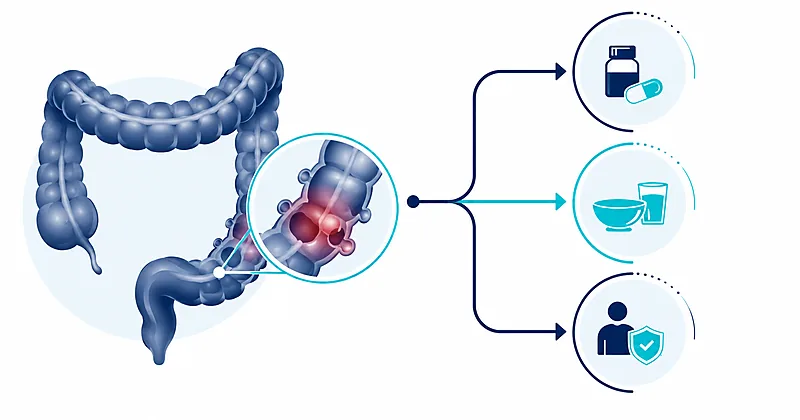
Why Acute Diverticulitis Treatment Matters
Colonic diverticulitis is one of the most common gastrointestinal reasons for hospital admission in high-income countries, and its frequency rises steeply with age. Over the past fifteen years, the way clinicians approach it has changed on the basis of randomised evidence rather than long habit.
Two traditions have drawn particular scrutiny. The first is the reflexive antibiotic prescription for every episode. The second is scheduling elective sigmoid resection once a patient reaches a set number of attacks. High-quality trials now challenge both.
Most presentations are mild. Uncomplicated disease — inflammation without abscess, perforation, fistula, obstruction, or stricture — accounts for the large majority of episodes, with complicated disease reported in roughly 12% of cases. The complications that antibiotics and surgery were meant to prevent are therefore the exception, not the rule.
The rethink is partly conceptual. Diverticulitis is increasingly understood as an inflammatory process rather than a primarily infectious one, which weakens the theoretical case for treating every episode with antibiotics.
The stakes cut both ways. Overtreating mild disease exposes patients to antibiotic harms and avoidable operations. Undertreating higher-risk patients risks perforation and sepsis. A more discriminating approach to acute diverticulitis treatment is now possible, and this review sets out what the trial data do and do not support.
Evidence Reviewed
The evidence base comprises four randomised controlled trials of antibiotic use, a pooled individual-patient meta-analysis, and two randomised trials of elective resection. Every figure in the table was taken from the primary report and cross-checked against the source this session.
| Study / Source | Design | N | Population | Comparison | Key result |
|---|---|---|---|---|---|
| AVOD (Chabok 2012) | Multicentre open-label RCT | 623 | CT-verified left-sided uncomplicated diverticulitis | Antibiotics (314) vs no antibiotics (309) | Complications 1.9% (no antibiotics) vs 1.0% (antibiotics), P = 0.302; 1-year recurrence 16% in both; median stay 3 days in both |
| DIABOLO (Daniels 2017) | Multicentre open-label non-inferiority RCT | 528 | First episode, CT-proven left-sided uncomplicated (small abscess allowed) | Observation vs antibiotics | Median recovery 14 vs 12 days; hazard ratio for recovery 0.91 (1-sided 95% CI lower limit 0.78; P = 0.151); sigmoid resection 3.8% vs 2.3% |
| STAND (Jaung 2021) | Double-blind, placebo-controlled RCT | 180 | CT-confirmed Hinchey 1a uncomplicated diverticulitis | Antibiotics (85) vs placebo (95) | No significant difference in length of hospital stay between placebo and antibiotics |
| DINAMO (Mora-López 2021) | Multicentre open-label non-inferiority RCT (outpatient) | 480 | Mild, CT-diagnosed uncomplicated diverticulitis | Symptomatic treatment without vs with antibiotics | Return visit with admission 3.3% (no antibiotics) vs 5.8% (antibiotics); absolute difference 2.58% (95% CI −1.17 to 6.32); non-inferior (margin 7%) |
| IPD meta-analysis (van Dijk 2020) | Individual-patient data meta-analysis (AVOD + DIABOLO) | 1,109 | Left-sided uncomplicated diverticulitis | Observation vs antibiotics (pooled) | No difference in recovery or adverse outcomes; a non-significant excess of complicated diverticulitis and sigmoid resection without antibiotics |
| DIRECT (van de Wall 2017) | Multicentre open-label RCT (stopped early for recruitment) | 109 | Recurrent (>2 episodes / 2 years) or ongoing complaints (>3 months) | Elective sigmoidectomy (53) vs conservative (56) | Significantly higher quality of life after sigmoidectomy at 6 months; about a quarter of the conservative group later had surgery |
| LASER (Santos 2021) | Multicentre open-label RCT | 85 | Recurrent, complicated, or persistent painful diverticulitis | Laparoscopic sigmoid resection (41) vs conservative | GIQLI quality-of-life score improved 11.8 points vs 0.2 points at 6 months; major complications in 4 of 41 (10%) after resection |
Key Findings on Acute Diverticulitis Treatment
Antibiotics can be withheld in uncomplicated disease
The most consistent signal in modern acute diverticulitis treatment is that antibiotics do not change the course of mild, CT-confirmed uncomplicated disease in immunocompetent patients. The AVOD trial randomised 623 patients and found no meaningful difference in complications between the no-antibiotic and antibiotic arms. Recovery and recurrence tracked together across both groups.
DIABOLO reinforced this in 528 patients using a non-inferiority design. Median time to recovery was 14 days with observation and 12 days with antibiotics, a difference that did not reach significance. Rates of complicated and recurrent diverticulitis were similar between strategies.
The STAND trial added the missing element of blinding. In 180 patients randomised to antibiotics or placebo, length of hospital stay did not differ, making it the first double-blind test of the question. Its result aligned with the two earlier open-label trials.
The durability of this finding matters as much as the short-term result. Long-term follow-up of the AVOD cohort found no significant difference between the two strategies in recurrence, complications, need for surgery, or reported quality of life.
Non-antibiotic management extends to the outpatient setting for carefully selected patients. DINAMO treated 480 patients with mild disease and found that omitting antibiotics was non-inferior for return visits requiring admission. The pooled individual-patient meta-analysis of AVOD and DIABOLO, covering 1,109 patients, reached the same overall conclusion on safety.
Which patients still warrant antibiotics
The trials define the boundary of their own conclusions. Every one excluded immunocompromised patients, pregnant women, and those with signs of sepsis, and most excluded complicated disease. The evidence for withholding antibiotics therefore stops at the door of these higher-risk groups.
The pooled analysis also carried a note of caution. Both trials showed a non-significant excess of complicated diverticulitis and sigmoid resection in the observation arm. This signal was associated with the no-antibiotic strategy without reaching significance, and which patients — if any — benefit from antibiotics remains unresolved.
Guidelines have converged on selective use. The American Gastroenterological Association advises using antibiotics selectively rather than routinely in immunocompetent patients with mild uncomplicated disease, while strongly advising them in immunocompromised patients. The society also flags comorbidity, frailty, refractory symptoms, and markedly raised inflammatory markers as reasons to treat.
Specific thresholds have been proposed as triggers for antibiotics. These include a C-reactive protein above 140 mg/L or a baseline white-cell count above 15 × 10⁹ cells/L, alongside vomiting, refractory symptoms, or a fluid collection on imaging.
Timing and indications for elective resection
Elective surgery has moved away from a fixed attack count. Historically, a set number of episodes triggered resection; the current approach weighs symptom burden, quality of life, and operative risk for the individual patient. Two randomised trials underpin this shift.
The DIRECT trial randomised 109 patients with recurrent or ongoing complaints to elective sigmoidectomy or conservative management. Surgery produced significantly higher quality of life at 6 months, and this benefit was sustained at 5-year follow-up. Notably, about a quarter of the conservative group ultimately chose surgery.
LASER tested laparoscopic resection in 85 patients with recurrent, complicated, or persistent painful disease. The gastrointestinal quality-of-life index improved by 11.8 points after surgery versus 0.2 points with conservative care. That benefit came with a cost: major complications occurred in 4 of 41 operated patients, and by 4 years roughly a third of the conservative group had also undergone surgery.
Surgical society guidance matches these data. The American Society of Colon and Rectal Surgeons recommends individualising the decision to operate after uncomplicated disease rather than fixing it to episode number. Elective resection is typically considered after an abscess managed without surgery, and is recommended for fistula, obstruction, or stricture.
The strongest, most reproducible finding across four randomised trials and a pooled individual-patient analysis is that antibiotics do not alter the trajectory of mild, CT-confirmed uncomplicated diverticulitis in immunocompetent patients. Every trial, however, excluded immunocompromised and septic patients — so the “no antibiotics” conclusion applies to low-risk disease and does not transfer to sicker or immunosuppressed patients.
Quality and Consistency of the Evidence
The strength of the evidence varies by question. The core antibiotic finding rests on several concordant trials; the resection evidence rests on two small trials with subjective endpoints.
- Strong and consistent — Antibiotics can be safely omitted in immunocompetent patients with mild uncomplicated diverticulitis. Four randomised trials and a pooled individual-patient meta-analysis point the same way, and one trial was double-blind.
- Moderate — Outpatient non-antibiotic management for selected mild disease. Supported by a single dedicated randomised trial (DINAMO) plus observational experience.
- Moderate — Elective sigmoid resection improves quality of life in recurrent or refractory disease. Two randomised trials agree in direction, but both are small, open-label, and use patient-reported endpoints.
- Low — The optimal threshold and timing for elective resection, and the identity of any subgroup that benefits from antibiotics. These remain undefined by current trials.
Two caveats apply across the antibiotic trials. Most were open-label, which can bias subjective outcomes, and all were powered for non-inferiority on common endpoints rather than for rare serious events such as free perforation.
What the Evidence Does Not Show
- It does not show that antibiotics can be safely omitted in immunocompromised, septic, pregnant, or complicated patients — these groups were excluded from every trial.
- The non-inferiority designs cannot exclude a small increase in rare complications; the trials were underpowered for events such as perforation.
- The pooled non-significant excess of complicated disease and resection without antibiotics is unexplained, and no subgroup that clearly benefits from antibiotics has been identified.
- The optimal timing and threshold for elective resection are undefined; the two trials enrolled patients already selected for recurrent or refractory disease.
- Long-term (beyond 5 years) resection outcomes and cost-effectiveness are incompletely characterised.
- The best antibiotic regimen, route, and duration when antibiotics are indicated have not been established by these trials.
Practical Implications
For an immunocompetent patient with CT-confirmed mild uncomplicated disease, the evidence supports observation without antibiotics. Outpatient management is a reasonable option for selected patients who meet stability criteria and can be followed closely.
Antibiotics are still supported where risk is higher. This includes complicated disease, immunosuppression, sepsis or systemic signs, significant comorbidity or frailty, refractory symptoms, and markedly elevated inflammatory markers. In these settings the trials offer no reassurance about omitting antibiotics.
Decisions about elective resection are best framed around symptom burden, quality of life, and operative risk rather than a fixed attack count. Because a substantial minority of conservatively managed patients later choose surgery, shared decision-making that revisits the option over time is reasonable.
After resolution, colonoscopy is advised in appropriate candidates to exclude an underlying malignancy, since a small proportion of presentations attributed to diverticulitis prove to be cancer. Timing and need depend on the recency of prior endoscopy and the severity of the episode.
Evidence Grade and Bottom Line
Overall evidence grade: Moderate- Most immunocompetent patients with mild, CT-confirmed uncomplicated diverticulitis do not need antibiotics; withholding them does not delay recovery or increase complications in the trials.
- Antibiotics should be reserved for complicated disease and higher-risk patients, where the supportive evidence for omission does not apply.
- Elective sigmoid resection improves quality of life in recurrent or refractory disease but carries a real operative risk, so it is individualised rather than triggered by attack number.
- The overall grade is moderate: the antibiotic evidence is strong and consistent, while the resection evidence comes from two small open-label trials.
Article Information and References
For Educational Purposes Only. This is an original evidence synthesis informed by the studies listed below. It does not replace clinical judgement. Drug dosages should be verified against current prescribing information.
- van Dijk ST, Chabok A, Dijkgraaf MG, Boermeester MA, Smedh K. Observational versus antibiotic treatment for uncomplicated diverticulitis: an individual-patient data meta-analysis. Br J Surg. 2020;107(8):1062–1069. DOI: https://doi.org/10.1002/bjs.11465
- Dichman ML, et al. Antibiotics for uncomplicated diverticulitis. Cochrane Database Syst Rev. 2022;(6):CD009092. DOI: https://doi.org/10.1002/14651858.CD009092.pub3
- Chabok A, Påhlman L, Hjern F, Haapaniemi S, Smedh K. Randomized clinical trial of antibiotics in acute uncomplicated diverticulitis. Br J Surg. 2012;99(4):532–539. DOI: https://doi.org/10.1002/bjs.8688
- Daniels L, Ünlü Ç, de Korte N, et al. Randomized clinical trial of observational versus antibiotic treatment for a first episode of CT-proven uncomplicated acute diverticulitis. Br J Surg. 2017;104(1):52–61. DOI: https://doi.org/10.1002/bjs.10309
- Jaung R, Nisbet S, Gosselink MP, et al. Antibiotics do not reduce length of hospital stay for uncomplicated diverticulitis in a pragmatic double-blind randomized trial. Clin Gastroenterol Hepatol. 2021;19(3):503–510.e1. DOI: https://doi.org/10.1016/j.cgh.2020.03.049
- Mora-López L, Ruiz-Edo N, Estrada-Ferrer O, et al. Efficacy and safety of nonantibiotic outpatient treatment in mild acute diverticulitis (DINAMO-study): a multicentre, randomised, open-label, noninferiority trial. Ann Surg. 2021;274(5):e435–e442. DOI: https://doi.org/10.1097/SLA.0000000000005031
- Isacson D, Smedh K, Nikberg M, Chabok A. Long-term follow-up of the AVOD randomized trial of antibiotic avoidance in uncomplicated diverticulitis. Br J Surg. 2019;106(11):1542–1548. DOI: https://doi.org/10.1002/bjs.11239
- van de Wall BJM, Stam MAW, Draaisma WA, et al. Surgery versus conservative management for recurrent and ongoing left-sided diverticulitis (DIRECT trial): an open-label, multicentre, randomised controlled trial. Lancet Gastroenterol Hepatol. 2017;2(1):13–22. DOI: https://doi.org/10.1016/S2468-1253(16)30109-1
- Bolkenstein HE, Consten ECJ, van der Palen J, et al. Long-term outcome of surgery versus conservative management for recurrent and ongoing complaints after an episode of diverticulitis: 5-year follow-up results of a multicentre randomized controlled trial (DIRECT-trial). Ann Surg. 2019;269(4):612–620. DOI: https://doi.org/10.1097/SLA.0000000000003033
- Santos A, Mentula P, Pinta T, et al. Comparing laparoscopic elective sigmoid resection with conservative treatment in improving quality of life of patients with diverticulitis: the laparoscopic elective sigmoid resection following diverticulitis (LASER) randomized clinical trial. JAMA Surg. 2021;156(2):129–136. DOI: https://doi.org/10.1001/jamasurg.2020.5151
- Hall J, Hardiman K, Lee S, et al. The American Society of Colon and Rectal Surgeons clinical practice guidelines for the treatment of left-sided colonic diverticulitis. Dis Colon Rectum. 2020;63(6):728–747. DOI: https://doi.org/10.1097/DCR.0000000000001679
- Peery AF, Shaukat A, Strate LL. AGA clinical practice update on medical management of colonic diverticulitis: expert review. Gastroenterology. 2021;160(3):906–911.e1. DOI: https://doi.org/10.1053/j.gastro.2020.09.059