
Small Bowel Obstruction Management: The Contrast Challenge and Surgery Timing
Where the water-soluble contrast study earns its keep, when a trial of non-operative care is safe, and how far the clock can run before the operating room.
One-Minute Takeaway
- In adhesive small bowel obstruction, the water-soluble contrast study is a strong diagnostic test: pooled sensitivity reached 96% and specificity 98% for predicting which patients resolve without surgery — high-quality diagnostic evidence.
- Its therapeutic effect is contested. The largest randomized trial (242 patients) and a randomized-trials-only meta-analysis (879 patients) found no clinically meaningful reduction in operations or length of stay.
- Surgical delay is associated with harm. In a 9,991-patient national audit, 30-day mortality was 7.2%, and operation after 72 hours carried higher mortality — though the data are observational.
- Guidelines support a non-operative trial for up to 72 hours when there is no peritonitis, strangulation, or ischemia; those signs point to prompt surgery.
- The pragmatic reading: let the contrast study guide the decision, and operate promptly once it fails or ischemia is suspected.
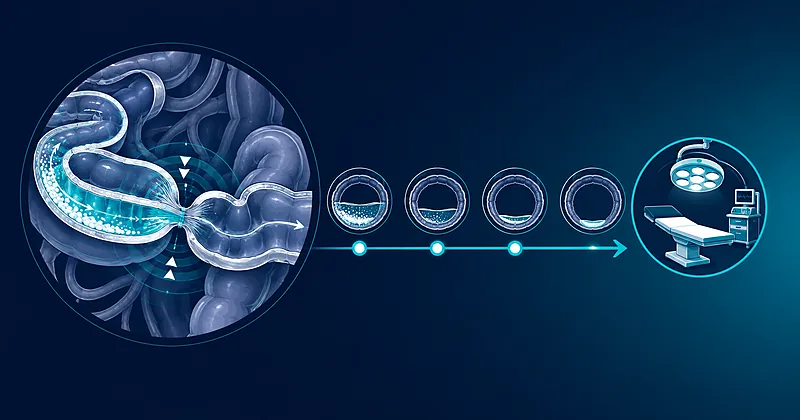
Why Small Bowel Obstruction Matters
Small bowel obstruction is one of the most common reasons a general surgeon is called to the acute abdomen. Most cases are adhesive, the mechanical footprint of previous abdominal or pelvic surgery.
The stakes sit in the decision, not the diagnosis. Cross-sectional imaging usually confirms obstruction quickly. The harder question is what to do next: give the bowel time to open, or take the patient to theatre.
Two failure modes bracket that choice. Operating on a patient who would have resolved exposes them to an avoidable laparotomy and fresh adhesions. Waiting on a patient with strangulation risks bowel loss, perforation, and death. Both are common; both are consequential.
National data frame the downside. In a UK audit of nearly ten thousand emergency laparotomies for small bowel obstruction, 30-day mortality was 7.2 per cent, and it rose with age, physiological derangement, and contamination at operation. The margin for a wrong call is thin.
The Clinical Problem in Small Bowel Obstruction
Two intertwined questions drive management of adhesive small bowel obstruction. First, who can safely avoid an operation? Second, if a trial of non-operative care begins, how long can it run before delay becomes the greater risk?
The water-soluble contrast study sits at the centre of the first question. A hyperosmolar agent such as Gastrografin is given orally or by nasogastric tube, and serial films track its passage. Contrast that reaches the colon signals that the lumen is patent enough to resolve without surgery.
A crucial distinction runs through the evidence. Predicting resolution and causing it are not the same claim. A test can identify who will get better on their own while doing nothing to speed their recovery. Much of the controversy below turns on conflating those two roles.
Diagnostic versus therapeutic — the core distinction
The contrast study can be a predictor (which obstructions will open without operation) and, separately, a proposed treatment (the hyperosmolar load drawing fluid into the lumen to relieve the obstruction). The evidence for the first role is strong and consistent. The evidence for the second is genuinely mixed. Reading a positive predictive study as proof of a treatment effect is the commonest misstep in this literature.
The second question — timing — has no randomized answer. Guidelines set a pragmatic ceiling on the non-operative trial, and large registries describe what happens when that ceiling is exceeded. The two lines of evidence are different in kind, and treating observational timing data as if it were causal overstates what is known.
Available Approaches
Three approaches are weighed in practice: the water-soluble contrast study as a decision tool, timely operative intervention, and a monitored trial of non-operative care. The comparative evidence below draws on diagnostic meta-analyses, randomized trials that both support and reject a treatment effect, and national cohorts on timing.
| Source | Design | N | Focus | Key result | Tier |
|---|---|---|---|---|---|
| Branco 2010 | Meta-analysis (14 prospective studies) | 14 studies | Diagnostic: contrast reaching colon at 4–24 h | Sensitivity 96%, specificity 98% for predicting non-surgical resolution | [V] |
| Ceresoli 2016 | Meta-analysis | Prospective studies + RCTs | Diagnostic and therapeutic value | Sensitivity 92%, specificity 93%; accuracy higher when film taken after ≥8 h | [V] |
| Di Saverio 2008 | Randomized controlled trial | 76 | Gastrografin meal (36 h cut-off) vs traditional care | Positive: contrast-guided protocol reduced operative need vs controls | [V] |
| Scotté 2017 (ASBO Study) | Multicentre randomized controlled trial | 242 | Gastrografin vs saline; endpoint = surgery within 48 h | Null: no reduction in operative intervention or hospital stay | [V] |
| Koh 2019 | Meta-analysis (9 randomized trials) | 879 | Therapeutic value vs control | Length of stay −0.15 days (not clinically significant); no reduction in surgery; no mortality difference | [V] |
| Almeghthawi 2025 | Meta-analysis (12 randomized trials) | 1,150 | Hyperosmolar contrast vs standard non-operative care | Length of stay −2.17 days (95% CI −3.28 to −1.06); surgery RR 0.63 (95% CI 0.50–0.81) | [V] |
| Peacock 2018 (NELA) | National cohort | 9,991 | Time from admission to laparotomy | Overall 30-day mortality 7.2%; delay >72 h associated with higher 30-day mortality (adjusted OR 1.39, 95% CI 1.09–1.76) | [V] |
| Richardson 2023 (NIS) | National cohort | 28,440 | Early (≤3 days) vs delayed (>3 days) intervention | Delay linked to major adverse events (AOR 1.30, 95% CI 1.16–1.45), longer stay, non-home discharge; death AOR 1.27 (95% CI 0.97–1.68, NS) | [V] |
The Water-Soluble Contrast Challenge
As a predictor, the contrast study performs well and consistently. Pooling fourteen prospective studies, contrast reaching the colon within 4 to 24 hours predicted non-surgical resolution with a sensitivity of 96 per cent and specificity of 98 per cent.
A later meta-analysis reported comparable accuracy, with sensitivity 92 per cent and specificity 93 per cent, and noted that predictive accuracy improved when the abdominal film was taken at least 8 hours after administration. The timing of the film, not just the study itself, shapes the result.
The therapeutic claim is weaker. An early randomized trial of 76 patients reported that a Gastrografin protocol reduced the need for operation compared with traditional care. That signal did not hold up under the most rigorous test.
The largest randomized trial to date — a multicentre study of 242 patients comparing Gastrografin with saline — found no reduction in operative intervention within 48 hours and no shorter hospital stay. A meta-analysis restricted to randomized trials, pooling 879 patients, concurred.
That randomized-only synthesis found a length-of-stay reduction of 0.15 days, roughly 3.6 hours, which the authors judged not clinically significant, with no reduction in operations and no mortality difference. On the highest-quality evidence, the treatment effect is small at best.
The picture is not uniform. A 2025 meta-analysis of twelve randomized trials and 1,150 patients reported a shorter stay by 2.17 days (95% CI −3.28 to −1.06) and a lower operative rate (relative risk 0.63, 95% CI 0.50–0.81). The discordance is real and traces to how the trials differ.
Older and positive syntheses lean on small, single-centre trials in which post-contrast radiology could unblind the treating team, and on pooled observational studies. The null results come from the largest multicentre trial and from randomized-only pooling. Design, blinding, and dosing all vary, and the field has not converged.
Timing of Operative Intervention
When operation is needed, delay tracks with worse outcomes across large datasets. In the UK national audit of 9,991 emergency laparotomies for small bowel obstruction, a delay of more than 72 hours was associated with higher 30-day mortality after adjustment (adjusted odds ratio 1.39, 95% CI 1.09–1.76).
A contemporary US analysis of 28,440 patients requiring surgery told a similar story. Compared with intervention within three days, delay beyond that point carried greater odds of major adverse events (adjusted odds ratio 1.30, 95% CI 1.16–1.45), longer postoperative stay, and non-home discharge.
In that dataset, in-hospital death was not significantly higher with delay (adjusted odds ratio 1.27, 95% CI 0.97–1.68). Separately, trials of non-operative management extending beyond three days were associated with increased morbidity among patients who ultimately came to surgery.
These associations are consistent, but they are observational. Sicker patients, and those with evolving strangulation, are more likely both to be operated on late and to fare badly. Confounding by indication means the numbers describe risk, not a proven causal penalty for the clock alone.
Non-Operative Management and Its Limits
For uncomplicated adhesive obstruction without alarm features, a monitored trial of non-operative care is standard: bowel rest, nasogastric decompression, and fluid resuscitation, with the contrast study layered in to predict resolution.
Guidelines put a boundary on that trial. The 2017 WSES Bologna update supports non-operative management for up to 72 hours in the absence of peritonitis, strangulation, or ischemia, and places the water-soluble contrast study within the diagnostic pathway.
The limit is failure to progress. Across series, a substantial minority — commonly cited around 20 to 30 per cent — do not resolve and require operation. Non-operative management buys a controlled window; it is not an endpoint, and its safety depends on the absence of ischemia.
Comparative Analysis
Placed side by side, the three approaches answer different parts of one decision. The contrast study answers “who,” timing answers “how long,” and non-operative care is the setting in which both play out.
On prediction, the evidence is strong and stable. Two meta-analyses independently found high sensitivity and specificity for contrast transit predicting non-surgical resolution. Used this way, the study meaningfully sharpens triage of who needs an operation.
On treatment, the strongest evidence is unconvincing. The largest randomized trial and a randomized-only meta-analysis found no clinically important reduction in operations or stay. Positive pooled results exist but rest on weaker, often unblinded trials. The defensible position is that contrast predicts more than it treats.
On timing, the association between delay and harm is consistent across national cohorts but not causal. Guidelines translate that uncertainty into a 72-hour trial with hard exceptions. The practical value of the timing literature is a ceiling, not a stopwatch.
The approaches therefore combine rather than compete. A contrast study that shows colonic filling supports continued non-operative care; one that does not, especially past the guideline window, supports operation. Alarm features override the whole sequence and send the patient straight to theatre.
Quality and Consistency of the Evidence
Strength of evidence varies sharply by claim. The following grades reflect the design and consistency behind each element of management.
- Diagnostic accuracy of the contrast study (High): Two independent meta-analyses report consistently high sensitivity and specificity for predicting non-surgical resolution. Strong evidence supports its predictive role.
- Therapeutic effect of contrast (Low to moderate, contested): Randomized trials conflict. The largest multicentre trial and a randomized-only meta-analysis are null; other syntheses are positive but lean on smaller, often unblinded studies. Evidence does not support a reliable treatment effect.
- Delay and adverse outcomes (Moderate, observational): Large national cohorts consistently associate later surgery with higher morbidity and mortality, but confounding by indication limits causal inference.
- Immediate surgery for strangulation or peritonitis (High consensus): Universal guideline agreement, supported by physiology and outcome data, though not randomized for ethical reasons.
- Optimal precise timing threshold (Low): No randomized trial isolates a causal timing effect or defines the ideal cut-off. The 72-hour figure is pragmatic, not proven.
What the Evidence Does Not Show
Specific gaps in the current evidence
No randomized trial establishes a causal timing threshold; the delay–mortality link is observational and confounded by disease severity.
The independent mechanism by which contrast might treat obstruction, rather than merely predict resolution, remains unproven, and trials diverge on blinding, single- versus multi-centre design, dose, and imaging interval.
Dose, route (oral versus nasogastric), and the interval to imaging are not standardized across trials, limiting direct comparison.
High-quality data are sparse on whether CT findings or biomarkers such as lactate and procalcitonin can shorten the decision window and flag early ischemia.
Most randomized evidence is confined to uncomplicated adhesive obstruction; complicated, malignant, and virgin-abdomen presentations are under-studied.
Long-term outcomes — recurrence and subsequent operations after contrast-guided non-operative care versus early surgery — are poorly characterized.
Practical Implications
The evidence supports a sequence rather than a single manoeuvre. What follows describes what the data back, not a substitute for bedside judgement.
Triage before testing. Peritonitis, strangulation, or ischemia on imaging point to prompt operation. The contrast study is not for these patients; it is a tool for the uncomplicated obstruction.
Use contrast to predict. In uncomplicated adhesive obstruction without ischemia, contrast reaching the colon within roughly 24 hours strongly favours non-surgical resolution and supports continued non-operative care.
Time the film. Predictive accuracy improves when the abdominal radiograph is taken at least 8 hours after administration, so an early negative film should not prematurely trigger operation.
Respect the window. A non-operative trial is reasonable for up to about 72 hours per guidelines. Because observational data associate longer delays with worse outcomes, failure to progress within that window supports operating.
Do not expect contrast to cure. Its proven value is predictive; the strongest randomized evidence shows little independent treatment effect. Manage expectations accordingly.
Reassess continuously. Rising lactate, fever, tachycardia, or worsening pain shifts the balance toward operation regardless of where the clock stands.
Evidence Grade and Bottom Line
Overall Grade
Diagnostic accuracy of the contrast study: High. Therapeutic effect of contrast: Low to moderate and contested. Delay–outcome association: Moderate (observational). Precise timing threshold: Low.
The confident claim is predictive: the water-soluble contrast study reliably identifies who will resolve without surgery. The uncertain claims are that it treats the obstruction and that any specific delay cut-off is causally correct.
- Rule out strangulation, peritonitis, and ischemia first; those findings mandate prompt operation and bypass the contrast pathway.
- In uncomplicated adhesive obstruction, use the contrast study to predict resolution, imaging at least 8 hours out for best accuracy.
- Support non-operative care for up to about 72 hours; treat failure to progress within that window as a reason to operate.
- Expect prediction, not cure, from the contrast agent, and let clinical deterioration override the timeline at any point.
Article Information and References
- Koh A, Adiamah A, Chowdhury A, Mohiuddin MK, Bharathan B. Therapeutic Role of Water-Soluble Contrast Media in Adhesive Small Bowel Obstruction: a Systematic Review and Meta-Analysis. J Gastrointest Surg. 2020;24(2):473–483. DOI: https://doi.org/10.1007/s11605-019-04341-7
- Branco BC, Barmparas G, Schnüriger B, Inaba K, Chan LS, Demetriades D. Systematic review and meta-analysis of the diagnostic and therapeutic role of water-soluble contrast agent in adhesive small bowel obstruction. Br J Surg. 2010;97(4):470–478. DOI: https://doi.org/10.1002/bjs.7019
- Ceresoli M, Coccolini F, Catena F, Montori G, Di Saverio S, Sartelli M, Ansaloni L. Water-soluble contrast agent in adhesive small bowel obstruction: a systematic review and meta-analysis of diagnostic and therapeutic value. Am J Surg. 2016;211(6):1114–1125. DOI: https://doi.org/10.1016/j.amjsurg.2015.06.012
- Almeghthawi AH, Alrawithi MS, Alshehri ZA, et al. Evaluating Hyperosmolar Water-Soluble Contrast Media for Diagnosing Adhesive Small Bowel Obstruction: A Systematic Review and Meta-Analysis of Randomized Controlled Trials. Cureus. 2025;17(11):e95937. DOI: https://doi.org/10.7759/cureus.95937
- Ten Broek RPG, Krielen P, Di Saverio S, et al. Bologna guidelines for diagnosis and management of adhesive small bowel obstruction (ASBO): 2017 update of the evidence-based guidelines from the World Society of Emergency Surgery ASBO working group. World J Emerg Surg. 2018;13:24. DOI: https://doi.org/10.1186/s13017-018-0185-2
- Maung AA, Johnson DC, Piper GL, et al. Evaluation and management of small-bowel obstruction: an Eastern Association for the Surgery of Trauma practice management guideline. J Trauma Acute Care Surg. 2012;73(5 Suppl 4):S362–S369. DOI: https://doi.org/10.1097/TA.0b013e31827019de
- Di Saverio S, Catena F, Ansaloni L, Gavioli M, Valentino M, Pinna AD. Water-soluble contrast medium (Gastrografin) value in adhesive small intestine obstruction (ASIO): a prospective, randomized, controlled, clinical trial. World J Surg. 2008;32(10):2293–2304. DOI: https://doi.org/10.1007/s00268-008-9694-6
- Scotté M, Mauvais F, Bubenheim M, et al. Use of water-soluble contrast medium (gastrografin) does not decrease the need for operative intervention nor the duration of hospital stay in uncomplicated acute adhesive small bowel obstruction? A multicenter, randomized, clinical trial (Adhesive Small Bowel Obstruction Study) and systematic review. Surgery. 2017;161(5):1315–1325. DOI: https://doi.org/10.1016/j.surg.2016.11.026
- Burge J, Abbas SM, Roadley G, Donald J, Connolly A, Bissett IP, Hill AG. Randomized controlled trial of Gastrografin in adhesive small bowel obstruction. ANZ J Surg. 2005;75(8):672–674. DOI: https://doi.org/10.1111/j.1445-2197.2005.03491.x
- Peacock O, Bassett MG, Kuryba A, Walker K, Davies E, Anderson I, Vohra RS. Thirty-day mortality in patients undergoing laparotomy for small bowel obstruction. Br J Surg. 2018;105(8):1006–1013. DOI: https://doi.org/10.1002/bjs.10812
- Richardson S, Chervu NL, Mabeza RM, et al. Impact of delayed intervention following admission for small bowel obstruction: A contemporary analysis. Surg Open Sci. 2023;16:8–13. DOI: https://doi.org/10.1016/j.sopen.2023.09.002
- Keenan JE, Turley RS, McCoy CC, Migaly J, Shapiro ML, Scarborough JE. Trials of nonoperative management exceeding 3 days are associated with increased morbidity in patients undergoing surgery for uncomplicated adhesive small bowel obstruction. J Trauma Acute Care Surg. 2014;76(6):1367–1372. DOI: https://doi.org/10.1097/TA.0000000000000246
- Schraufnagel D, Rajaee S, Millham FH. How many sunsets? Timing of surgery in adhesive small bowel obstruction: a study of the Nationwide Inpatient Sample. J Trauma Acute Care Surg. 2013;74(1):181–187. DOI: https://doi.org/10.1097/TA.0b013e31827891a1