
The Annual Wellness Visit and Adult Immunizations: Making Every Preventive Visit Count
Clinical Practice Update — AWV Components and Documentation, the ACIP 2025 Adult Immunization Schedule, USPSTF Screening Integration, and Practical Workflows for Primary Care
This is an original clinical education article informed by current guidelines and evidence. See References below for source documents.
- Clinical Focus
- Medicare Annual Wellness Visit structure and documentation, Health Risk Assessment, personalised prevention plan, ACIP 2025 adult immunization schedule by age, USPSTF A/B preventive screenings, depression and cognitive screening, fall risk assessment, advance care planning
- Target Audience
- Family physicians, general internists, nurse practitioners, physician assistants, pharmacists, care managers, residents
- Setting
- Outpatient primary care, Medicare wellness clinics, FQHCs, rural health clinics
- Source Evidence
- •CMS Medicare Annual Wellness Visit Requirements (42 CFR §410.15)
- •ACIP Recommended Adult Immunization Schedule, United States, 2025 (MMWR 2025;74(2):30–33) with 2025 Addendum
- •USPSTF A and B Recommendations for Preventive Services (current as of 2025)
- •CDC STEADI Initiative for Fall Risk Assessment
Key Clinical Takeaways
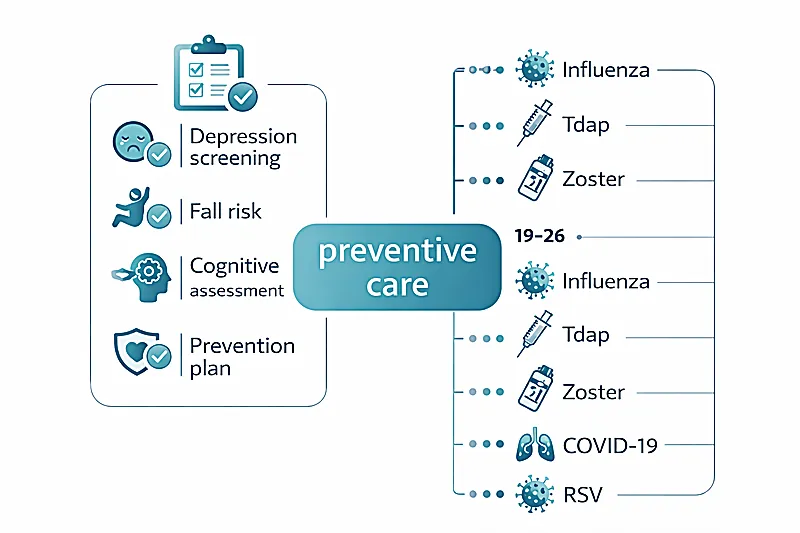
- 1The AWV is NOT a physical exam — it is a structured preventive planning visit that generates a personalised prevention plan based on the patient’s health risk assessment → AWV Components
- 2Every AWV must include: Health Risk Assessment, medical/family/social history update, current medications and providers list, depression screening, cognitive assessment, functional ability and fall risk assessment, and a written personalised prevention plan → Checklist
- 3Use the ACIP adult immunization schedule to update vaccines at every AWV — key routine vaccines include influenza (annual), Td/Tdap, Zoster (RZV, age ≥50), pneumococcal (PCV, age ≥65 or risk-based), and COVID-19 → Immunizations
- 4The 2025 ACIP schedule introduced several changes: influenza vaccines switched to trivalent formulations, new PCV21 option for pneumococcal vaccination, and RSV vaccine now recommended for adults 50–59 at increased risk (addendum) → What Changed
- 5Integrate USPSTF A and B recommendations into the AWV prevention plan — Medicare covers preventive services with an A or B rating at no cost-sharing to the beneficiary → Screenings
- 6Advance care planning (ACP) is an optional but reimbursable component of the AWV — offer it at the patient’s discretion → ACP
- 7If a separately identifiable E/M service is needed during the AWV (e.g., addressing a chronic condition), bill the E/M code with modifier -25 in addition to the AWV code → Billing
- 8Do not restart or add doses to a vaccine series for extended intervals between doses — pick up where the patient left off → Catch-Up
What Must the Annual Wellness Visit Include?
The AWV is a preventive planning visit, not a head-to-toe physical exam. Its purpose is to develop or update a personalised prevention plan. CMS requires specific components to be documented for proper reimbursement. The visit is covered at 100% with no copay, coinsurance, or deductible for the beneficiary.
| Required Component | What to Document | Practical Tip |
|---|---|---|
| Health Risk Assessment (HRA) | Demographics, self-assessed health status, psychosocial risks (depression, stress, social isolation), behavioural risks (tobacco, alcohol, physical activity, nutrition), ADLs and IADLs | Can be completed by the patient before the visit (via portal, mailed form, or in-office questionnaire). Staff can collect most HRA data before the provider enters the room. |
| Medical, family, and social history | Update with attention to modifiable risk factors; include past surgical history, reproductive history, and substance use | Focus the history update on changes since the last visit and new family diagnoses that alter screening recommendations (e.g., first-degree relative with CRC diagnosed <60). |
| Current medications and providers | Complete list of current medications (including OTCs, supplements) and all current providers/suppliers | Medication reconciliation is a key safety opportunity. Flag high-risk medications (anticoagulants, insulin, opioids) and check for drug interactions. |
| Depression screening | Use a validated tool: PHQ-2 (screen), PHQ-9 (if positive), or Geriatric Depression Scale | Depression screening is a USPSTF B recommendation for all adults. If positive, document a follow-up plan (referral, medication, re-screening). |
| Cognitive assessment | Assess for cognitive impairment using structured observation or a validated tool (Mini-Cog, MMSE, MoCA, or SLUMS) | CMS requires assessment of cognitive function but does not mandate a specific tool. Observe for signs during the visit and use a formal screen if concerns arise. |
| Fall risk assessment | Functional ability and level of safety; use CDC STEADI tools (Timed Up and Go, 30-Second Chair Stand, 4-Stage Balance Test) | Assessing fall risk is a minimum CMS requirement. If fall risk is identified, document referral for PT/OT, medication review (sedatives, antihypertensives), home safety assessment, and vision check. |
| Routine measurements | Height, weight, BMI, blood pressure | Baseline weight and BMI are useful for tracking changes over time. BP screening is a USPSTF A recommendation for all adults. |
| Personalised prevention plan | Written plan listing: risk factors/conditions requiring intervention, USPSTF/ACIP-recommended screenings and immunizations, health education referrals, and advance care planning status | The prevention plan must be furnished to the patient (printed or via portal). This is the central deliverable of the AWV. Include a vaccination schedule update. |
Which Vaccines Should You Offer at the AWV?
The AWV is the ideal opportunity to review vaccination status and close immunization gaps. The ACIP 2025 adult immunization schedule (approved October 2024, with addendum updates through 2025) is the authoritative reference. Always use the full schedule — including Tables 1 (by age), 2 (by medical condition), Notes, and Appendix — when making patient-specific decisions.
| Vaccine | Who Needs It | Schedule | What to Tell the Patient |
|---|---|---|---|
| Influenza | All adults, annually | 1 dose every season (trivalent formulations for 2024–25 and 2025–26 seasons) | For adults ≥65, use high-dose, adjuvanted, or recombinant formulations (preferred over standard-dose). Vaccine composition is updated each season. |
| Td/Tdap | All adults | 1 dose Tdap if not previously received, then Td or Tdap booster every 10 years. Tdap during each pregnancy (27–36 weeks). | Many adults are overdue for boosters. Check date of last tetanus vaccine at every AWV. Wound management may warrant earlier booster. |
| Zoster (RZV) | Adults ≥50 years; adults ≥19 if immunocompromised | 2 doses, 2–6 months apart. Recommended even if patient previously received the live zoster vaccine (ZVL). | RZV is >90% effective against shingles. Common side effects (injection site pain, fatigue, myalgia) are short-lived. Emphasise both doses are needed for full protection. |
| Pneumococcal (PCV) | Adults ≥65 (routine); ages 19–64 with risk conditions | 1 dose PCV15, PCV20, or PCV21 if not previously vaccinated with any PCV. If PCV15 is used, follow with 1 dose PPSV23 at least 1 year later. | PCV21 is a new option in the 2025 schedule. For patients who previously received only PPSV23, a dose of PCV is still recommended. Check prior pneumococcal vaccination history carefully. |
| COVID-19 | All adults; additional doses for ≥65 and immunocompromised | Per current ACIP recommendations (updated seasonally). Check the ACIP schedule addendum for the most current guidance. | Recommendations evolve with each season. Confirm the patient has received the most recently recommended formulation. Adults ≥65 may receive an additional dose. |
| RSV | Adults ≥75 (routine); ages 60–74 at increased risk; ages 50–59 at increased risk (2025 addendum) | 1 dose (Arexvy, Abrysvo, or mResvia). Additional doses not currently recommended. | RSV vaccine is relatively new for adults. The 2025 addendum extended the recommendation down to ages 50–59 for those at increased risk of severe RSV disease. Pregnancy: single dose of Abrysvo (32–36 weeks) to protect the newborn. |
| Hepatitis B | Universal for ages 19–59; risk-based for ≥60 | 2-dose (Heplisav-B) or 3-dose (Engerix-B, Recombivax HB, PreHevbrio) series | Universal Hep B vaccination for adults 19–59 was updated in 2022. Many adults lack documentation of childhood vaccination. If status is unknown, vaccinate rather than test. |
- Always check the full ACIP schedule (Tables 1 and 2, Notes, Appendix, and Addendum) for the most current recommendations, as addendum updates occur between annual publications.
- Do not restart vaccine series for extended intervals between doses. Resume where the patient left off.
- Catch-up vaccines for adults: check MMR (born 1957 or later without evidence of immunity), varicella (born 1980 or later without evidence of immunity), HPV (through age 26, shared decision 27–45).
Clinical Decision Pathway
Evidence in Context
What Changed in the 2025 ACIP Adult Schedule
Key changes from the 2024 schedule include: all influenza vaccine sections now reflect trivalent formulations (replacing quadrivalent); PCV21 was added as a new pneumococcal conjugate vaccine option alongside PCV15 and PCV20; RSV vaccine recommendations were updated; COVID-19 vaccine guidance was revised for 2024–25 season formulations with additional doses for adults ≥65 and immunocompromised; inactivated polio vaccine was added to the tables; and meningococcal serogroup B vaccine dosing intervals were updated. The 2025 addendum further added RSV vaccine for adults 50–59 at increased risk of severe disease and approved a pentavalent meningococcal vaccine (MenABCWY).
AWV vs. Routine Physical Exam vs. IPPE
These are distinct services. The Initial Preventive Physical Examination (IPPE, G0402) is a once-in-a-lifetime benefit available during the first 12 months of Medicare Part B enrolment. The AWV (G0438 initial, G0439 subsequent) is available annually after the first 12 months. Neither the IPPE nor the AWV is a comprehensive physical exam — Medicare does not cover routine physical examinations. If a provider performs an IPPE or AWV and also addresses a separate medical problem during the same encounter, the additional E/M service can be billed with modifier -25. The AWV can also be conducted via telehealth.
Why AWV Completion Rates Matter
Despite being free to the beneficiary, AWV completion rates remain below 50% nationally. Practices that implement team-based AWV workflows (using care managers, MAs, and pharmacists to collect pre-visit data and administer vaccines) have demonstrated substantial increases in completion rates, improved quality measure performance (HEDIS, star ratings), and significant revenue gains. The AWV also serves as an initiating visit for certain Medicare care management services (e.g., chronic care management, principal care management).
Integrating USPSTF Screenings Into the AWV
Medicare covers preventive services with a USPSTF A or B rating at no cost-sharing. Key screenings to address during the AWV include: hypertension screening (A), depression screening (B), prediabetes/T2DM screening in overweight/obese adults 35–70 (B), lung cancer screening with low-dose CT for high-risk adults 50–80 (B), colorectal cancer screening ages 45–75 (A), breast cancer screening with mammography ages 40–74 (B), cervical cancer screening ages 21–65 (A), hepatitis C screening ages 18–79 (B), HIV screening ages 15–65 (A), abdominal aortic aneurysm screening for male smokers 65–75 (B), statin use for primary prevention (B), and falls prevention counseling for community-dwelling adults ≥65 (B). Building a checklist of age- and sex-appropriate screenings into the AWV template ensures nothing is missed.
References
- 1.Wodi AP, Issa AN, Moser CA, Cineas S. Advisory Committee on Immunization Practices Recommended Immunization Schedule for Adults Aged 19 Years or Older — United States, 2025. MMWR. 2025;74(2):30–33. doi:10.15585/mmwr.mm7402a3
- 2.Centers for Medicare & Medicaid Services. Annual Wellness Visit. cms.gov
- 3.CDC. Adult Immunization Schedule by Age, 2025. cdc.gov
- 4.USPSTF. A and B Recommendations. uspreventiveservicestaskforce.org
How to Read the Evidence Tags
This article uses descriptive source tags (ACIP 2025, CMS, USPSTF) rather than the standard Medaptly strength/evidence tags because the content is primarily procedural guidance (CMS requirements) and consensus immunization recommendations (ACIP), rather than individual clinical recommendations amenable to traditional evidence grading. Consult the original source documents in References for the full evidence frameworks used by each body.