
Hypertension Lifestyle Management: A Practical Guide
Clinical Practice Update — Evidence-Based Lifestyle Interventions and Home Blood Pressure Monitoring in Adults
This is an original clinical education article informed by current guidelines and evidence. See References below for source documents.
- Clinical Focus
- Non-pharmacological hypertension lifestyle management and home BP monitoring in adults
- Target Audience
- Family physicians, primary care nurses, pharmacists, residents
- Setting
- Primary care, community clinics, pharmacy-led clinics
- Source Evidence
- •ACC/AHA Guideline for the Prevention, Detection, Evaluation, and Management of High Blood Pressure (2017, updated guidance)
- •ESC/ESH Guidelines for the Management of Arterial Hypertension (2023/2024)
- •NICE Guideline NG136 — Hypertension in Adults: Diagnosis and Management
- •DASH-Sodium Trial and PREMIER Trial (dietary and combined lifestyle evidence)
Key Clinical Takeaways
Effective hypertension lifestyle management rests on a handful of interventions that, stacked together, can lower systolic pressure as much as a single antihypertensive drug. The most reliable gains come from dietary pattern, sodium reduction, weight loss, regular activity, and alcohol moderation — reinforced by accurate home blood pressure monitoring that keeps both clinician and patient anchored to real numbers rather than clinic snapshots.
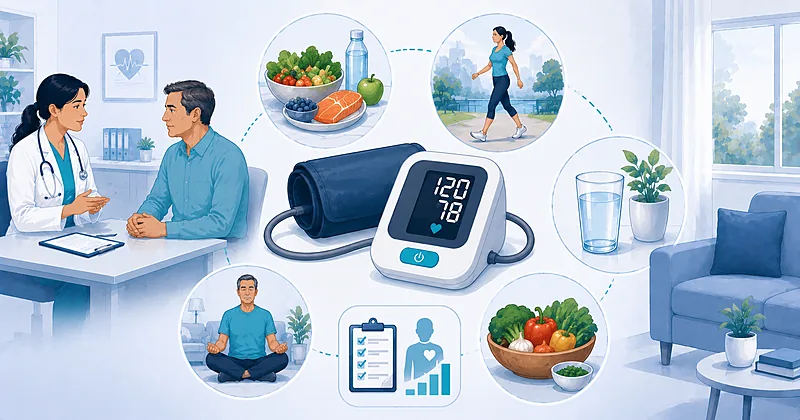
- 1Recommend the DASH dietary pattern as the foundation of lifestyle change — it produces the largest single dietary effect on blood pressure.
- 2Target a dietary sodium intake below 2,000–2,300 mg daily; even partial reduction lowers systolic pressure.
- 3Advise weight loss in adults with overweight or obesity — roughly 1 mmHg drop per kilogram lost.
- 4Prescribe at least 150 minutes of moderate aerobic activity weekly, supplemented by resistance and isometric work.
- 5Counsel patients to keep alcohol within low-risk limits; reduction yields a dose-dependent fall in pressure.
- 6Increase dietary potassium through food in patients without contraindications — it offsets the pressor effect of sodium.
- 7Teach validated home blood pressure monitoring technique — duplicate morning and evening readings over seven days.
- 8Use an upper-arm device with a clinically validated cuff; discourage wrist and finger monitors for routine tracking.
- 9Reassess lifestyle adherence and home readings at every visit — sustained change, not a single number, is the goal.
Who Benefits From Hypertension Lifestyle Management
Lifestyle change is not a holding pattern for patients waiting to start medication. It is first-line therapy in its own right for adults with elevated blood pressure or stage 1 hypertension at low cardiovascular risk, and it remains essential adjunctive therapy at every later stage. Even patients already taking two or three agents gain meaningful additional control from the interventions described below.
The practical decision is one of intensity and timing rather than whether to intervene. A patient with stage 1 hypertension and low cardiovascular risk can reasonably trial three to six months of structured lifestyle change before drug therapy is considered. A patient with stage 2 hypertension or high overall risk should begin lifestyle change and pharmacotherapy together, since waiting offers no advantage.
Dietary Foundations of Hypertension Lifestyle Management
Diet is where hypertension lifestyle management delivers its largest and most reproducible effect. The dietary pattern as a whole matters more than any single nutrient, but sodium and potassium each carry independent weight worth addressing explicitly with patients.
Advise the DASH eating pattern — rich in vegetables, fruit, whole grains, legumes, nuts, and low-fat dairy, with reduced saturated fat and red meat. Expect a systolic reduction of roughly 8–11 mmHg in adherent patients.
Strong Rec High Evidence ACC/AHA 2017 DASH-Sodium TrialReduce dietary sodium toward 1,500–2,300 mg per day. The largest contributor in most diets is not the salt shaker but processed foods, bread, and restaurant meals, so target those first.
Strong Rec High Evidence ACC/AHA 2017 ESC/ESH 2023Encourage potassium-rich foods such as leafy greens, beans, bananas, and potatoes in patients with normal renal function. Avoid potassium supplements and salt substitutes in those with chronic kidney disease or on renin-angiotensin blockers without monitoring.
Moderate Rec Moderate Evidence ACC/AHA 2017Do not rely on isolated supplements — calcium, magnesium, or fish oil capsules — as a substitute for dietary pattern change. Their independent effect on blood pressure is small and inconsistent.
Against Moderate Evidence ESC/ESH 2023Activity, Weight, and Alcohol
Beyond diet, three behavioural levers carry the strongest evidence: regular physical activity, weight reduction, and moderation of alcohol. Each produces an independent fall in pressure, and their effects accumulate when pursued together.
Prescribe at least 150 minutes weekly of moderate-intensity aerobic activity, or 75 minutes of vigorous activity, spread across most days. Expect a systolic reduction of around 5–8 mmHg with consistent practice.
Strong Rec High Evidence ACC/AHA 2017 ESC/ESH 2023Add resistance training two to three times weekly, and consider isometric exercise such as wall sits or handgrip protocols, which recent meta-analyses suggest produce a notable systolic effect.
Moderate Rec Moderate Evidence ESC/ESH 2023Advise gradual weight loss toward a healthier body weight in adults with overweight or obesity. Each kilogram lost lowers systolic pressure by roughly 1 mmHg, and the first 5–10% of body weight delivers disproportionate benefit.
Strong Rec High Evidence ACC/AHA 2017 PREMIER TrialCounsel patients who drink heavily to reduce intake toward low-risk limits. The pressure benefit is dose-dependent, and the greatest gains appear in those cutting back from the highest baseline consumption.
Strong Rec Moderate Evidence NICE NG136Advise complete smoking cessation. While smoking does not raise resting pressure chronically in the same way, it sharply amplifies cardiovascular risk and acutely spikes pressure with each cigarette.
Strong Rec High Evidence ACC/AHA 2017Home Blood Pressure Monitoring in Practice
Home monitoring is the connective tissue of hypertension lifestyle management. It surfaces white-coat and masked hypertension, exposes the real effect of behavioural change, and gives patients a feedback loop that sustains motivation. Done well, it reflects out-of-office pressure far better than intermittent clinic readings.
The value of home readings depends entirely on technique. A patient measuring once, on a wrist cuff, immediately after climbing the stairs will generate numbers that mislead. The protocol below standardises measurement so that the readings can actually guide decisions, including the detection of masked hypertension.
Recommend a validated, automated upper-arm device with an appropriately sized cuff. Point patients to independent validation listings rather than choosing on price or brand alone.
Strong Rec High Evidence ESC/ESH 2023 NICE NG136Instruct patients to take two readings one minute apart, morning and evening, for seven consecutive days, discarding the first day. Average the remaining values to guide treatment decisions.
Strong Rec Moderate Evidence ESC/ESH 2023Teach correct posture: seated and rested for five minutes, back supported, feet flat, arm at heart level, no talking, with an empty bladder and no caffeine or smoking in the preceding 30 minutes.
Strong Rec High Evidence ACC/AHA 2017Interpret home readings against the lower out-of-office threshold rather than the clinic threshold, since home values run slightly below office measurements in most patients.
Moderate Rec Moderate Evidence ESC/ESH 2023Avoid routine reliance on wrist and finger devices for ongoing tracking. Reserve wrist monitors for selected patients in whom an upper-arm cuff cannot be fitted, and confirm against a validated arm device.
Conditional Rec Low Evidence NICE NG136Clinical Decision Pathway
A question-based approach to positioning lifestyle change and home monitoring within an overall hypertension plan. Work through the questions in order.
Lifestyle Levers at a Glance
This summary pairs each intervention with a realistic expected effect and the practical detail that most often determines whether it succeeds.
| Intervention | Typical Systolic Effect | Practical Detail That Decides Success | Common Pitfall |
|---|---|---|---|
| DASH dietary pattern | ~8–11 mmHg | Whole-pattern shift, not one swapped food; written meal examples help | Adding DASH foods without removing sodium-dense ones |
| Sodium reduction | ~4–6 mmHg | Target processed foods and eating out, not just table salt | Focusing only on the salt shaker |
| Weight loss | ~1 mmHg per kg | Modest, sustained loss beats aggressive short-term dieting | Setting an unrealistic target and abandoning it |
| Aerobic activity | ~5–8 mmHg | Consistency across the week matters more than intensity | All-or-nothing bursts followed by inactivity |
| Alcohol reduction | ~3–5 mmHg in heavy drinkers | Quantify current intake honestly before setting a goal | Underestimating baseline consumption |
| Isometric exercise | Emerging, potentially notable | Short, repeatable protocols improve adherence | Treating it as a replacement for aerobic work |
Setting Up Reliable Home Monitoring
Use this as a teaching checklist when handing a patient their first device. Each row pairs the step with what to confirm and where patients most often go wrong.
| Step | What to Confirm | Why It Matters | Where Patients Slip |
|---|---|---|---|
| Choose device | Validated upper-arm model, correct cuff size | A wrong cuff size alone can skew readings substantially | Buying on price or grabbing a wrist cuff |
| Prepare | Five minutes seated, empty bladder, no caffeine | Pre-measurement state changes the number more than people expect | Measuring straight after rushing home |
| Position | Back supported, feet flat, arm at heart level | An unsupported arm or back inflates the reading | Sitting on a stool or holding the arm up |
| Measure | Two readings a minute apart, AM and PM, 7 days | A single reading is too noisy to act on | Taking one reading and stopping |
| Record | Log every value; discard day one before averaging | Selective recording hides the true pattern | Noting only the low or the high readings |
Follow-Up and Sustaining Change
The first review after starting lifestyle change is where most plans live or die. Booking it explicitly, and reading the home data together, signals that the prescription is real and creates accountability that vague follow-up does not.
| Review Point | When | What to Assess | Common Pitfall |
|---|---|---|---|
| First review | 4–8 weeks | Home average, adherence, one early win to reinforce | Judging success on the clinic reading alone |
| Decision point | 3–6 months | Whether targets are met or drug therapy is now needed | Indefinite lifestyle trials with no end date |
| Ongoing | Every visit | Sustained habits, device accuracy, fresh barriers | Assuming early gains will hold without support |
Evidence in Context
Where the major guidelines converge, where they part ways, and what the landmark trials actually demonstrated.
Where ACC/AHA, ESC/ESH, and NICE Agree
All three frameworks position lifestyle change as first-line therapy, endorse a DASH-style dietary pattern, advocate sodium reduction, and recommend confirming the diagnosis with out-of-office measurement before committing to lifelong drug treatment. The DASH-Sodium findings underpin much of this shared dietary advice.
Where They Differ on Thresholds
The frameworks define hypertension at different cut points and set somewhat different treatment thresholds, which changes how many patients fall into the lifestyle-first category. The practical implication is that the same patient may be “stage 1” under one framework and “high-normal” under another — the intervention is similar, but the label and urgency differ.
What the Diet Trials Showed
The DASH and DASH-Sodium trials demonstrated that dietary pattern and sodium reduction independently lower blood pressure, and that combining them produces the largest effect. The PREMIER trial confirmed that a package of combined lifestyle changes is achievable in real-world primary care settings, not just under tightly controlled trial conditions.
The Case for Home Monitoring
Trials of self-monitoring, particularly when paired with structured support or co-management, show improved blood pressure control compared with usual care. The effect is strongest when home readings are actually used to adjust treatment, rather than simply collected and filed.
References
- 1.Whelton PK, Carey RM, Aronow WS, et al. 2017 ACC/AHA Guideline for the Prevention, Detection, Evaluation, and Management of High Blood Pressure in Adults. J Am Coll Cardiol. 2018;71(19):e127–e248. doi:10.1016/j.jacc.2017.11.006
- 2.Sacks FM, Svetkey LP, Vollmer WM, et al. Effects on Blood Pressure of Reduced Dietary Sodium and the DASH Diet. N Engl J Med. 2001;344(1):3–10. doi:10.1056/NEJM200101043440101
- 3.Writing Group of the PREMIER Collaborative Research Group. Effects of Comprehensive Lifestyle Modification on Blood Pressure Control. JAMA. 2003;289(16):2083–2093. doi:10.1001/jama.289.16.2083
- 4.Mancia G, Kreutz R, Brunström M, et al. 2023 ESH Guidelines for the Management of Arterial Hypertension. J Hypertens. 2023;41(12):1874–2071. doi:10.1097/HJH.0000000000003480
- 5.National Institute for Health and Care Excellence. Hypertension in adults: diagnosis and management. NICE Guideline NG136. 2019. nice.org.uk/guidance/ng136
How to Read the Evidence Tags
Every recommendation carries two tags — one for strength, one for evidence quality. These are Medaptly’s own simplified interpretations, designed for quick reading rather than as a substitute for the full grading systems used by the source guidelines.
Recommendation Strength
| Tag | What It Means |
|---|---|
| Strong Rec | High-quality evidence broadly supports this action. |
| Moderate Rec | The weight of evidence favours this action. |
| Conditional Rec | The benefit is less certain — individualise. |
| Against | Evidence shows no benefit or potential harm. |
Evidence Quality
| Tag | What It Means |
|---|---|
| High Evidence | Multiple well-designed RCTs or high-quality meta-analyses. |
| Moderate Evidence | Single RCT or large observational studies. |
| Low Evidence | Expert consensus or small studies. |