
Iron Deficiency Anemia Workup: 9 Essential Steps
Clinical Practice Update — Primary Care Diagnosis, Cause-Finding, and Oral Iron Strategy in Adults
This is an original clinical education article informed by current guidelines and evidence. See References below for source documents.
- Clinical Focus
- Iron deficiency anemia workup, cause identification, and oral iron treatment in adults
- Target Audience
- Family physicians, general practitioners, primary care nurses, pharmacists, residents
- Setting
- Primary care and family medicine clinics
- Source Evidence
- •BSG Guidelines on Iron Deficiency Anaemia in Adults (Gut, 2021)
- •AGA Clinical Practice Update on Iron Deficiency Anemia (Clin Gastroenterol Hepatol, 2024)
- •Stoffel et al. — Alternate-Day Oral Iron Absorption (Haematologica, 2020)
- •Stoffel et al. — Consecutive vs Alternate-Day Dosing (Lancet Haematol, 2017)
Key Clinical Takeaways
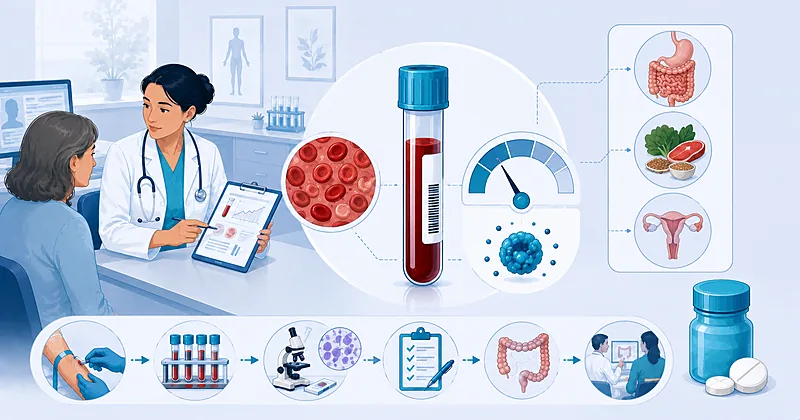
A reliable iron deficiency anemia workup in primary care rests on three connected tasks: confirm true iron deficiency with the right blood tests, look hard for the cause, and replace iron in a way the patient can actually tolerate. A well-run iron deficiency anemia workup turns that sequence into rules you can apply in a routine consultation.
- 1Treat a low ferritin as diagnostic of iron deficiency — in microcytic anemia it is the single most useful test.
- 2When inflammation may falsely raise ferritin, add transferrin saturation to avoid missing the diagnosis.
- 3Every iron deficiency anemia workup must ask why — occult blood loss is the default assumption until proven otherwise.
- 4Refer most adult men and postmenopausal women for bidirectional endoscopy unless a clear non-GI cause is found.
- 5Send coeliac serology in every newly diagnosed case — it is a common and reversible cause.
- 6Start one tablet of a ferrous salt daily — one tablet is enough, and more is not better.
- 7Offer alternate-day dosing when side effects threaten adherence — absorption per dose improves.
- 8Check hemoglobin at 2–4 weeks — a rise confirms both the diagnosis and adherence.
- 9Continue iron for roughly three months after hemoglobin normalises to refill body stores.
Confirming the Diagnosis: Where the Iron Deficiency Anemia Workup Begins
The first job in any iron deficiency anemia workup is to prove that iron is genuinely low, not simply assume it from a small red cell. A full blood count showing microcytosis and hypochromia raises the suspicion, but it is the iron studies that anchor the iron deficiency anemia workup and settle the question.
Perform a serum ferritin in every patient with unexplained anemia. A low result confirms iron deficiency and is the most informative single test in the workup.
Strong Rec High Evidence BSG 2021Add transferrin saturation when a coexisting inflammatory or chronic illness could push ferritin into the normal range and mask a true deficiency.
Moderate Rec Moderate Evidence BSG 2021 AGA 2024Reassess the diagnosis through the response to treatment. A clear hemoglobin rise after starting iron is itself strong evidence of absolute deficiency, even when iron studies were borderline.
Moderate Rec Low Evidence BSG 2021Reading the Iron Studies Together
No single number tells the whole story in the iron deficiency anemia workup. The table below frames the common iron study patterns by the clinical picture they paint, with the practical move each one prompts.
| Pattern at a Glance | Ferritin | Transferrin Saturation | What It Usually Means | Your Next Move |
|---|---|---|---|---|
| Classic deficiency | Low | Low | Absolute iron deficiency | Start iron, search for the cause |
| Masked by inflammation | Normal or high | Low | Deficiency plus active inflammation | Treat iron; check CRP and the underlying illness |
| Chronic disease only | Normal or high | Normal or low | Anemia of chronic disease without true deficiency | Manage the disease; iron rarely helps alone |
| Stores tapped, not yet anemic | Low | Normal | Early iron depletion before anemia | Consider replacement if symptomatic; recheck |
Finding the Cause: The Half of the Iron Deficiency Anemia Workup That Saves Lives
Replacing iron without finding the cause is the most consequential shortcut in primary care. In adults, the deficiency is usually a marker of blood loss, and a meaningful share of unexplained cases conceal a gastrointestinal malignancy. The cause-finding limb of the iron deficiency anemia workup is therefore not optional — it is the part that turns a blood-count abnormality into a potentially life-saving diagnosis.
The investigations that matter most in primary care are a careful history, targeted blood tests, and a low threshold for endoscopic referral. History should cover bowel habit, overt bleeding, weight loss, dietary intake, medications such as anticoagulants and non-steroidal anti-inflammatories, and a family history of gastrointestinal cancer. Each of these reshapes how urgently the patient needs to be seen.
Refer adult men and postmenopausal women with unexplained iron deficiency anemia for upper and lower endoscopy to exclude a gastrointestinal source of blood loss.
Strong Rec High Evidence BSG 2021 AGA 2024Send coeliac serology in every newly diagnosed adult. Undiagnosed coeliac disease is a common, treatable cause and changes the entire management plan when found.
Strong Rec Moderate Evidence BSG 2021Evaluate for menstrual and obstetric blood loss in premenopausal women before assuming a gastrointestinal source, while staying alert to coexisting GI symptoms that warrant their own assessment.
Moderate Rec Moderate Evidence AGA 2024Do not delay urgent investigation while a trial of iron is running. Iron replacement and the search for a cause should proceed together, not in sequence.
Against Moderate Evidence BSG 2021Oral Iron Strategy: Dosing for Absorption, Not Just Replacement
For most patients, oral iron remains first-line in the iron deficiency anemia workup: it is cheap, effective, and safe. The classic instinct to push two or three tablets daily, however, runs against the physiology. A single oral dose triggers a hepcidin rise that suppresses absorption of the next dose for roughly a day, so piling on tablets mostly buys more side effects rather than more iron.
Prescribe a single daily tablet of a ferrous salt as first-line treatment. One tablet a day delivers enough elemental iron for most adults and is better tolerated than divided high-dose regimens.
Strong Rec High Evidence BSG 2021 AGA 2024Consider alternate-day dosing when gastrointestinal side effects threaten adherence. Giving iron every second day raises fractional absorption per dose and lowers the burden of nausea and constipation.
Conditional Rec Moderate Evidence Stoffel 2020 Stoffel 2017Counsel patients to take iron on an empty stomach with a source of vitamin C, and to separate it from tea, coffee, dairy, and calcium supplements that blunt absorption.
Moderate Rec Low Evidence AGA 2024Switch the iron salt or the schedule before abandoning oral therapy. Many patients labelled intolerant simply need a lower elemental dose, a different preparation, or every-other-day timing.
Moderate Rec Low Evidence BSG 2021Oral Iron Preparations: A Practical Comparison
The choice between ferrous salts within the iron deficiency anemia workup is driven less by efficacy than by elemental iron content and tolerability. This comparison is organised by preparation, with the elemental dose and the practical counselling point for each.
| Preparation | Approx. Elemental Iron per Tablet | Where It Fits | Practical Counselling Point |
|---|---|---|---|
| Ferrous sulfate | ~65 mg | Default first-line where available | Highest elemental load; the most GI complaints come from here |
| Ferrous fumarate | ~65 mg | Equivalent alternative to sulfate | Often tried when sulfate is poorly tolerated |
| Ferrous gluconate | ~35 mg | Lower-dose option for sensitive patients | Less iron per tablet can mean fewer symptoms |
| Liquid ferrous salt | Dose-titratable | Patients needing fine dose control | Use a straw and rinse to limit dental staining |
Each oral iron dose lifts serum hepcidin, the hormone that closes the door on intestinal iron uptake. That elevation lasts close to 24 hours, so a dose given the very next day lands while absorption is still suppressed. Spacing doses to every second day lets hepcidin fall back to baseline, so a larger fraction of each dose is actually taken up.
When Oral Iron Is Not Enough
Oral therapy will not suit everyone in the iron deficiency anemia workup. Some patients cannot absorb iron from the gut, others cannot tolerate it at any dose, and a few need their stores corrected faster than tablets allow. Recognising these situations early prevents months of fruitless prescribing.
Refer for intravenous iron when oral therapy fails, is not tolerated despite dose and schedule changes, or when malabsorption or ongoing significant loss makes the gut route unreliable.
Moderate Rec Moderate Evidence BSG 2021 AGA 2024Reassess the diagnosis before escalating when there has been no response at all. Genuine non-response should prompt a rethink — a wrong diagnosis, continued bleeding, or an unaddressed absorption problem — rather than simply a stronger formulation.
Moderate Rec Low Evidence BSG 2021Clinical Decision Pathway
A question-based route through the iron deficiency anemia workup for a new presentation. Work through the questions in order, letting each answer point to the next decision.
Monitoring and Follow-Up
Follow-up closes the loop on the iron deficiency anemia workup: it confirms the diagnosis was right, that the patient is taking the iron, and that stores are being rebuilt rather than just the hemoglobin nudged.
| Parameter | When to Check | What to Look For | Common Pitfalls |
|---|---|---|---|
| Hemoglobin | 2–4 weeks after starting iron | A meaningful rise confirms response and adherence | Checking too early and wrongly concluding failure |
| Ferritin | After hemoglobin normalises | Confirms stores are replenished, not just hemoglobin corrected | Stopping iron the moment hemoglobin looks normal |
| Adherence and symptoms | Each review | Tolerability and whether dosing needs adjusting | Labelling a patient a non-responder when they simply stopped the tablets |
| Response failure | If no rise despite good adherence | Trigger to reconsider cause or move to intravenous iron | Repeated oral trials without rethinking the diagnosis |
Evidence in Context
Where the major sources behind this iron deficiency anemia workup line up, where they emphasise different things, and what the dosing trials actually demonstrated.
Where BSG and AGA Agree
Both the British and American sources converge on the essentials: ferritin as the primary diagnostic test, a mandatory search for a cause in adults, coeliac testing in new cases, and oral iron as first-line therapy for most patients.
Where the Emphasis Differs
The two sources weight the threshold for intravenous iron and the role of newer formulations differently, reflecting their different health systems and the populations each was written for. The direction of travel, toward earlier consideration of intravenous iron in selected patients, is shared.
What the Alternate-Day Trials Showed
Controlled studies in iron-deficient women found that fractional absorption per dose was higher when iron was given on alternate days rather than daily, with the effect mediated by the hepcidin response to each dose. Gastrointestinal side effects clustered on the days iron was actually taken, so fewer dosing days meant fewer symptomatic days.
The Limits of These Data
The dosing trials measured absorption and short-term tolerability rather than long-term clinical outcomes, and were conducted largely in women. They make a strong physiological case for alternate-day dosing as a tolerance strategy, but daily dosing remains a reasonable choice for a patient who tolerates it well and needs replacement promptly.
References
- 1.Snook J, Bhala N, Beales ILP, et al. British Society of Gastroenterology guidelines for the management of iron deficiency anaemia in adults. Gut. 2021;70(11):2030–2051. doi:10.1136/gutjnl-2021-325210
- 2.DeLoughery TG, Jackson CS, Ko CW, Rockey DC. AGA Clinical Practice Update on Management of Iron Deficiency Anemia: Expert Review. Clin Gastroenterol Hepatol. 2024;22(8):1575–1583. doi:10.1016/j.cgh.2024.03.046
- 3.Stoffel NU, Zeder C, Brittenham GM, Moretti D, Zimmermann MB. Iron absorption from supplements is greater with alternate day than with consecutive day dosing in iron-deficient anemic women. Haematologica. 2020;105(5):1232–1239. doi:10.3324/haematol.2019.220830
- 4.Stoffel NU, Cercamondi CI, Brittenham G, et al. Iron absorption from oral iron supplements given on consecutive versus alternate days and as single morning doses versus twice-daily split dosing in iron-depleted women: two open-label, randomised controlled trials. Lancet Haematol. 2017;4(11):e524–e533. doi:10.1016/S2352-3026(17)30182-5
How to Read the Evidence Tags
Each recommendation in this iron deficiency anemia workup carries two tags — one for how strongly it is recommended and one for the quality of evidence behind it. These are Medaptly’s own simplified interpretations, not any guideline body’s classification.
Recommendation Strength
| Tag | What It Means |
|---|---|
| Strong Rec | High-quality evidence broadly supports this action. |
| Moderate Rec | The weight of evidence favours this action. |
| Conditional Rec | The benefit is less certain — individualise. |
| Against | Evidence shows no benefit or potential harm. |
Evidence Quality
| Tag | What It Means |
|---|---|
| High Evidence | Multiple well-designed RCTs or high-quality meta-analyses. |
| Moderate Evidence | Single RCT or large observational studies. |
| Low Evidence | Expert consensus or small studies. |